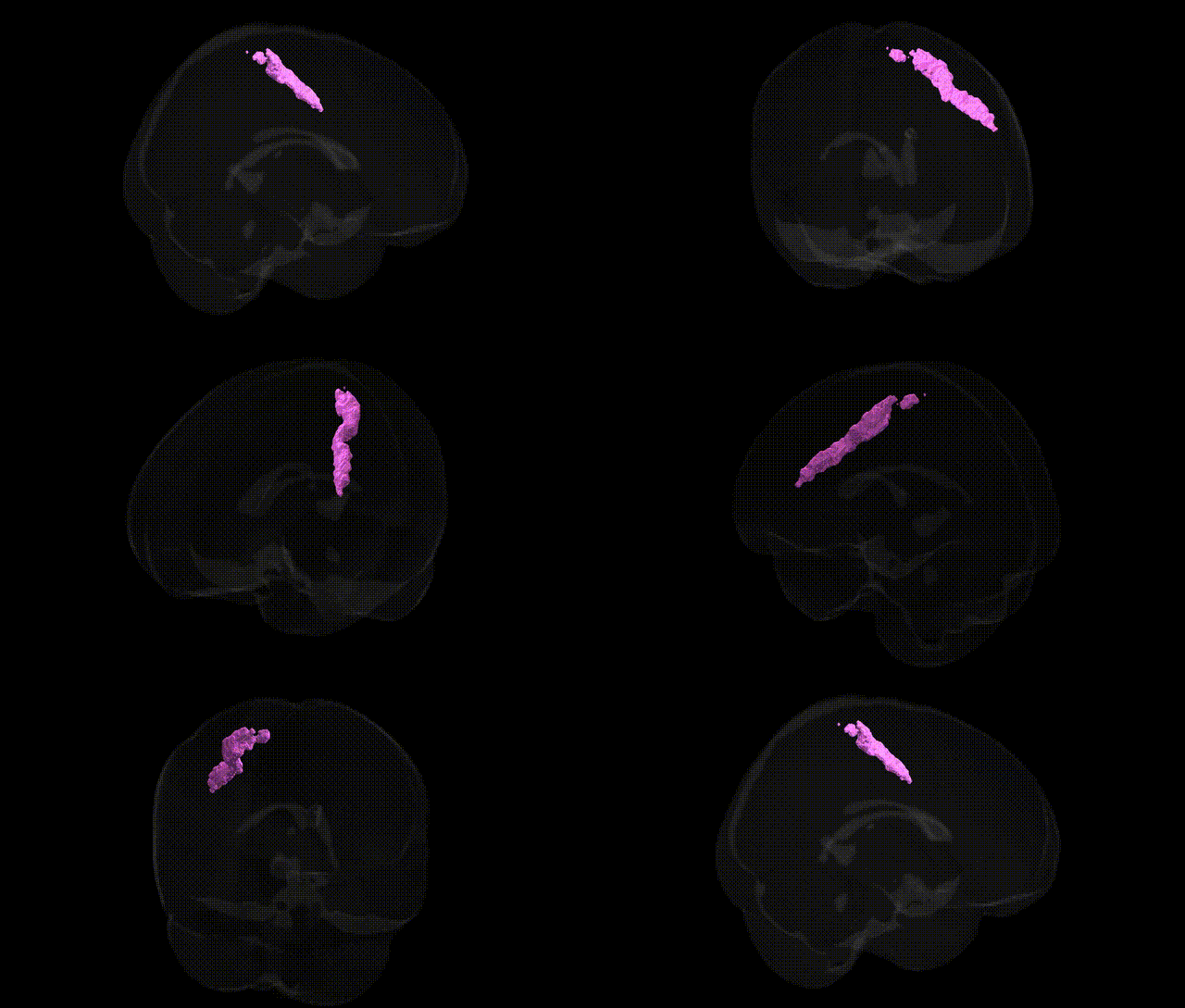
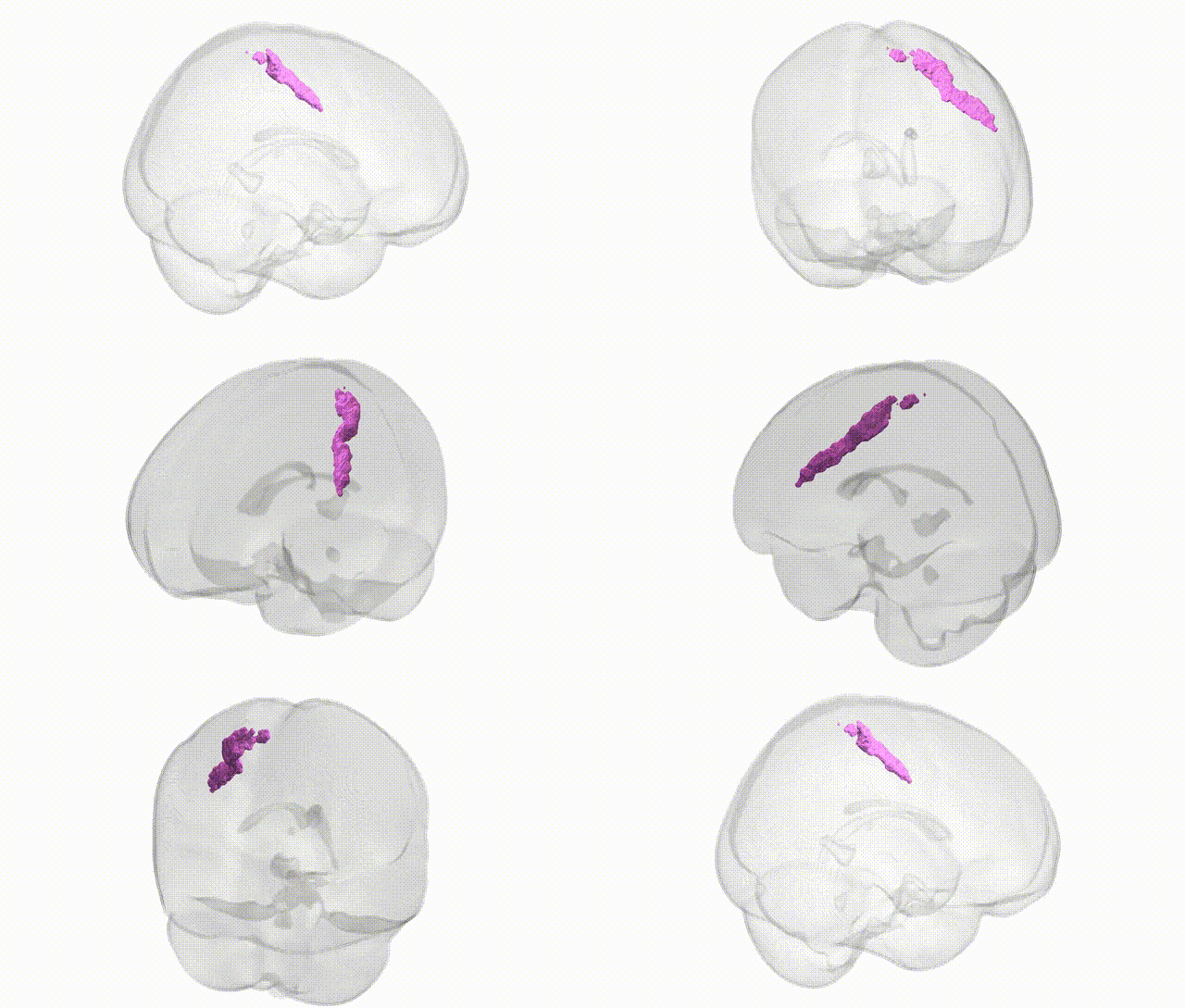
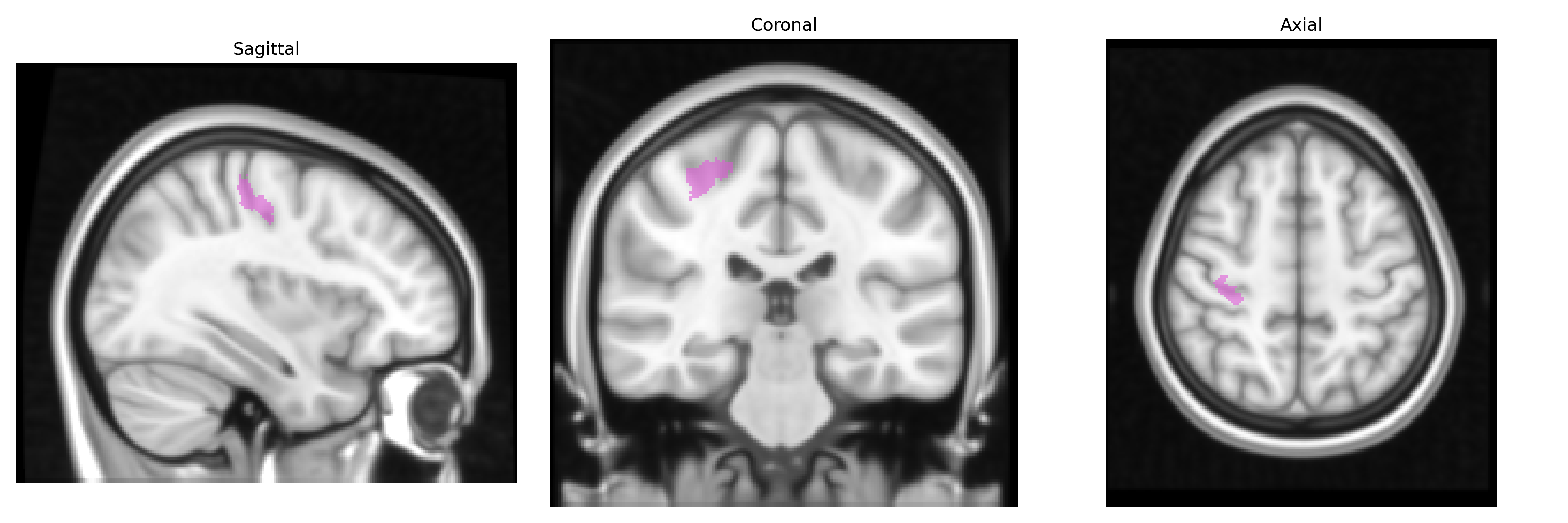
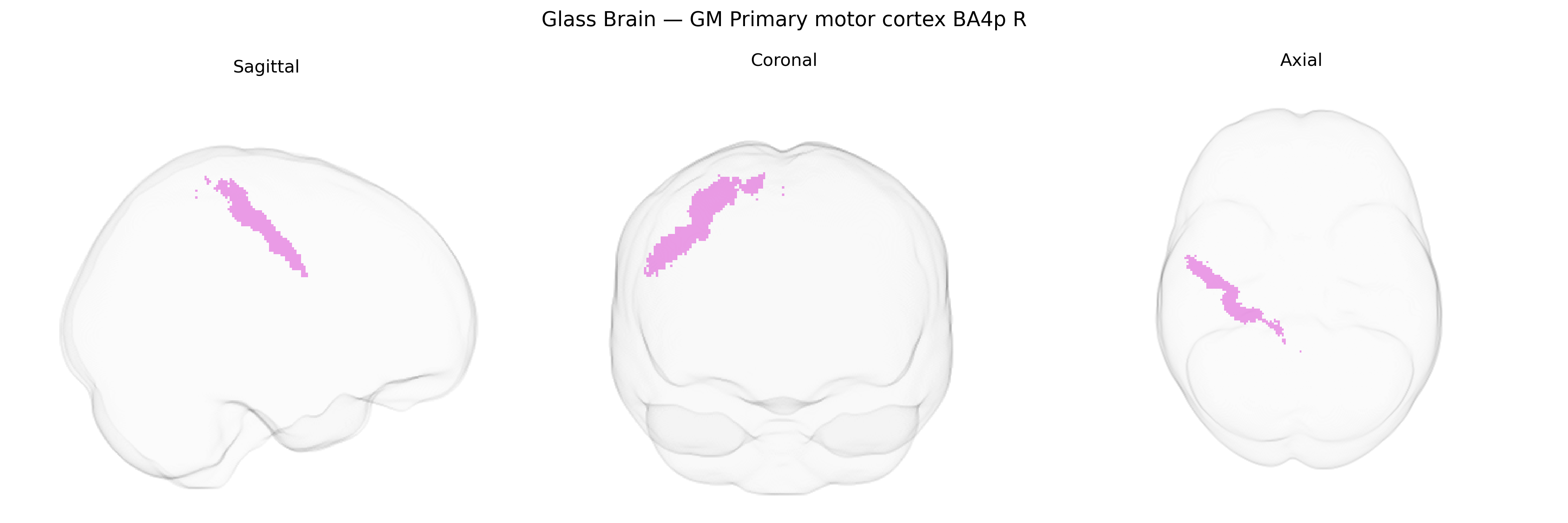
The bilateral GM Primary motor cortex BA4p R, as defined in the Juelich maxprob thr25 1mm Atlas, corresponds to the posterior (4p) subdivision of Brodmann area 4 within the precentral gyrus, forming a core part of the primary motor cortex responsible for the execution of voluntary movements. This region contains a high density of large pyramidal neurons, including Betz cells, which project via the corticospinal and corticobulbar tracts to spinal and brainstem motor nuclei, thereby exerting direct control over somatic musculature. Functionally, BA4p is involved in fine motor control and the precise force and timing of muscle contractions, particularly for distal limb movements, and exhibits somatotopic organization consistent with the motor homunculus. It integrates inputs from premotor and somatosensory cortices and participates in motor learning, though it is primarily associated with movement execution rather than planning. There is no direct Wikipedia article for “BA4p,” but it is a cytoarchitectonic subdivision of the Primary motor cortex.
The bilateral GM primary motor cortex BA4p (R) region, as defined in the Juelich maxprob thr25 1mm atlas, is a key node for voluntary motor control and has been implicated indirectly in a range of genetic findings, though relatively few GWAS or imaging-genetics studies target BA4p specifically as an isolated parcel. Variants in genes involved in synaptic plasticity, axonal guidance, and neurodevelopment—such as BDNF, CNTNAP2, CACNA1C, and multiple glutamatergic and GABAergic pathway genes—have been associated with structural and functional differences in primary motor cortex, including cortical thickness, surface area, and activation during motor tasks. Large-scale imaging GWAS (e.g., ENIGMA, UK Biobank-based studies) have identified numerous common variants linked to motor cortex morphology and microstructure, which overlap with loci implicated in neurodevelopmental traits, general cognitive ability, and handedness. Motor cortex, including BA4p, is also consistently involved in monogenic and polygenic movement disorders such as amyotrophic lateral sclerosis (ALS), hereditary spastic paraplegia, and certain dystonias, where risk variants and causal mutations (e.g., in SOD1, C9orf72, KIF5A, ATP7B, and multiple cerebellar/striatal genes) are associated with degeneration or dysregulation of motor cortical output pathways. Additionally, polygenic risk scores for schizophrenia, bipolar disorder, ADHD, and autism spectrum disorder show subtle associations with sensorimotor cortical structure and connectivity, suggesting that genetic architectures of these conditions partly influence BA4p-related circuits, although these effects are typically distributed and not specific to this subregion alone.
Overview generated by GPT-4o (2026).
Region ID: 50
Hemisphere: bilateral
Atlas: Juelich maxprob thr25 1mm
Full Quality Version: Download MP4
Full Quality Version: Download MP4
Wali Sidiqyar*, Gaurav Rudravaram*, Elyssa M. McMaster, Trent M. Schwartz, Adam M. Saunders, Kurt G. Schilling, Bennett A. Landman "Introducing SPINS: A Shared Public Visualization Library of Neuroanatomical Structures." Medical Imaging with Deep Learning- short paper
This resource is licensed under CC0 1.0 Universal (Public Domain).