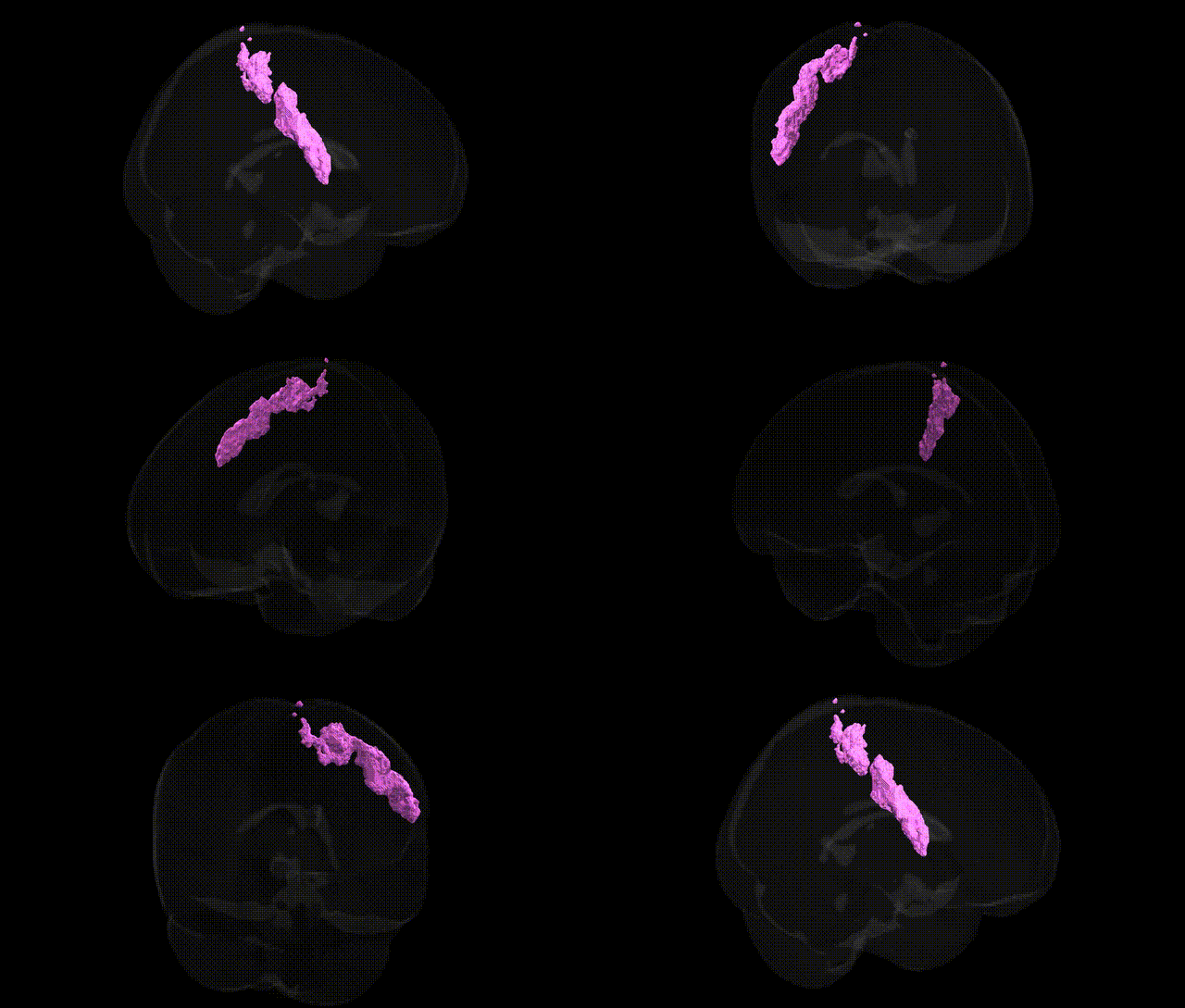
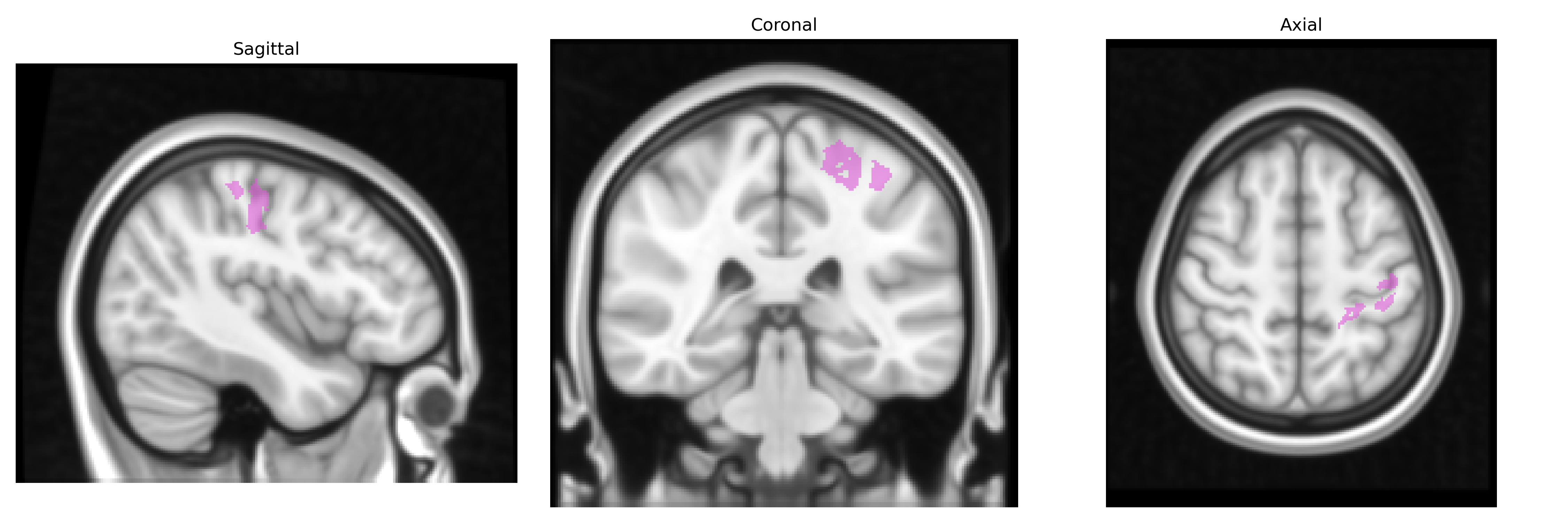
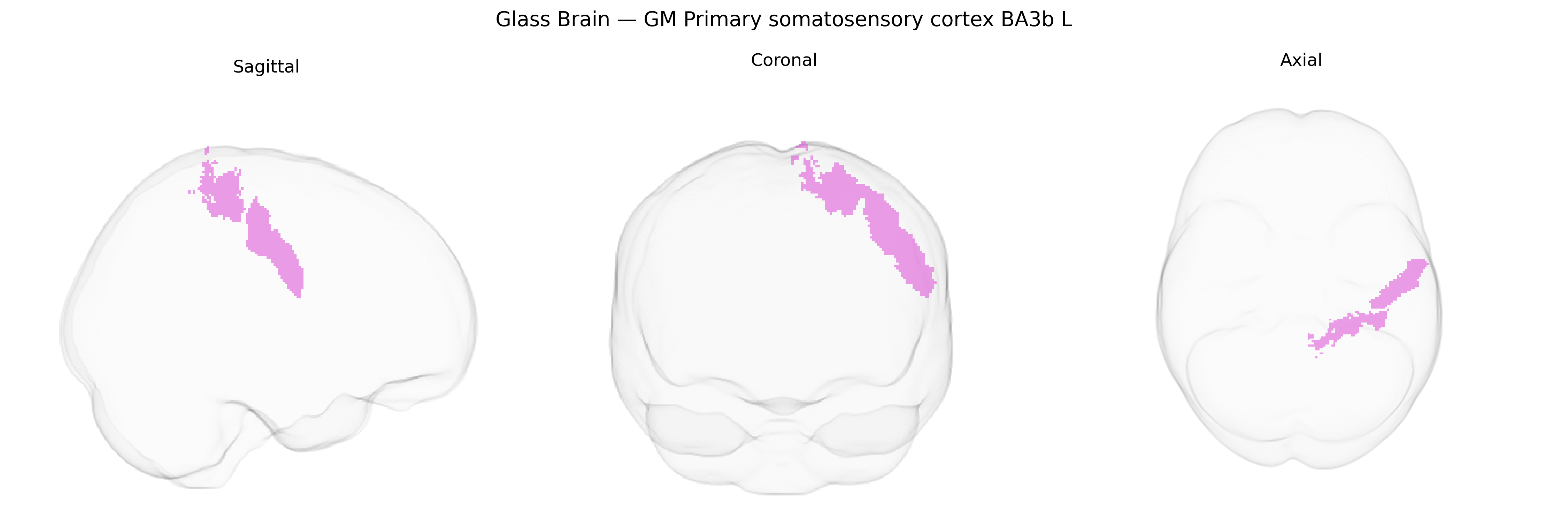
The bilateral GM Primary somatosensory cortex BA3b L from the Juelich maxprob thr25 1mm Atlas corresponds to the left-hemisphere portion of Brodmann area 3b, a core subregion of the primary somatosensory cortex located in the anterior bank of the postcentral gyrus. This region is characterized by dense granular layer IV and strong thalamocortical input from the ventral posterior nucleus, and it is specialized for processing cutaneous somatosensory information such as fine touch, pressure, and texture from the contralateral side of the body. Neurons in BA3b form somatotopically organized representations (somatotopy) and provide the initial cortical processing stage that feeds forward to adjacent somatosensory areas (e.g., BA1 and BA2) for higher-order integration of tactile and proprioceptive signals. There is no direct Wikipedia article for “BA3b”; a closely related and encompassing structure is the Primary somatosensory cortex.
The bilateral GM primary somatosensory cortex BA3b (L) from the Juelich maxprob thr25 1mm atlas has been implicated in several genetically influenced traits and disorders via imaging genetics and GWAS-based brain-mapping studies, though most findings are reported at the level of overall somatosensory or sensorimotor cortex rather than BA3b specifically. Twin and SNP-heritability analyses (e.g., ENIGMA, UK Biobank) indicate moderate to high heritability of cortical thickness and surface area in primary somatosensory regions, with associated loci including genes involved in neurodevelopment, synaptic function, and axon guidance (such as variants in or near MIR137, PLEKHM1, KIAA0586, and other neurodevelopmental loci identified in large cortical GWAS). Somatosensory cortex structural and functional alterations, including those encompassing BA3b, have been reported in genetically influenced conditions such as autism spectrum disorder, ADHD, schizophrenia, focal epilepsy, and pain syndromes; for example, polygenic risk scores for schizophrenia and autism show associations with cortical morphology in primary sensory areas, and channelopathy- and synaptopathy-related genes (e.g., SCN, GABA, and glutamatergic pathway genes) have been linked to somatosensory cortical excitability in epilepsy and sensory processing abnormalities. GWAS of chronic pain and neuropathic pain traits identify variants in genes implicated in neural plasticity and nociceptive signaling that correlate with altered somatosensory cortex activation or structure, while motor and sensorimotor traits (e.g., handedness, fine motor control) show polygenic associations with sensorimotor cortical regions that include BA3b. Overall, existing genetic evidence supports a heritable basis for BA3b morphology and function and links variation in this region to neurodevelopmental, psychiatric, pain, and sensorimotor traits, but highly specific gene–BA3b associations remain comparatively coarse and are usually inferred from broader somatosensory or sensorimotor cortex analyses rather than this Juelich-defined parcel alone.
Overview generated by GPT-4o (2026).
Region ID: 57
Hemisphere: bilateral
Atlas: Juelich maxprob thr25 1mm
Full Quality Version: Download MP4
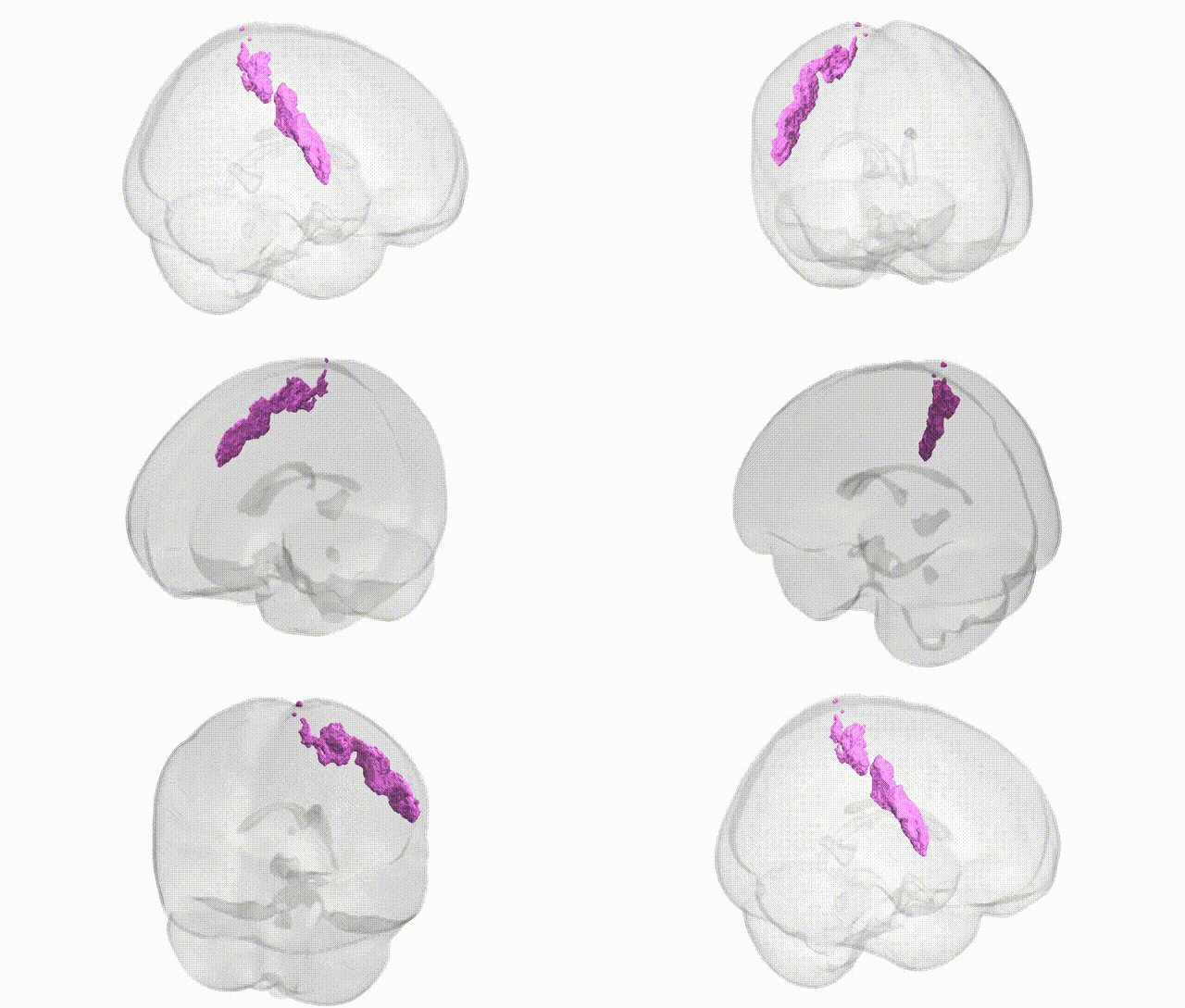
Full Quality Version: Download MP4
Wali Sidiqyar*, Gaurav Rudravaram*, Elyssa M. McMaster, Trent M. Schwartz, Adam M. Saunders, Kurt G. Schilling, Bennett A. Landman "Introducing SPINS: A Shared Public Visualization Library of Neuroanatomical Structures." Medical Imaging with Deep Learning- short paper
This resource is licensed under CC0 1.0 Universal (Public Domain).