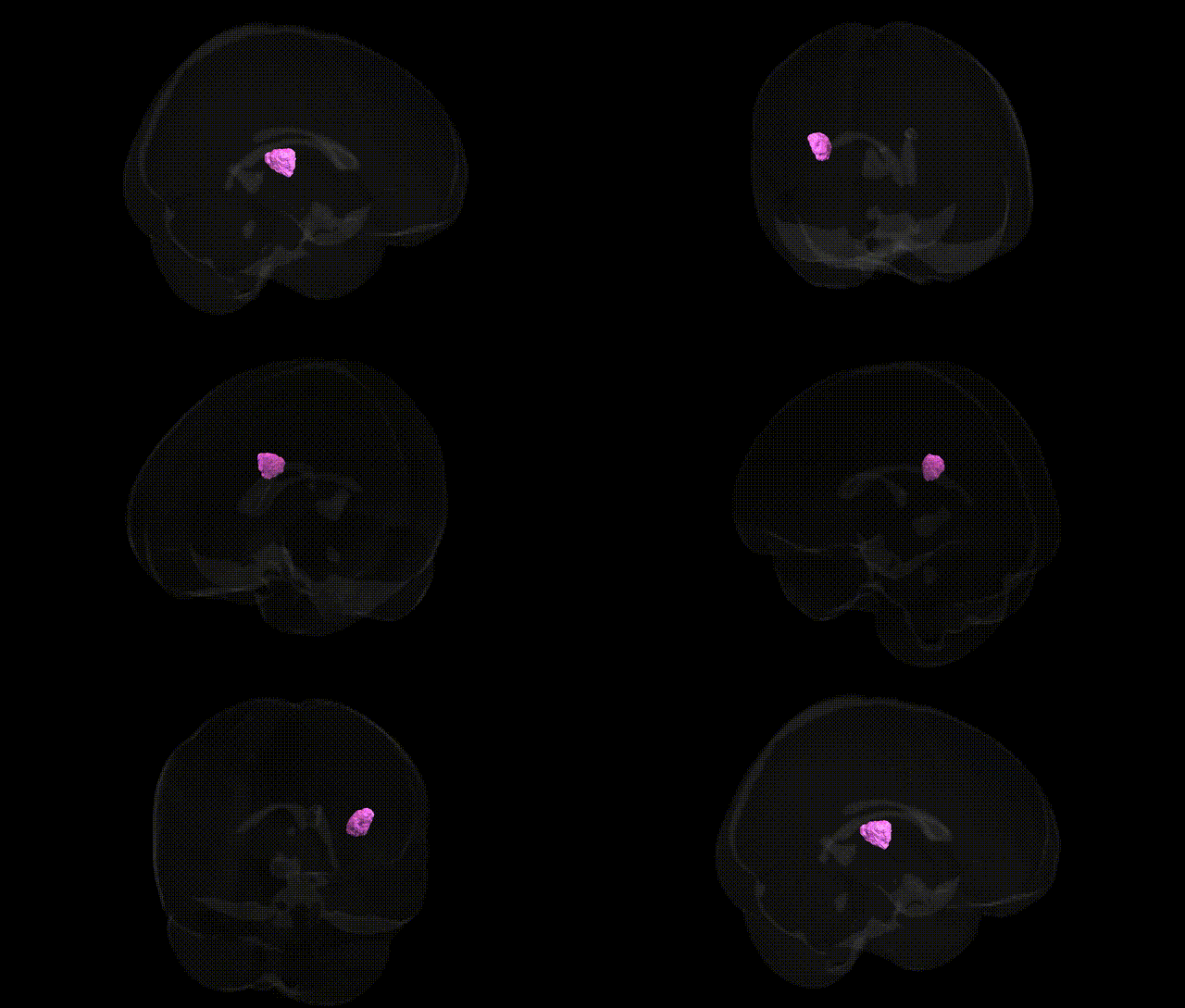
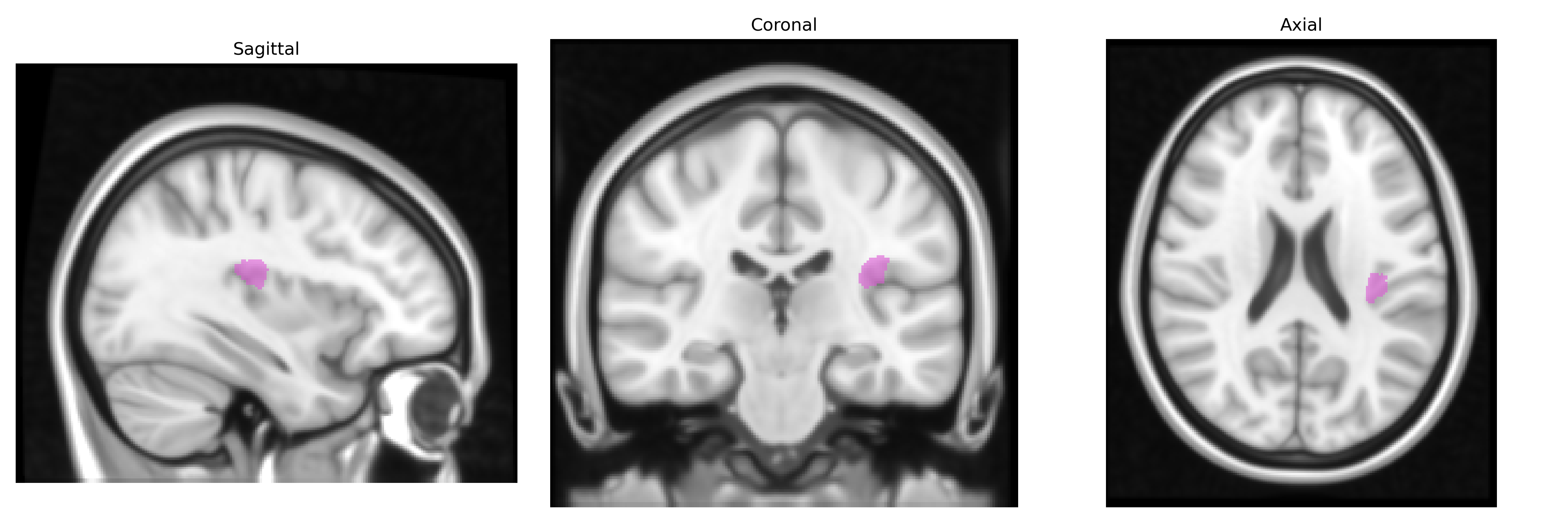
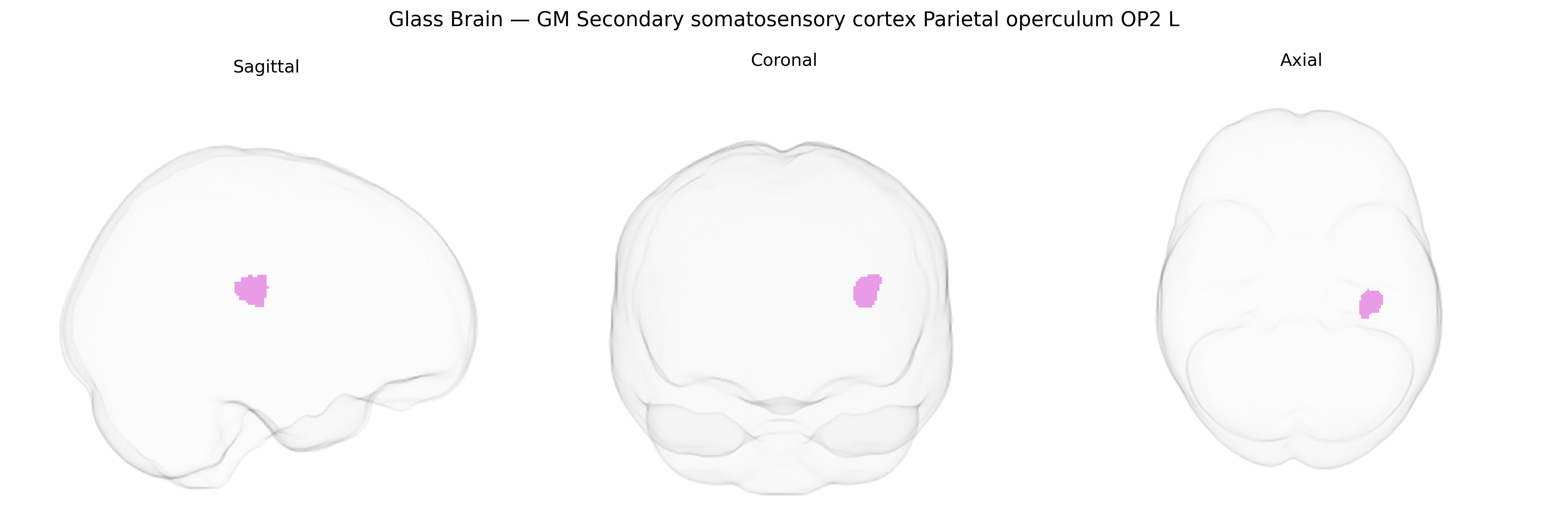
The bilateral GM Secondary somatosensory cortex Parietal operculum OP2 L is a cytoarchitectonically defined subregion of the human parietal operculum, localized within the suprasylvian cortex overlying the insula and mapped in the Juelich maxprob thr25 1mm Atlas. It forms part of the secondary somatosensory cortex (SII), receiving convergent tactile, nociceptive, and proprioceptive inputs from primary somatosensory cortex and thalamic nuclei, and is implicated in higher-order processing of somatosensory information, including texture discrimination, tactile object recognition, and bilateral integration of sensory signals. OP2 is also strongly associated with vestibular processing and multimodal integration, contributing to spatial orientation, perception of self-motion, and coordination of body representation in peripersonal space. Functionally, this region participates in sensorimotor networks and is engaged during tasks involving somatosensory attention, body awareness, and integration of somatic and vestibular cues. There is no direct link for OP2, but it is part of the Parietal operculum.
The bilateral GM Secondary somatosensory cortex Parietal operculum OP2 L (per the Juelich maxprob thr25 1mm atlas) lies within the posterior insula–parietal operculum complex, a region implicated in vestibular processing, somatosensory integration, and aspects of pain and bodily self-awareness; however, direct gene–region associations specific to OP2 L are limited, as most genetic imaging work targets broader cortical or insular/temporal-parietal areas rather than fine-grained cytoarchitectonic parcels. Large-scale GWAS and imaging-genetic studies have linked structural and functional variation in the adjacent parietal operculum and posterior insula to traits such as chronic pain sensitivity, migraine, vestibular dysfunction, and affective disorders, with implicated loci including genes involved in synaptic transmission and neuroplasticity (e.g., CACNA1A and other calcium-channel genes for migraine and vestibular phenotypes, and several pain-related loci identified by UK Biobank and other cohorts), but these associations typically report effects at the level of lobes or networks (e.g., somatosensory, salience, and vestibular networks) rather than OP2 L specifically. Gene expression atlases (e.g., Allen Human Brain Atlas) indicate that OP2 and neighboring opercular cortex express a profile enriched for neurotransmitter receptors (glutamatergic, GABAergic, and neuromodulatory genes such as DRD2 and HTR2A) and ion channels consistent with multimodal sensory and vestibular integration, and polygenic risk scores for disorders involving body perception and pain (such as chronic pain syndromes, anxiety, and depression) show associations with cortical thickness and functional connectivity in operculo–insular networks, indirectly implicating OP2 L. Overall, current genetic evidence supports a role for this parietal opercular territory in heritable variation in vestibular function, pain processing, and emotional-somatic integration, but region-specific GWAS targeting OP2 L as defined in the Juelich atlas have not yet been reported, and findings remain extrapolated from broader network-level and cytoarchitectonic studies.
Overview generated by GPT-4o (2026).
Region ID: 61
Hemisphere: bilateral
Atlas: Juelich maxprob thr25 1mm
Full Quality Version: Download MP4
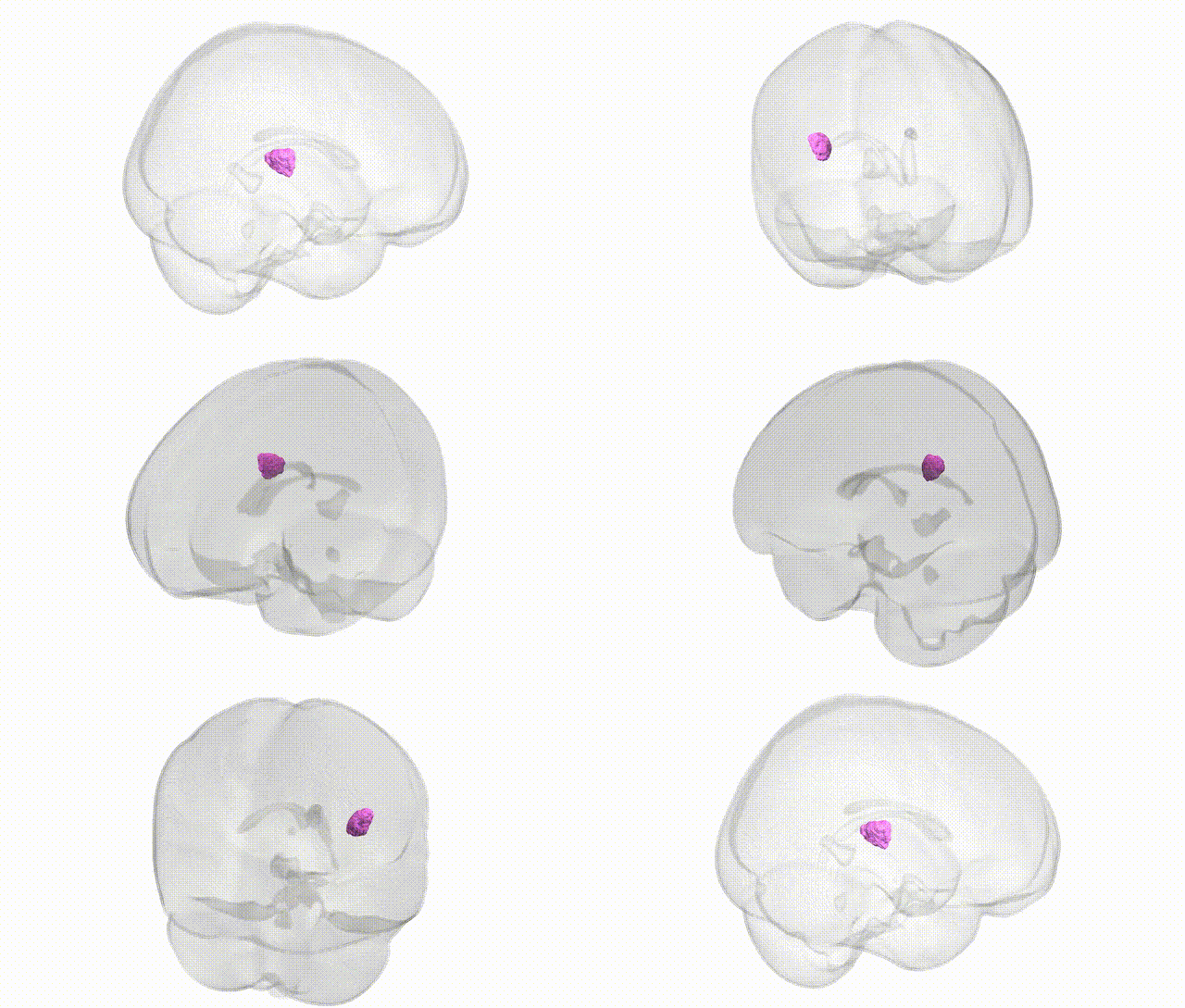
Full Quality Version: Download MP4
Wali Sidiqyar*, Gaurav Rudravaram*, Elyssa M. McMaster, Trent M. Schwartz, Adam M. Saunders, Kurt G. Schilling, Bennett A. Landman "Introducing SPINS: A Shared Public Visualization Library of Neuroanatomical Structures." Medical Imaging with Deep Learning- short paper
This resource is licensed under CC0 1.0 Universal (Public Domain).