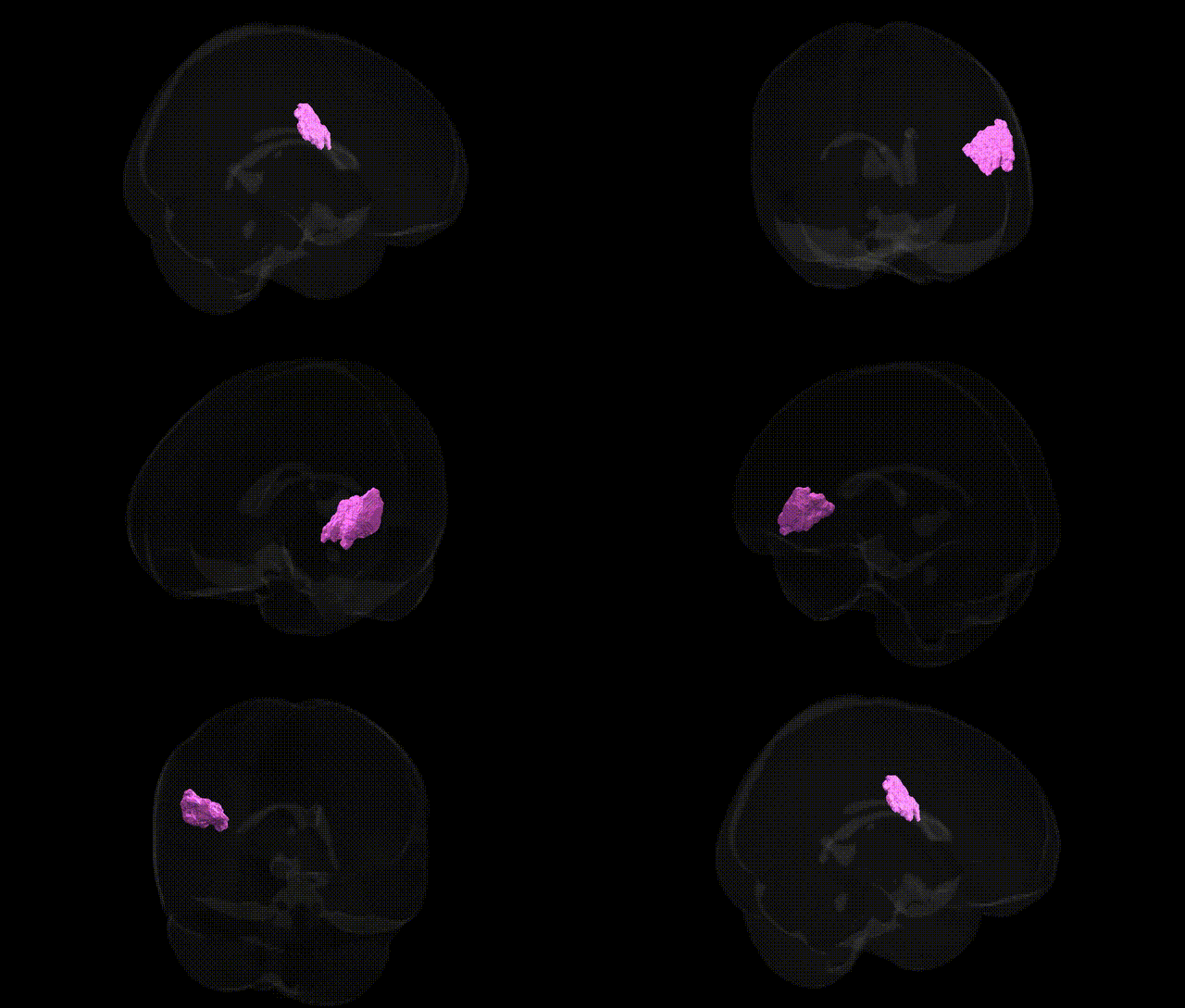
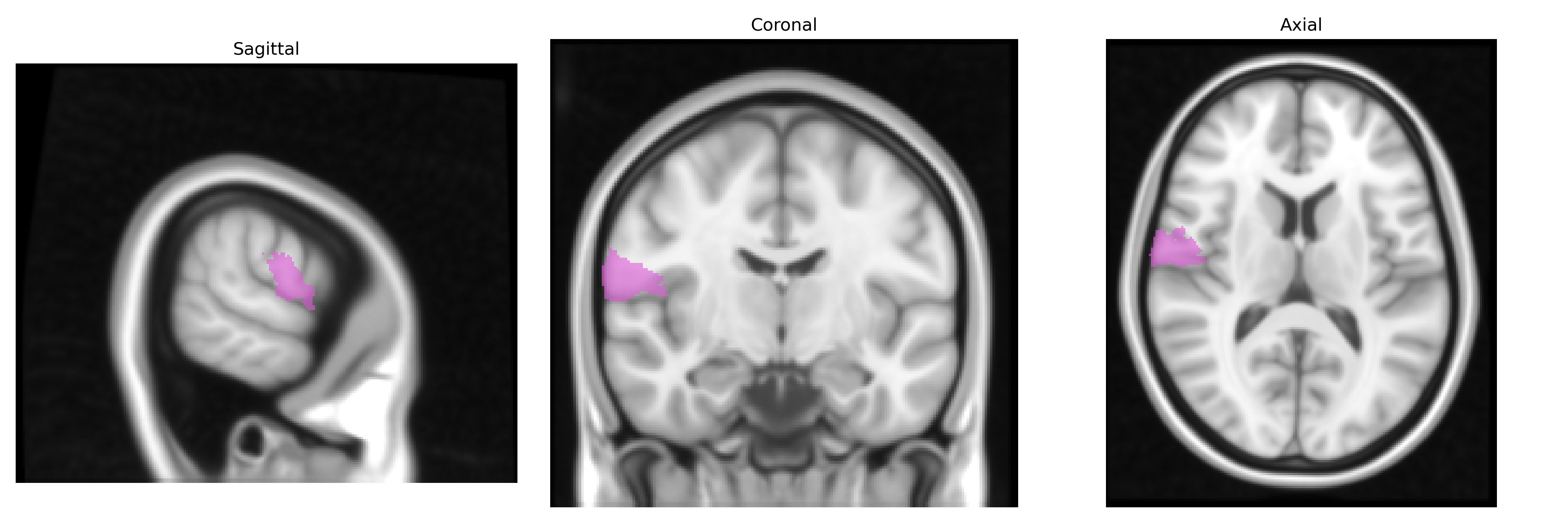
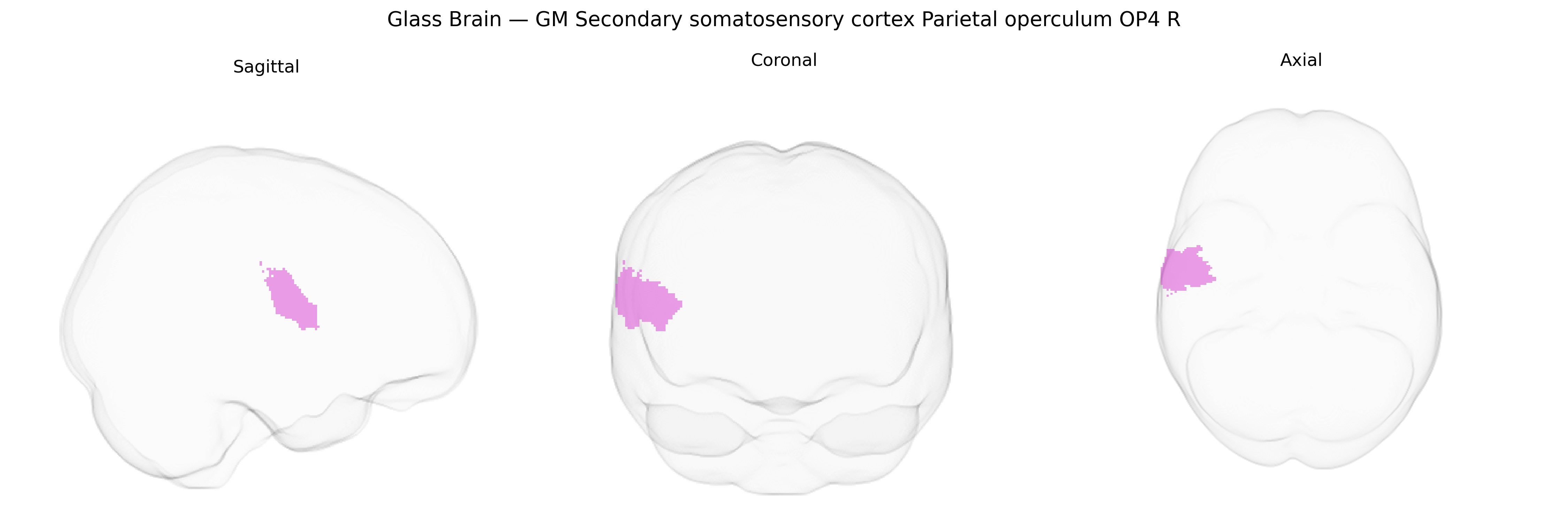
The bilateral GM Secondary somatosensory cortex Parietal operculum OP4 R, as defined in the Juelich maxprob thr25 1mm atlas, corresponds to a cytoarchitectonic subregion of the parietal operculum that forms part of the secondary somatosensory cortex (S2). OP4 is involved in higher-order processing of tactile and proprioceptive information, including integration of inputs from primary somatosensory areas, bilateral representation of the body, and contributions to sensorimotor integration, tactile discrimination, and possibly aspects of pain and body perception. Functionally, this region participates in transforming somatosensory signals into more complex percepts that can be linked to action, attention, and multimodal integration with other sensory systems. There is no direct Wikipedia article specifically for OP4; a closely related structure is the Secondary somatosensory cortex.
The bilateral gray matter of the Secondary somatosensory cortex, Parietal operculum OP4 (R) in the Juelich atlas corresponds to a key node of the human somatosensory and pain network, and genetic associations relevant to this region arise primarily from imaging genetics and GWAS of brain structure, pain, and sensory processing rather than from OP4-specific gene studies. Large-scale neuroimaging GWAS (e.g., ENIGMA, UK Biobank) have identified common variants influencing cortical thickness and surface area in parietal and opercular somatosensory areas, with notable loci near genes such as CENPW, TBR1, and multiple synaptic and neurodevelopmental genes, though these findings typically map to broader parietal or insular regions rather than uniquely to OP4. Functional imaging genetics work has linked candidate genes involved in pain modulation (e.g., COMT, OPRM1, GCH1) and neuroinflammatory pathways to activity and connectivity patterns in secondary somatosensory cortex during nociceptive stimulation, suggesting a genetically modulated role of OP4 in pain sensitivity, but these studies usually treat SII/parietal operculum as a composite region. GWAS of chronic pain disorders (such as migraine, low-back pain, and multisite chronic pain) and somatosensory-related traits (e.g., tactile acuity, pain thresholds) have implicated genes involved in synaptic signaling, ion channel function, and neuroimmune regulation; imaging follow-ups often show altered structure or function in parietal operculum/SII in carriers of risk alleles, again supporting indirect genetic links to OP4. Psychiatric and neurodevelopmental GWAS (including autism spectrum disorder, ADHD, and schizophrenia) have identified risk variants in genes affecting cortical development and sensorimotor integration (e.g., CACNA1C, GRIN2A, DLG2), and morphometric and connectivity studies frequently report atypical features in somatosensory and opercular cortices, consistent with OP4 participation in genetically influenced sensory and social-perceptual phenotypes. However, no robust, replicated GWAS currently isolates OP4 as a uniquely associated locus; existing evidence points to OP4 as part of a broader somatosensory–pain–salience network whose structure, function, and vulnerability to pain and neuropsychiatric disorders are shaped by polygenic influences distributed across many neurodevelopmental, synaptic, and neuromodulatory genes.
Overview generated by GPT-4o (2026).
Region ID: 66
Hemisphere: bilateral
Atlas: Juelich maxprob thr25 1mm
Full Quality Version: Download MP4
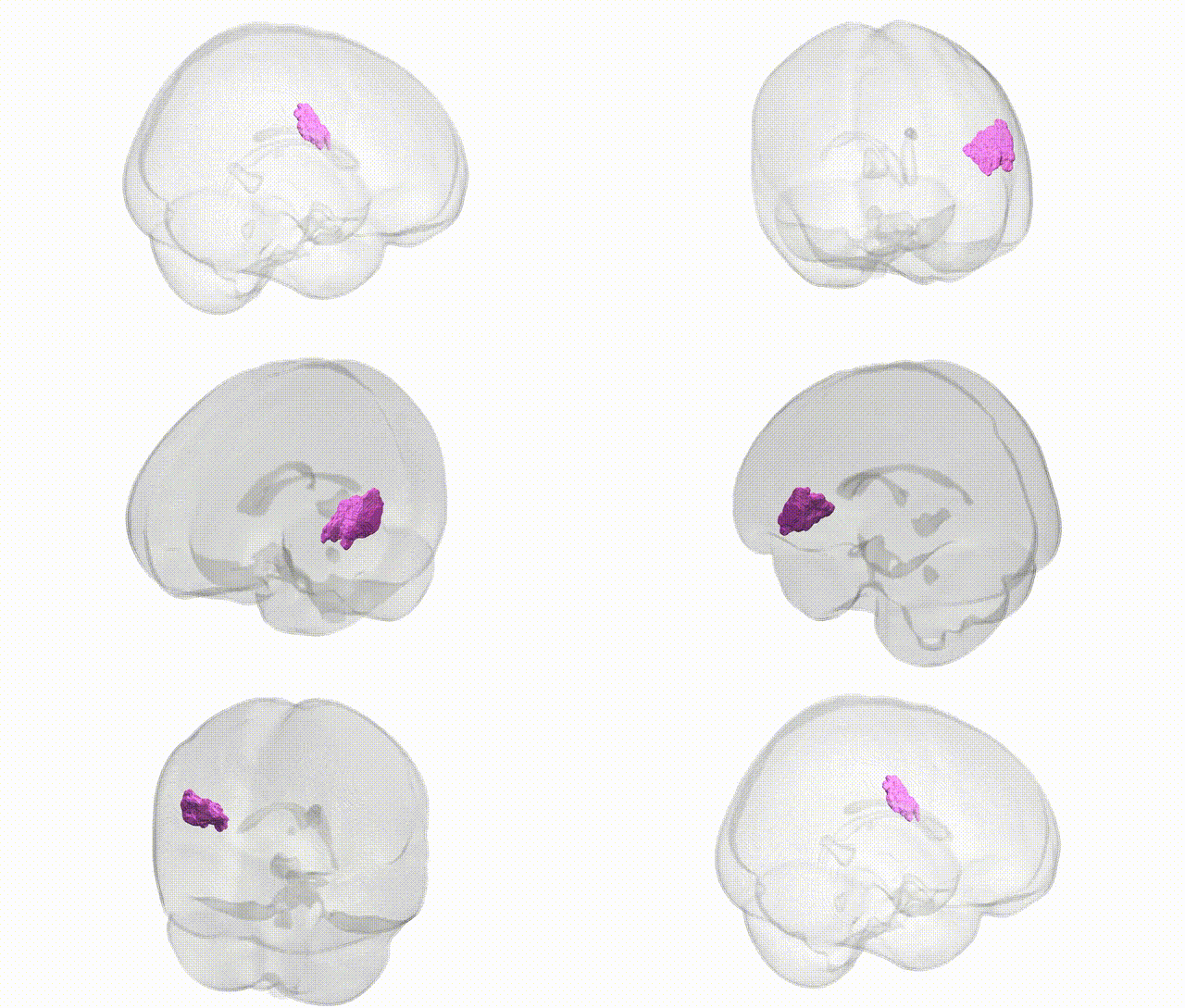
Full Quality Version: Download MP4
Wali Sidiqyar*, Gaurav Rudravaram*, Elyssa M. McMaster, Trent M. Schwartz, Adam M. Saunders, Kurt G. Schilling, Bennett A. Landman "Introducing SPINS: A Shared Public Visualization Library of Neuroanatomical Structures." Medical Imaging with Deep Learning- short paper
This resource is licensed under CC0 1.0 Universal (Public Domain).