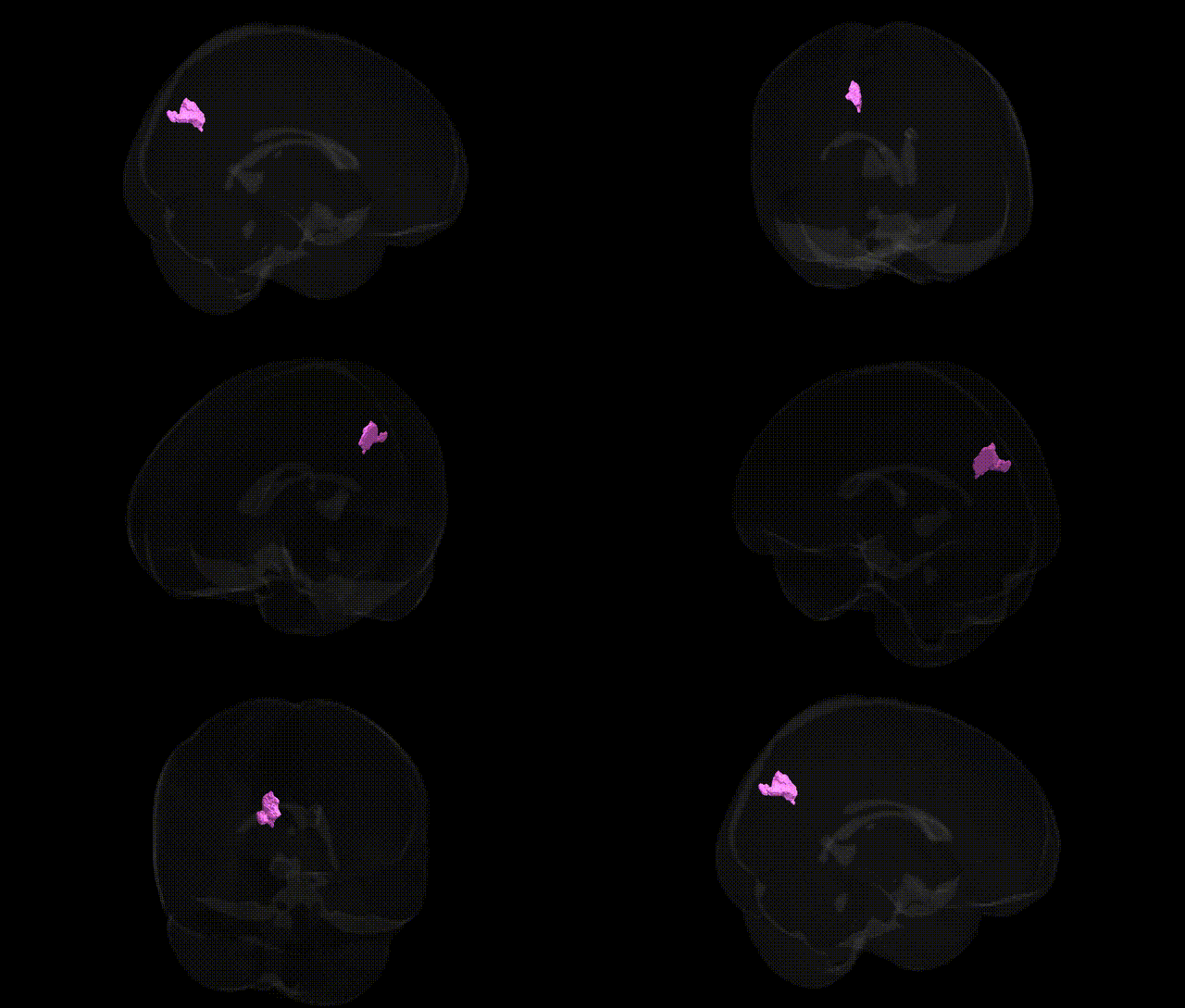
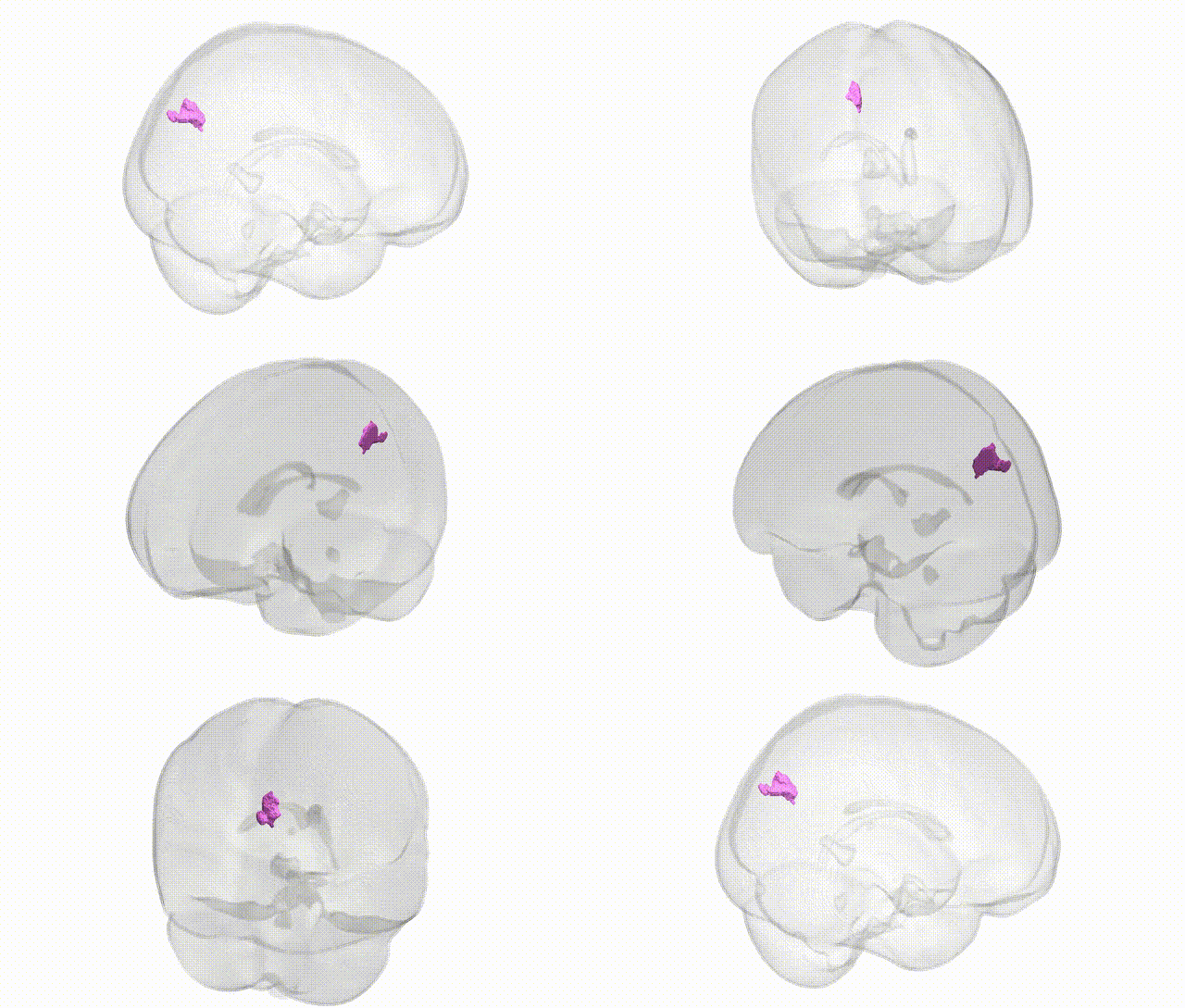
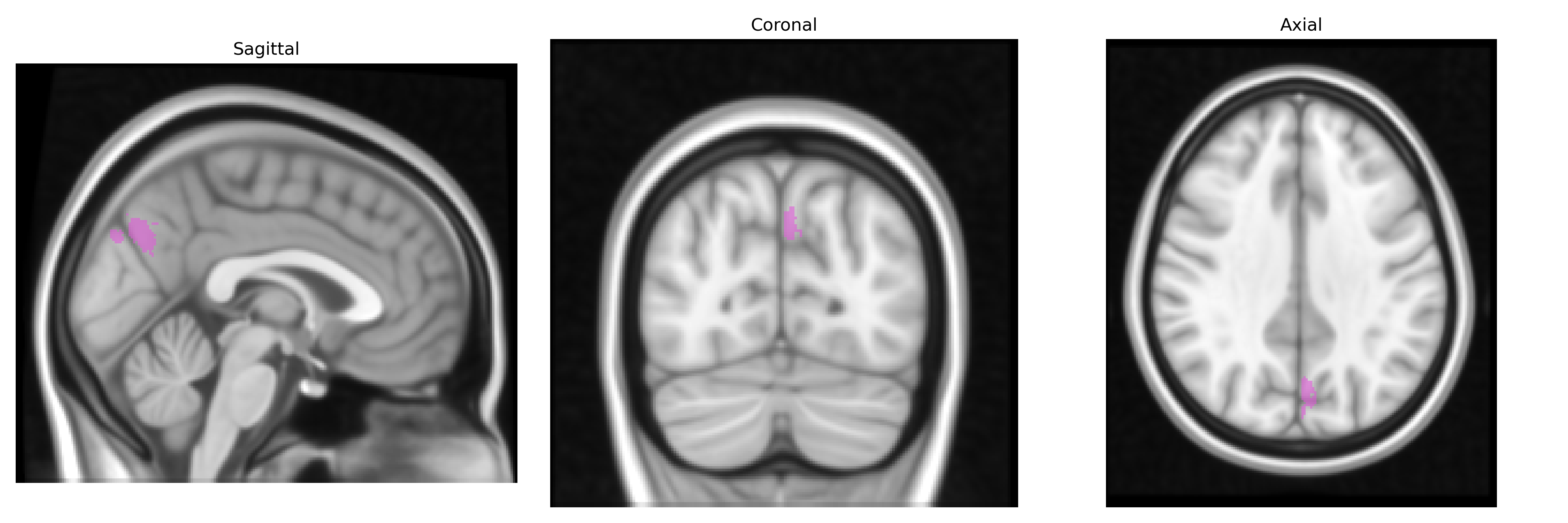
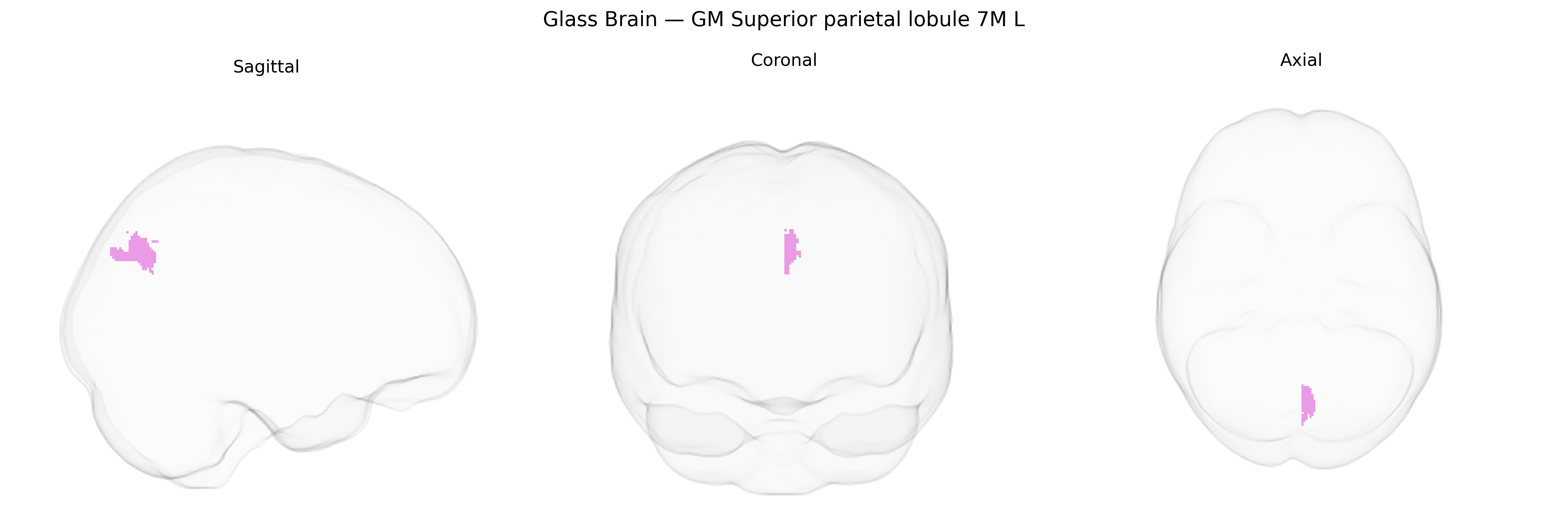
The bilateral GM Superior parietal lobule 7M L (Juelich maxprob thr25 1mm Atlas) corresponds to a medial subregion of Brodmann area 7 within the superior parietal lobule, located on the medial aspect of the posterior parietal cortex. This region is implicated in high-level visuospatial processing, integration of somatosensory and visual information, and the coordination of attention and eye–hand movements, supporting functions such as spatial perception, mental rotation, and the guidance of goal-directed actions. It contributes to body-centered spatial representation and may play a role in the interface between perception and action, as well as in aspects of working memory for spatial information. There is no direct Wikipedia article for area 7M; a closely related entry describing its broader anatomical context is Superior parietal lobule.
The bilateral GM Superior parietal lobule 7M L region (as defined in the Juelich maxprob thr25 1 mm atlas) has been implicated in genetic studies primarily through its roles in visuospatial processing, attention, working memory, and sensorimotor integration, with several genome-wide association studies (GWAS) linking variability in superior parietal structure and function to specific genetic loci and polygenic architectures. GWAS of cortical surface area and thickness (e.g., ENIGMA and UK Biobank–based consortia) have identified associations between superior parietal morphology and variants in genes involved in neurodevelopment, synaptic function, and axon guidance, including pathways related to Wnt signaling, cell adhesion, and cytoskeletal organization; many of these effects appear partly region-specific within the parietal cortex but are not restricted exclusively to area 7M. Polygenic risk scores for neuropsychiatric disorders such as schizophrenia, autism spectrum disorder, attention-deficit/hyperactivity disorder, and major depression have been associated with altered parietal cortical measures, including superior parietal thinning or surface-area changes, suggesting that disease-related genetic risk contributes to structural and functional alterations in this region. Additional imaging-genetics studies have related superior parietal activity or connectivity, often encompassing 7M, to common variants in dopaminergic and glutamatergic genes, as well as to Alzheimer’s disease risk loci (e.g., APOE) through effects on parietal atrophy and default mode network connectivity, and to GWAS loci for cognitive performance, educational attainment, and general intelligence, consistent with the region’s role in higher-order cognition. However, most existing genetic findings concern the superior parietal lobule as a broader anatomical unit, and fine-grained, area-specific genetic associations uniquely targeting Juelich-defined 7M L remain sparse, with current evidence primarily extrapolated from larger parietal ROIs and network-level analyses rather than from GWAS explicitly focused on this particular subregion.
Overview generated by GPT-4o (2026).
Region ID: 75
Hemisphere: bilateral
Atlas: Juelich maxprob thr25 1mm
Full Quality Version: Download MP4
Full Quality Version: Download MP4
Wali Sidiqyar*, Gaurav Rudravaram*, Elyssa M. McMaster, Trent M. Schwartz, Adam M. Saunders, Kurt G. Schilling, Bennett A. Landman "Introducing SPINS: A Shared Public Visualization Library of Neuroanatomical Structures." Medical Imaging with Deep Learning- short paper
This resource is licensed under CC0 1.0 Universal (Public Domain).