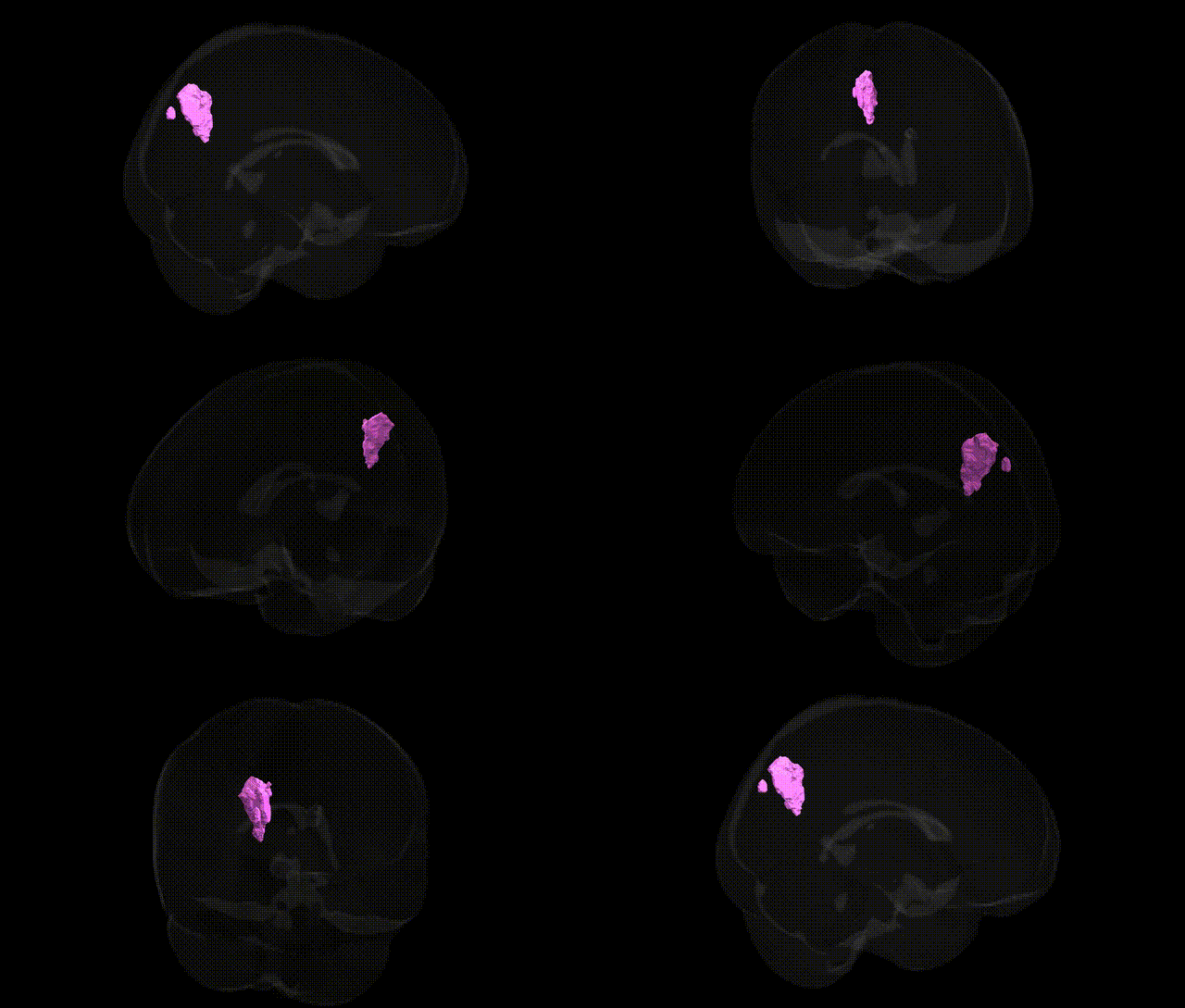
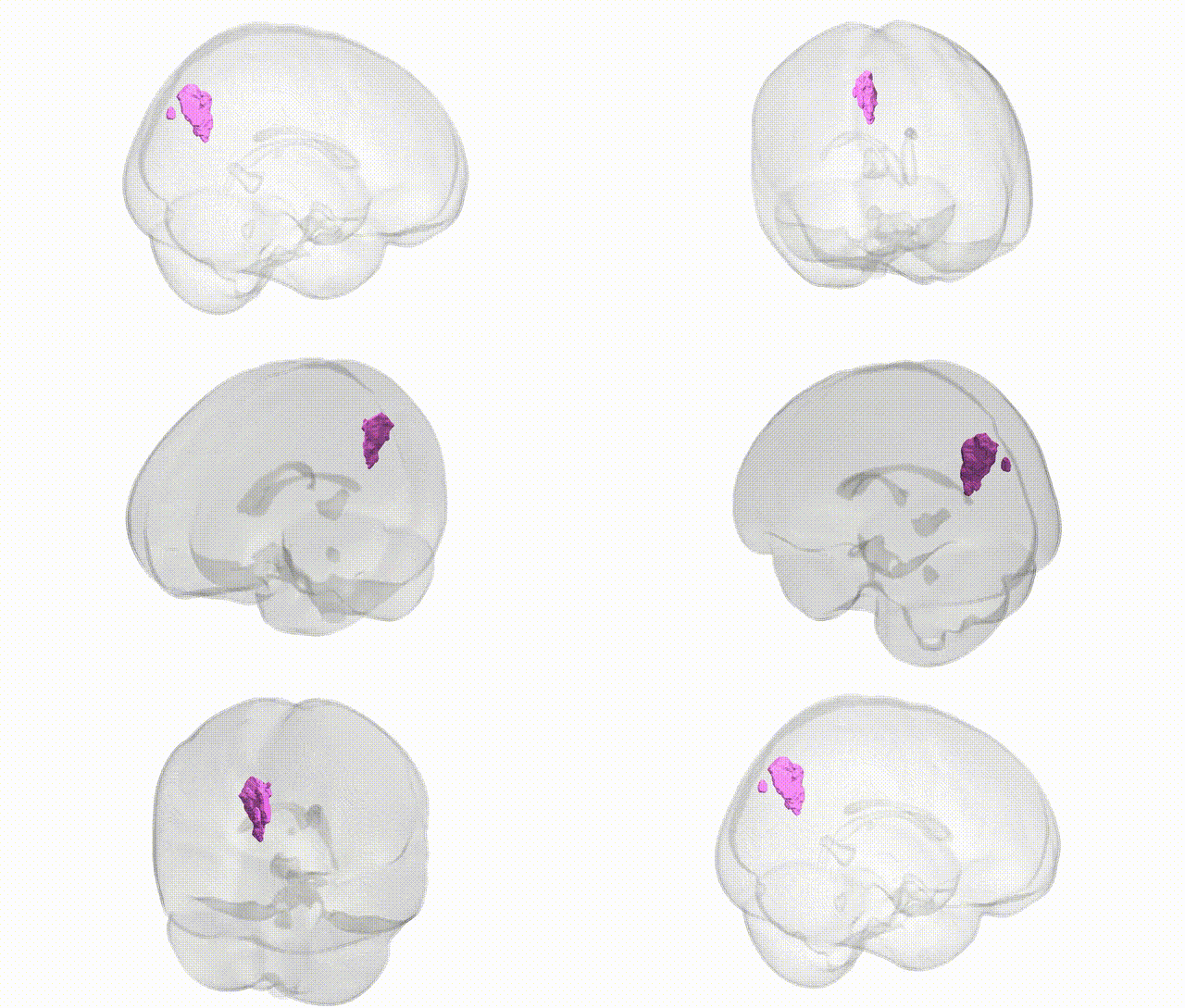
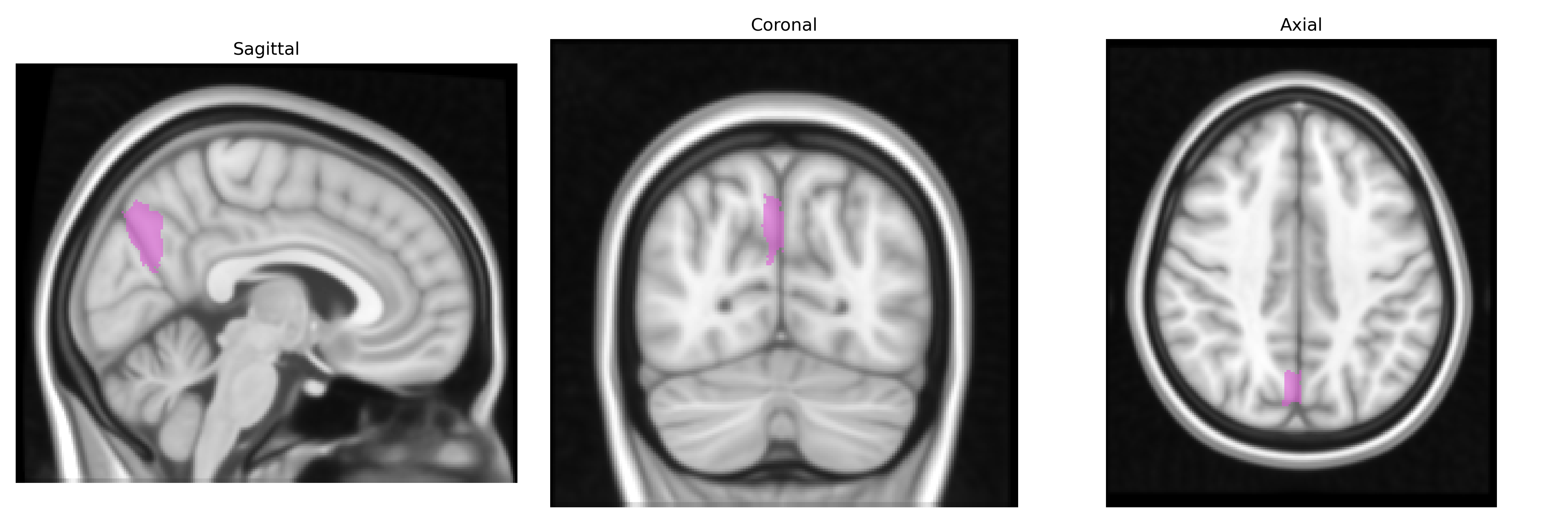
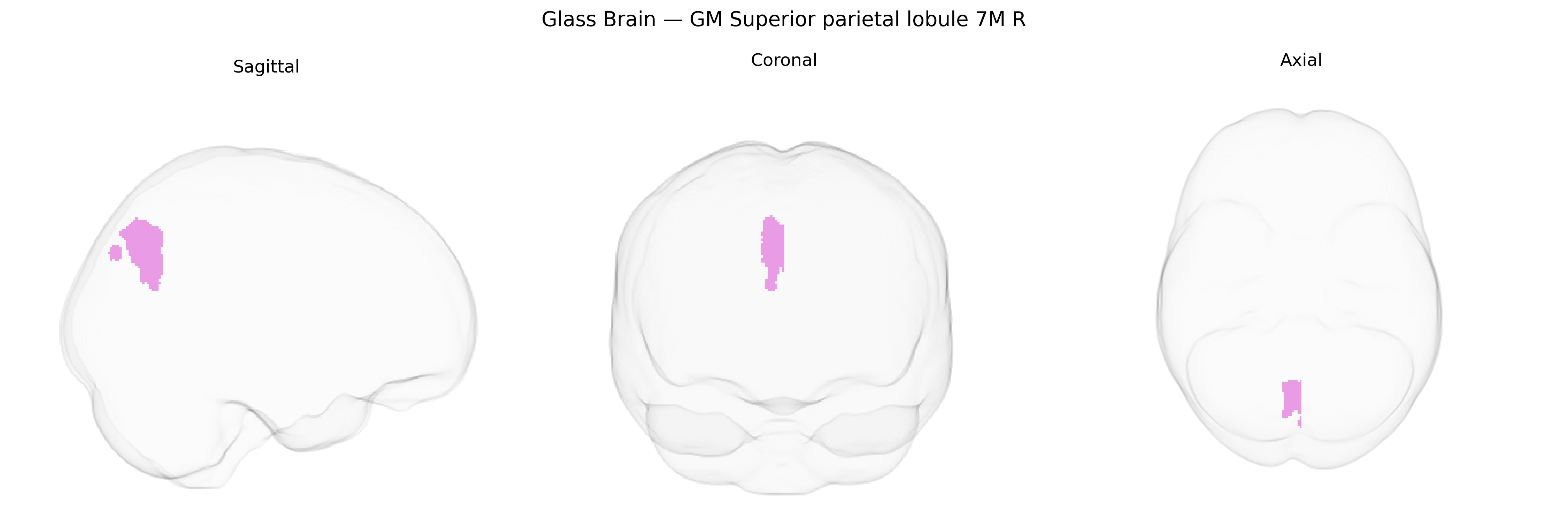
The bilateral GM Superior parietal lobule 7M R, as defined in the Juelich maxprob thr25 1mm atlas, corresponds to a cytoarchitectonically characterized subregion of Brodmann area 7 located in the medial portion of the superior parietal lobule, bordering the precuneus and adjacent parietal fields. This region participates in higher-order somatosensory integration, visuospatial processing, and the transformation of sensory input into coordinated motor output, including contributions to attention, eye–hand coordination, and spatial aspects of working memory. Neuronal populations within 7M exhibit multimodal convergence of visual, somatosensory, and proprioceptive signals, supporting body schema representation and the guidance of goal-directed actions in extrapersonal space. There is no direct Wikipedia article for area 7M; a related structure is the Superior parietal lobule.
The bilateral gray matter Superior Parietal Lobule area 7M (right hemisphere) in the Juelich maxprob thr25 1mm atlas corresponds broadly to a superior parietal association territory involved in visuospatial attention, sensorimotor integration, and higher-order cognition, and genetic associations to this region largely come from imaging-genetics and GWAS of cortical structure and brain-wide networks rather than region-specific studies. Large-scale neuroimaging GWAS (e.g., ENIGMA, UK Biobank) have identified multiple loci influencing superior parietal cortical thickness and surface area, including variants near genes involved in neurodevelopment and synaptic function such as KIAA0586, PAX6, and MAPT/H1 haplotype regions, although these associations typically reference “superior parietal” or “parietal lobe” measures rather than the cytoarchitectonic 7M field specifically. Polygenic scores for general cognitive ability, educational attainment, and schizophrenia have been reported to correlate with structural and functional measures in the superior parietal cortex, suggesting shared genetic architecture between parietal morphology and these traits, and parietal association areas including 7M have also been implicated in GWAS of attention-deficit/hyperactivity disorder and autism spectrum conditions through distributed cortical thinning or altered connectivity patterns. Additionally, variants in genes related to Alzheimer’s disease risk (such as APOE) and tau pathology (including MAPT) show downstream associations with parietal atrophy and hypometabolism, implicating superior parietal regions in genetically mediated neurodegenerative processes, but current evidence still treats 7M as part of a broader parietal or dorsal attention/network-level phenotype rather than a uniquely targeted locus in genetic studies.
Overview generated by GPT-4o (2026).
Region ID: 76
Hemisphere: bilateral
Atlas: Juelich maxprob thr25 1mm
Full Quality Version: Download MP4
Full Quality Version: Download MP4
Wali Sidiqyar*, Gaurav Rudravaram*, Elyssa M. McMaster, Trent M. Schwartz, Adam M. Saunders, Kurt G. Schilling, Bennett A. Landman "Introducing SPINS: A Shared Public Visualization Library of Neuroanatomical Structures." Medical Imaging with Deep Learning- short paper
This resource is licensed under CC0 1.0 Universal (Public Domain).