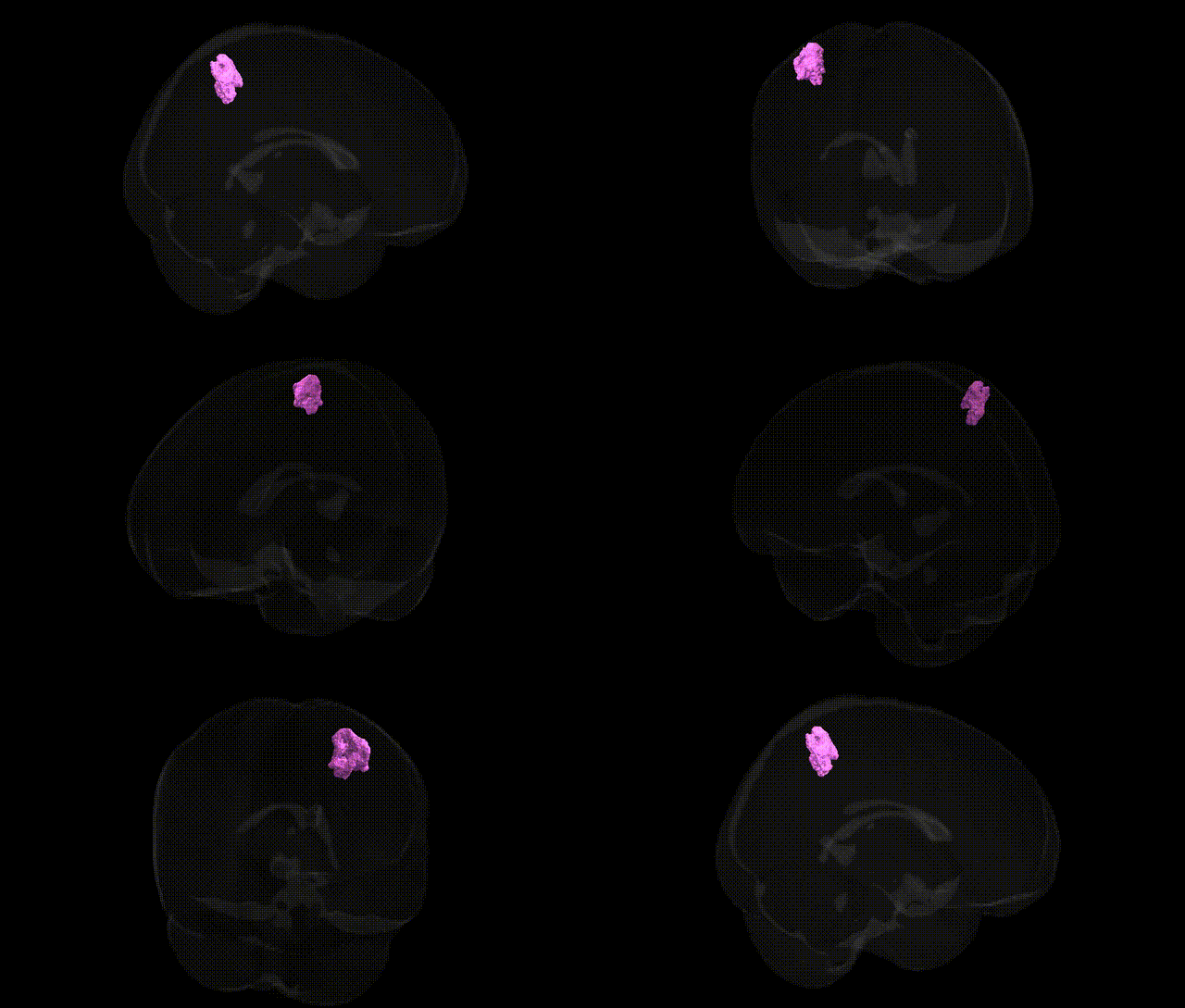
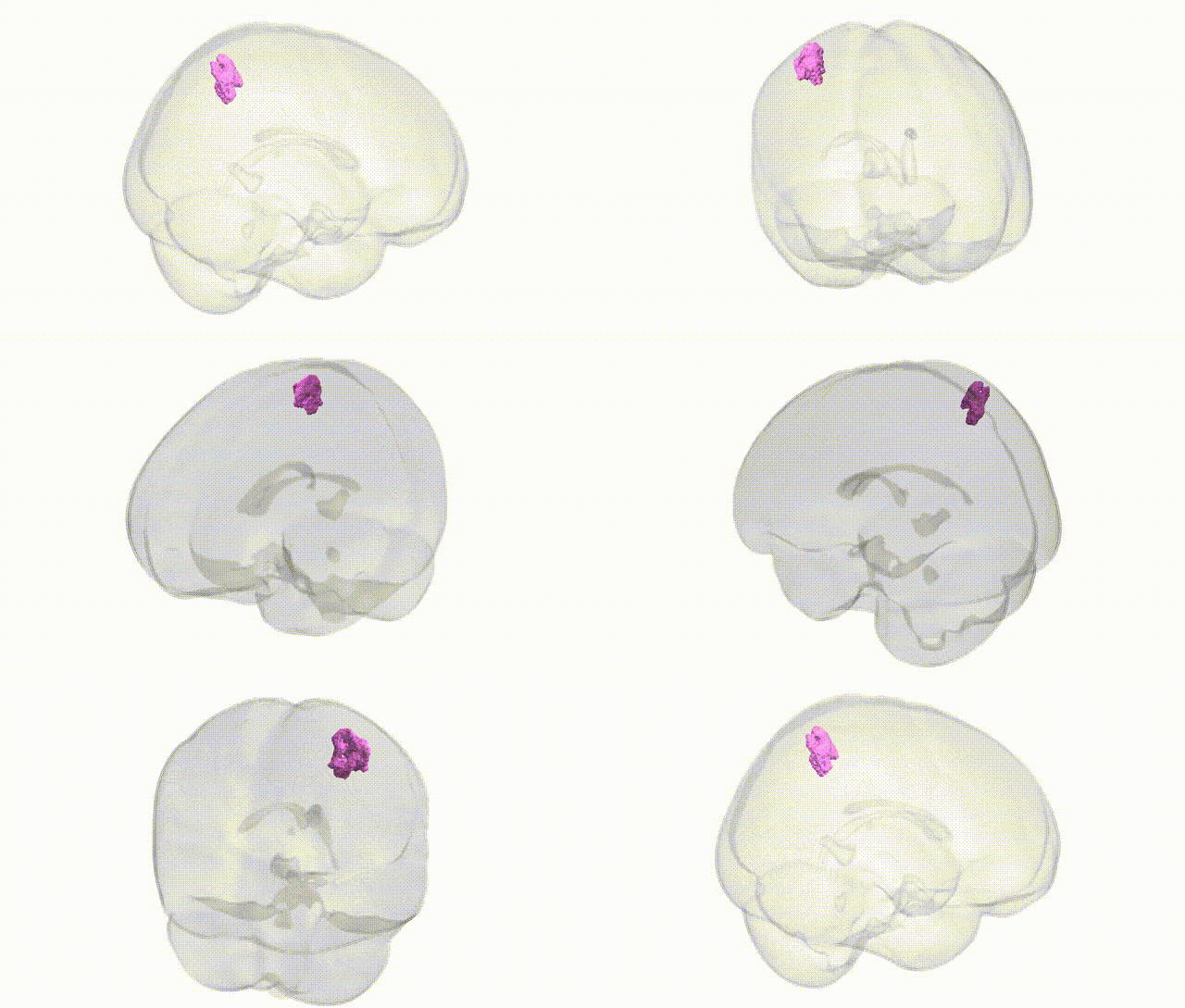
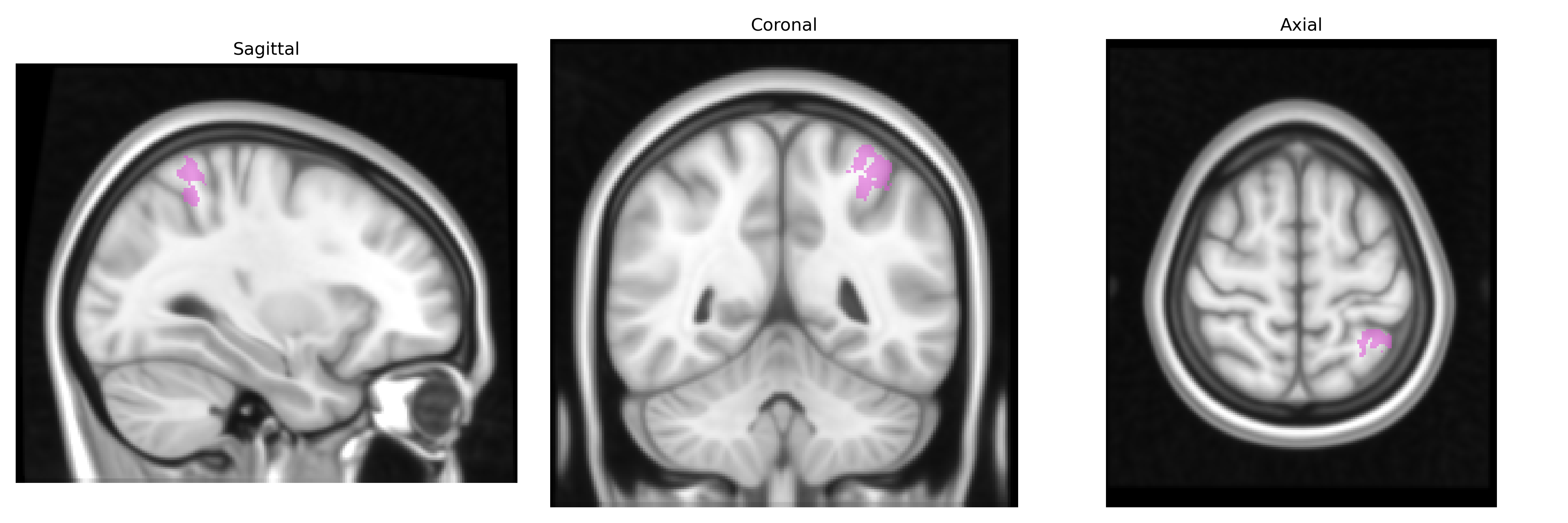
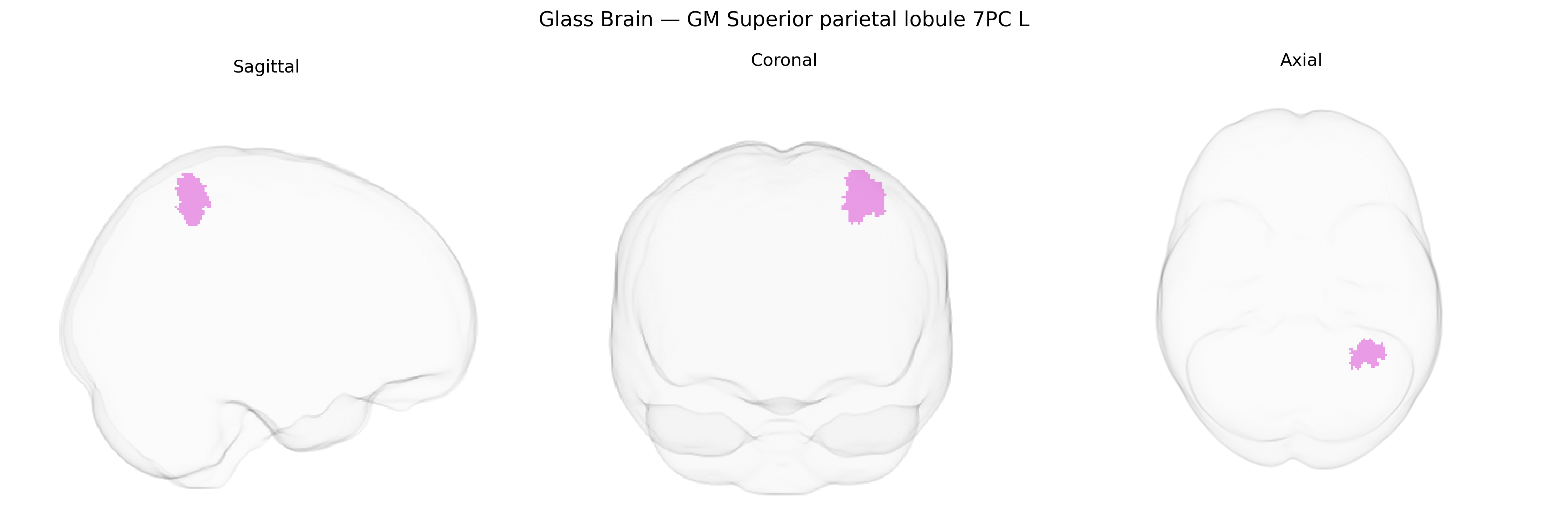
The bilateral GM Superior parietal lobule 7PC L, as defined in the Juelich maxprob thr25 1mm atlas, corresponds to a cytoarchitectonically characterized subregion of Brodmann area 7 within the superior parietal lobule of the left hemisphere. This region is situated dorsally in the parietal lobe and is implicated in higher-order somatosensory integration, visuospatial processing, and the coordination of attention and motor planning, particularly in tasks requiring spatial orientation and the transformation of sensory input into goal-directed actions. Neuronal populations in 7PC contribute to body-centered and object-centered spatial representations and interact with frontal and occipital cortices as part of dorsal stream networks involved in sensorimotor integration and visually guided behavior. There is no direct link for “Area 7PC”; a closely related structure is the superior parietal lobule: Superior parietal lobule.
The bilateral gray matter of the Superior Parietal Lobule 7PC L, as defined in the Juelich maxprob thr25 1mm atlas, has been implicated in several genetic and neuroimaging genetics studies, although direct, locus-specific GWAS results for this precise subregion are limited. More broadly, the superior parietal lobule shows heritable variation in cortical thickness and surface area, with multiple large-scale GWAS implicating genes involved in neurodevelopment, synaptic function, and axonal guidance (including loci near genes such as RSRC1, KCNK2, and others identified in ENIGMA and UK Biobank–based cortical morphology studies). Parietal regions encompassing or overlapping 7PC have been associated with genetic risk for cognitive performance and educational attainment, visuospatial processing, and general intelligence, with polygenic scores for these traits correlating with structure and function in superior parietal cortex. Furthermore, variants linked to neurodevelopmental and psychiatric disorders—including schizophrenia, autism spectrum disorder, and attention-deficit/hyperactivity disorder—have shown downstream effects on parietal morphology and connectivity, often involving the superior parietal lobule as part of frontoparietal or attention networks. Alzheimer’s disease and other forms of cognitive aging also show genetically influenced changes in parietal regions, with risk loci (e.g., APOE and others) associated with cortical thinning or hypometabolism that include superior parietal territories. However, current evidence generally treats the superior parietal lobule as part of larger parietal or frontoparietal circuits rather than isolating the Juelich-defined 7PC L subregion, so most genetic associations should be interpreted as regionally overlapping rather than specific to this exact atlas parcel.
Overview generated by GPT-4o (2026).
Region ID: 77
Hemisphere: bilateral
Atlas: Juelich maxprob thr25 1mm
Full Quality Version: Download MP4
Full Quality Version: Download MP4
Wali Sidiqyar*, Gaurav Rudravaram*, Elyssa M. McMaster, Trent M. Schwartz, Adam M. Saunders, Kurt G. Schilling, Bennett A. Landman "Introducing SPINS: A Shared Public Visualization Library of Neuroanatomical Structures." Medical Imaging with Deep Learning- short paper
This resource is licensed under CC0 1.0 Universal (Public Domain).