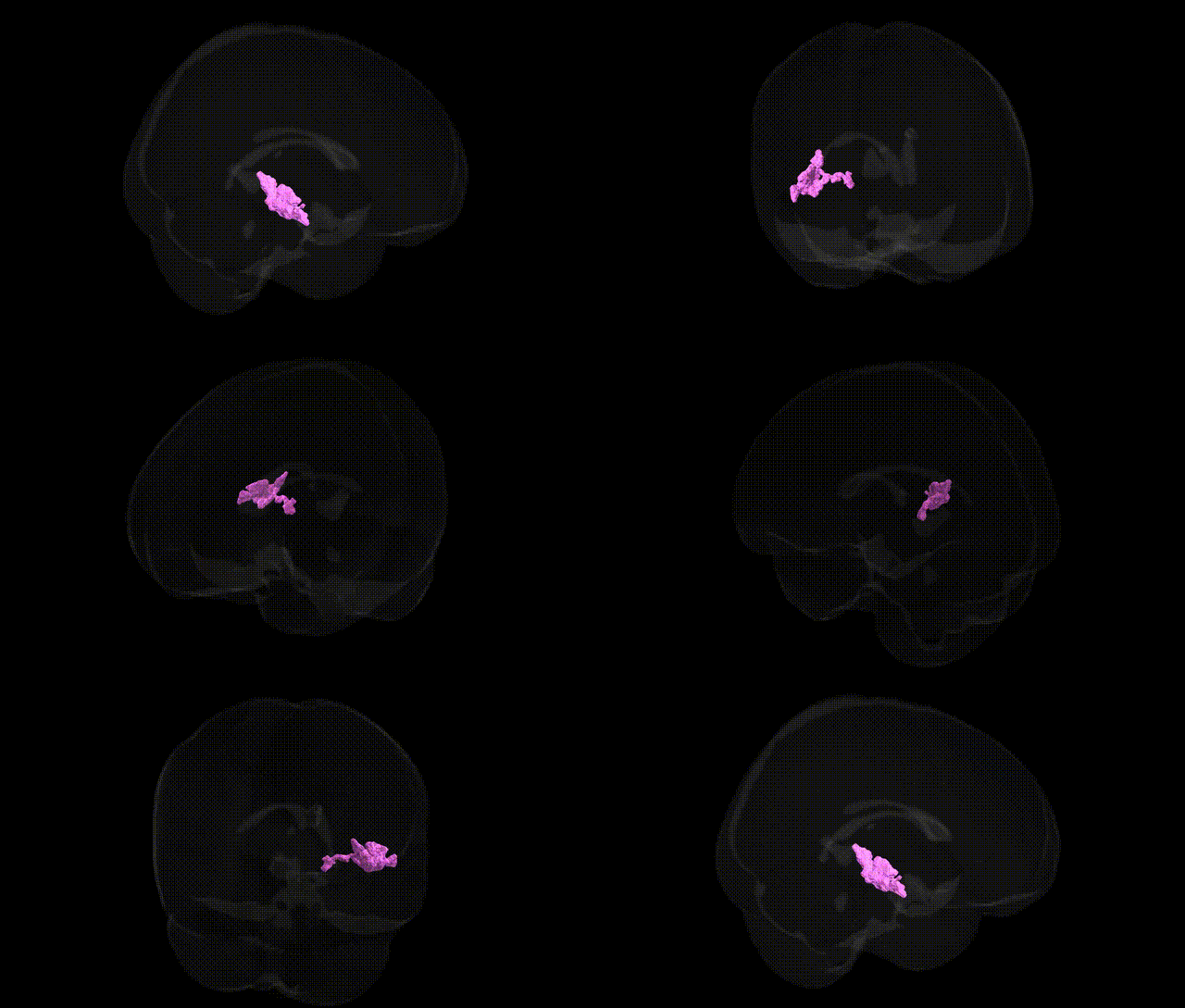
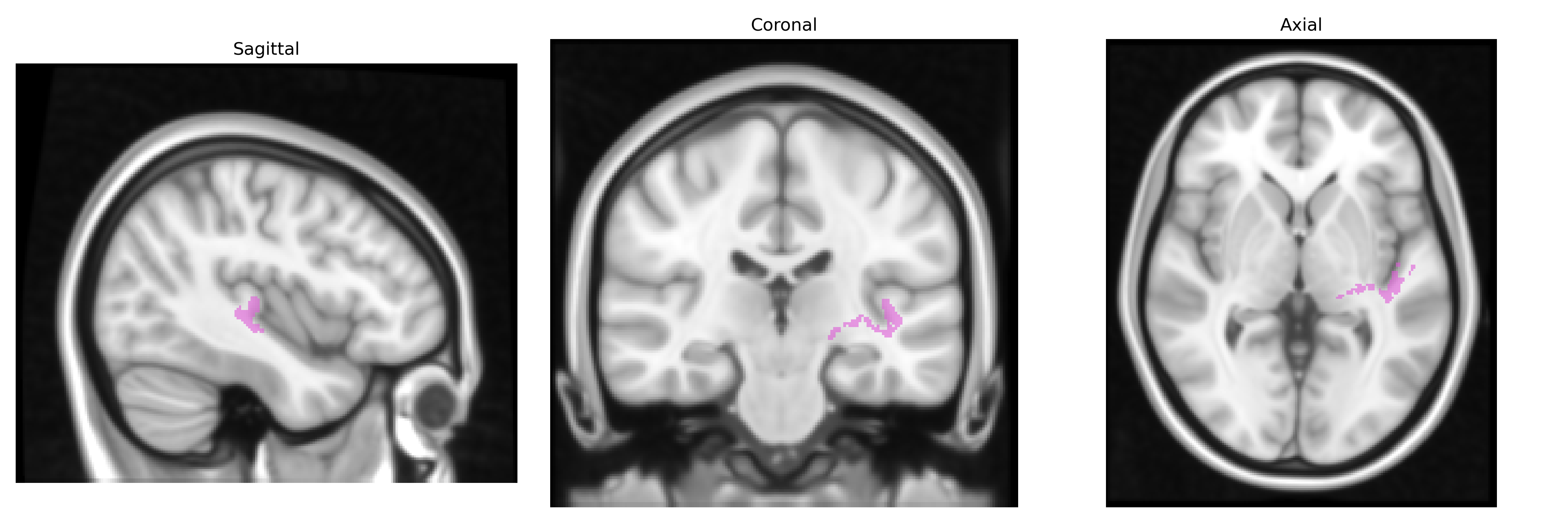
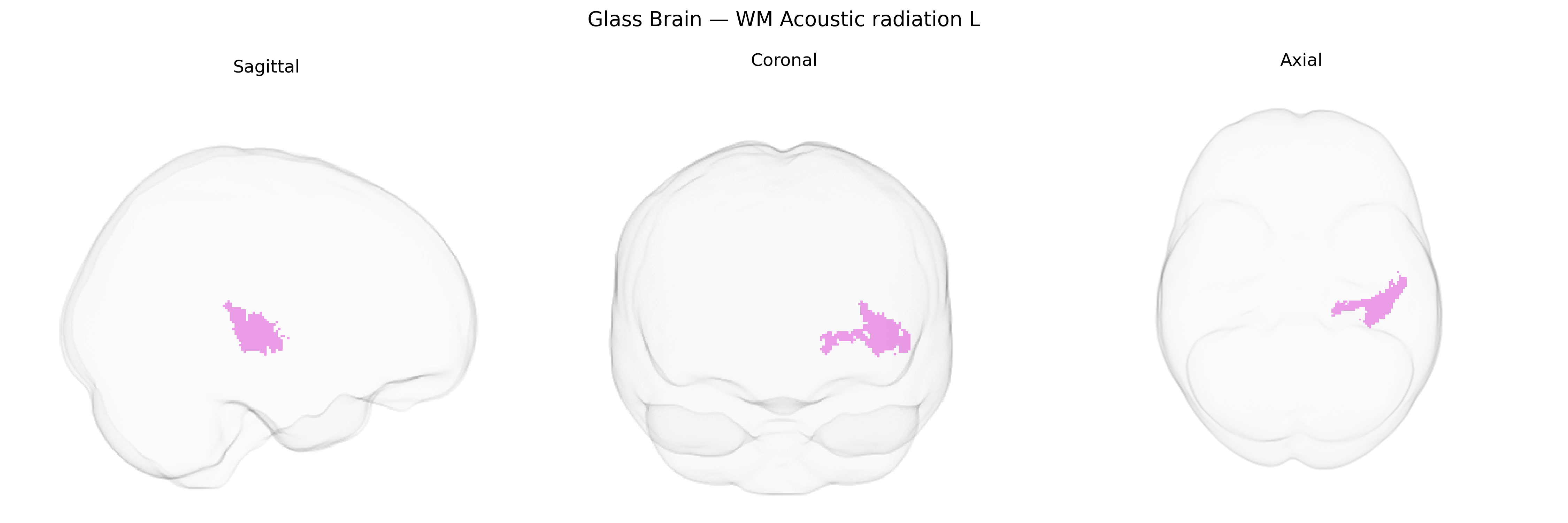
The bilateral WM Acoustic radiation L region in the Juelich maxprob thr25 1mm atlas corresponds to the left-sided acoustic (or auditory) radiation, a major white matter pathway that carries auditory information from the medial geniculate body of the thalamus to the primary auditory cortex in the superior temporal gyrus. These fibers course through the sublenticular portion of the internal capsule and fan out toward Heschl’s gyrus, forming part of the larger auditory pathway that transmits frequency, intensity, and temporal features of sound for cortical processing. Functionally, this tract is essential for conscious hearing and contributes to sound localization and speech perception by relaying processed cochlear signals to cortical fields involved in higher-order auditory analysis. There is no direct Wikipedia article for “acoustic radiation,” but it is a component of the Auditory pathway.
The bilateral white-matter acoustic radiation in the left hemisphere (from the Juelich maxprob thr25 1mm atlas) corresponds largely to auditory thalamocortical pathways (including projections from the medial geniculate nucleus to primary and secondary auditory cortex), and genetic associations involving this region have emerged primarily from imaging–genetics and GWAS of white-matter microstructure and auditory-related traits rather than region-specific candidate-gene work. Large diffusion MRI GWAS (e.g., UK Biobank–based studies using tract-based or region-of-interest approaches) have identified common variants in genes involved in axon guidance, myelination, and oligodendrocyte function (such as variants in or near CNTNAP2, MAG, NRG1, and myelin-related loci) that are associated with fractional anisotropy and other diffusion metrics in major auditory and posterior thalamic radiations, which anatomically overlap the acoustic radiation. Polygenic risk for schizophrenia, bipolar disorder, and major depression has been linked to reduced integrity in auditory and thalamocortical white-matter tracts, suggesting shared genetic influences on both psychiatric risk and structural properties of these pathways; similarly, autism spectrum disorder–related risk variants and language-related loci (including FOXP2-region variation and other GWAS hits for speech and language) have shown associations with microstructural measures in temporal and auditory radiations. GWAS for hearing-related traits (such as speech-in-noise perception and pure-tone thresholds) have identified loci implicated in cochlear and central auditory processing, and imaging–genetics analyses indicate that some of these loci also modulate white-matter properties in auditory radiations, further linking genetic variation affecting hearing and speech processing to structural differences in this region. However, no large GWAS to date has reported a set of variants uniquely or exclusively mapped to the “bilateral WM Acoustic radiation L” label itself; instead, genetic associations are inferred from studies of overlapping auditory, thalamic, and temporal white-matter tracts that share the same anatomical substrate.
Overview generated by GPT-4o (2026).
Region ID: 94
Hemisphere: bilateral
Atlas: Juelich maxprob thr25 1mm
Full Quality Version: Download MP4
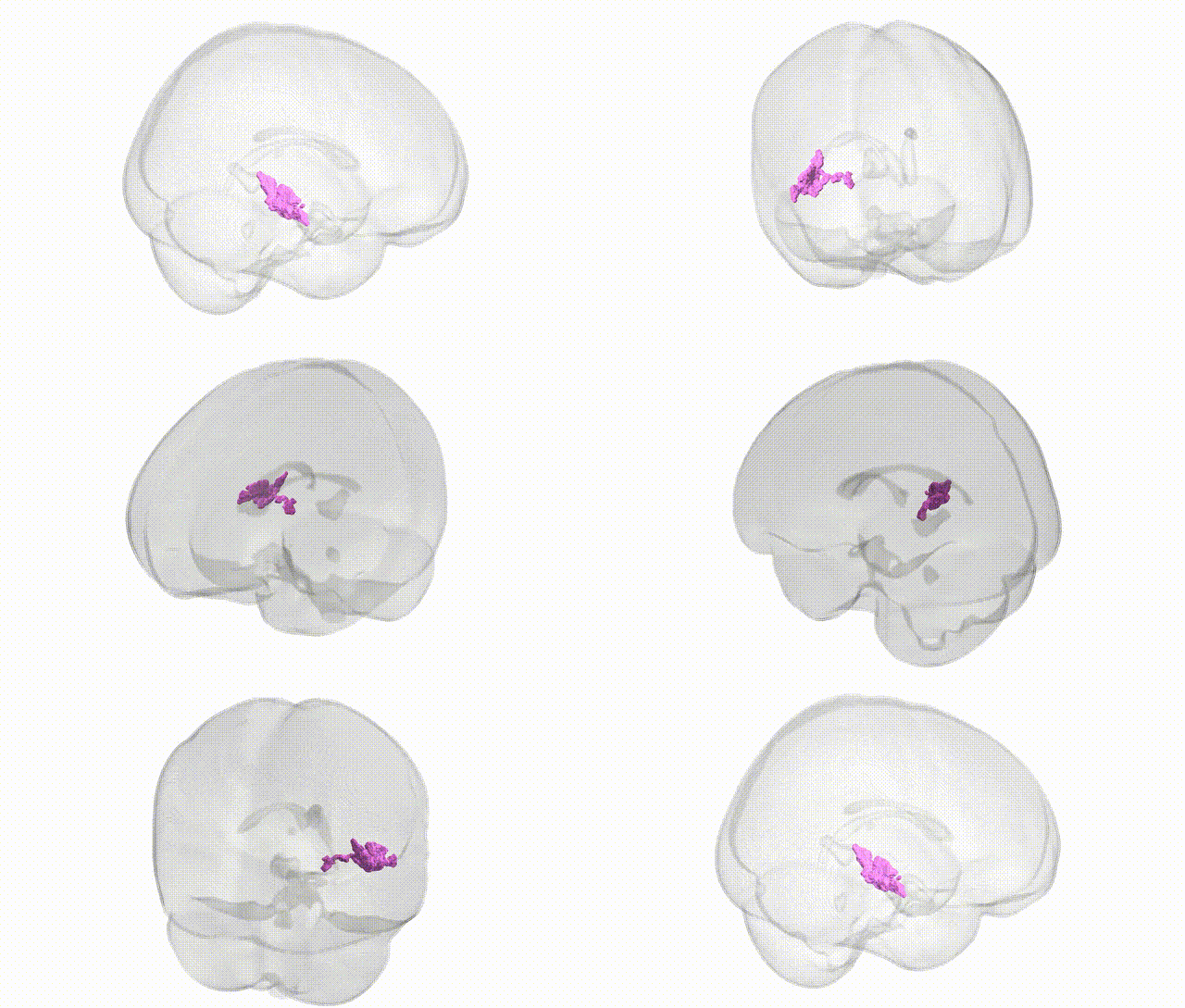
Full Quality Version: Download MP4
Wali Sidiqyar*, Gaurav Rudravaram*, Elyssa M. McMaster, Trent M. Schwartz, Adam M. Saunders, Kurt G. Schilling, Bennett A. Landman "Introducing SPINS: A Shared Public Visualization Library of Neuroanatomical Structures." Medical Imaging with Deep Learning- short paper
This resource is licensed under CC0 1.0 Universal (Public Domain).