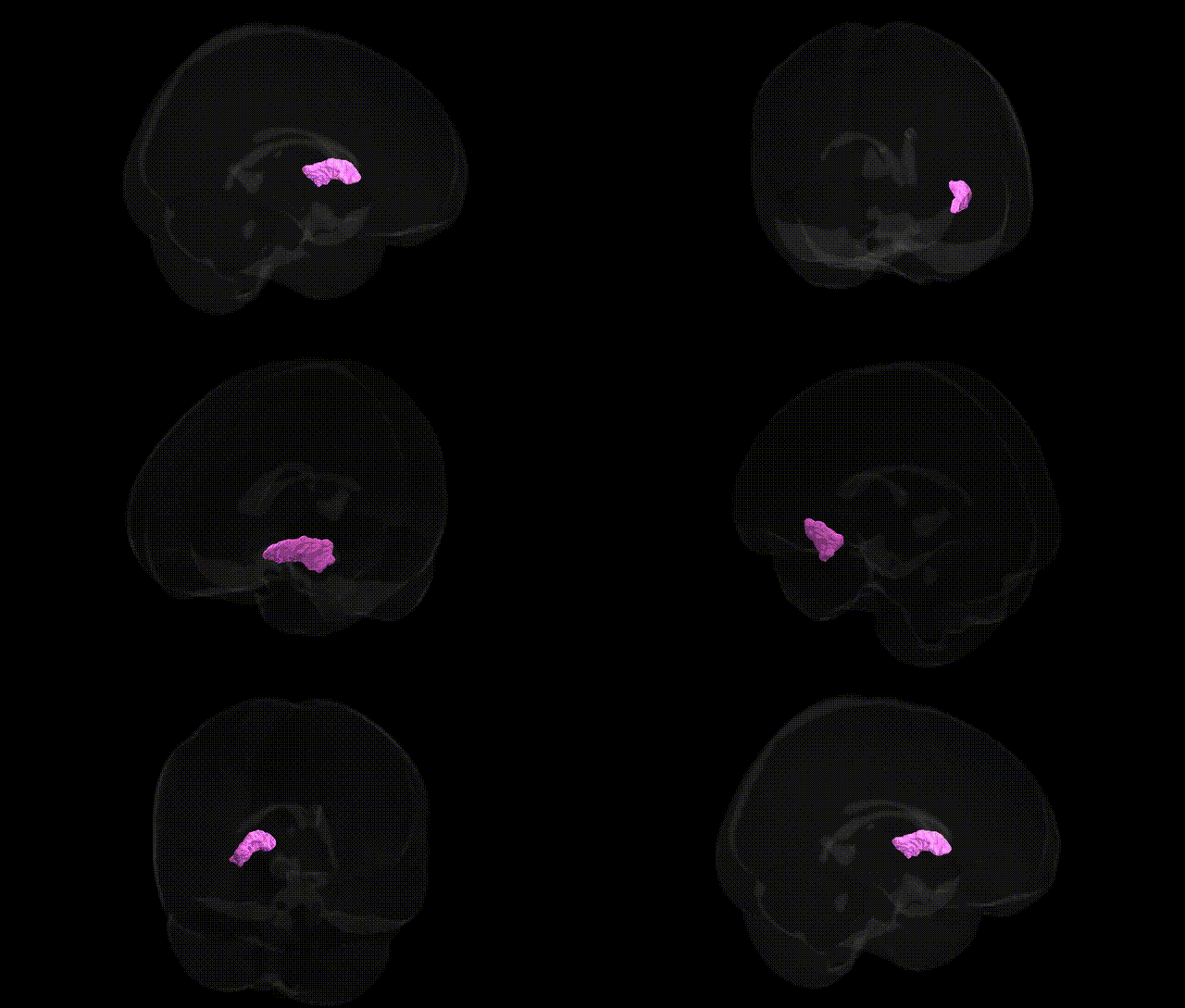
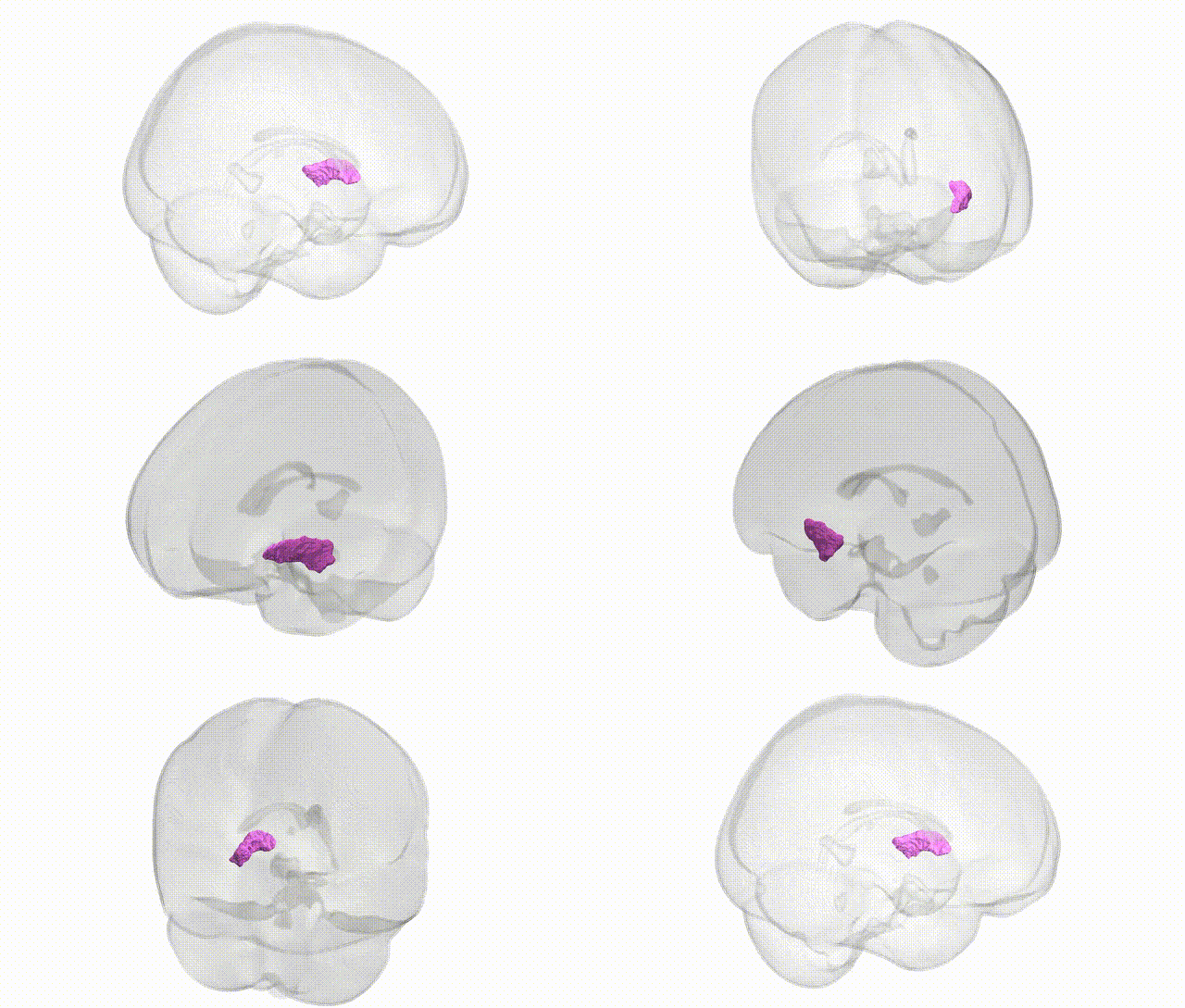
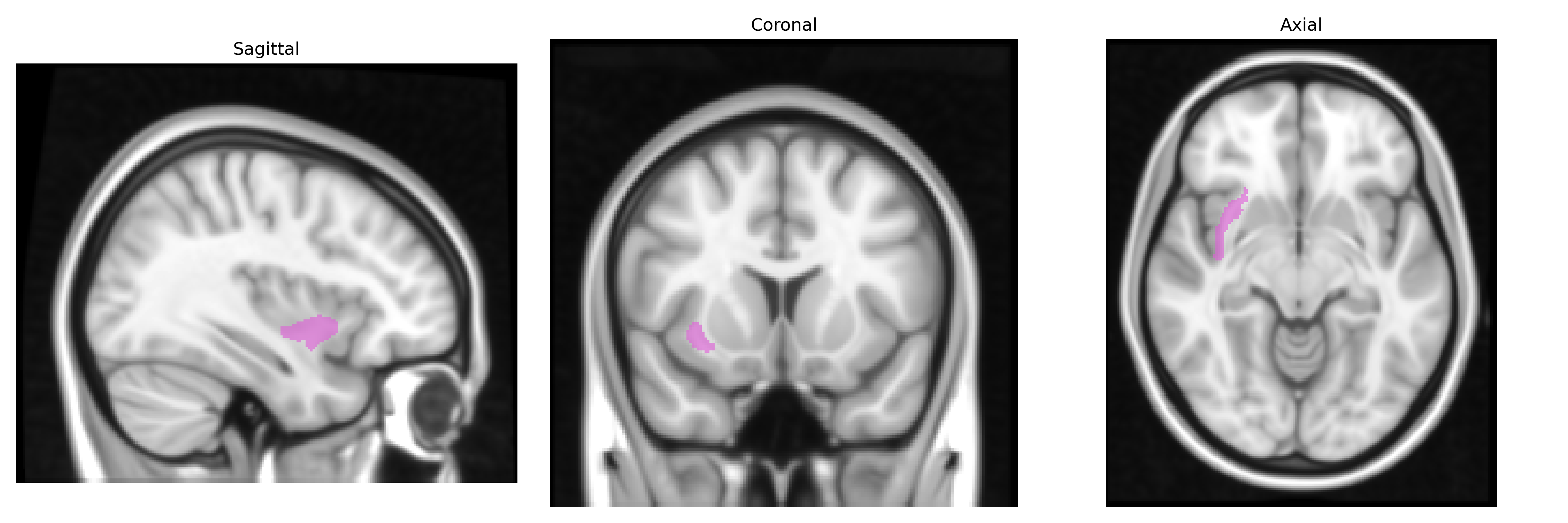
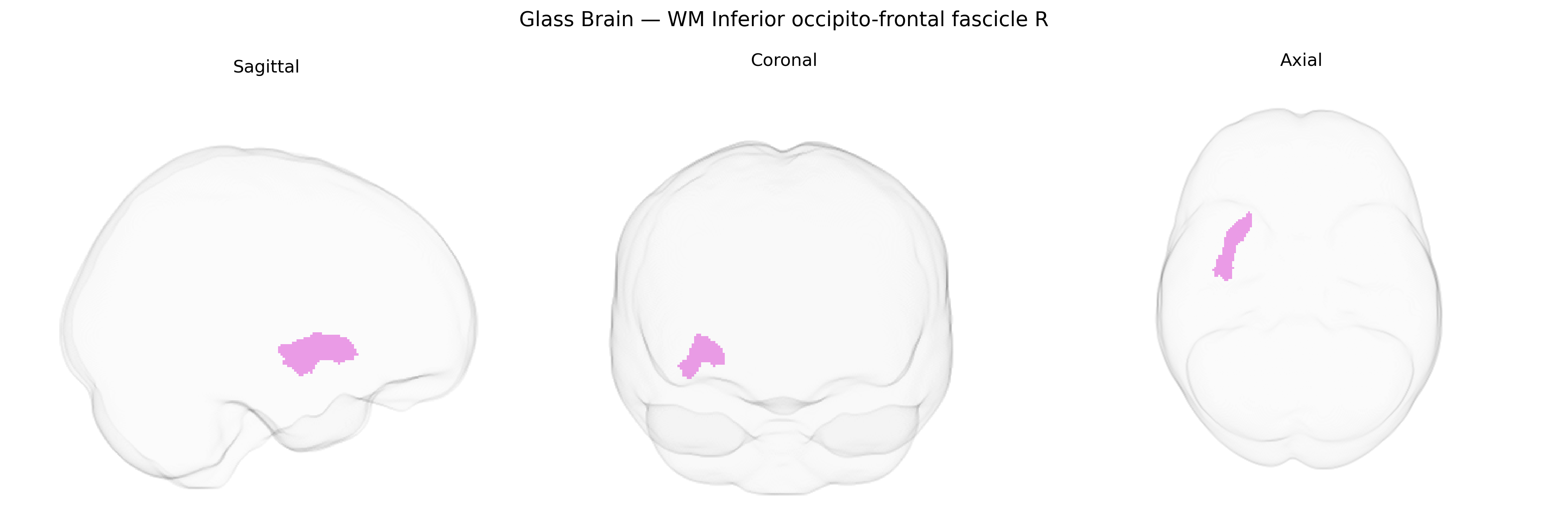
The bilateral WM Inferior occipito-frontal fascicle R in the Juelich maxprob thr25 1mm atlas corresponds to the right inferior fronto-occipital fasciculus (IFOF), a major association white-matter pathway linking occipital and posterior temporal regions with the frontal lobe through the deep white matter of the temporal stem and external/extreme capsules. This tract is implicated in visual processing, semantic integration, language, and higher-order cognitive functions by enabling rapid transfer of information between visual association areas and prefrontal cortex. It comprises long-range fibers that run medial to the insula and lateral to the basal ganglia, and is often studied in diffusion MRI and tractography as part of the broader fronto-occipital and ventral language networks. There is no direct Wikipedia article for this specific tract label; a closely related structure is the Inferior fronto-occipital fasciculus.
The right inferior fronto‑occipital fasciculus (IFOF) is a major association white‑matter tract implicated in language, visual processing, and higher‑order cognition, and genetic studies link its microstructure and integrity to multiple loci and traits. Large neuroimaging GWAS (especially UK Biobank–based) have identified common variants associated with diffusion MRI measures (FA, MD, RD, AD) in IFOF or overlapping long association tracts, frequently implicating genes involved in axon guidance, myelination, and oligodendrocyte function, such as those in the NRG1/ERBB pathway, MAG, and other myelin‑related loci, though specific hits vary by study and are often reported at the level of global or lobar white matter rather than a single tract. Polygenic influences on IFOF integrity overlap with risk architecture for major psychiatric and neurodevelopmental disorders, including schizophrenia, bipolar disorder, major depressive disorder, and autism spectrum disorder, consistent with frequent DTI reports of reduced FA or altered diffusivity in these conditions; several imaging‑genetics studies have shown that higher polygenic risk scores for schizophrenia and depression predict lower FA in IFOF and related fronto‑temporal tracts. Additional genetic associations involve cognitive traits (intelligence, educational attainment, reading ability) and risk factors for small‑vessel disease and neurodegeneration, where variants influencing vascular health, amyloid processing, and neuroinflammation (e.g., in APOE and other Alzheimer’s disease–related loci) show associations with white‑matter hyperintensities and microstructural changes that include the IFOF in older adults. Overall, current evidence supports a polygenic, pleiotropic architecture in which genes governing neurodevelopment, myelination, and synaptic signaling jointly shape IFOF structure and contribute to vulnerability for psychiatric illness, cognitive variation, and age‑related white‑matter pathology, although tract‑specific genetic effects for the right IFOF as defined in the Juelich maxprob thr25 1 mm atlas remain only partly resolved.
Overview generated by GPT-4o (2026).
Region ID: 101
Hemisphere: bilateral
Atlas: Juelich maxprob thr25 1mm
Full Quality Version: Download MP4
Full Quality Version: Download MP4
Wali Sidiqyar*, Gaurav Rudravaram*, Elyssa M. McMaster, Trent M. Schwartz, Adam M. Saunders, Kurt G. Schilling, Bennett A. Landman "Introducing SPINS: A Shared Public Visualization Library of Neuroanatomical Structures." Medical Imaging with Deep Learning- short paper
This resource is licensed under CC0 1.0 Universal (Public Domain).