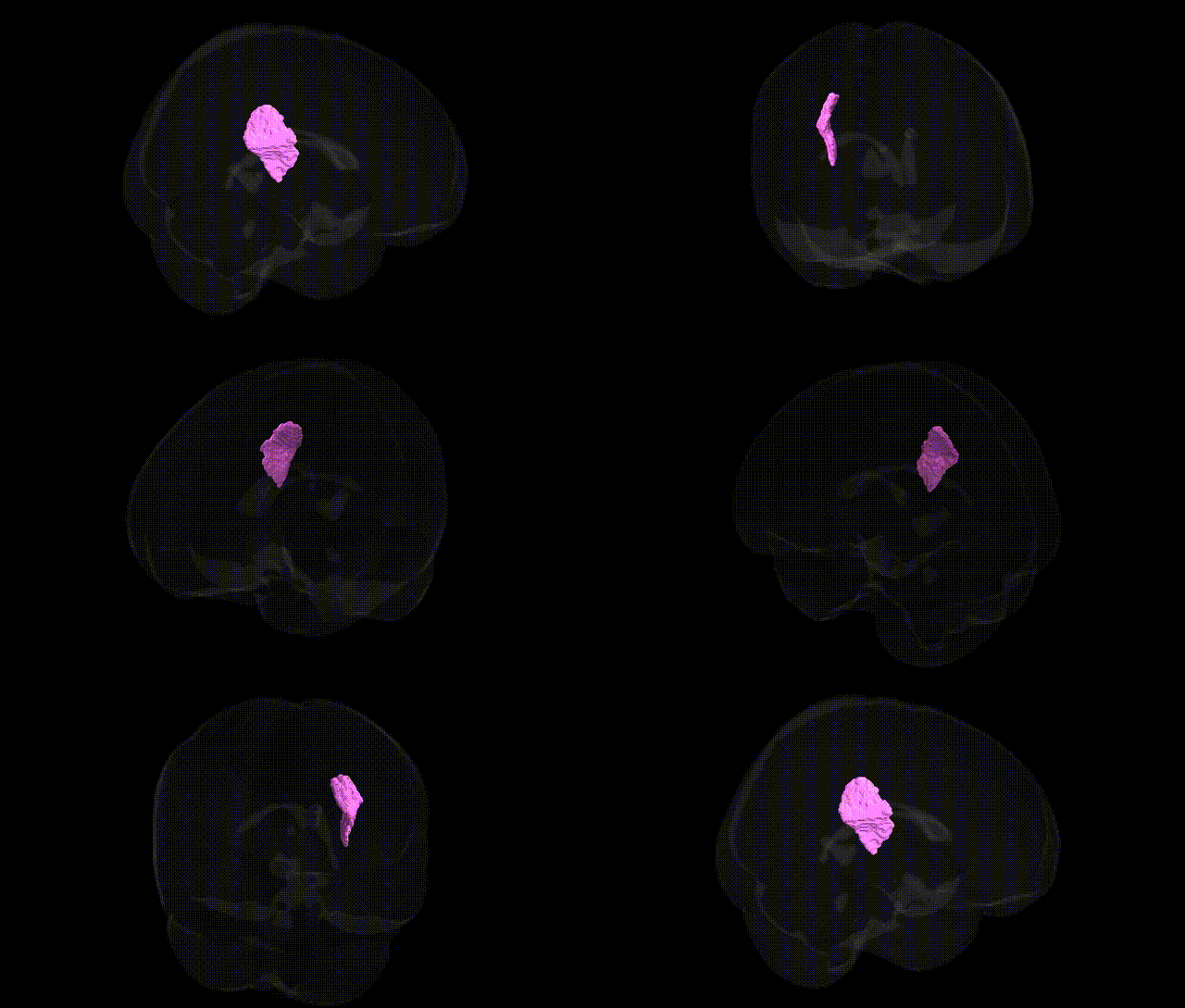
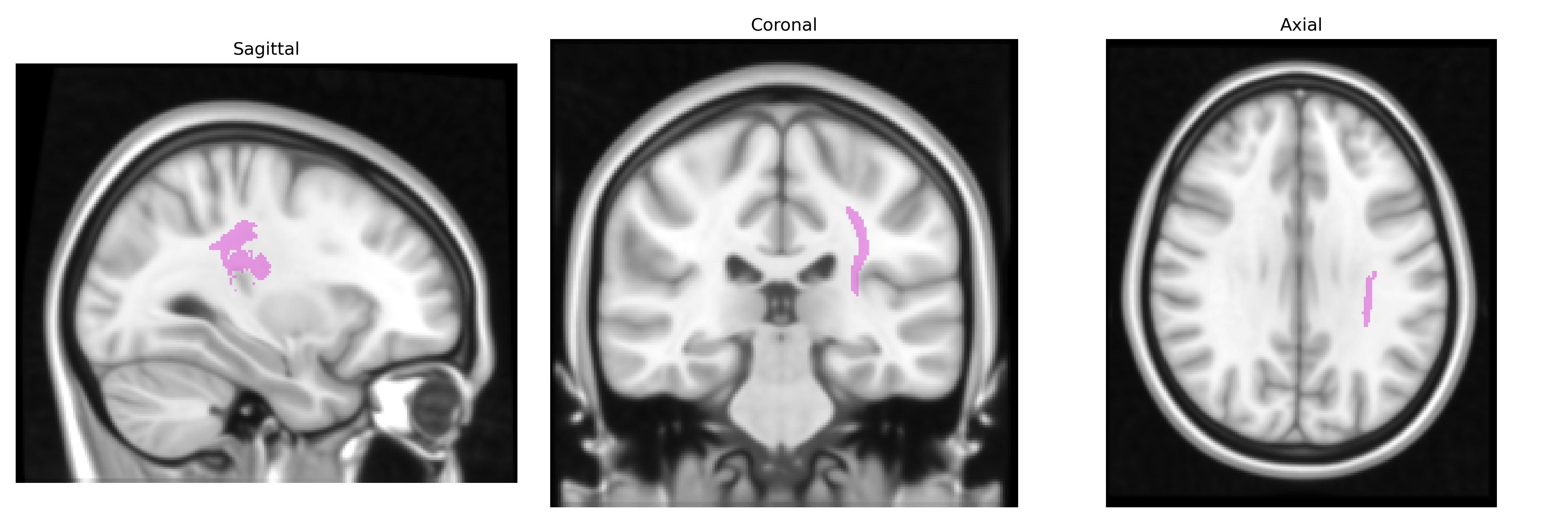
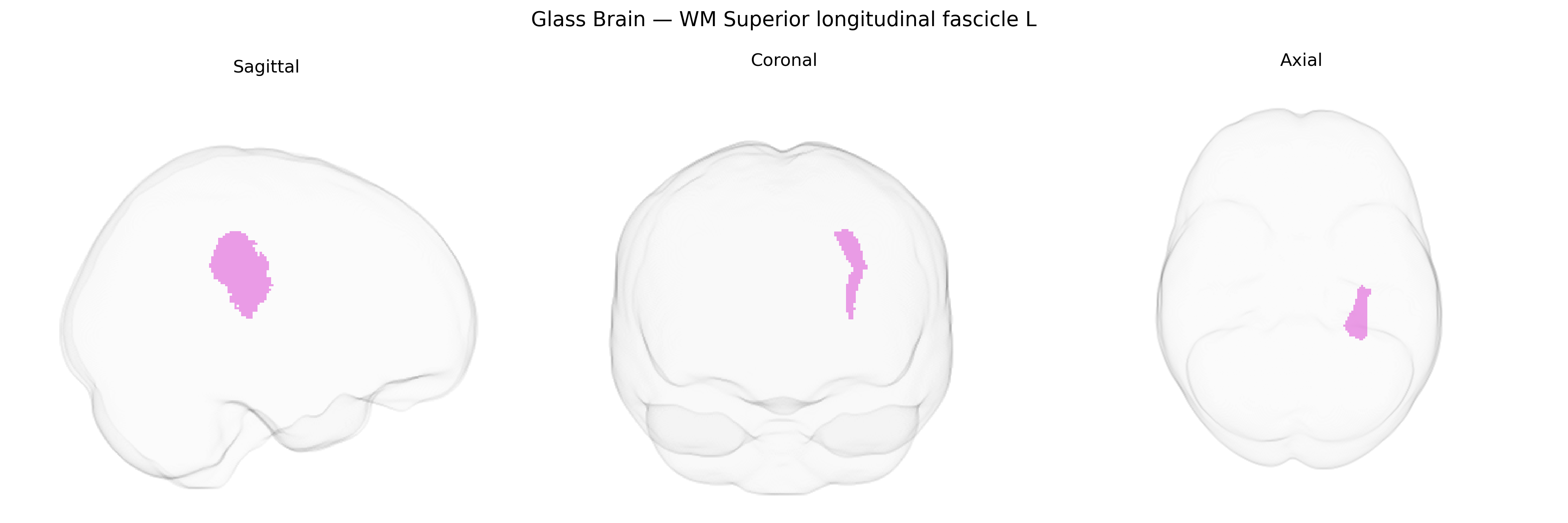
The bilateral WM Superior longitudinal fascicle L (SLF; white matter, left hemisphere) in the Juelich maxprob thr25 1 mm Atlas represents a major association fiber bundle that interconnects frontal, parietal, and temporal cortical regions, supporting higher-order functions such as language, attention, working memory, and visuospatial processing. Anatomically, the SLF courses dorsally and laterally within the hemisphere, arching above the insula and lateral ventricles, and is composed of multiple subcomponents (often described as SLF I–III and the arcuate fasciculus) that link specific cortical territories in a topographically organized manner. Histologically, it consists of heavily myelinated axons that facilitate rapid long-range communication among distributed neocortical association areas, forming a critical backbone of frontoparietal and frontotemporal networks. There is no direct Wikipedia article for “Superior longitudinal fascicle,” but it is closely related to and often discussed with the Superior longitudinal fasciculus.
The bilateral superior longitudinal fasciculus (SLF)—a major white-matter tract connecting frontal, parietal, temporal, and occipital regions—has been implicated in multiple genetic and genome-wide association studies (GWAS) examining white-matter microstructure, particularly via diffusion tensor imaging measures such as fractional anisotropy and mean diffusivity. Common variants in genes related to axon guidance, myelination, and neurodevelopment (for example, neuregulin/ERBB signaling genes, cell-adhesion molecules, and oligodendrocyte-related genes) have repeatedly shown associations with SLF integrity, although individual loci often differ across cohorts. Large imaging–genetics consortia (e.g., ENIGMA, UK Biobank analyses) report that polygenic scores for schizophrenia, bipolar disorder, major depressive disorder, and attention-deficit/hyperactivity disorder are associated with altered SLF microstructure, consistent with the tract’s role in frontoparietal and attentional networks. SLF abnormalities and related genetic risk have also been linked to autism spectrum disorder, dyslexia and other language/reading traits, and cognitive abilities such as working memory and intelligence, with heritability estimates indicating a substantial genetic contribution to interindividual variation in SLF properties. While the Juelich maxprob thr25 1 mm atlas provides an anatomical definition of the bilateral WM superior longitudinal fascicle L region, current genetic findings generally reference SLF subcomponents (e.g., SLF I–III, arcuate fasciculus) rather than this specific atlas label, and associations should therefore be interpreted at the level of the broader SLF system.
Overview generated by GPT-4o (2026).
Region ID: 111
Hemisphere: bilateral
Atlas: Juelich maxprob thr25 1mm
Full Quality Version: Download MP4
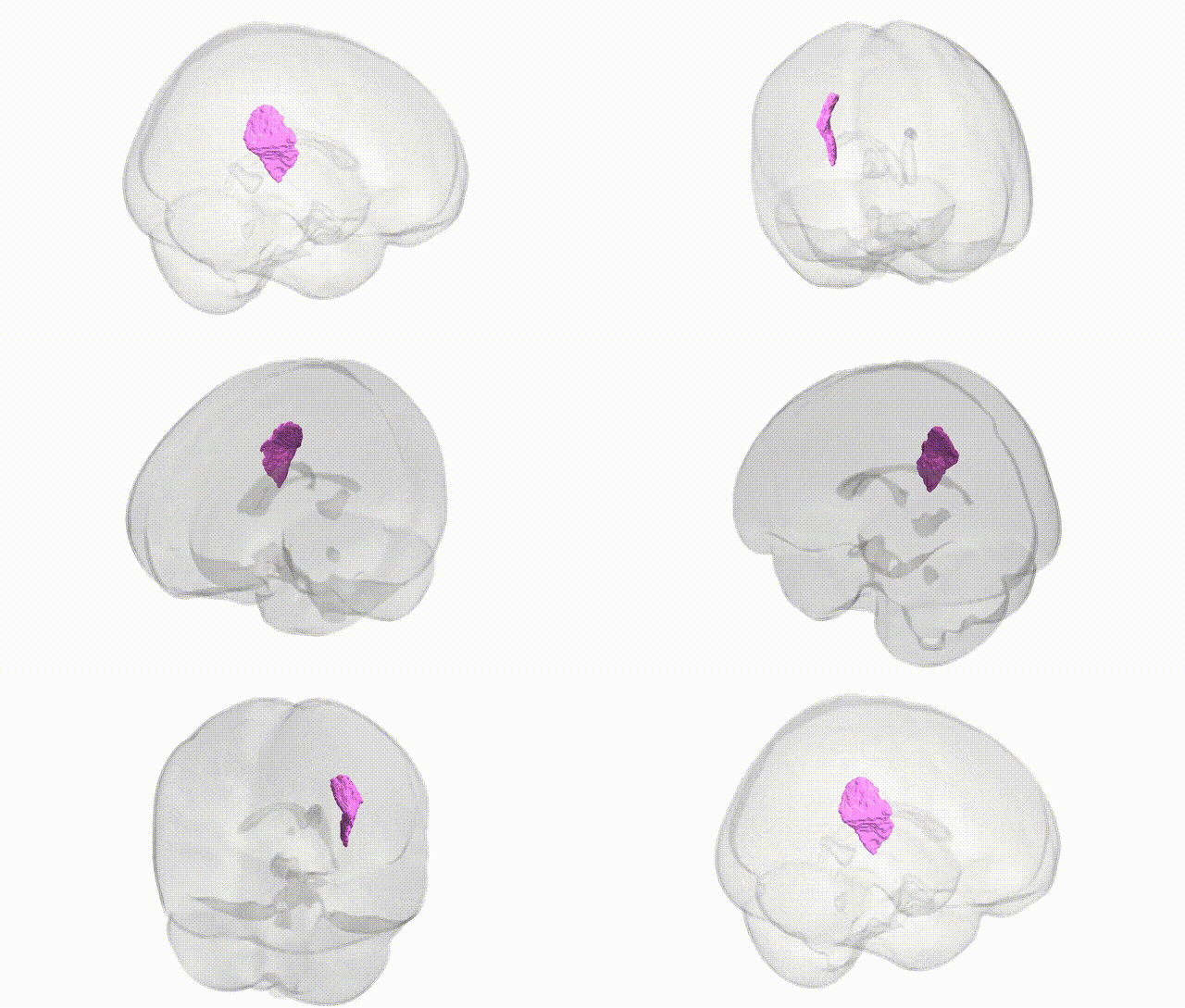
Full Quality Version: Download MP4
Wali Sidiqyar*, Gaurav Rudravaram*, Elyssa M. McMaster, Trent M. Schwartz, Adam M. Saunders, Kurt G. Schilling, Bennett A. Landman "Introducing SPINS: A Shared Public Visualization Library of Neuroanatomical Structures." Medical Imaging with Deep Learning- short paper
This resource is licensed under CC0 1.0 Universal (Public Domain).