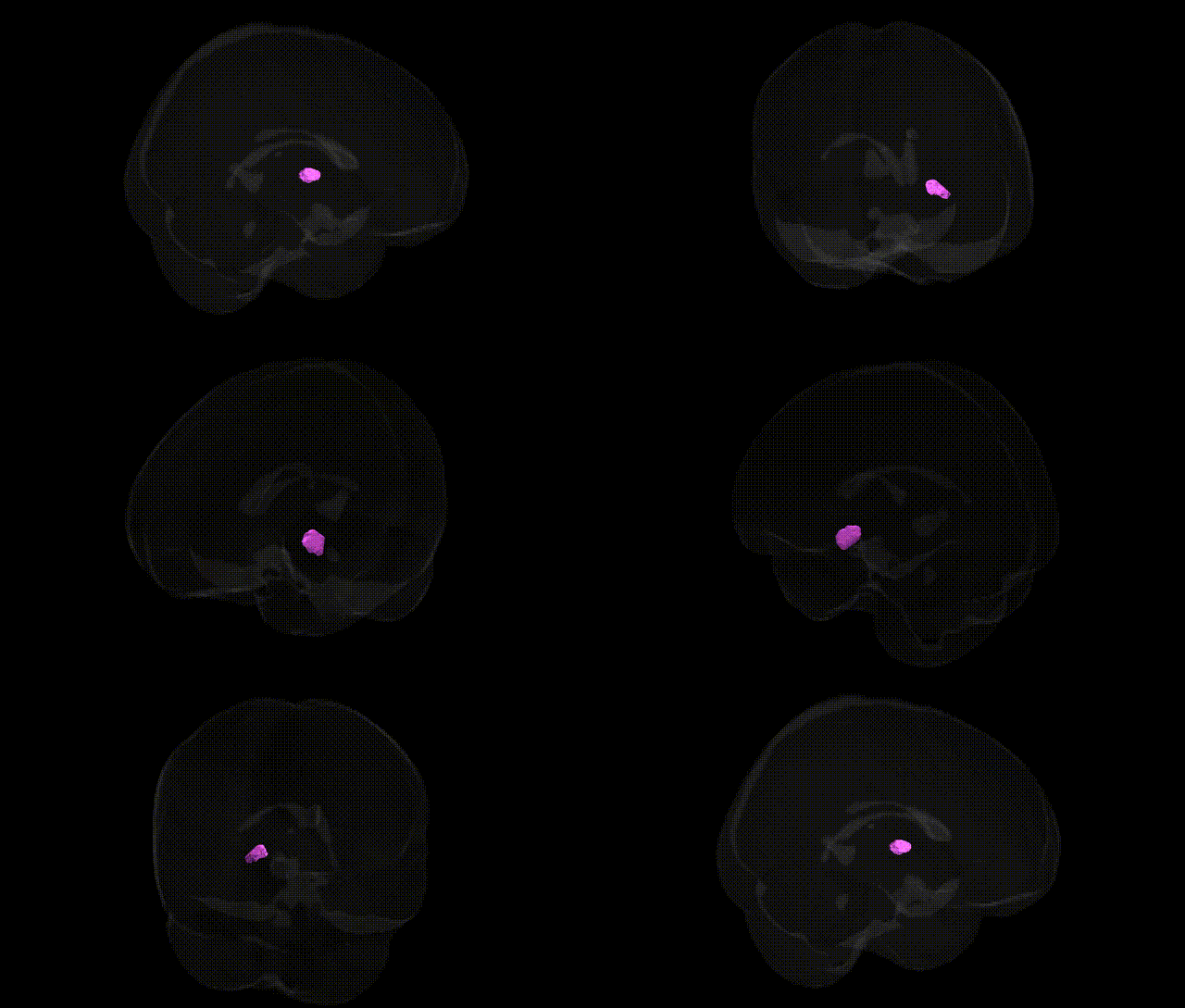
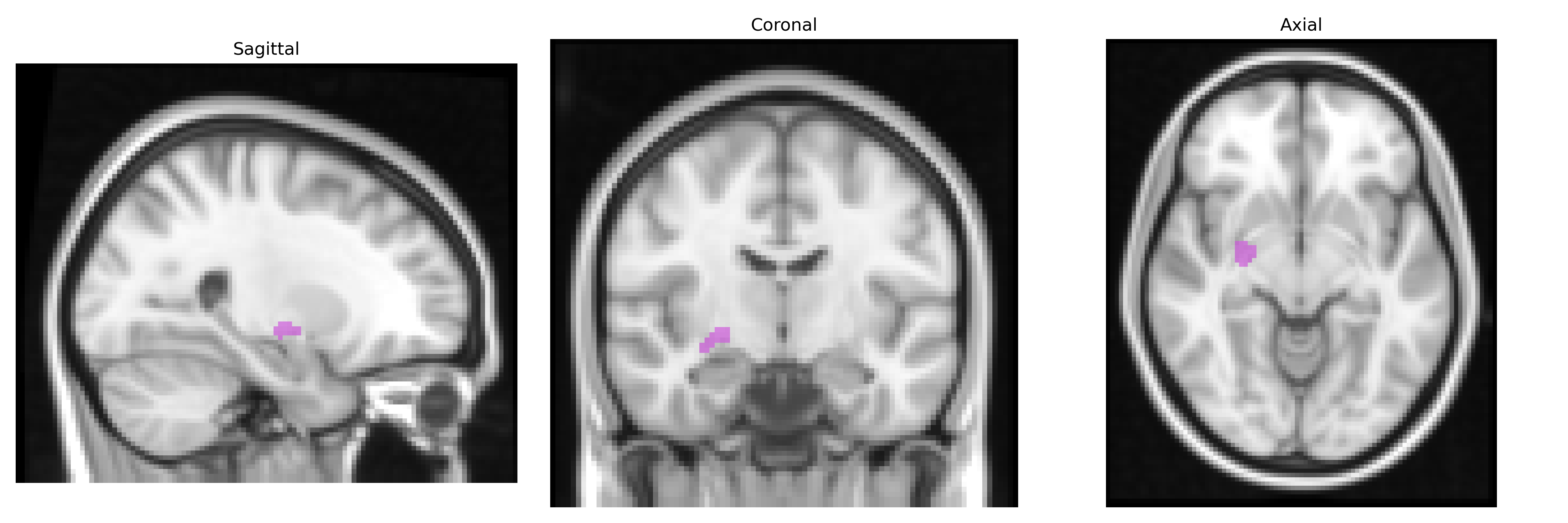
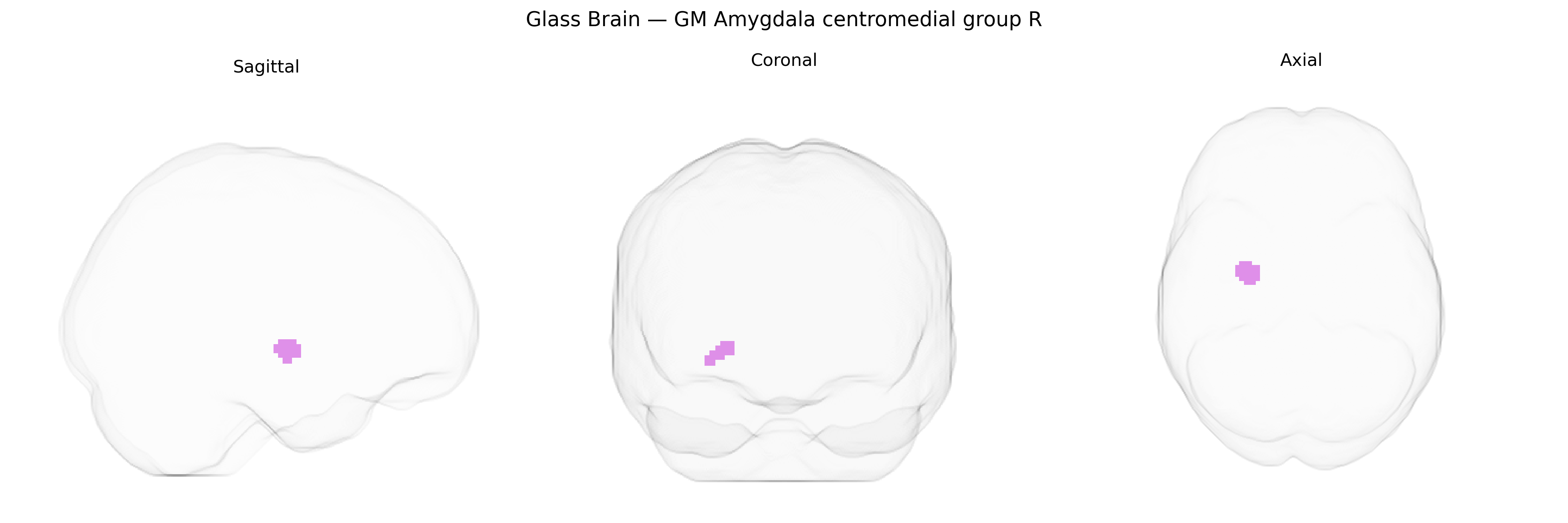
The bilateral GM Amygdala centromedial group R (from the Juelich maxprob thr25 2mm atlas) refers to the gray-matter portion of the right centromedial nuclear complex of the amygdala, a subcortical structure located in the medial temporal lobe and critically involved in emotion, threat detection, and autonomic regulation. The centromedial group comprises primarily the central and medial nuclei, which serve as major output channels from the amygdala to hypothalamic and brainstem regions, modulating fear responses, defensive behaviors, and neuroendocrine and autonomic functions. Cytoarchitectonically, this group is characterized by dense nuclear cell populations with strong connections to the basal nuclei and extended amygdala, integrating sensory and contextual information to influence behavioral and physiological responses. There is no direct Wikipedia article for the centromedial group; a related structure is the Amygdala.
The bilateral gray matter centromedial amygdala (GM Amygdala centromedial group R) in the Juelich maxprob thr25 2mm atlas corresponds to a subregion strongly implicated in genetic influences on threat processing, aggression, fear learning, and stress responsivity, with multiple GWAS and imaging-genetics studies linking variation in this area to psychiatric and behavioral traits. Common polymorphisms in genes related to serotonin signaling (e.g., SLC6A4/5-HTTLPR, HTR1A, HTR2A), glutamatergic function (e.g., GRM3, GRIN2B), and neuropeptide systems (e.g., OXTR, AVPR1A) have been associated with altered centromedial amygdala volume, reactivity, or connectivity, in turn correlating with anxiety, depression, neuroticism, and stress-related phenotypes. Large-scale GWAS integrating structural MRI with genetics (e.g., ENIGMA, UK Biobank) have identified polygenic contributions to amygdala subnuclei volume, with significant heritability and overlap with loci linked to major depressive disorder, schizophrenia, bipolar disorder, and post-traumatic stress disorder; several of these studies show that risk alleles for these conditions are associated with increased or decreased gray matter in the centromedial complex specifically. GWAS of aggression and irritability traits, callous-unemotional behavior, and antisocial tendencies have highlighted variants in dopaminergic and neurodevelopmental genes (e.g., MAOA, DRD2/DRD4, BDNF) that modulate activity in centromedial amygdala circuits, supporting a mechanistic role in threat-related action selection and reactive aggression. In addition, polygenic scores for internalizing symptoms, social anxiety, and fear conditioning have been tied to functional and structural measures within centromedial amygdala networks, suggesting that this subregion acts as a convergence point where distributed genetic risk for mood and anxiety disorders shapes defensive behavior and autonomic responses.
Overview generated by GPT-4o (2026).
Region ID: 8
Hemisphere: bilateral
Atlas: Juelich maxprob thr25 2mm
Full Quality Version: Download MP4
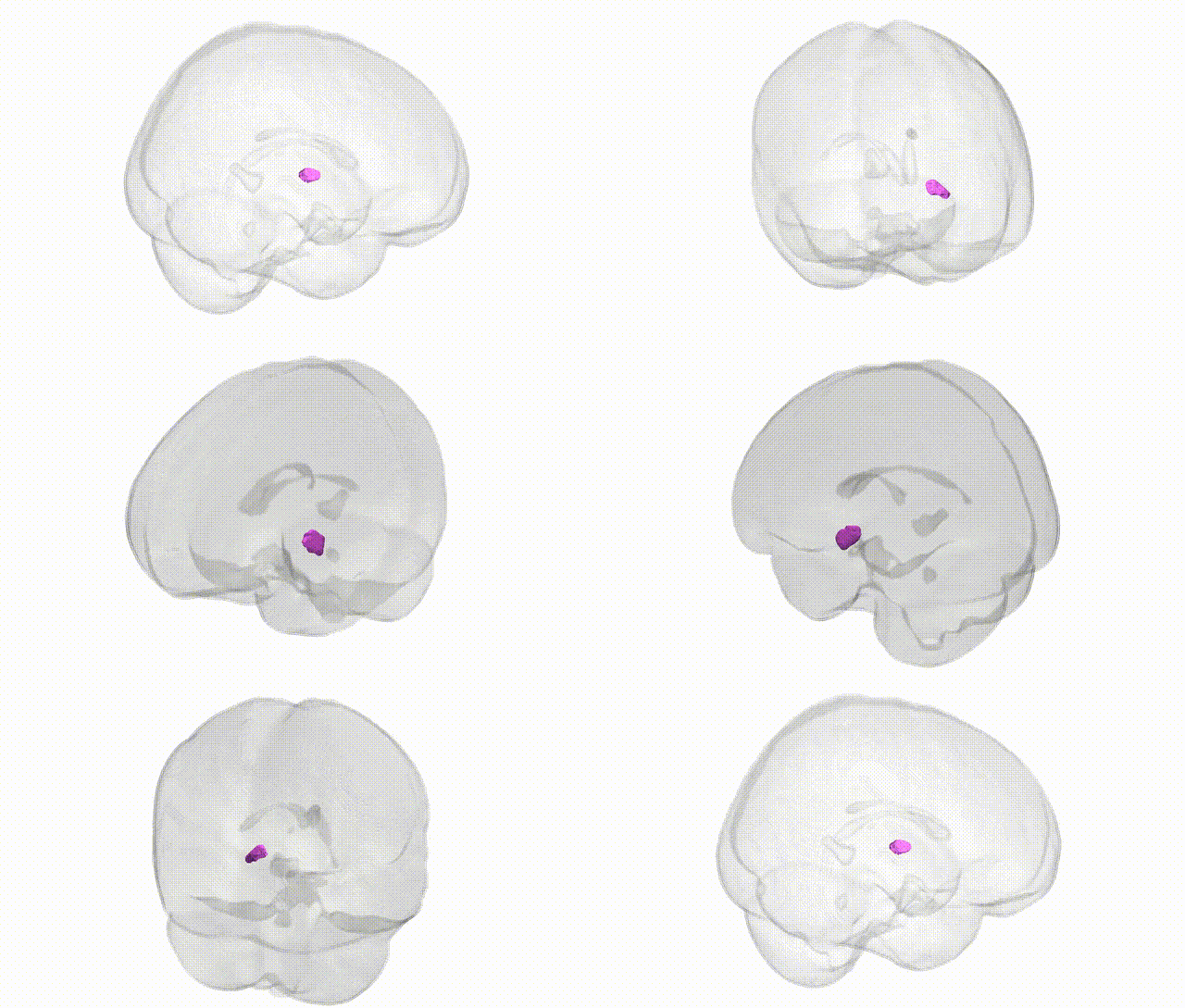
Full Quality Version: Download MP4
Wali Sidiqyar*, Gaurav Rudravaram*, Elyssa M. McMaster, Trent M. Schwartz, Adam M. Saunders, Kurt G. Schilling, Bennett A. Landman "Introducing SPINS: A Shared Public Visualization Library of Neuroanatomical Structures." Medical Imaging with Deep Learning- short paper
This resource is licensed under CC0 1.0 Universal (Public Domain).