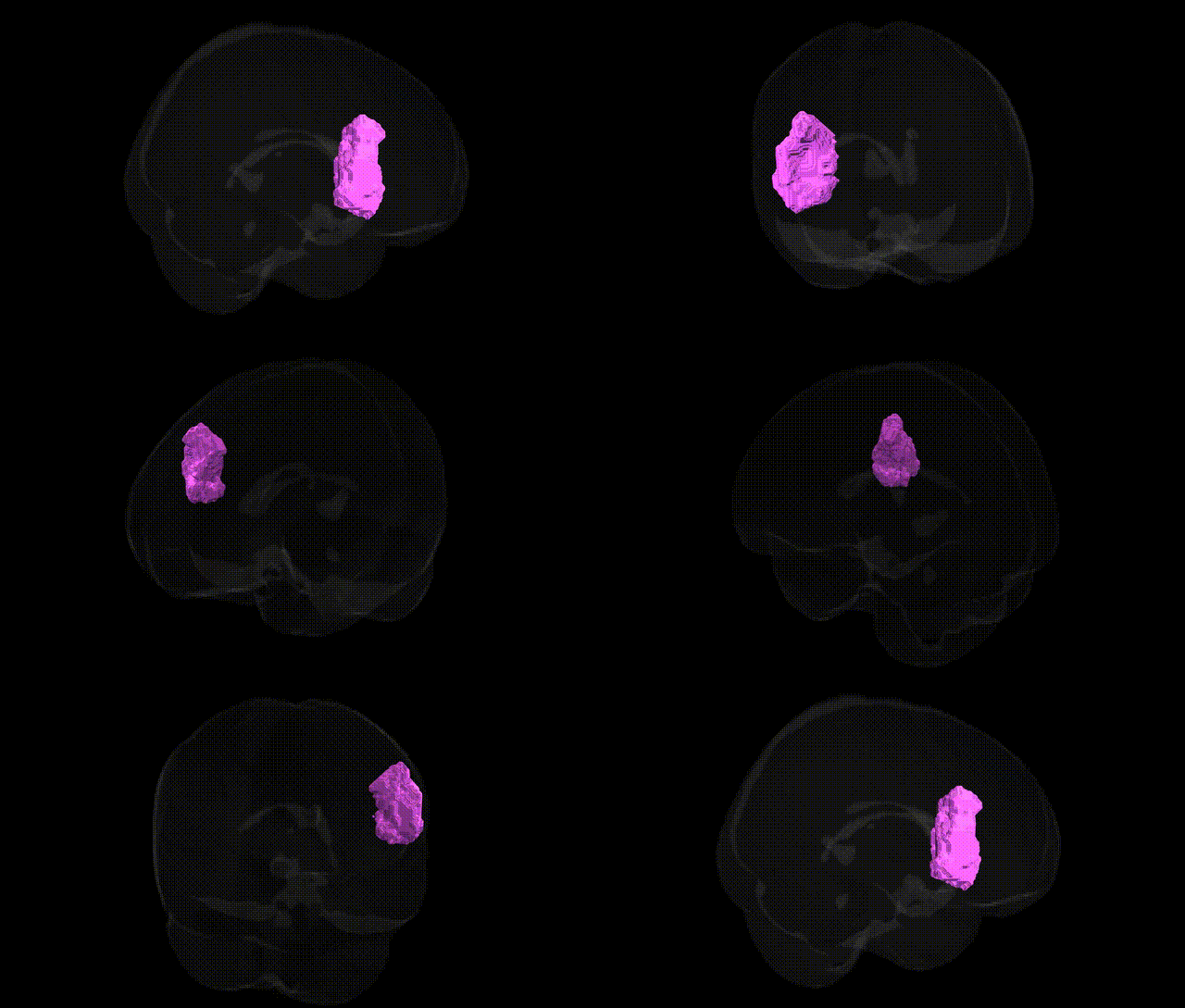
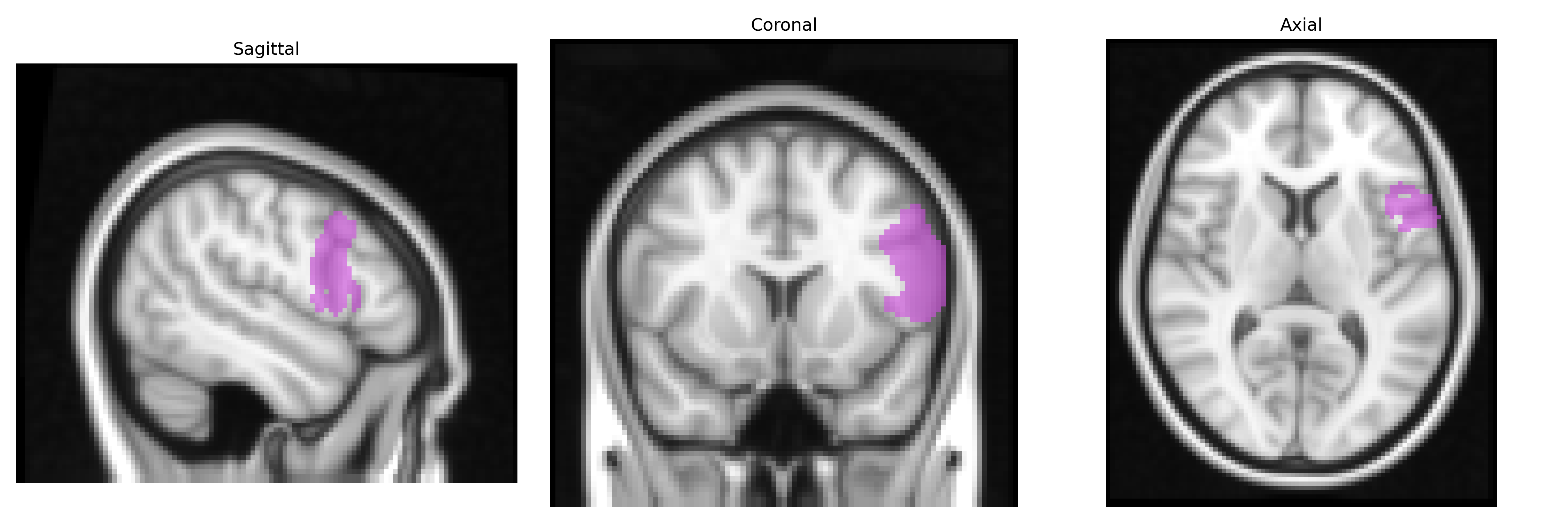
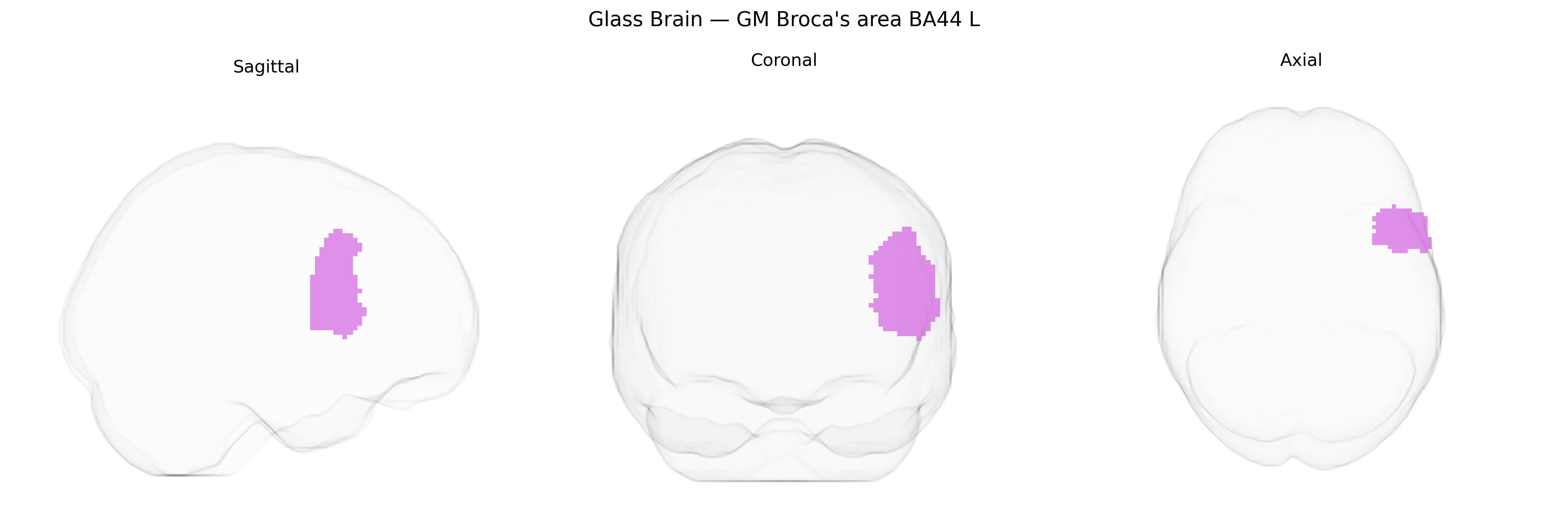
Bilateral GM Broca’s area BA44 L, as defined in the Juelich maxprob thr25 2 mm atlas, corresponds to the cytoarchitectonically defined Brodmann area 44 within the pars opercularis of the inferior frontal gyrus, predominantly in the left hemisphere but with a homologous region in the right hemisphere. This region is characterized by its granular frontal cortex morphology and is a core component of the classical Broca’s area, contributing critically to speech production, phonological and syntactic processing, and aspects of articulatory planning, as well as participation in broader language and cognitive control networks. Functionally, BA44 shows strong connectivity with posterior temporal and parietal perisylvian regions and subcortical structures, supporting the dorsal language pathway involved in sensorimotor integration of speech. In the Juelich atlas, “GM” denotes gray matter probability, “maxprob thr25” indicates that voxels are assigned to BA44 when the probability of belonging to this area exceeds 25%, and “L” denotes the left-hemispheric label, although bilateral homologues are typically considered together in functional analyses. Broca’s area
Broca’s area BA44 in the Juelich maxprob thr25 2mm atlas, a core node of the left-lateralized language network, has been implicated in several genetic and transcriptomic studies, although specific single-gene associations to the bilateral GM BA44 L parcel are not yet firmly established. Imaging genetics and GWAS of language-related traits (such as verbal fluency, reading ability, and educational attainment) have repeatedly linked variation in FOXP2, CNTNAP2, DCDC2, KIAA0319, ROBO1, and other neurodevelopmental genes to structural and functional variation in left inferior frontal gyrus regions encompassing BA44, as well as to language and literacy disorders including developmental dyslexia and specific language impairment. Large GWAS of cortical morphology have identified polygenic influences on inferior frontal cortical thickness and surface area, with gene sets enriched for synaptic signaling, neuronal migration, and axon guidance, but these typically report regional effects rather than parcel-specific associations to BA44 from the Juelich atlas. Transcriptomic alignment studies using resources like the Allen Brain Atlas suggest that BA44 shows distinctive expression of genes involved in glutamatergic transmission, GABAergic modulation, and long-range connectivity, which overlap with loci implicated in schizophrenia, autism spectrum conditions, and ADHD—disorders that frequently show altered activation or morphology in Broca’s area—though these represent convergent, network-level associations rather than direct GWAS hits uniquely tied to the bilateral GM BA44 L region.
Overview generated by GPT-4o (2026).
Region ID: 13
Hemisphere: bilateral
Atlas: Juelich maxprob thr25 2mm
Full Quality Version: Download MP4
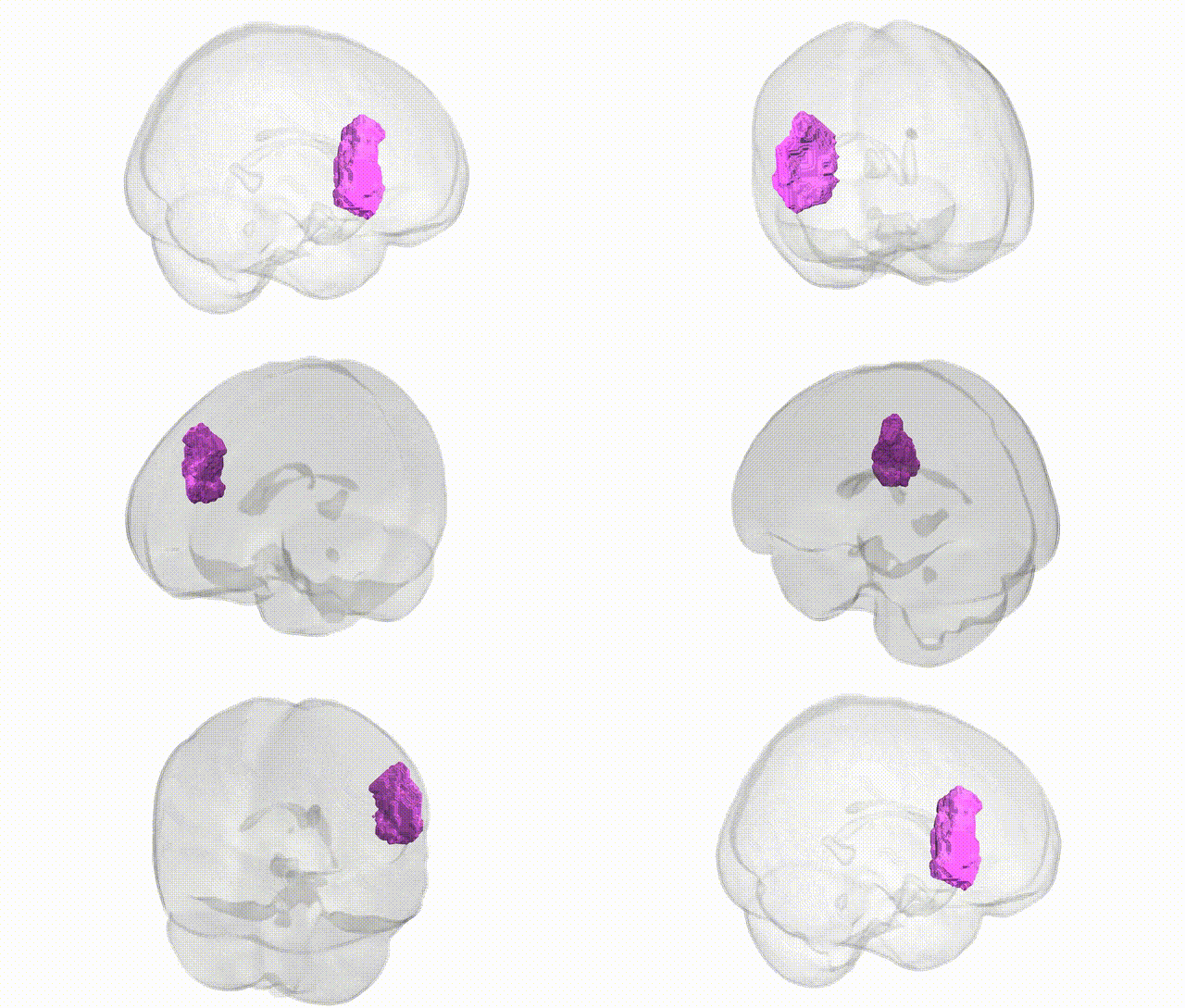
Full Quality Version: Download MP4
Wali Sidiqyar*, Gaurav Rudravaram*, Elyssa M. McMaster, Trent M. Schwartz, Adam M. Saunders, Kurt G. Schilling, Bennett A. Landman "Introducing SPINS: A Shared Public Visualization Library of Neuroanatomical Structures." Medical Imaging with Deep Learning- short paper
This resource is licensed under CC0 1.0 Universal (Public Domain).