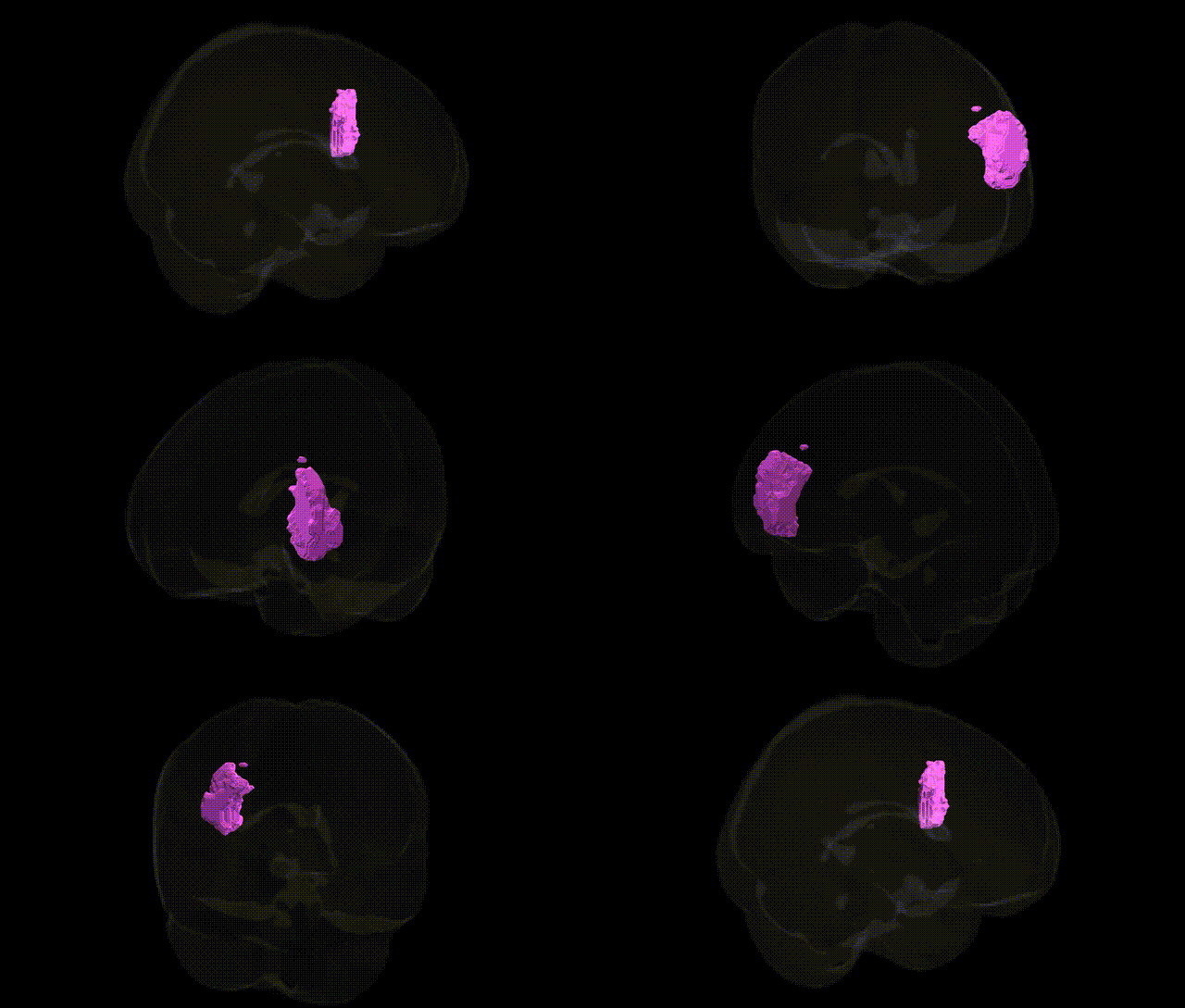
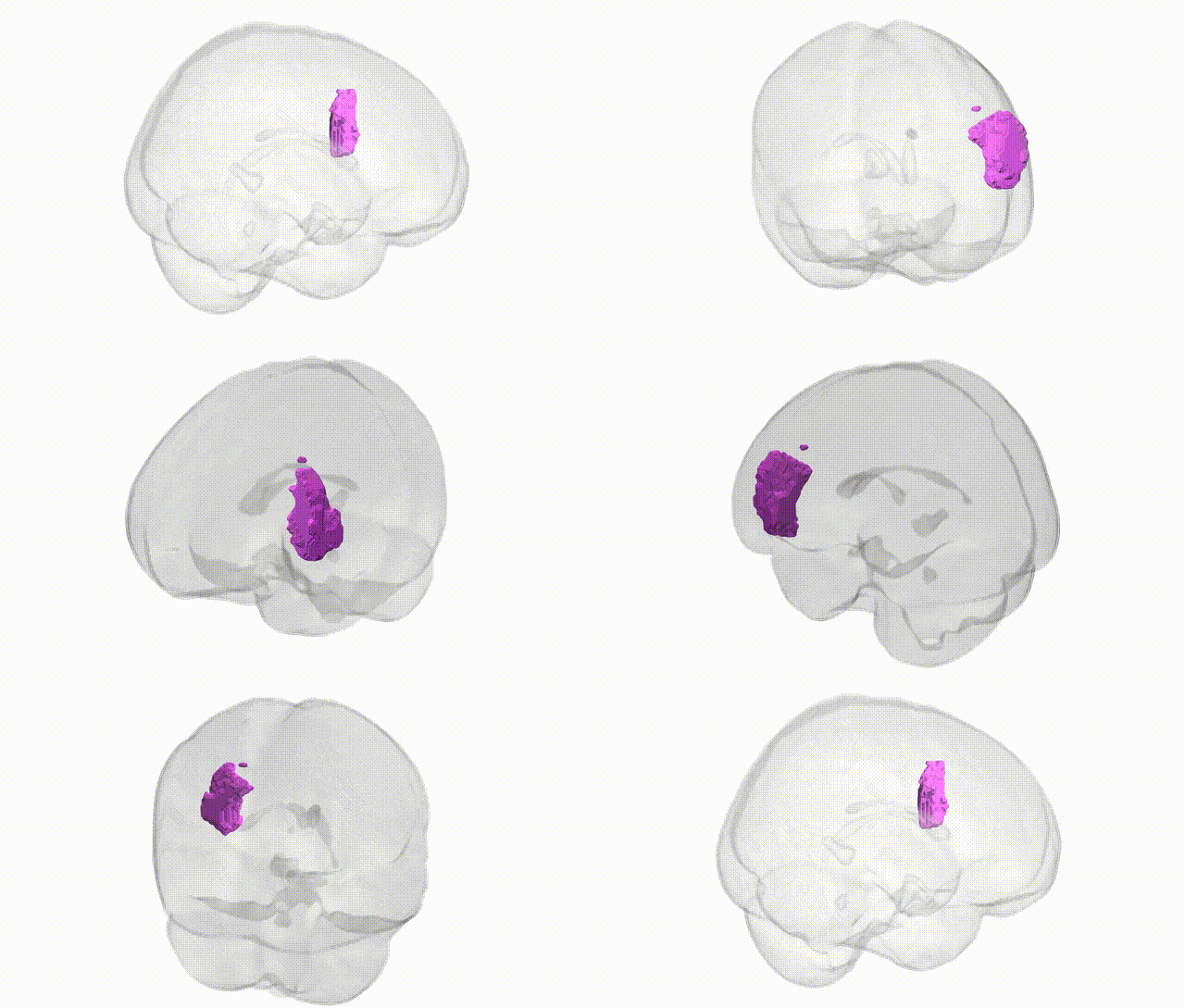
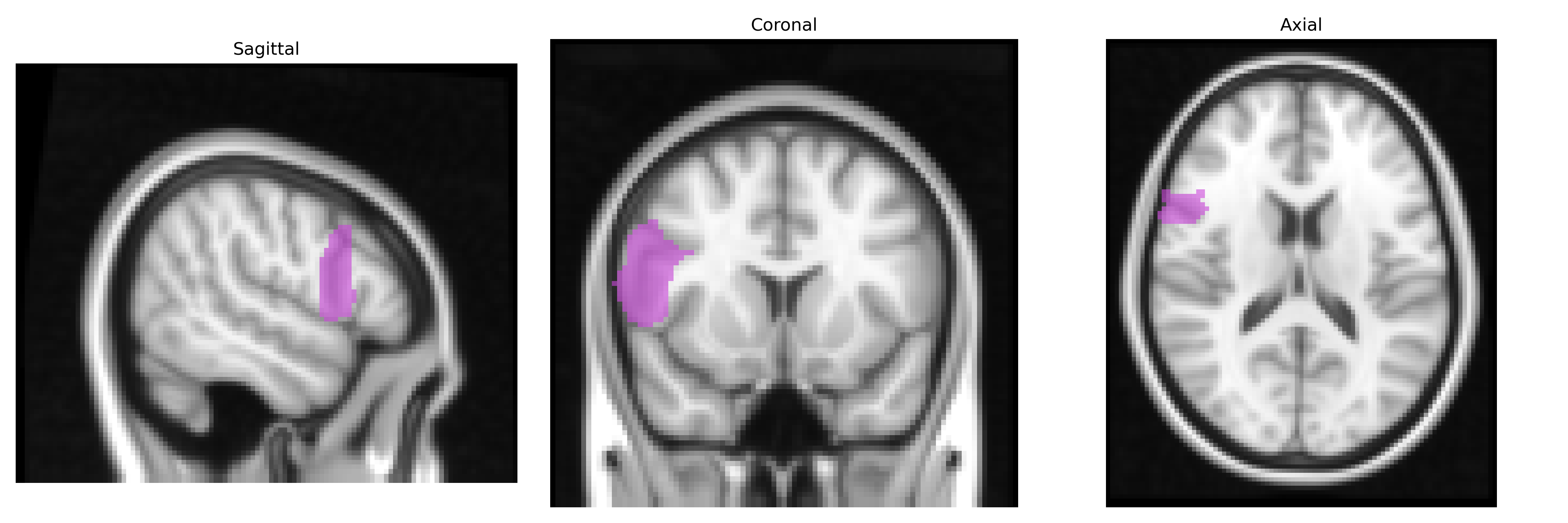
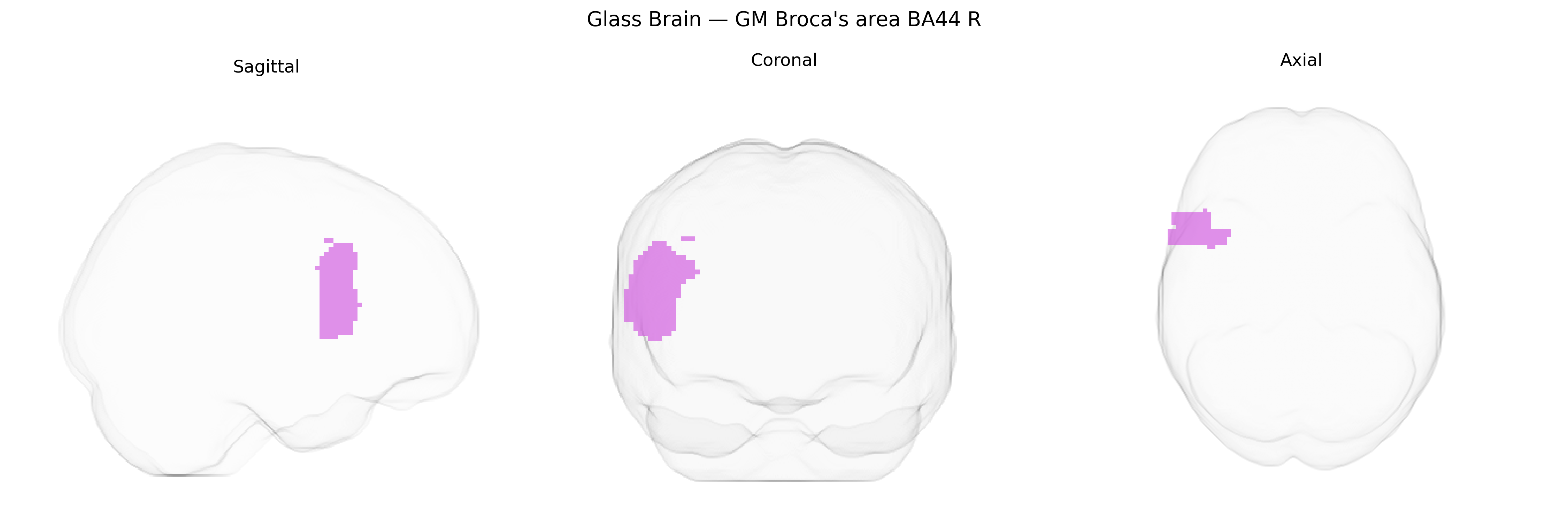
The bilateral GM Broca’s area BA44 R from the Juelich maxprob thr25 2 mm atlas corresponds to the right-hemispheric component of cytoarchitectonic area 44, a subdivision of the inferior frontal gyrus (pars opercularis) that forms a major part of the classical Broca’s complex. This region consists of granular frontal cortex and is involved in higher-order motor and cognitive functions, including aspects of speech and language (such as prosody and discourse-level processing), action observation and imitation, and cognitive control. Although Broca’s area is traditionally associated with the left hemisphere, the right BA44 contributes to complementary functions such as emotional–prosodic modulation and non-verbal communication, as well as broader networks involved in motor planning and working memory. There is no direct Wikipedia article for “Broca’s area BA44 R,” but it is encompassed within Broca’s area.
Broca’s area (BA44), as defined in the Jülich maxprob atlas, has been implicated in several genetic and GWAS-based associations primarily through studies of language, cognition, and neuropsychiatric risk rather than single, region-specific “BA44 genes.” Polygenic influences from loci associated with general cognitive ability and educational attainment (for example in genes such as FOXP2, KIAA0319, DCDC2, and other language/reading-related genes) have been linked to structural and functional variation in inferior frontal regions that include BA44, with some imaging genetics studies reporting associations between FOXP2 variants and activation or morphology in left inferior frontal gyrus during speech and language tasks. GWAS of cortical thickness and surface area have identified common variants in multiple loci (e.g., MIR124- and LRP1B-related regions) that influence inferior frontal cortex morphology, while large-scale imaging-genetics consortia (e.g., ENIGMA) have shown that polygenic risk scores for schizophrenia, autism spectrum disorder, and major depressive disorder correlate with altered structure or connectivity in frontal language networks involving BA44. Additional associations have been reported between inferior frontal/Broca’s area variation and genetic risk for developmental language disorder, dyslexia, and stuttering, though effects are typically small and distributed across many loci, reflecting a highly polygenic architecture rather than specific “Broca’s area genes.”
Overview generated by GPT-4o (2026).
Region ID: 14
Hemisphere: bilateral
Atlas: Juelich maxprob thr25 2mm
Full Quality Version: Download MP4
Full Quality Version: Download MP4
Wali Sidiqyar*, Gaurav Rudravaram*, Elyssa M. McMaster, Trent M. Schwartz, Adam M. Saunders, Kurt G. Schilling, Bennett A. Landman "Introducing SPINS: A Shared Public Visualization Library of Neuroanatomical Structures." Medical Imaging with Deep Learning- short paper
This resource is licensed under CC0 1.0 Universal (Public Domain).