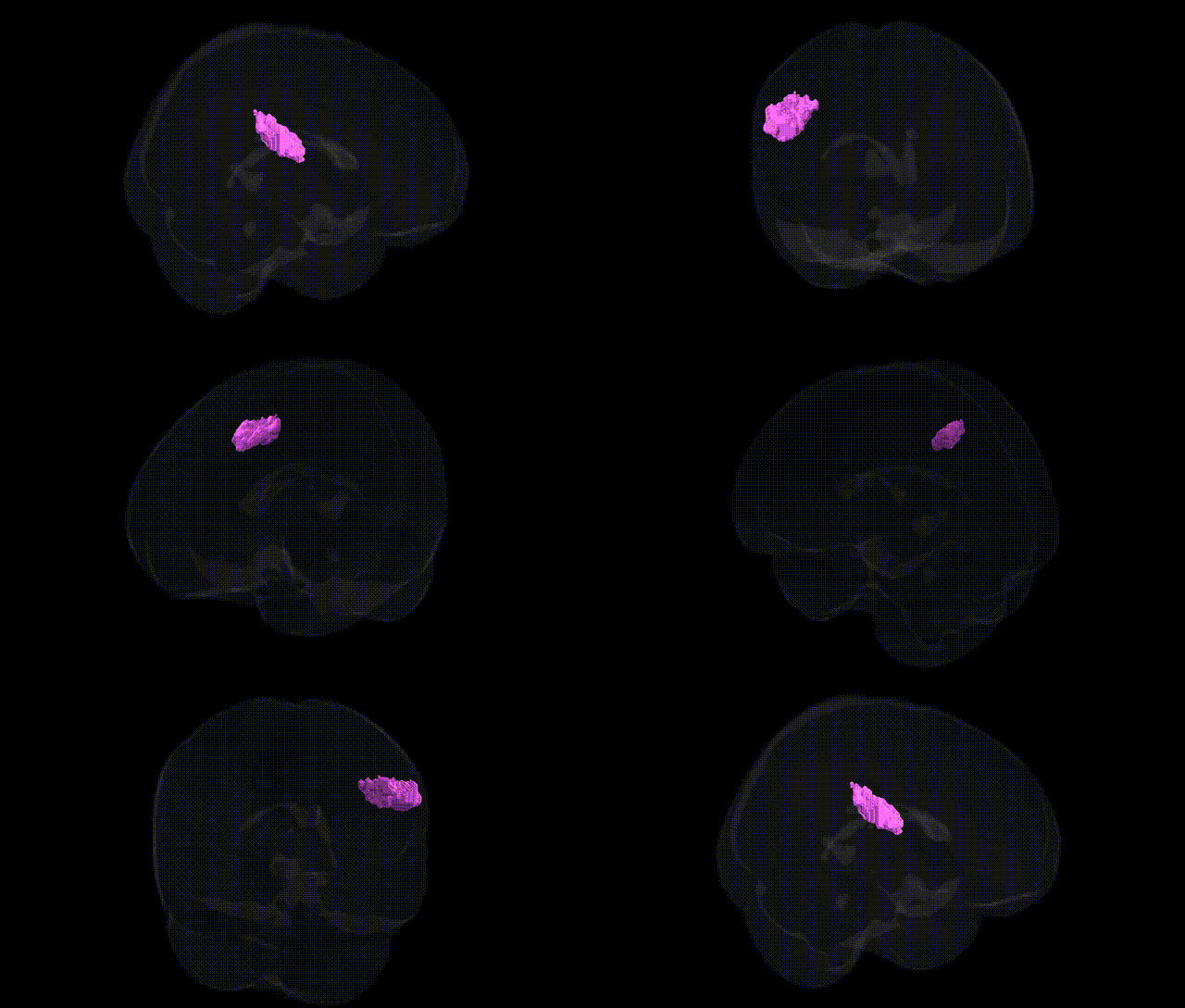
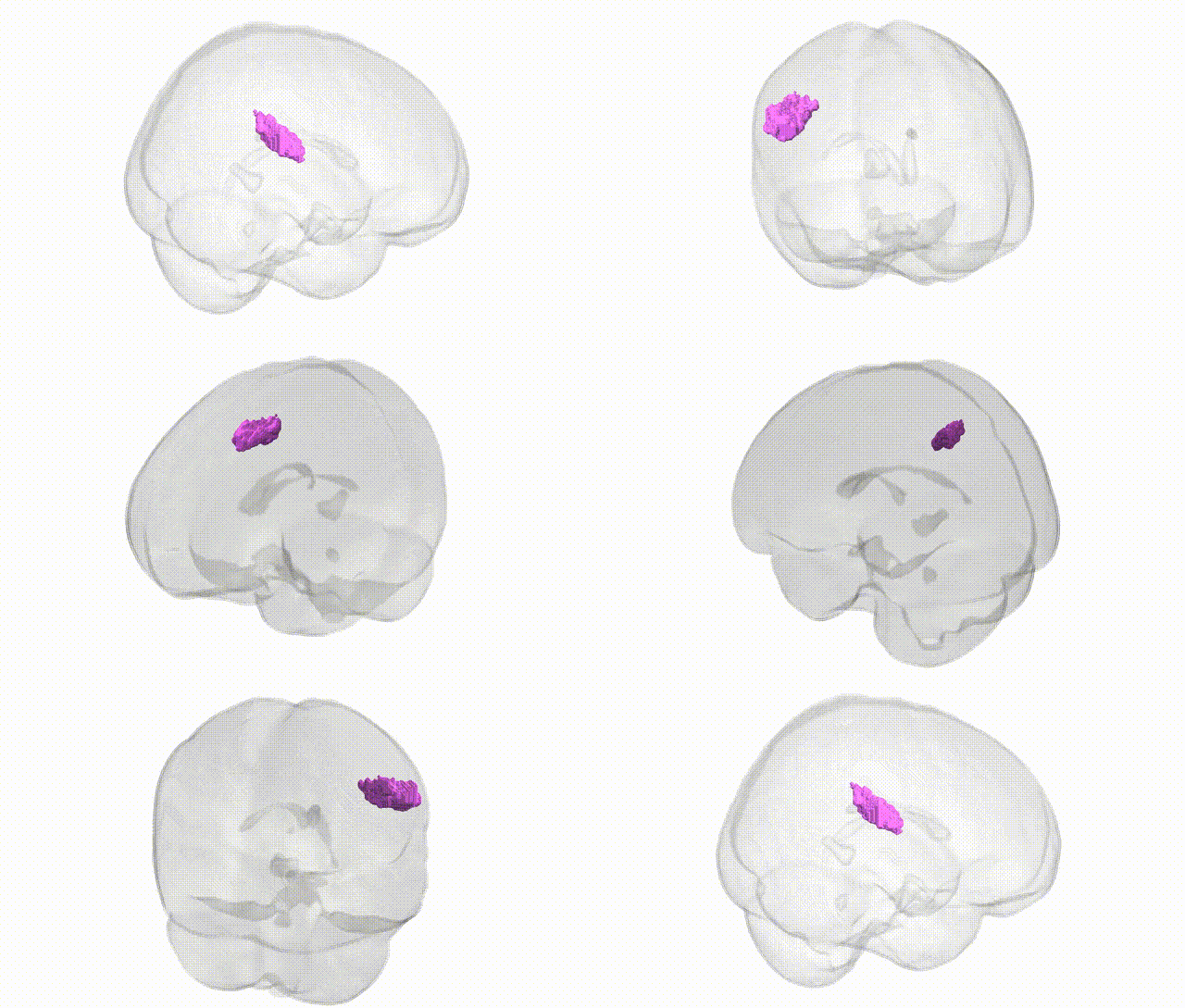
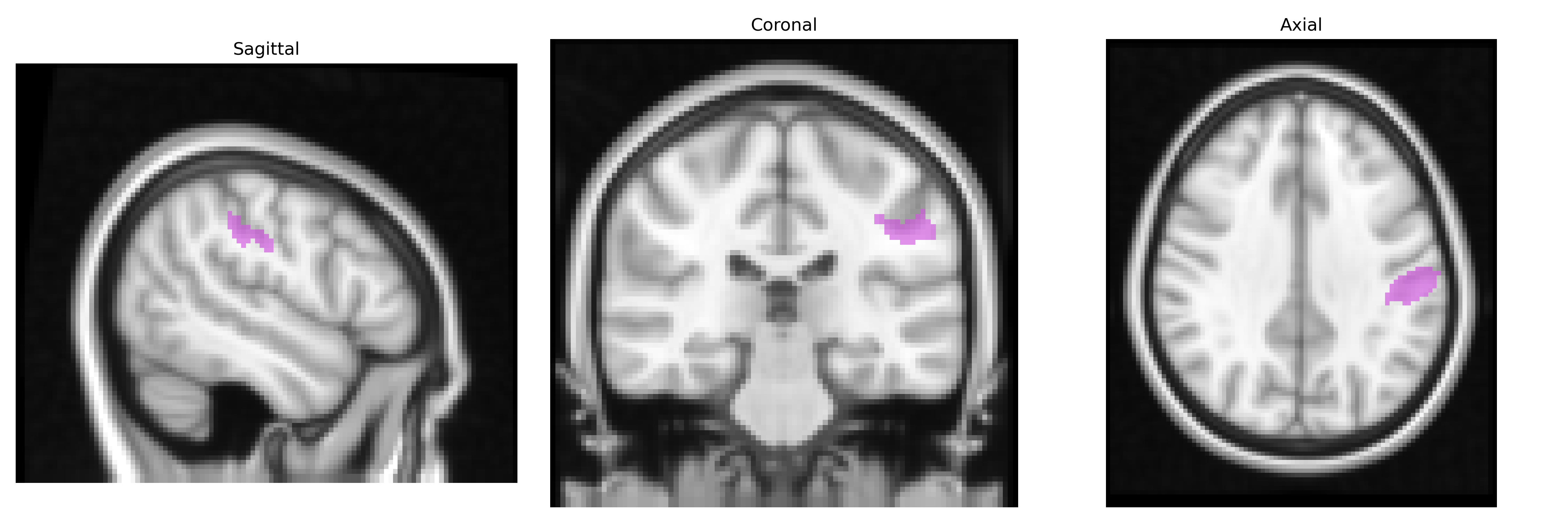
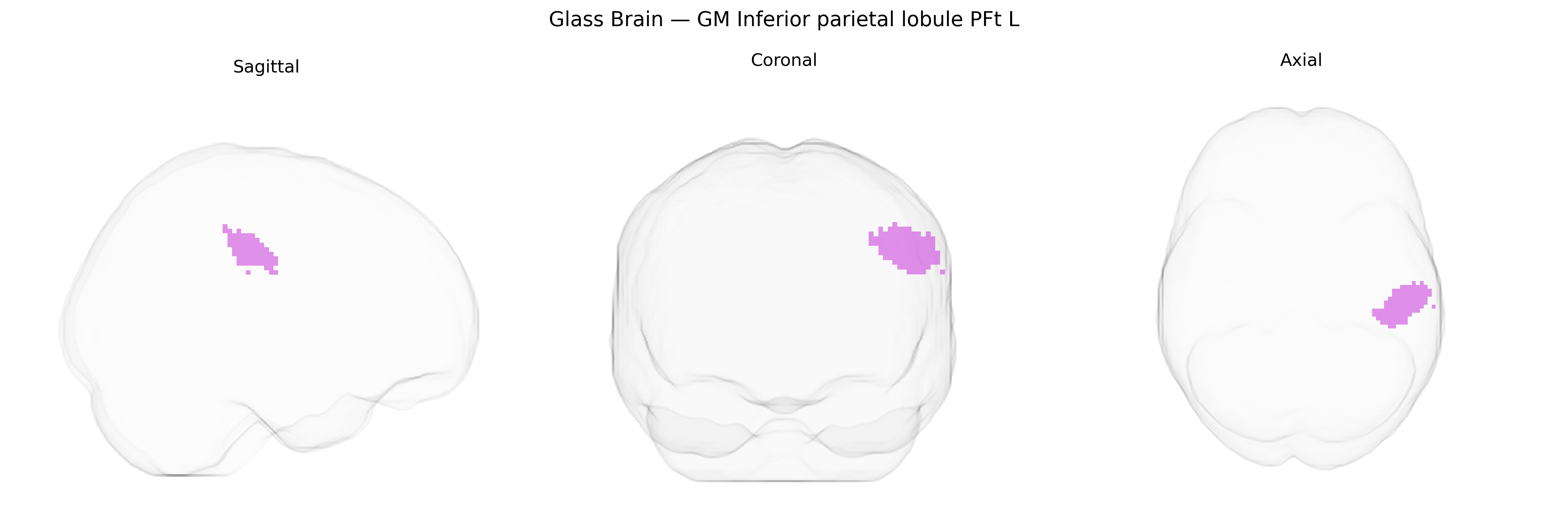
The bilateral GM Inferior parietal lobule PFt L from the Juelich maxprob thr25 2mm atlas refers to a cytoarchitectonically defined subregion (PFt) within the inferior parietal lobule (IPL), localized predominantly in the posterior part of the supramarginal gyrus of the left hemisphere and its right-hemisphere homologue. This area belongs to the posterior parietal cortex and is implicated in multimodal integration, including the processing of somatosensory, visual, and auditory information, and in higher-order functions such as action understanding, tool use, and aspects of language and social cognition. PFt is part of the broader inferior parietal cortex network that interfaces with frontal and temporal regions, contributing to functions such as attention reorienting, praxis, and the representation of body-related actions. There is no direct Wikipedia article for PFt; a related structure is the Inferior parietal lobule.
The bilateral GM Inferior parietal lobule PFt (left hemisphere) from the Juelich maxprob thr25 2mm atlas lies within the broader inferior parietal lobule/supramarginal–angular gyrus territory, for which genetic associations are typically reported at the level of regional cortical thickness, surface area, or parietal lobe volume rather than the cytoarchitectonic PFt field itself; thus, evidence is indirect and regionally coarse. Large-scale GWAS of cortical morphology (e.g., ENIGMA, UK Biobank–based studies) have linked variation in inferior parietal and supramarginal gyrus thickness/area to loci near genes involved in neurodevelopmental and synaptic pathways, including candidates such as HMGA2, IGF1, TCF4, and others, although these signals are not uniquely assigned to PFt. Parietal lobe and inferior parietal measures overlapping PFt have been implicated in GWAS of general cognitive ability, educational attainment, and reading-related traits, and imaging–genetics work shows that risk variants for schizophrenia, major depression, and autism spectrum disorder can modulate structure and connectivity in inferior parietal regions. Additionally, polygenic scores for attention-deficit/hyperactivity disorder, Alzheimer’s disease, and other neuropsychiatric or neurodegenerative conditions have been associated with altered parietal cortex morphology and functional coupling in networks that heavily involve the inferior parietal lobule. However, current GWAS and imaging-genetics datasets do not yet provide robust, PFt-specific genetic associations, and most links remain at the macroanatomical level of the inferior parietal/supramarginal region rather than the Juelich-defined PFt subregion.
Overview generated by GPT-4o (2026).
Region ID: 35
Hemisphere: bilateral
Atlas: Juelich maxprob thr25 2mm
Full Quality Version: Download MP4
Full Quality Version: Download MP4
Wali Sidiqyar*, Gaurav Rudravaram*, Elyssa M. McMaster, Trent M. Schwartz, Adam M. Saunders, Kurt G. Schilling, Bennett A. Landman "Introducing SPINS: A Shared Public Visualization Library of Neuroanatomical Structures." Medical Imaging with Deep Learning- short paper
This resource is licensed under CC0 1.0 Universal (Public Domain).