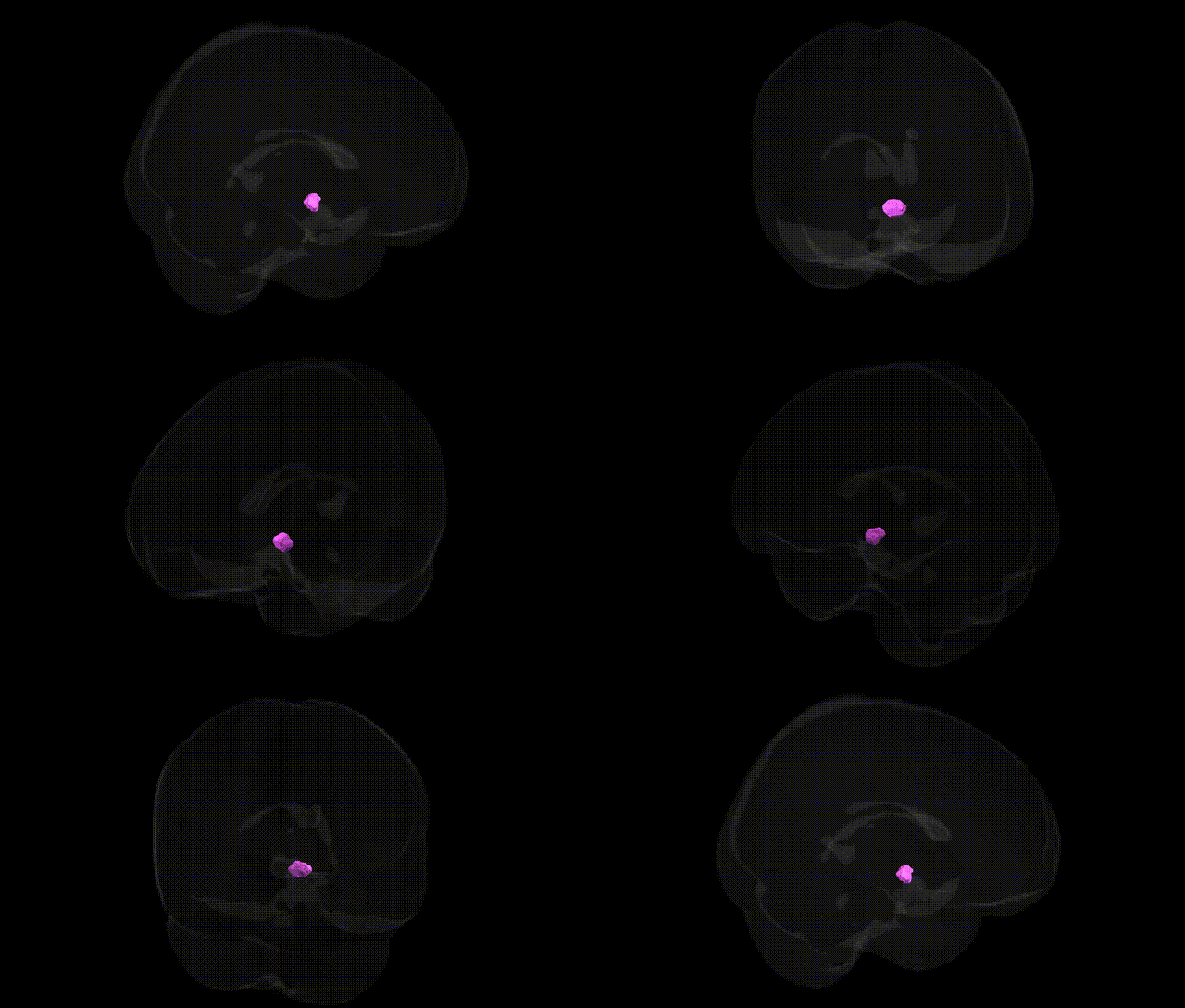
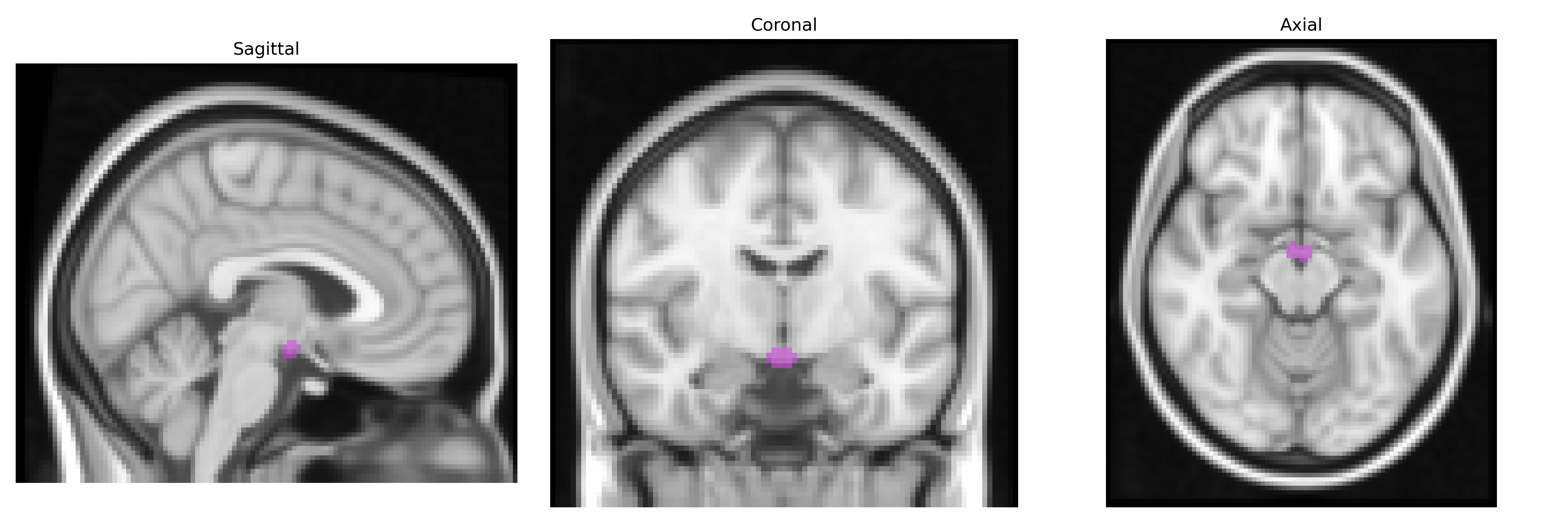
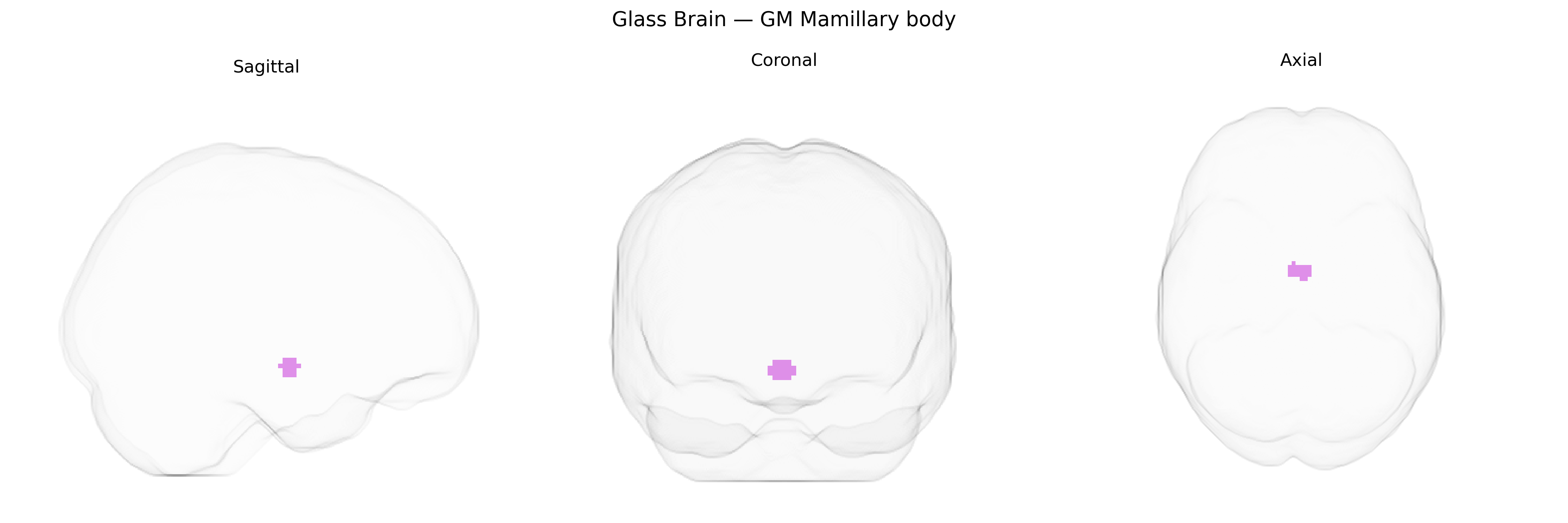
The bilateral GM Mamillary body region in the Juelich maxprob thr25 2mm Atlas corresponds to the paired mammillary bodies, small round structures located on the ventral surface of the hypothalamus and forming part of the diencephalon. They are key nodes in the Papez circuit, receiving major input from the hippocampal formation via the fornix and projecting primarily to the anterior nuclei of the thalamus through the mammillothalamic tract, thereby contributing critically to episodic memory processing and spatial memory. Histologically, they contain densely packed grey matter nuclei involved in relaying and modulating limbic information, and lesions in this region are classically associated with memory deficits such as those seen in Wernicke–Korsakoff syndrome. A related article is: Mammillary body.
The bilateral gray-matter mamillary bodies, part of the Papez circuit and critical for episodic memory, show indirect genetic associations primarily through disorders and traits affecting diencephalic and limbic circuitry rather than region-specific GWAS hits. Variants in genes implicated in Wernicke–Korsakoff syndrome and thiamine metabolism (e.g., SLC19A2, SLC19A3, and related metabolic and alcohol-use–linked loci) contribute to selective vulnerability of the mamillary bodies, which commonly exhibit atrophy or signal change in this condition. Broader neuropsychiatric and neurodegenerative GWAS—particularly for schizophrenia, bipolar disorder, major depression, and Alzheimer’s disease—have identified polygenic architectures (e.g., involving CACNA1C, GRIN2A, APOE, BIN1, CLU) that impact limbic–diencephalic networks including the hippocampus and connected structures such as the mamillary bodies, though associations are typically reported at the network or hippocampal/diencephalic level rather than as mamillary-specific peaks. Imaging-genetics consortia (e.g., ENIGMA) and large UK Biobank analyses have linked common variants in neurodevelopmental, synaptic, and myelination genes (such as BDNF and candidate regulatory loci near MAPT and SORL1) with volumetric and connectivity measures in adjacent limbic and thalamic regions, suggesting shared genetic influences on the structural integrity of the Papez circuit that encompass the mamillary bodies, but without robust, replicated mamillary-body-specific GWAS signals to date.
Overview generated by GPT-4o (2026).
Region ID: 105
Hemisphere: bilateral
Atlas: Juelich maxprob thr25 2mm
Full Quality Version: Download MP4
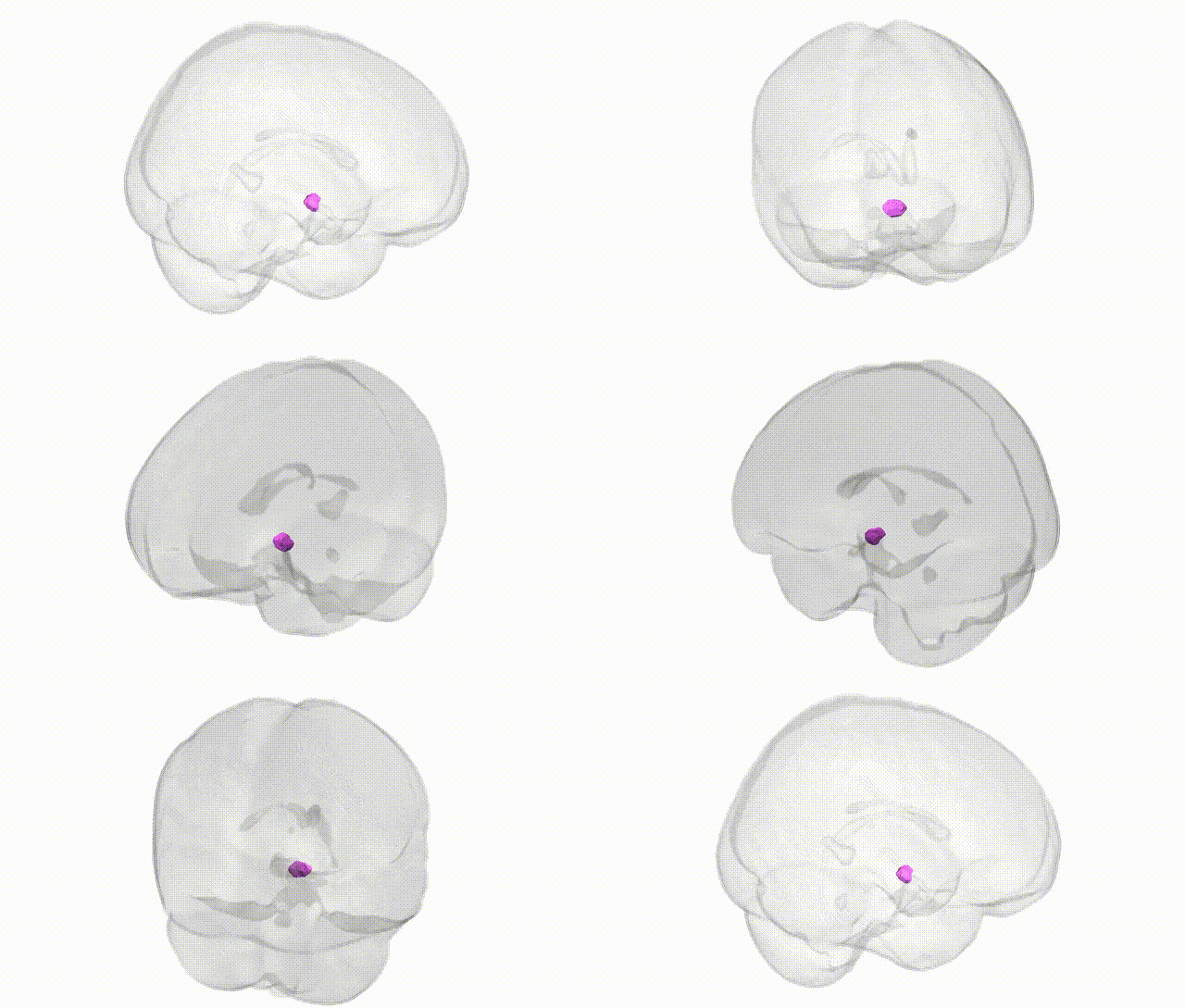
Full Quality Version: Download MP4
Wali Sidiqyar*, Gaurav Rudravaram*, Elyssa M. McMaster, Trent M. Schwartz, Adam M. Saunders, Kurt G. Schilling, Bennett A. Landman "Introducing SPINS: A Shared Public Visualization Library of Neuroanatomical Structures." Medical Imaging with Deep Learning- short paper
This resource is licensed under CC0 1.0 Universal (Public Domain).