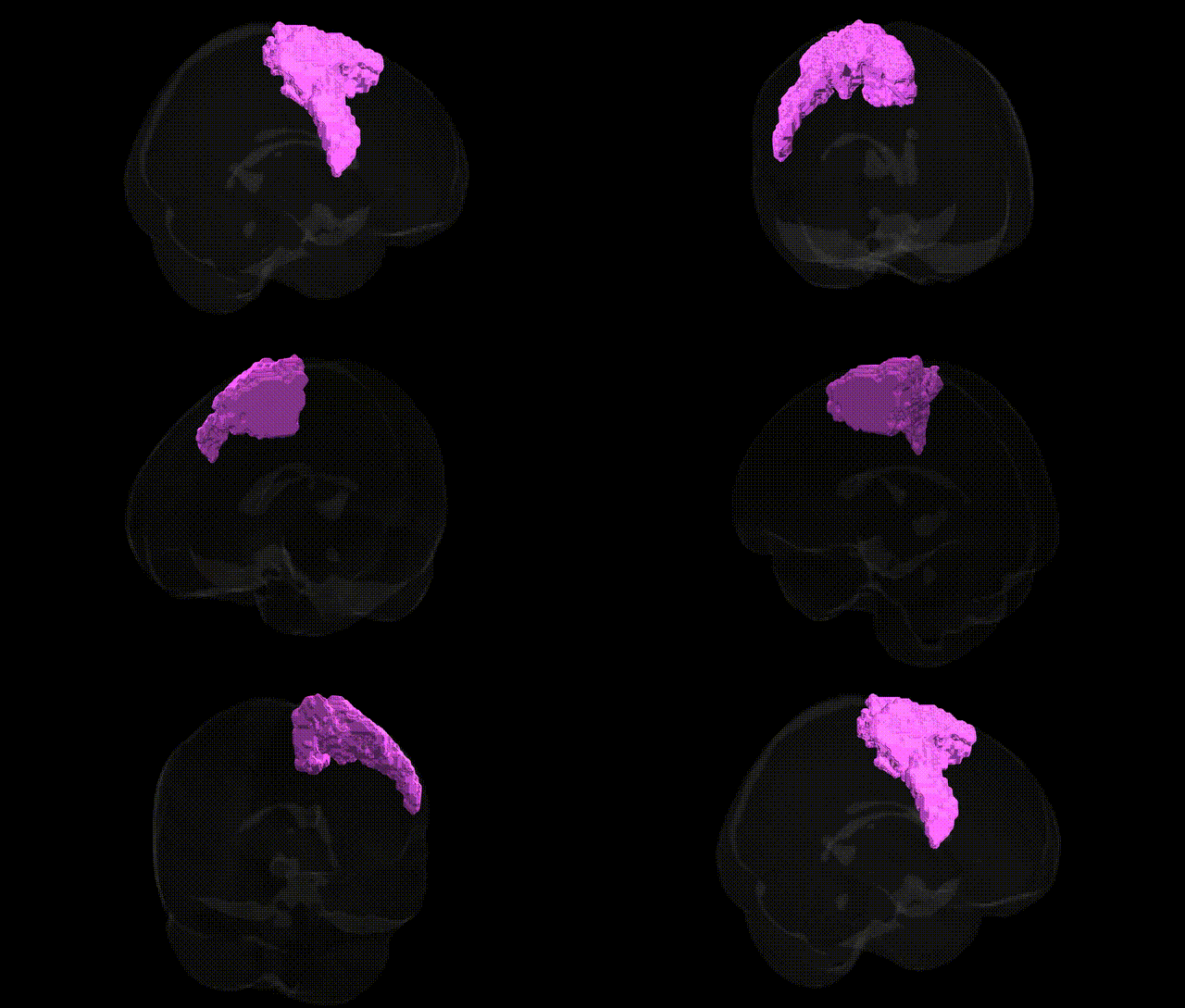
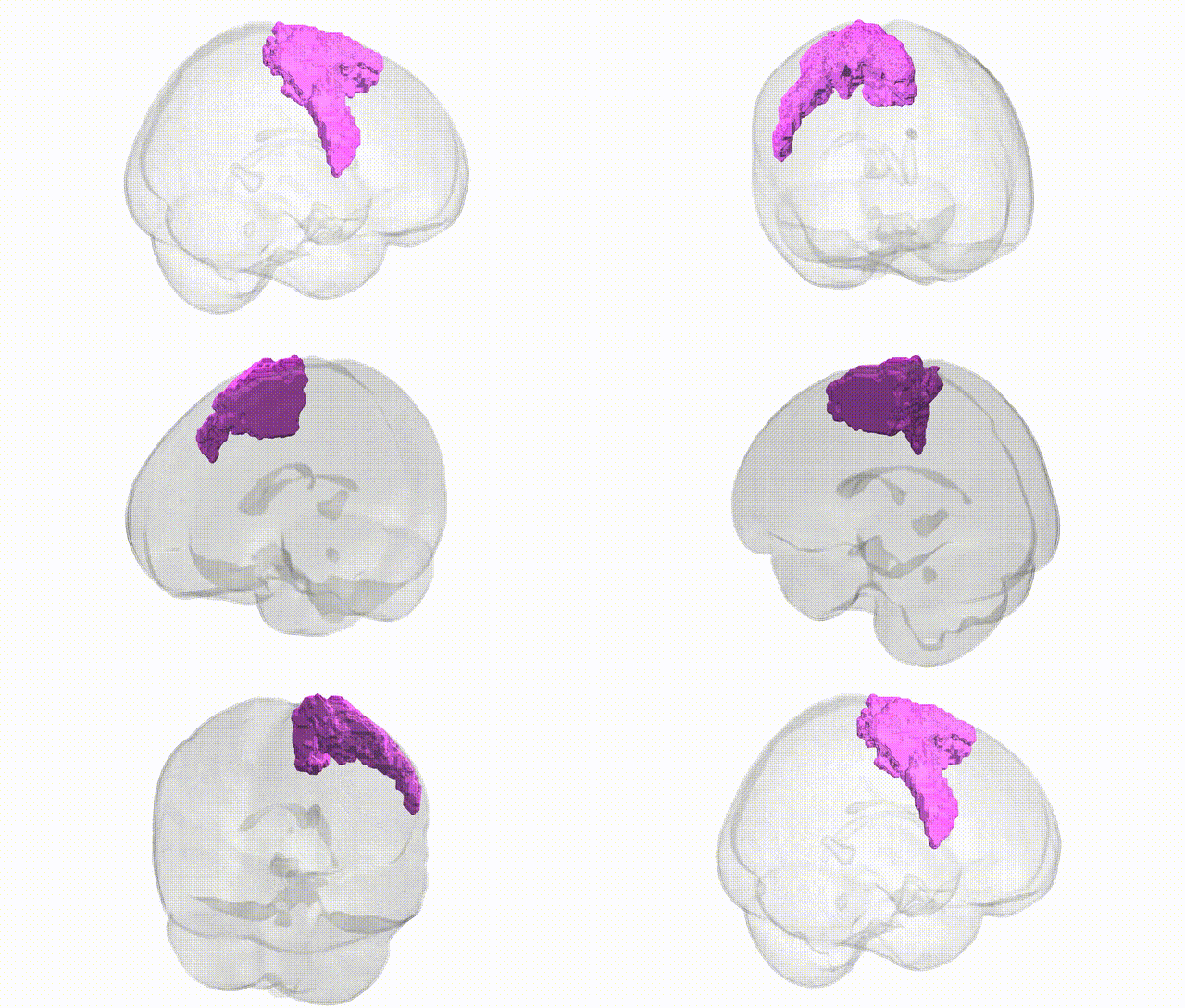
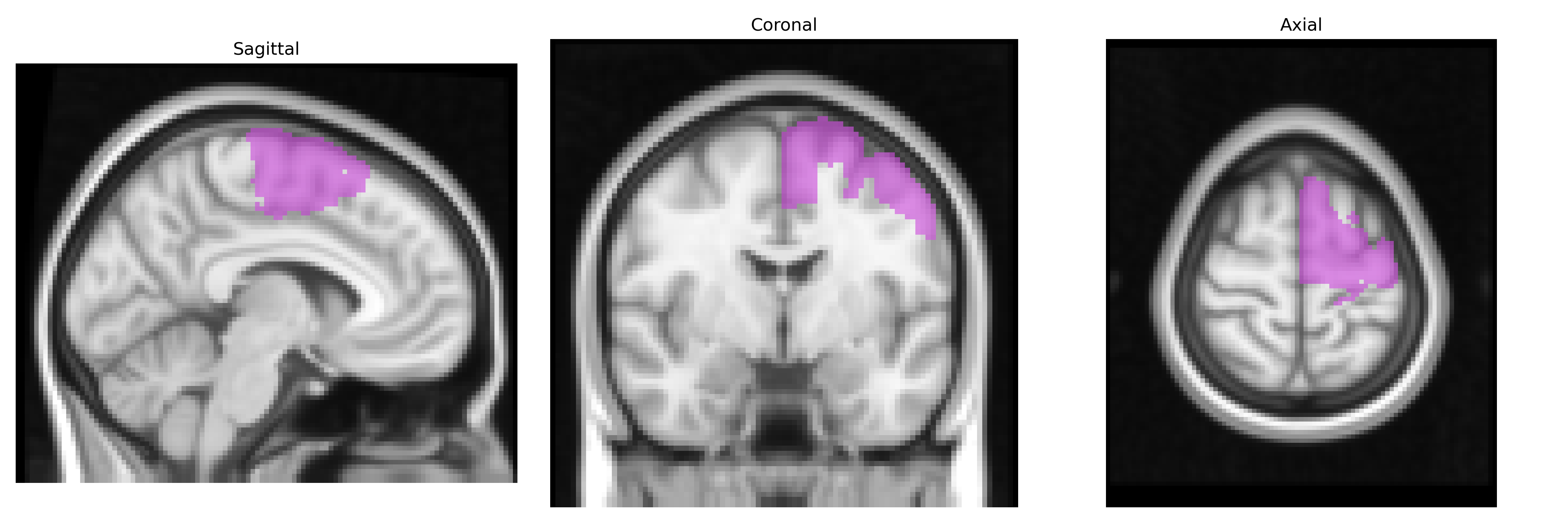
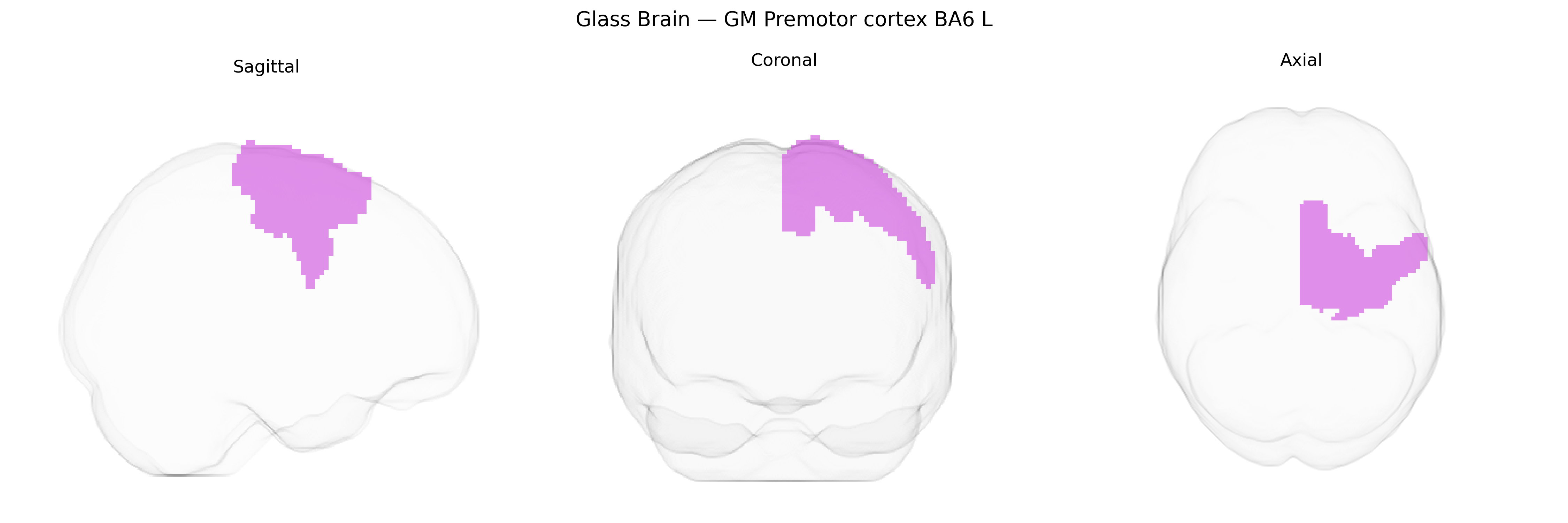
The bilateral GM Premotor cortex BA6 L (Juelich maxprob thr25 2mm Atlas) corresponds to the left-hemispheric portion of Brodmann area 6, a higher-order motor region located anterior to the primary motor cortex (BA4) on the lateral frontal lobe. This region contains the lateral premotor cortex, which integrates multisensory and cognitive information to plan, select, and prepare voluntary movements, particularly those guided by external cues, and contributes to the organization of complex motor sequences, motor attention, and sensorimotor transformations. Neuronal populations within BA6 project to primary motor cortex, brainstem motor structures, and spinal cord interneurons, modulating execution of limb and facial movements and participating in motor learning and adaptation. There is no direct link for “Premotor cortex BA6 L,” but the region is encompassed within Brodmann area 6.
Genetic associations involving the bilateral premotor cortex (BA6, left hemisphere) from the Juelich maxprob thr25 2 mm atlas derive largely from imaging–genetics and GWAS-based brain mapping studies that link common variants to cortical thickness, surface area, or functional connectivity in premotor regions, as well as to motor, cognitive, and neuropsychiatric traits whose neuroanatomical substrates include BA6. Large-scale consortia such as ENIGMA and UK Biobank have identified multiple loci (e.g., in genes related to neurodevelopment, synaptic plasticity, and myelination, including variants in MAPT on 17q21, microtubule- and cytoskeleton-related genes, and calcium-channel genes like CACNA1C) associated with structural variation in frontal and premotor cortices, including BA6-adjacent areas, while polygenic scores for educational attainment, general cognitive ability, and schizophrenia show consistent though modest associations with premotor cortical measures. Disorders with robust genetic and neuroanatomical links to premotor cortex include Parkinson’s disease and other movement disorders (where risk genes such as LRRK2, SNCA, and GBA are associated with altered premotor activity and connectivity), as well as autism spectrum disorder, attention-deficit/hyperactivity disorder, and schizophrenia, in which risk variants in synaptic and neurodevelopmental genes (e.g., NRXN1, GRIN2A, DLG2) have been related to atypical activation or morphology in BA6 during motor planning and higher-order control tasks. GWAS of handedness and motor skill learning have also implicated premotor and supplementary motor regions, suggesting that polygenic influences on motor lateralization and sequence learning partly converge on BA6 circuitry, although specific variants mapping uniquely and exclusively to the left Juelich BA6 premotor region remain to be precisely delineated and are usually inferred from broader frontal or premotor cortex parcellations rather than that atlas label alone.
Overview generated by GPT-4o (2026).
Region ID: 91
Hemisphere: bilateral
Atlas: Juelich maxprob thr25 2mm
Full Quality Version: Download MP4
Full Quality Version: Download MP4
Wali Sidiqyar*, Gaurav Rudravaram*, Elyssa M. McMaster, Trent M. Schwartz, Adam M. Saunders, Kurt G. Schilling, Bennett A. Landman "Introducing SPINS: A Shared Public Visualization Library of Neuroanatomical Structures." Medical Imaging with Deep Learning- short paper
This resource is licensed under CC0 1.0 Universal (Public Domain).