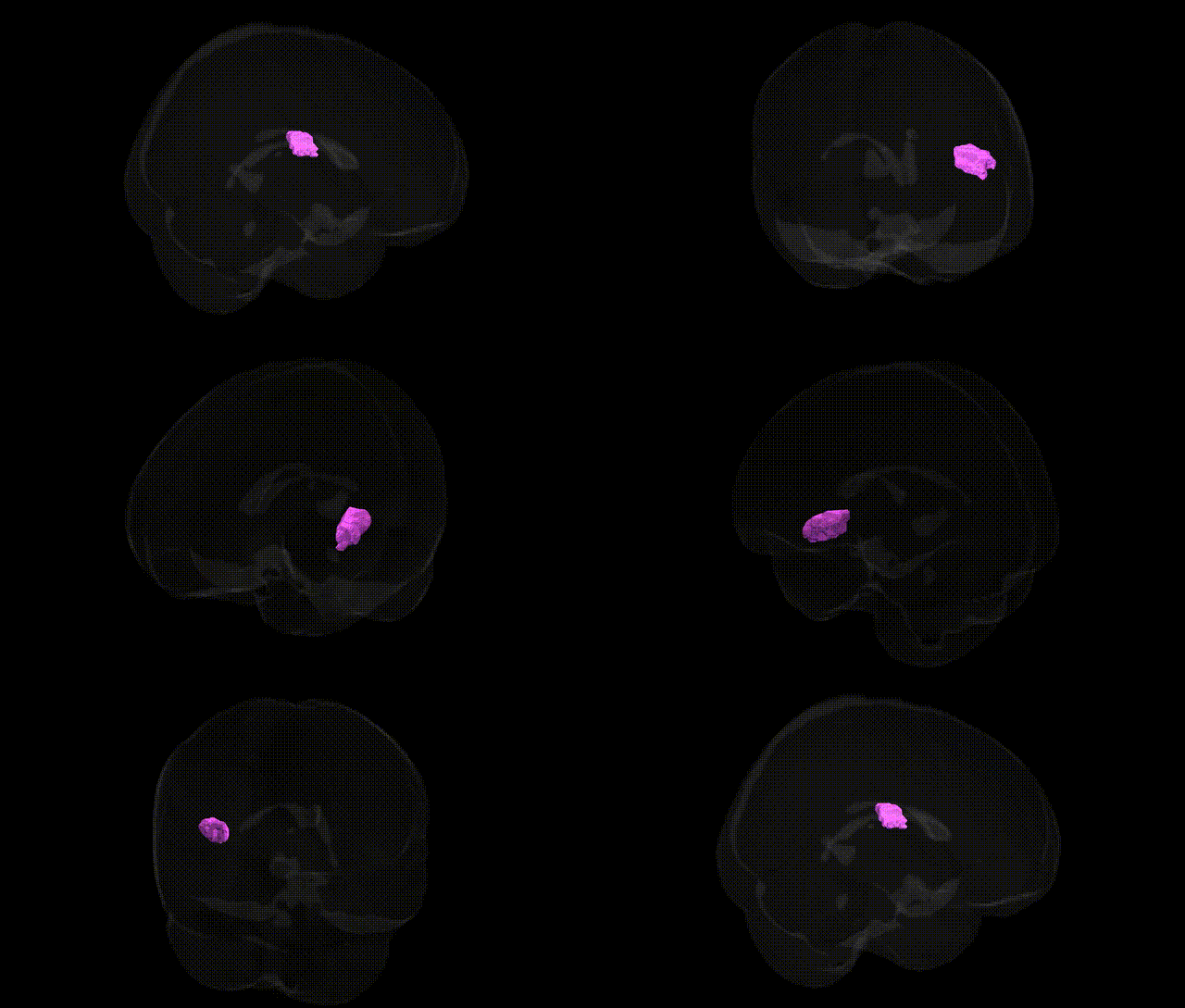
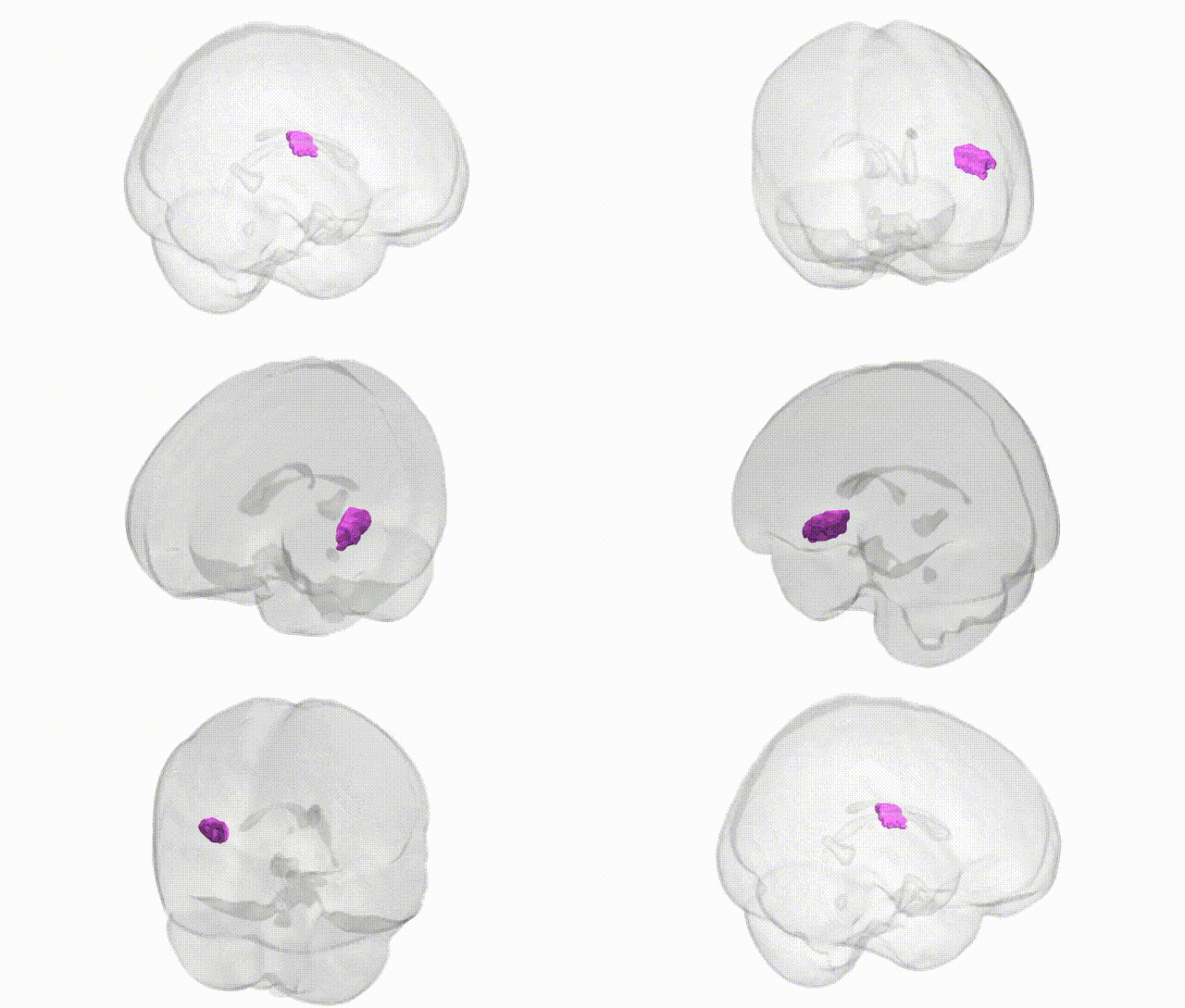
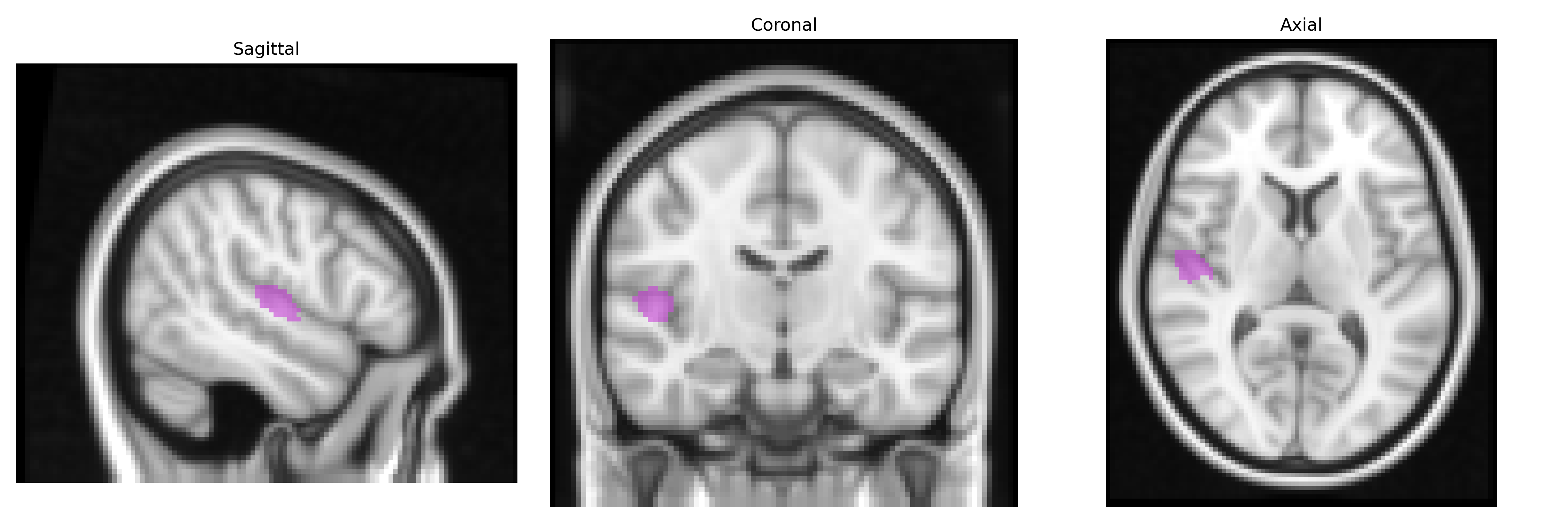
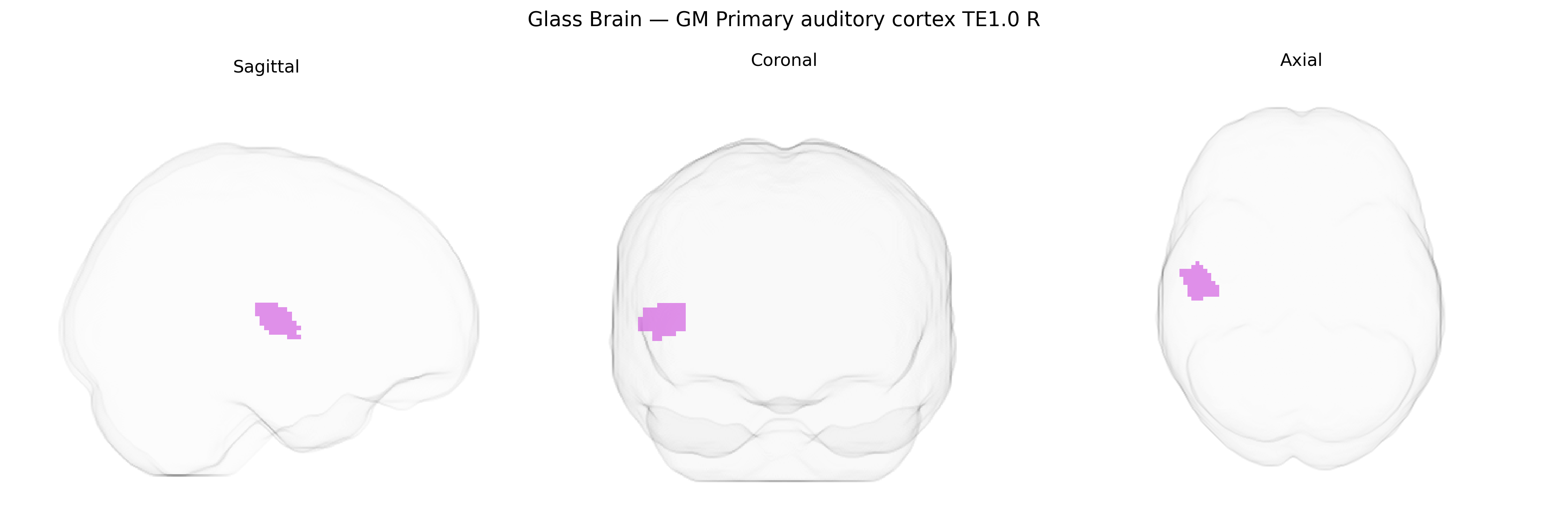
The bilateral GM Primary auditory cortex TE1.0 R, as defined in the Juelich maxprob thr25 2mm Atlas, corresponds to the core primary auditory field located on the transverse temporal (Heschl’s) gyrus of the superior temporal lobe, primarily encompassing Brodmann area 41. This cytoarchitectonically defined region is characterized by a highly granular cortical lamination and dense thalamocortical input from the medial geniculate body of the thalamus, supporting precise encoding of basic acoustic features such as frequency, intensity, and temporal structure. TE1.0 represents the central, most typical portion of primary auditory cortex within the broader TE1 complex and serves as a major entry point for auditory information into the cortical hierarchy, providing feedforward outputs to adjacent non-primary auditory areas involved in higher-order sound analysis, speech perception, and auditory object processing. There is no direct Wikipedia article for TE1.0; a closely related structure is the Primary auditory cortex.
The bilateral gray matter of the right primary auditory cortex (TE1.0 R) from the Juelich maxprob atlas has been implicated in several genetic and transcriptomic studies linking auditory processing circuits to neuropsychiatric and cognitive traits, although direct GWAS hits on this specific parcel are rare. Imaging genetics work using structural and functional MRI has shown that variability in primary auditory cortex anatomy and activation is influenced by common variants associated with schizophrenia (for example in CACNA1C, GRIN2A, and other glutamatergic and synaptic genes), autism spectrum disorder, and dyslexia, where altered auditory cortex structure and responses to speech sounds or phonemes have been repeatedly observed. Large-scale ENIGMA and UK Biobank–based GWAS of cortical thickness and surface area have identified loci (e.g., in genes involved in neurodevelopment and axon guidance such as PAX6- and semaphorin-related pathways) affecting temporal lobe and auditory cortex morphology, with downstream correlations to intelligence, language ability, and educational attainment. Gene expression maps (e.g., Allen Human Brain Atlas integrated with Juelich regions) indicate enrichment of genes involved in synaptic transmission, myelination, and tonotopic organization in TE1.0, and spatial transcriptomic analyses have linked primary auditory cortex expression profiles to polygenic risk for schizophrenia, bipolar disorder, and major depression. Additionally, variants in FOXP2 and other language-related genes, while not specifically mapped to TE1.0 R, have been associated with altered activation in surrounding superior temporal areas during speech and phonological tasks, indirectly tying genetic influences on language and communication traits to this primary auditory region.
Overview generated by GPT-4o (2026).
Region ID: 42
Hemisphere: bilateral
Atlas: Juelich maxprob thr25 2mm
Full Quality Version: Download MP4
Full Quality Version: Download MP4
Wali Sidiqyar*, Gaurav Rudravaram*, Elyssa M. McMaster, Trent M. Schwartz, Adam M. Saunders, Kurt G. Schilling, Bennett A. Landman "Introducing SPINS: A Shared Public Visualization Library of Neuroanatomical Structures." Medical Imaging with Deep Learning- short paper
This resource is licensed under CC0 1.0 Universal (Public Domain).