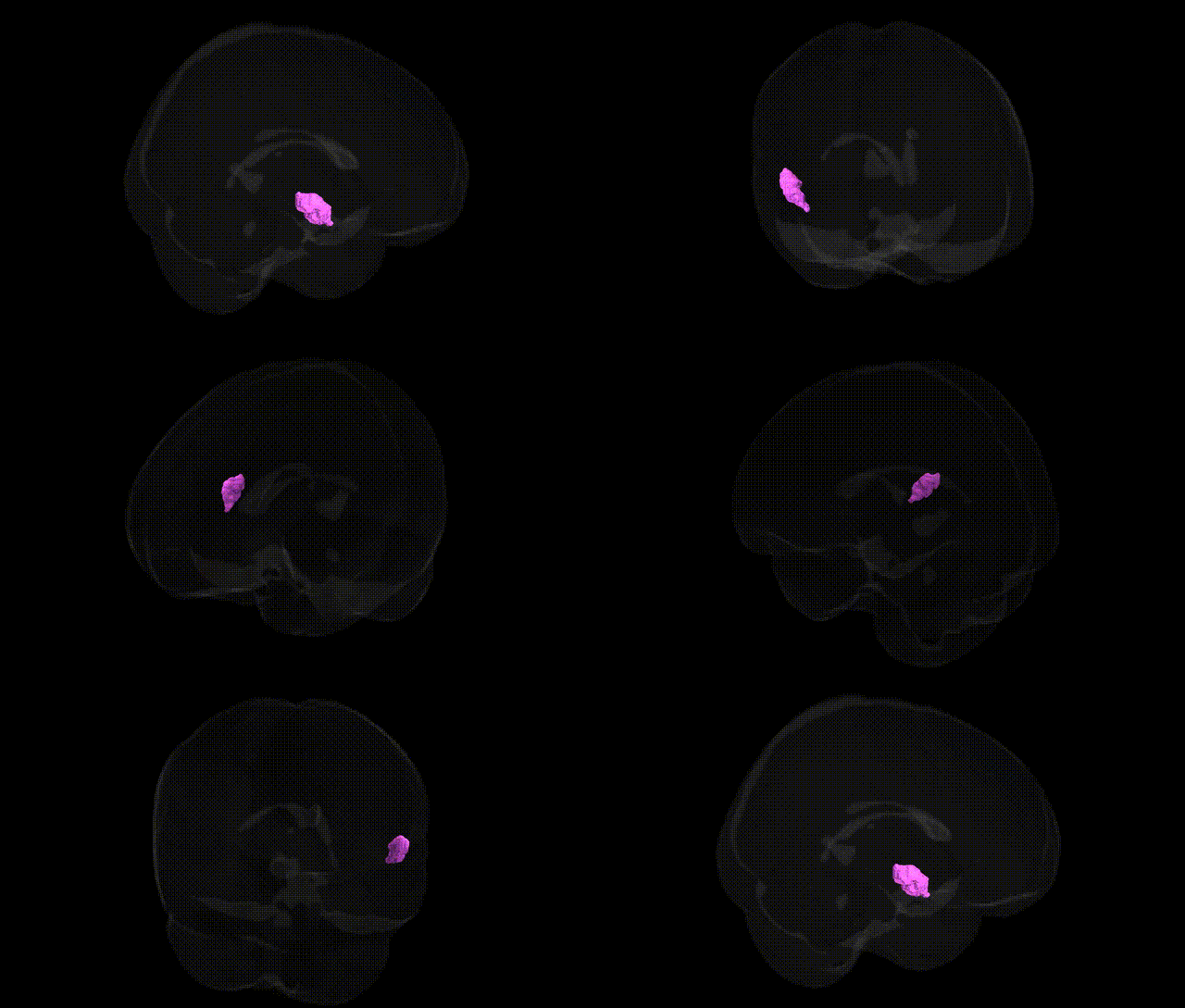
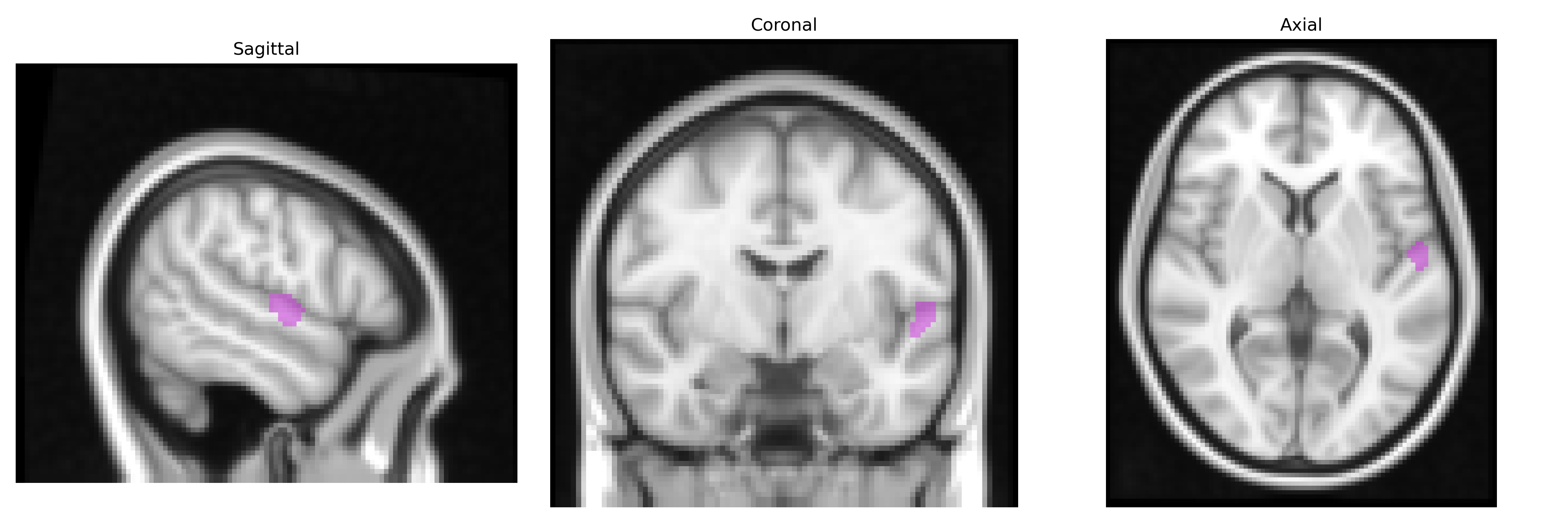
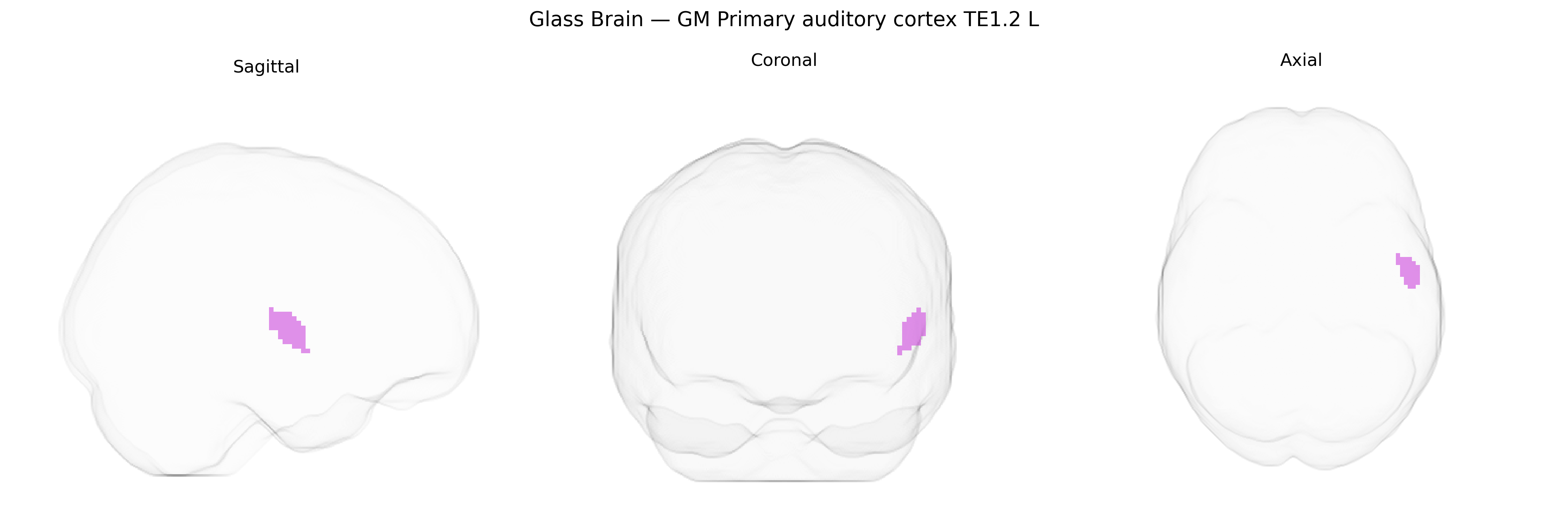
The bilateral GM Primary auditory cortex TE1.2 L from the Juelich maxprob thr25 2mm Atlas represents a cytoarchitectonically defined subregion of Heschl’s gyrus within the primary auditory cortex, characterized by granular isocortex with dense thalamocortical input from the medial geniculate nucleus. TE1.2 is associated with early-stage processing of acoustic features such as frequency, intensity, and temporal patterns, forming part of the core auditory field that supports basic sound representation and serves as a gateway to higher-order auditory areas in the belt and parabelt regions. Neuronal organization within TE1.2 exhibits tonotopic gradients, laminar differentiation with prominent layer IV granule cells, and robust corticocortical and callosal connectivity with contralateral auditory cortex and nearby temporal regions. There is no direct Wikipedia article for TE1.2; it is a subregion of the broader Primary auditory cortex.
The bilateral GM Primary auditory cortex TE1.2 L (Juelich maxprob thr25 2mm) corresponds to core auditory fields in Heschl’s gyrus, a region where genetic influences on cortical thickness, surface area, and gyrification have been demonstrated in large-scale imaging–genetics consortia such as ENIGMA and UK Biobank, with heritability estimates indicating strong additive genetic effects on auditory cortex morphology and functional organization; GWAS of regional brain volumes and cortical measures have implicated common variants in genes involved in neurodevelopment, synaptic plasticity, and myelination (for example pathways including neuregulin/ERBB signaling, calcium-channel–related genes, and axon guidance genes), though single genes are rarely specific to TE1.2 alone. Polygenic risk scores for schizophrenia, bipolar disorder, and major depressive disorder have been associated with structural and functional alterations in primary and association auditory cortices, consistent with repeated findings of reduced Heschl’s gyrus volume and cortical thinning in psychotic disorders and congenital or acquired hearing loss. Variants associated with language and reading traits (including dyslexia), speech perception, and musical aptitude show convergent effects on superior temporal and primary auditory regions, linking genes related to neuronal migration and cortical patterning (for example DCDC2, KIAA0319, and other dyslexia risk loci) to interindividual differences in auditory cortical structure and phonological processing. Additional associations include tinnitus and age-related hearing impairment, where genetic risk for peripheral auditory dysfunction interacts with cortical plasticity in TE1.2, and cross-trait genetic correlations have been reported between hearing-related GWAS signals and superior temporal/auditory cortex measures, indicating that part of the genetic architecture of this region overlaps with susceptibility to neuropsychiatric, language, and hearing-related phenotypes.
Overview generated by GPT-4o (2026).
Region ID: 45
Hemisphere: bilateral
Atlas: Juelich maxprob thr25 2mm
Full Quality Version: Download MP4
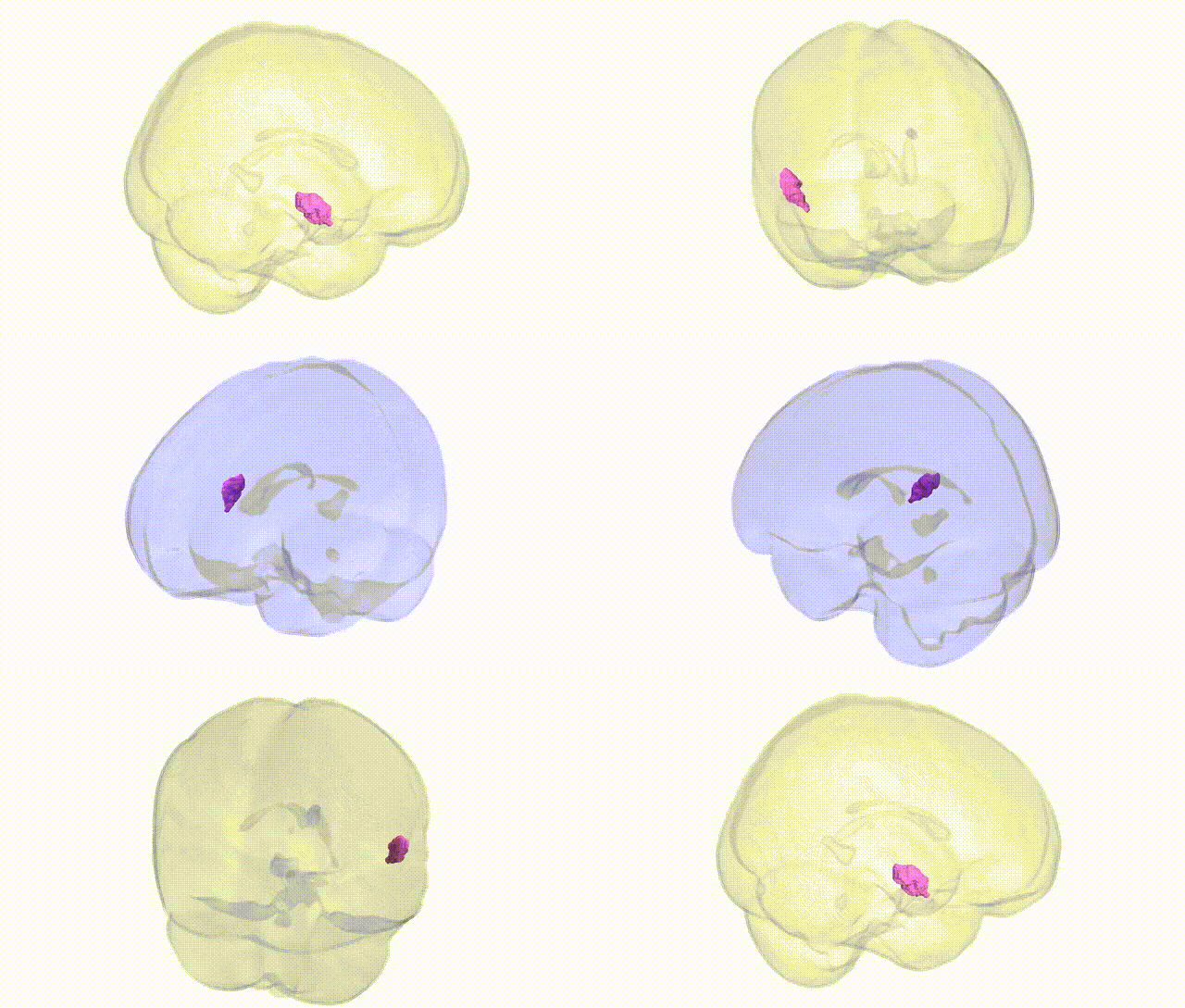
Full Quality Version: Download MP4
Wali Sidiqyar*, Gaurav Rudravaram*, Elyssa M. McMaster, Trent M. Schwartz, Adam M. Saunders, Kurt G. Schilling, Bennett A. Landman "Introducing SPINS: A Shared Public Visualization Library of Neuroanatomical Structures." Medical Imaging with Deep Learning- short paper
This resource is licensed under CC0 1.0 Universal (Public Domain).