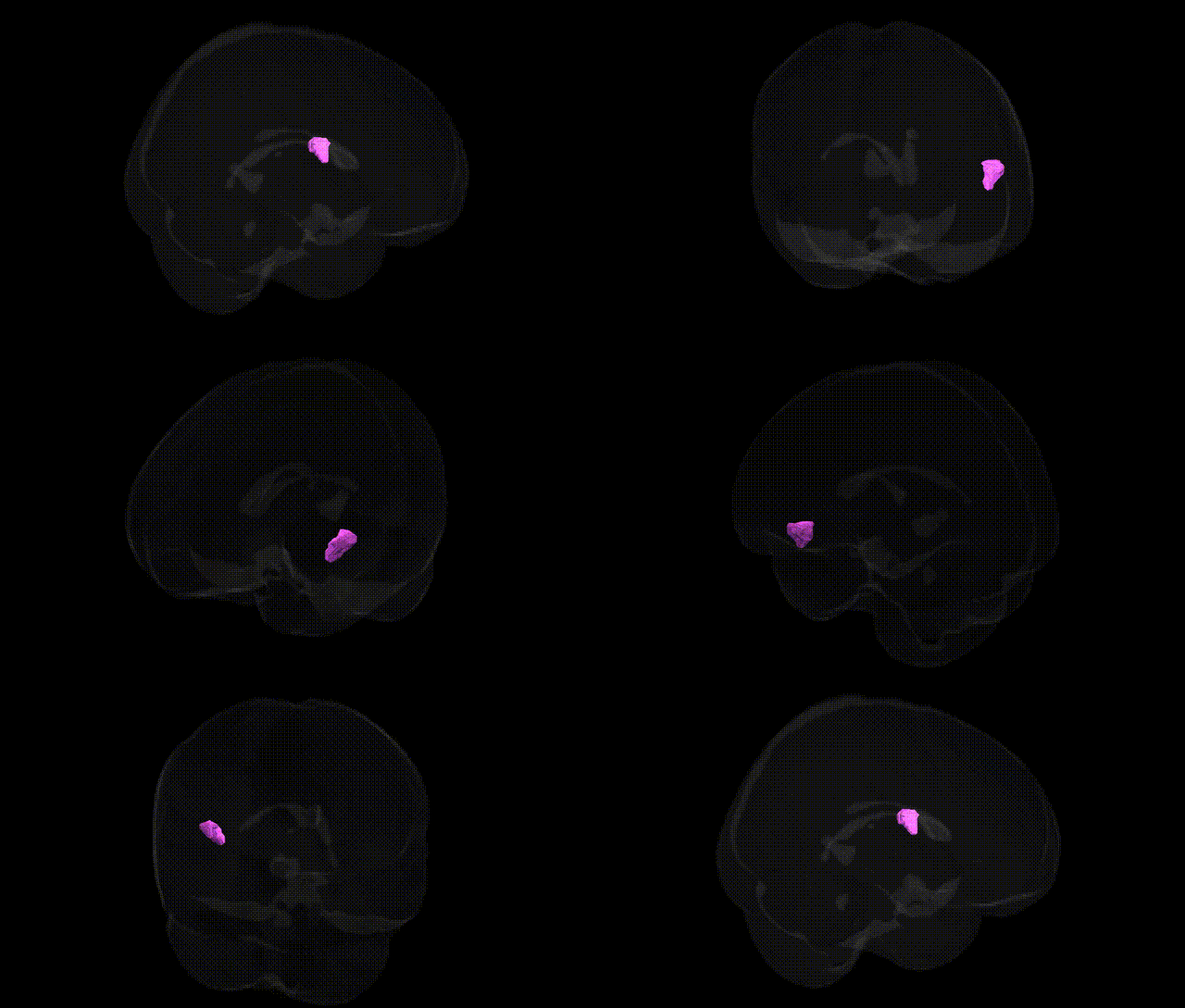
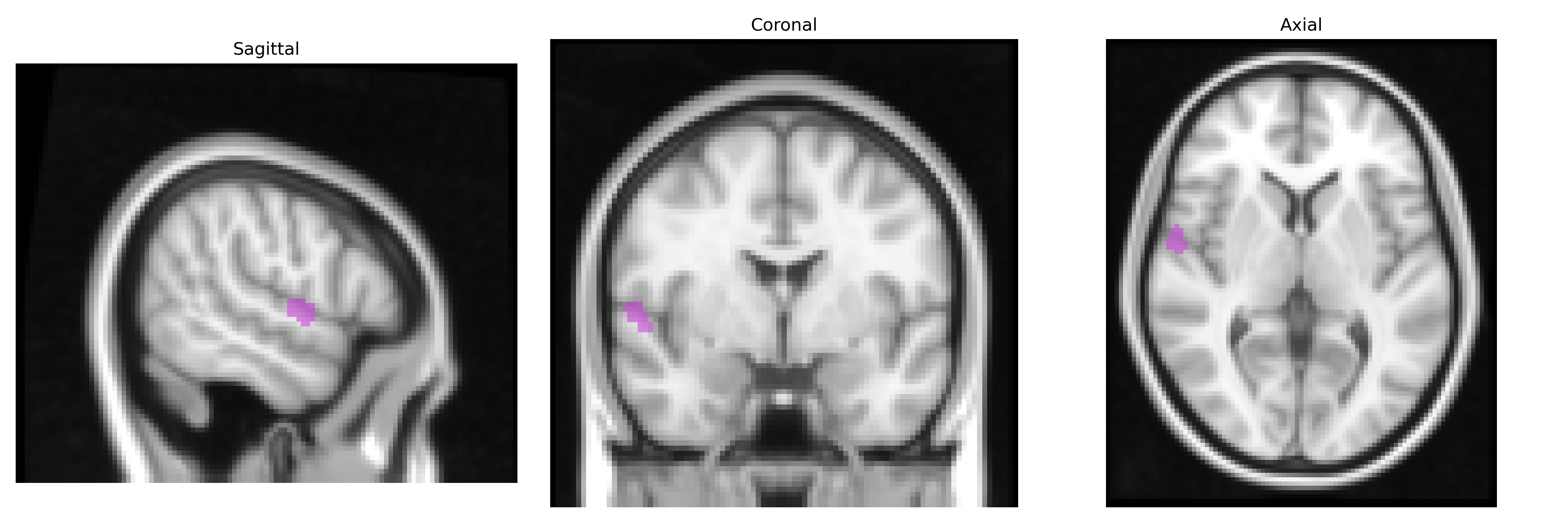
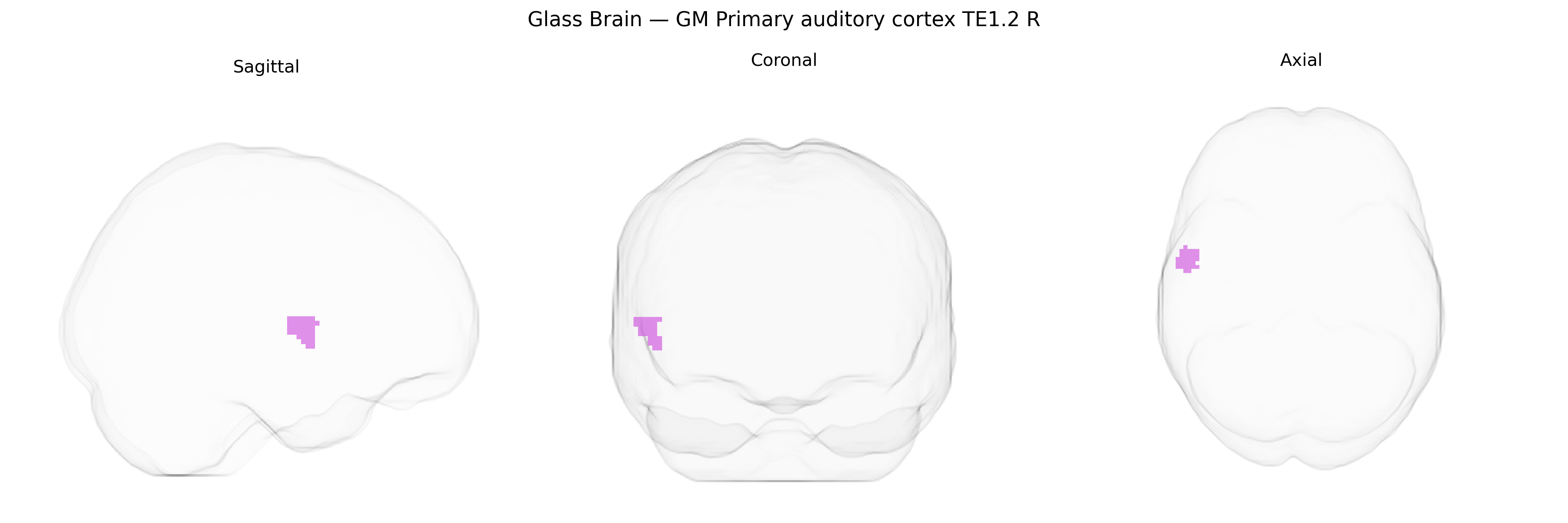
The bilateral GM Primary auditory cortex TE1.2 R, as defined in the Juelich maxprob thr25 2mm atlas, corresponds to a cytoarchitectonically characterized subdivision of the human primary auditory cortex located on the superior temporal plane within Heschl’s gyrus. This region is part of the Te1 complex (Te1.0, Te1.1, Te1.2) and is distinguished by its granular koniocortical architecture, dense thalamocortical input from the medial geniculate body, and tonotopic organization supporting early-stage processing of acoustic information such as sound frequency, intensity, and temporal structure. Functionally, TE1.2 contributes to basic auditory perception and serves as a gateway for higher-order auditory and speech-related processing in adjacent belt and parabelt auditory areas of the temporal lobe. There is no direct Wikipedia article for TE1.2; a closely related structure is the Primary auditory cortex.
The bilateral GM primary auditory cortex TE1.2 R, as defined in the Juelich maxprob thr25 2mm atlas, lies within Heschl’s gyrus and overlaps core auditory fields that have been implicated indirectly in several genetic and GWAS-based findings, although relatively few studies target TE1.2 specifically; instead, associations are typically reported for broader auditory cortex or temporal lobe regions. Structural and functional variation in this area has been linked to genes involved in synaptic plasticity and cortical microcircuit development, including variants in FOXP2, DCDC2, KIAA0319, and CNTNAP2 in studies of language, reading, and developmental dyslexia, where altered gray matter or activation in primary and adjacent auditory cortex has been observed. Large-scale imaging–genetics consortia (e.g., ENIGMA) have reported heritability of superior temporal and Heschl’s gyrus thickness and surface area and identified common variants in loci encompassing genes such as HMGA2, MIR148A, and others related to neurodevelopment and cortical patterning, though these effects generally span multiple auditory subregions rather than TE1.2 alone. GWAS of tinnitus and hearing-related traits have implicated genes involved in cochlear and central auditory processing (e.g., PCSK2, ARID5B, and several loci near potassium and glutamatergic signaling genes), with neuroimaging work showing that individuals carrying risk variants often exhibit altered activity or morphology in primary auditory cortex. Additionally, disorders with strong genetic components—schizophrenia, autism spectrum disorder, and specific language impairment—frequently show abnormal activation, connectivity, or cortical thickness in primary auditory cortex and adjacent temporal areas, and some risk loci (e.g., in GRIN2A, NRXN1, and 16p11.2 CNVs) have been associated with auditory cortical processing anomalies, though causal links to TE1.2 R specifically remain indirect and inferred from regional overlap and functional connectivity rather than parcel-level GWAS.
Overview generated by GPT-4o (2026).
Region ID: 46
Hemisphere: bilateral
Atlas: Juelich maxprob thr25 2mm
Full Quality Version: Download MP4
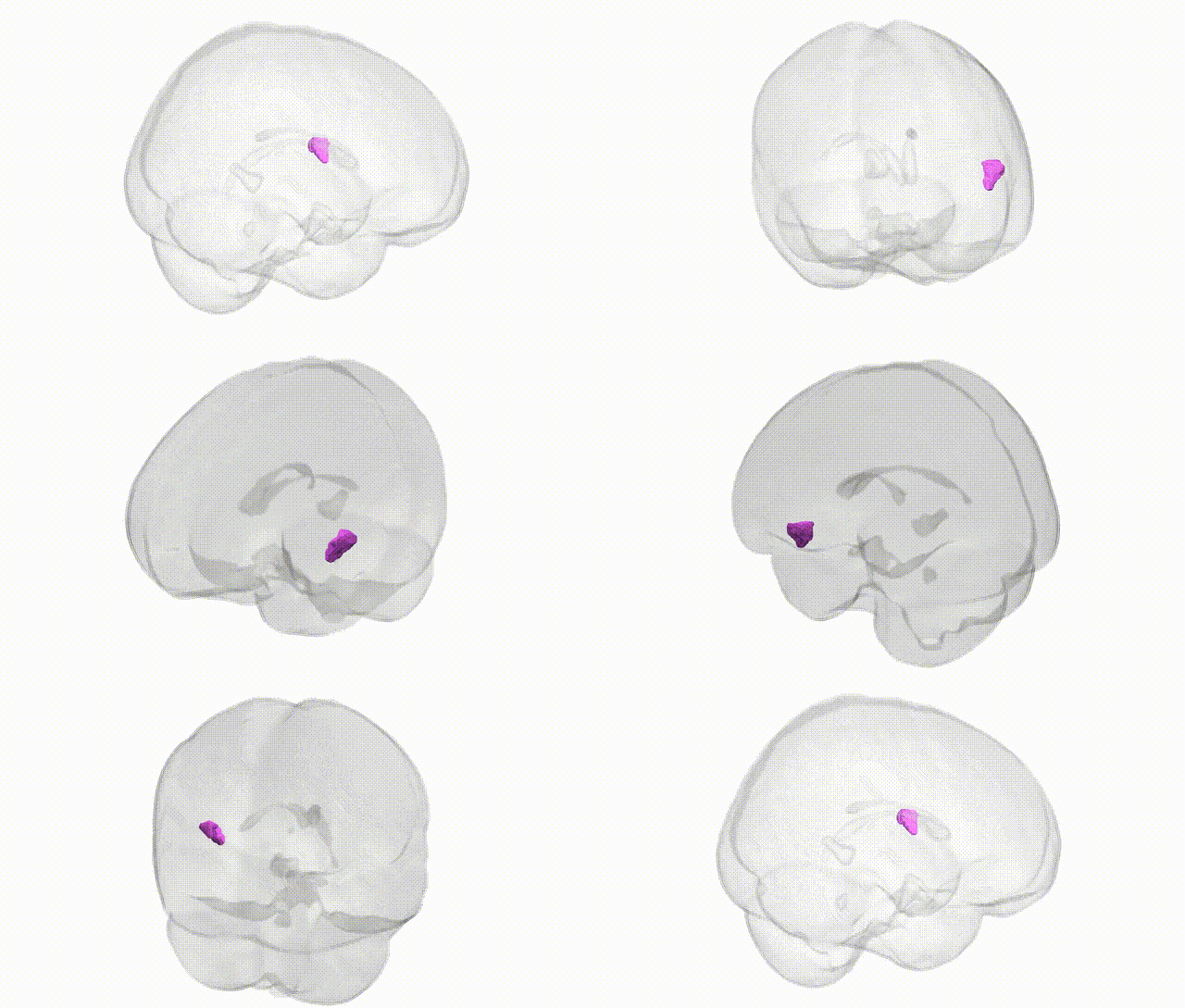
Full Quality Version: Download MP4
Wali Sidiqyar*, Gaurav Rudravaram*, Elyssa M. McMaster, Trent M. Schwartz, Adam M. Saunders, Kurt G. Schilling, Bennett A. Landman "Introducing SPINS: A Shared Public Visualization Library of Neuroanatomical Structures." Medical Imaging with Deep Learning- short paper
This resource is licensed under CC0 1.0 Universal (Public Domain).