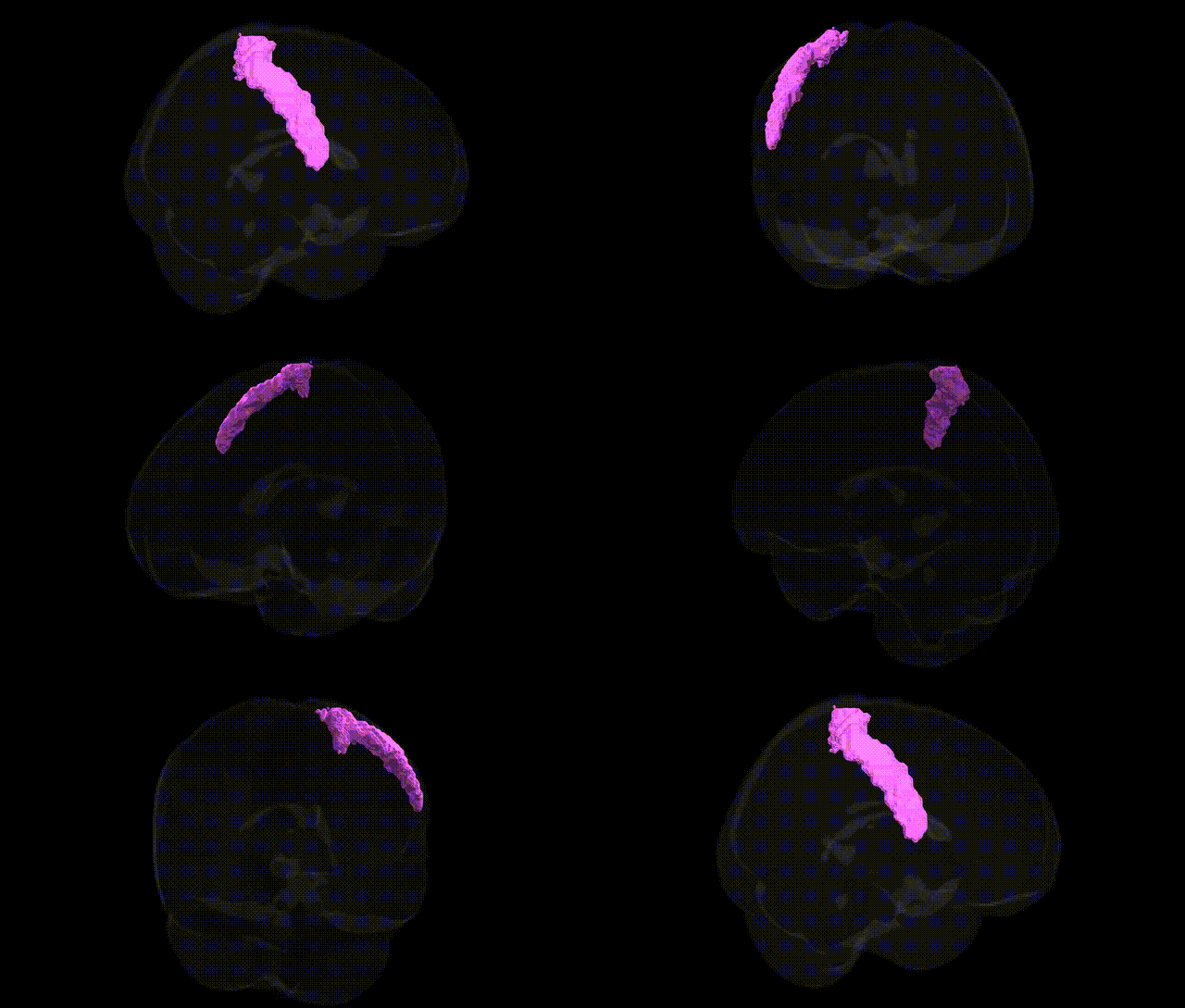
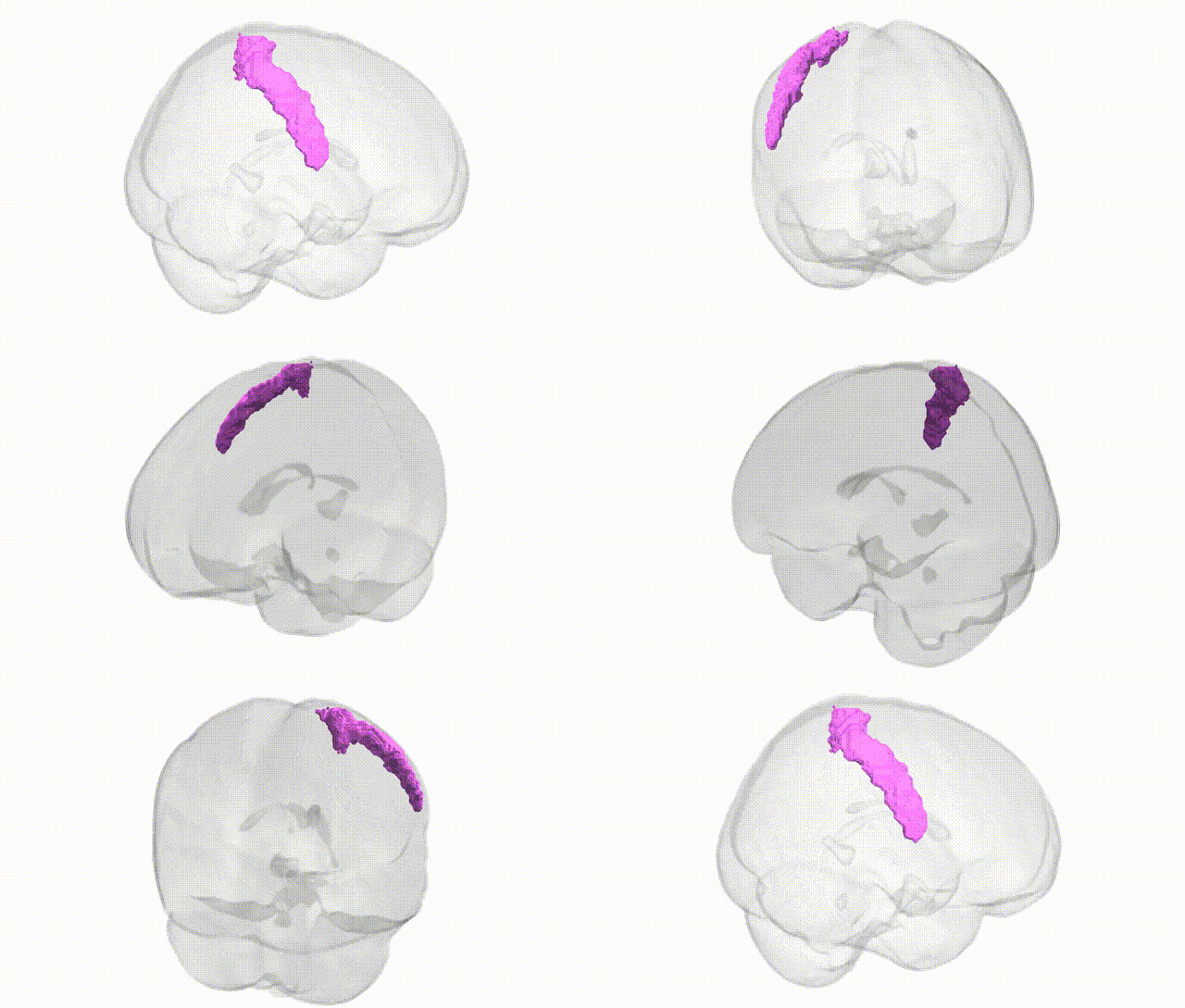
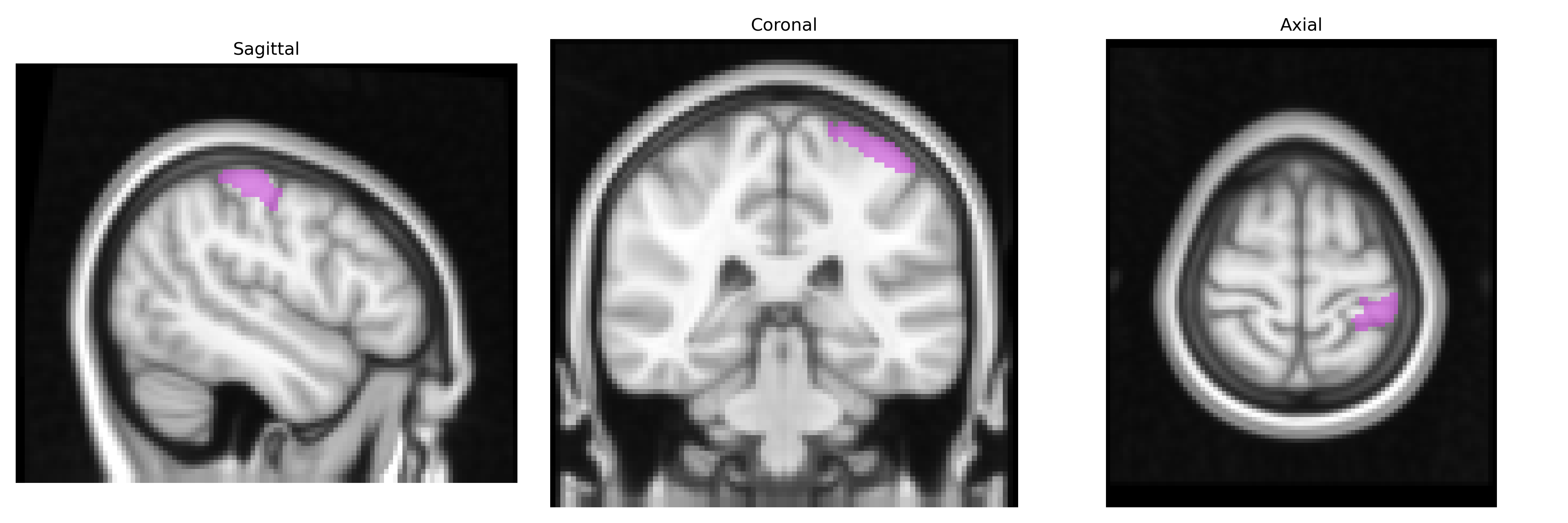
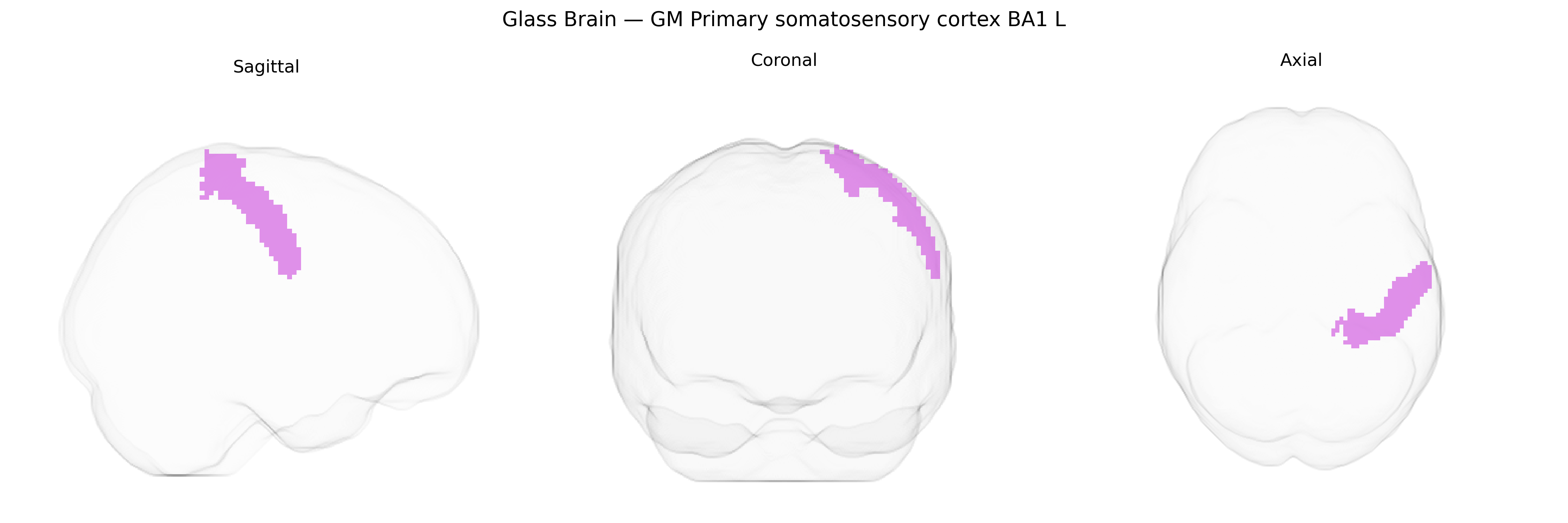
The bilateral GM Primary somatosensory cortex BA1 L (from the Juelich maxprob thr25 2mm Atlas) corresponds to the gray matter of Brodmann area 1 in the left primary somatosensory cortex, located on the postcentral gyrus of the parietal lobe. This region receives and processes somatosensory input relayed from thalamic nuclei and adjacent somatosensory areas, with a particular role in higher-order processing of tactile information such as texture and fine spatial details, building on more basic receptive inputs from BA3. Neurons in BA1 contribute to conscious perception of touch and integration of cutaneous signals into representations of the body surface, and exhibit somatotopic organization aligned with the classic sensory homunculus. There is no direct Wikipedia article for “Primary somatosensory cortex BA1,” but it is a subregion of the Primary somatosensory cortex.
The bilateral gray matter primary somatosensory cortex BA1 (left hemisphere) in the Juelich maxprob thr25 2mm atlas has been implicated in genetic studies primarily through imaging genetics and GWAS that link cortical structure and function to common variants and neuropsychiatric risk. Large-scale brain MRI GWAS (e.g., ENIGMA, UK Biobank) have identified polygenic influences on cortical thickness and surface area in primary somatosensory regions, with variants near genes involved in neurodevelopment and synaptic function (such as those in Wnt signaling, cell adhesion, and axon guidance pathways), although specific BA1-focused loci are rarely isolated due to the parcel-level resolution of most studies. Somatosensory cortex measures show modest genetic correlations with general cognitive ability, educational attainment, and some psychiatric traits, reflecting shared polygenic architecture rather than region-specific single-gene effects. In clinical genetics, alterations of somatosensory cortex structure or activation, including BA1, have been reported in carriers of risk alleles for autism spectrum disorder, schizophrenia, and ADHD, as well as in chronic pain and migraine GWAS, where variants in ion channels and neurotransmission genes are linked to altered pain processing networks that prominently involve primary somatosensory areas. Overall, genetic influences on BA1 appear highly polygenic and embedded within broader sensorimotor and association networks, with current findings pointing to distributed neurodevelopmental and synaptic pathways rather than discrete, BA1-specific genetic determinants.
Overview generated by GPT-4o (2026).
Region ID: 51
Hemisphere: bilateral
Atlas: Juelich maxprob thr25 2mm
Full Quality Version: Download MP4
Full Quality Version: Download MP4
Wali Sidiqyar*, Gaurav Rudravaram*, Elyssa M. McMaster, Trent M. Schwartz, Adam M. Saunders, Kurt G. Schilling, Bennett A. Landman "Introducing SPINS: A Shared Public Visualization Library of Neuroanatomical Structures." Medical Imaging with Deep Learning- short paper
This resource is licensed under CC0 1.0 Universal (Public Domain).