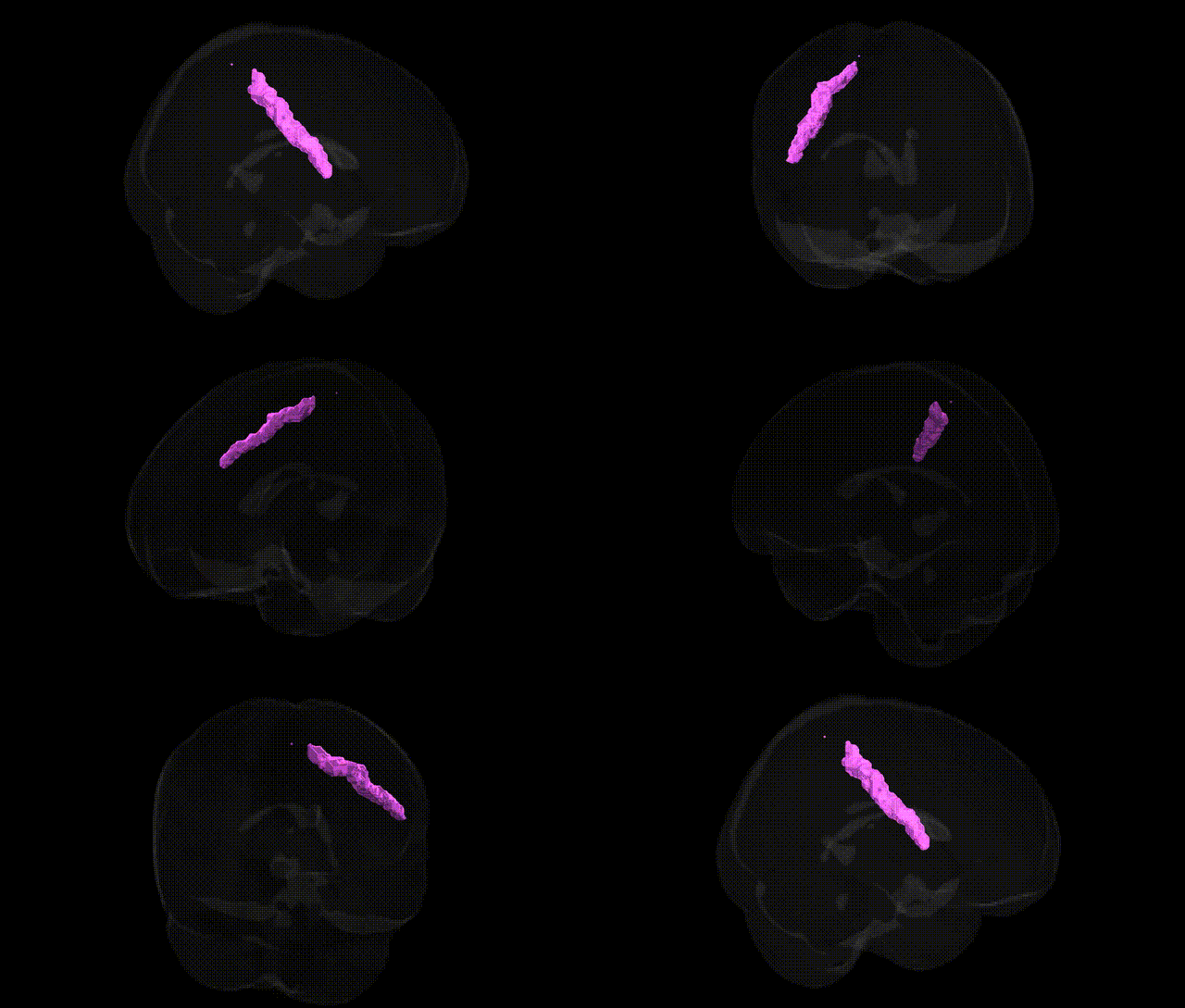
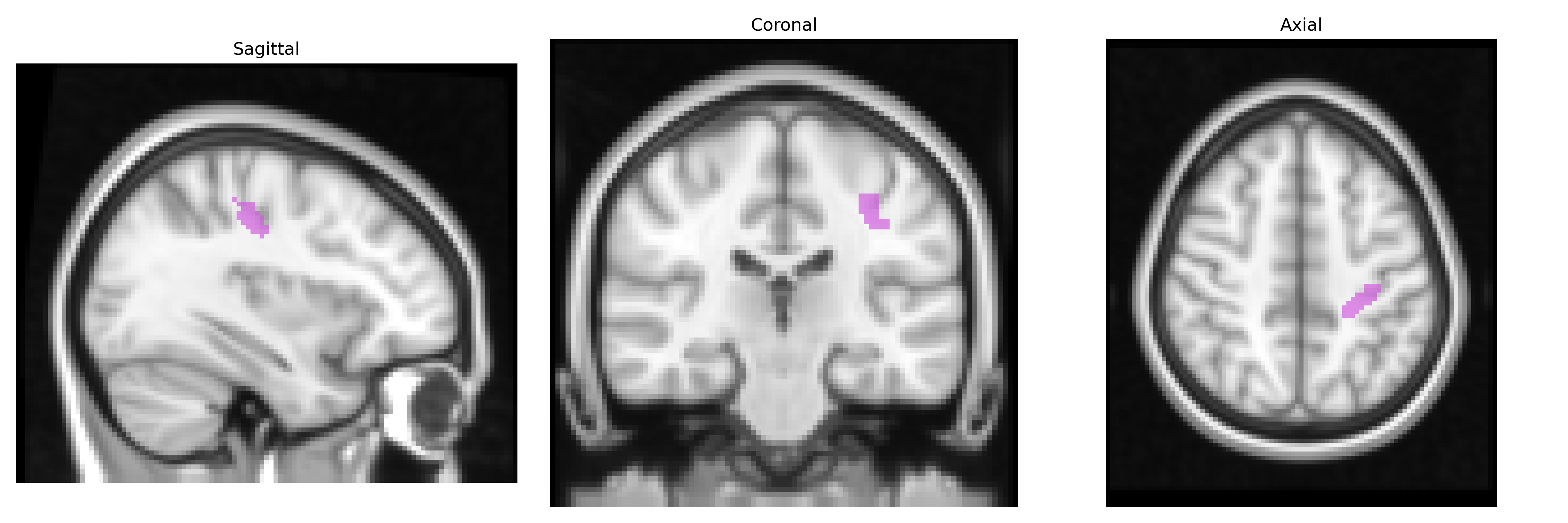
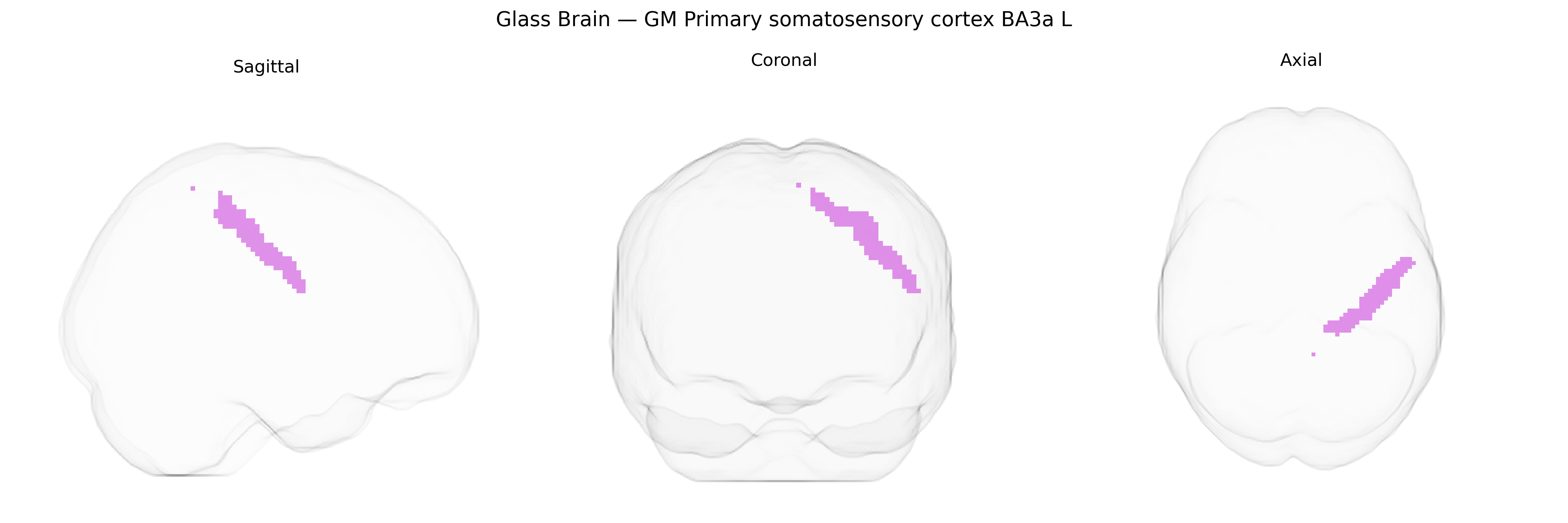
The bilateral GM Primary somatosensory cortex BA3a L (Juelich maxprob thr25 2mm Atlas) corresponds to the granular subdivision of Brodmann area 3 within the postcentral gyrus, predominantly involved in the earliest cortical processing of proprioceptive input from muscles and joints. Located in the anterior portion of the primary somatosensory cortex (S1), BA3a receives dense thalamocortical projections from somatosensory nuclei and contributes to fine-grained coding of limb position, movement, and deep tactile information, which are essential for sensorimotor integration and precise motor control. This region exhibits somatotopic organization, with different body parts represented in distinct cortical zones, and forms part of a hierarchical network with adjacent areas BA3b, BA1, and BA2 for progressively complex tactile and proprioceptive processing. There is no direct Wikipedia article for “BA3a” specifically; a closely related and encompassing structure is the Primary somatosensory cortex.
The bilateral primary somatosensory cortex (S1), including Brodmann area 3a as defined in the Juelich maxprob atlas, shows genetic associations primarily through large-scale imaging–genetics and neuropsychiatric GWAS rather than region-specific candidate studies. Variability in S1 cortical thickness, surface area, and activation has been linked to common variants in genes involved in neurodevelopment, synaptic function, and axon guidance (e.g., microtubule- and cytoskeleton-related genes, glutamatergic signaling genes) identified by ENIGMA and UK Biobank imaging GWAS, though these typically report broader parietal or global cortical associations rather than BA3a-specific loci. Polygenic risk scores for schizophrenia, autism spectrum disorder, major depression, and ADHD have been associated with altered somatosensory and parietal morphometry, implicating S1 in the downstream effects of risk variants across multiple psychiatric conditions. Somatosensory cortex structure and function, including BA3a-adjacent regions, have also been linked to genetic influences on pain sensitivity and chronic pain disorders, with GWAS of chronic back pain, migraine, and multisite pain showing enrichment for genes whose expression is notable in sensorimotor cortices. In movement and sensory disorders, genetic forms of dystonia, essential tremor, and certain epilepsies with somatosensory auras show altered S1 activation and plasticity, although the causal variants (e.g., in KCNMA1, GCH1, CACNA1A) act on widespread circuits rather than targeting BA3a selectively. Overall, genetic findings implicate the primary somatosensory cortex as a convergent locus of polygenic effects on cortical development, pain perception, motor-sensory integration, and psychiatric vulnerability, but no robust, uniquely BA3a-specific genetic associations have been established to date.
Overview generated by GPT-4o (2026).
Region ID: 55
Hemisphere: bilateral
Atlas: Juelich maxprob thr25 2mm
Full Quality Version: Download MP4
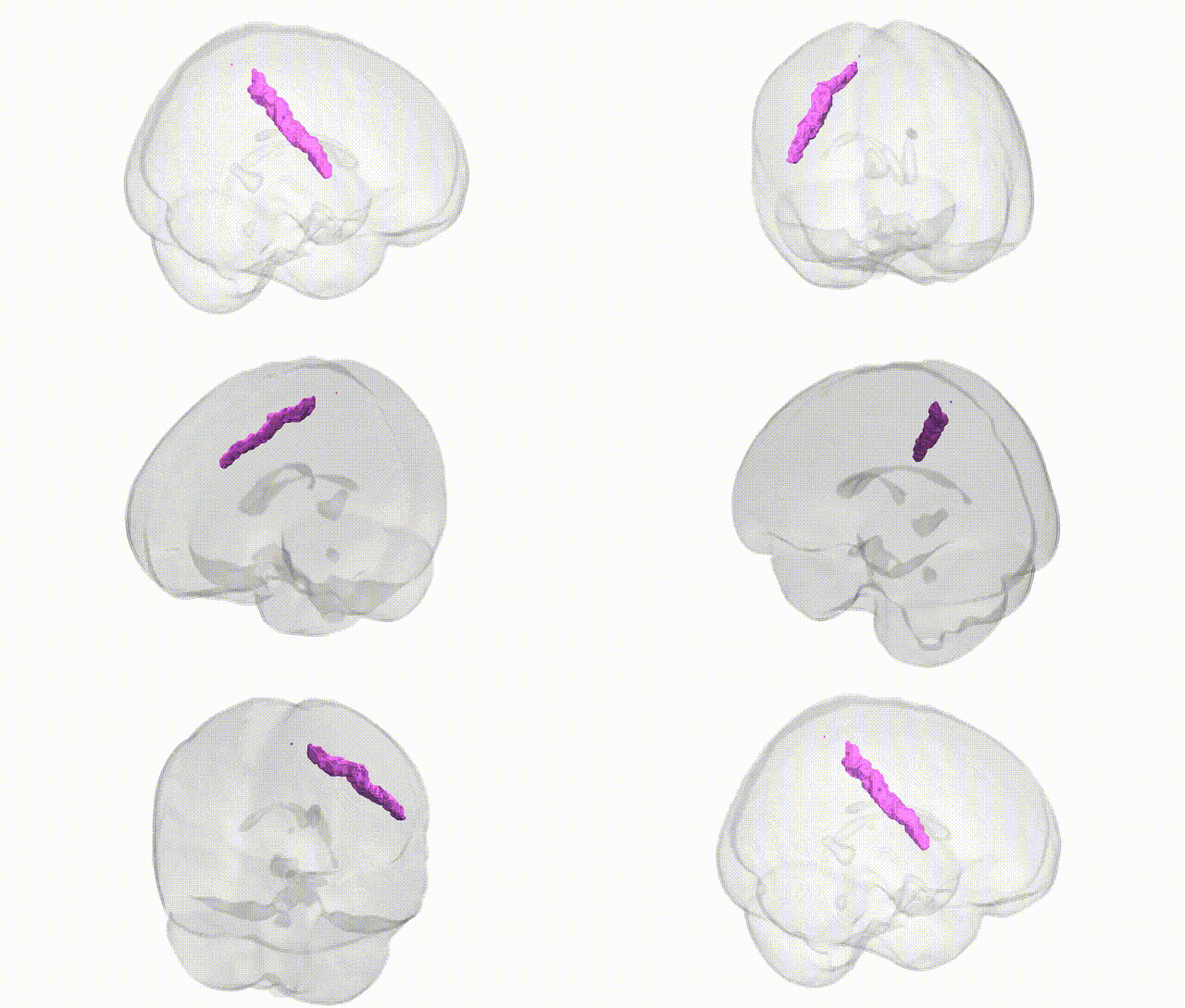
Full Quality Version: Download MP4
Wali Sidiqyar*, Gaurav Rudravaram*, Elyssa M. McMaster, Trent M. Schwartz, Adam M. Saunders, Kurt G. Schilling, Bennett A. Landman "Introducing SPINS: A Shared Public Visualization Library of Neuroanatomical Structures." Medical Imaging with Deep Learning- short paper
This resource is licensed under CC0 1.0 Universal (Public Domain).