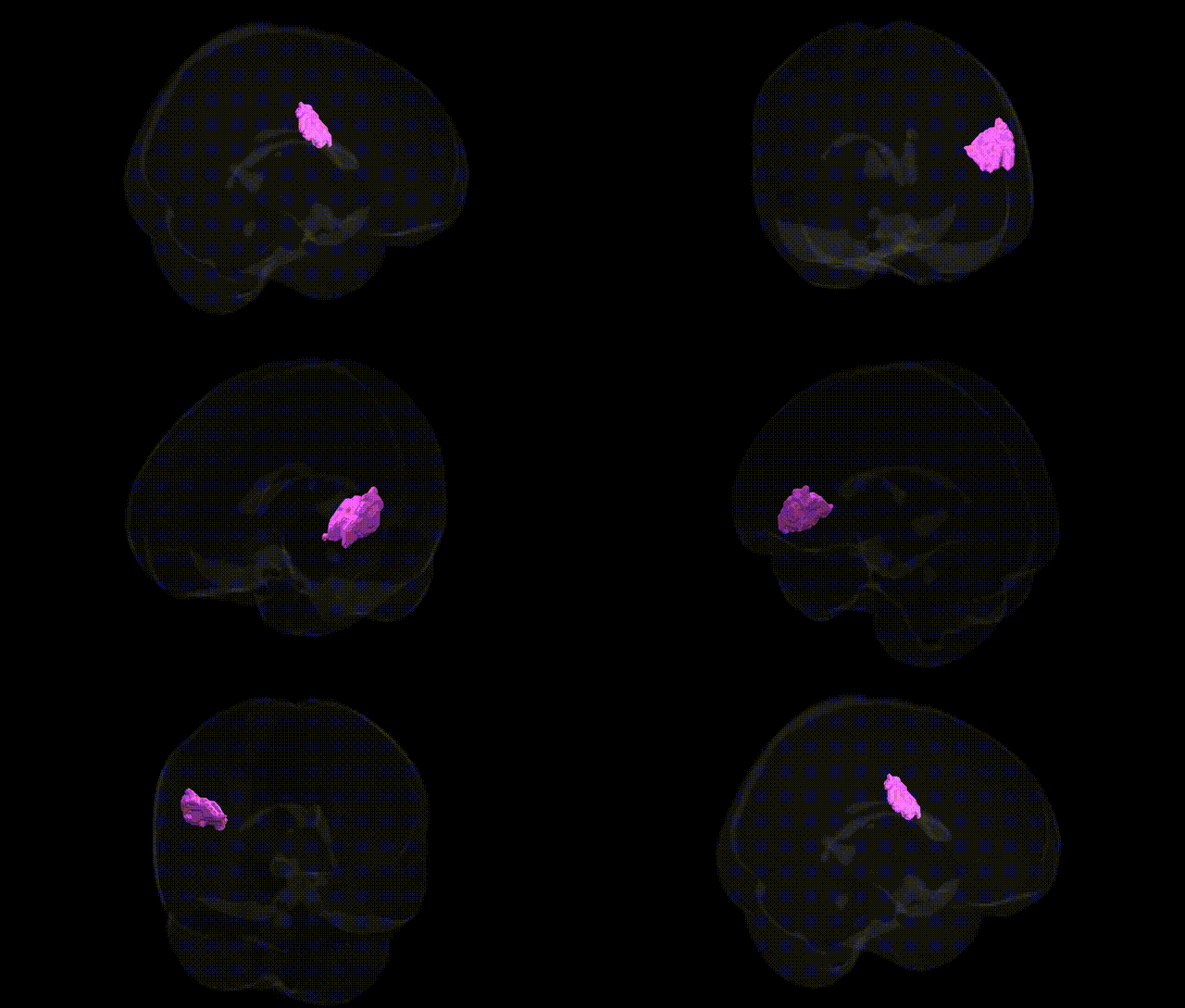
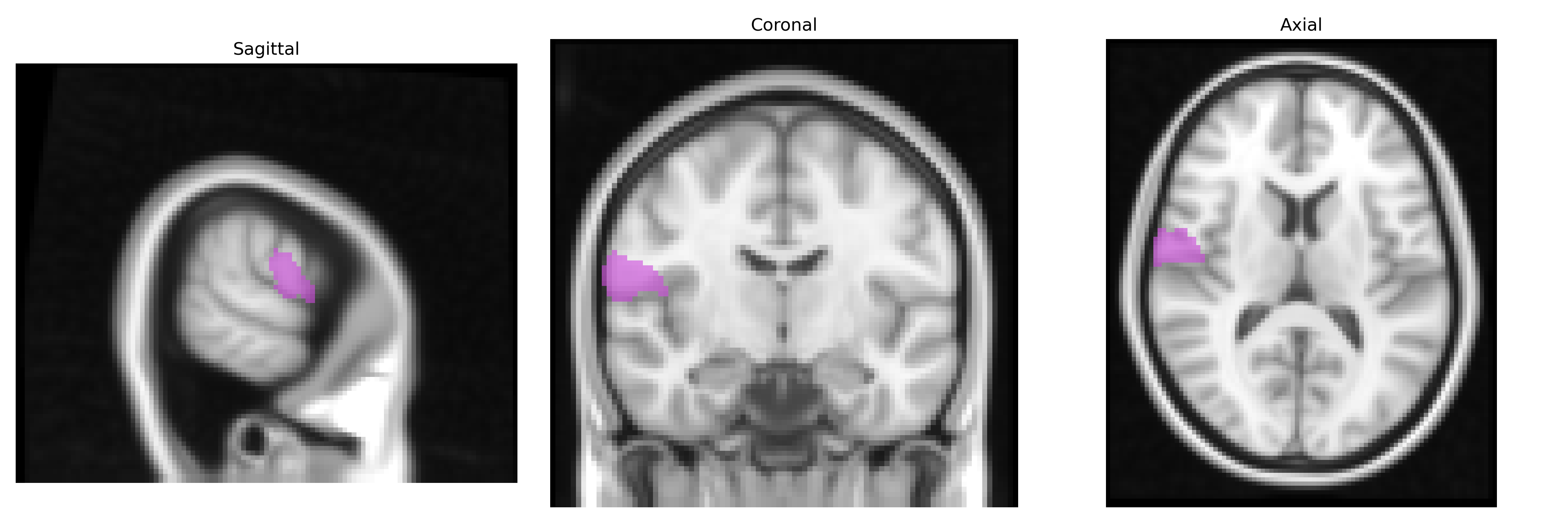
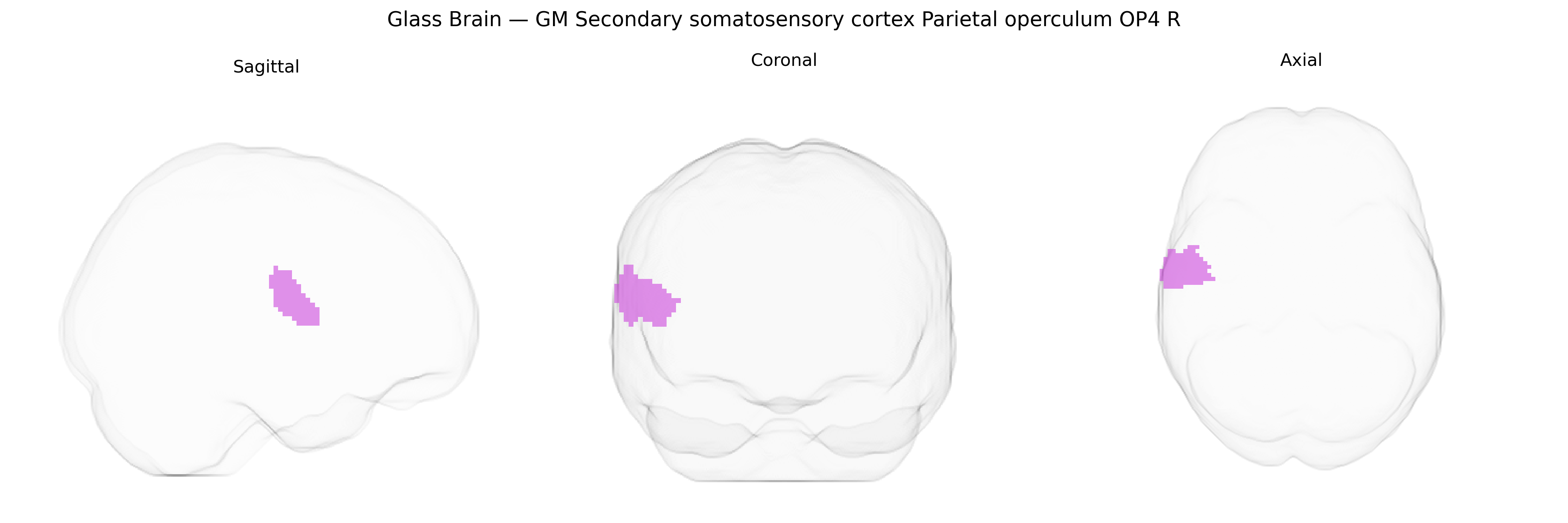
The bilateral GM Secondary somatosensory cortex Parietal operculum OP4 R, as defined in the Juelich maxprob thr25 2mm atlas, corresponds to a cytoarchitectonically distinct subregion (OP4) of the parietal operculum that forms part of the human secondary somatosensory cortex (SII). Located along the dorsal bank of the lateral sulcus overlying the insula, OP4 integrates tactile and proprioceptive inputs from primary somatosensory areas and subcortical structures, contributing to higher-order somatosensory functions such as texture discrimination, sensorimotor integration, and bilateral representation of the body. This region exhibits strong connectivity with primary somatosensory cortex, motor regions, and multimodal association areas, supporting roles in somatic perception, action planning, and possibly pain and haptic object recognition. There is no direct Wikipedia article for OP4; a related structure is the Parietal operculum.
The bilateral gray matter of the Secondary somatosensory cortex, Parietal operculum OP4 R (as defined in the Juelich maxprob thr25 2mm atlas), does not currently have well-established, region-specific genetic associations in the literature, because most imaging genetics and GWAS studies focus on macro-anatomical regions (e.g., lobes, larger cortical parcels) or functional networks rather than fine-grained cytoarchitectonic areas like OP4. Nonetheless, genetic influences on somatosensory cortex structure and function are supported by twin and SNP-based heritability studies showing moderate to high heritability for cortical thickness and surface area in parietal and opercular regions, and GWAS of cortical morphology have implicated loci in genes involved in neurodevelopment, synaptic formation, and axon guidance (for example, variants near genes such as MEF2C, DCC, and other neurodevelopmental regulators), although these are typically reported for broader parietal or supramarginal/opercular parcels rather than OP4 specifically. Functional imaging genetics has linked common variants in genes such as COMT, BDNF, and dopamine or glutamatergic pathway genes to altered pain, tactile, and sensorimotor processing in operculo-insular and parietal regions, and large-scale GWAS of chronic pain, migraine, and somatic symptom traits suggest polygenic architectures that likely modulate secondary somatosensory cortex responsiveness, but do not isolate OP4. Neuropsychiatric and neurodevelopmental disorder GWAS (e.g., autism spectrum disorder, schizophrenia, ADHD) implicate genes that affect cortical development and connectivity in frontoparietal and sensorimotor networks, with imaging studies frequently reporting altered activation or connectivity in parietal operculum and adjacent somatosensory regions, yet the genetic links remain network-level and indirect rather than OP4-specific. Overall, existing evidence supports substantial genetic modulation of structure and function in parietal opercular somatosensory areas, but precise GWAS-level associations targeting the OP4 R region itself have not been delineated, and current genetic findings should be interpreted as relating to broader somatosensory and parietal opercular networks.
Overview generated by GPT-4o (2026).
Region ID: 66
Hemisphere: bilateral
Atlas: Juelich maxprob thr25 2mm
Full Quality Version: Download MP4
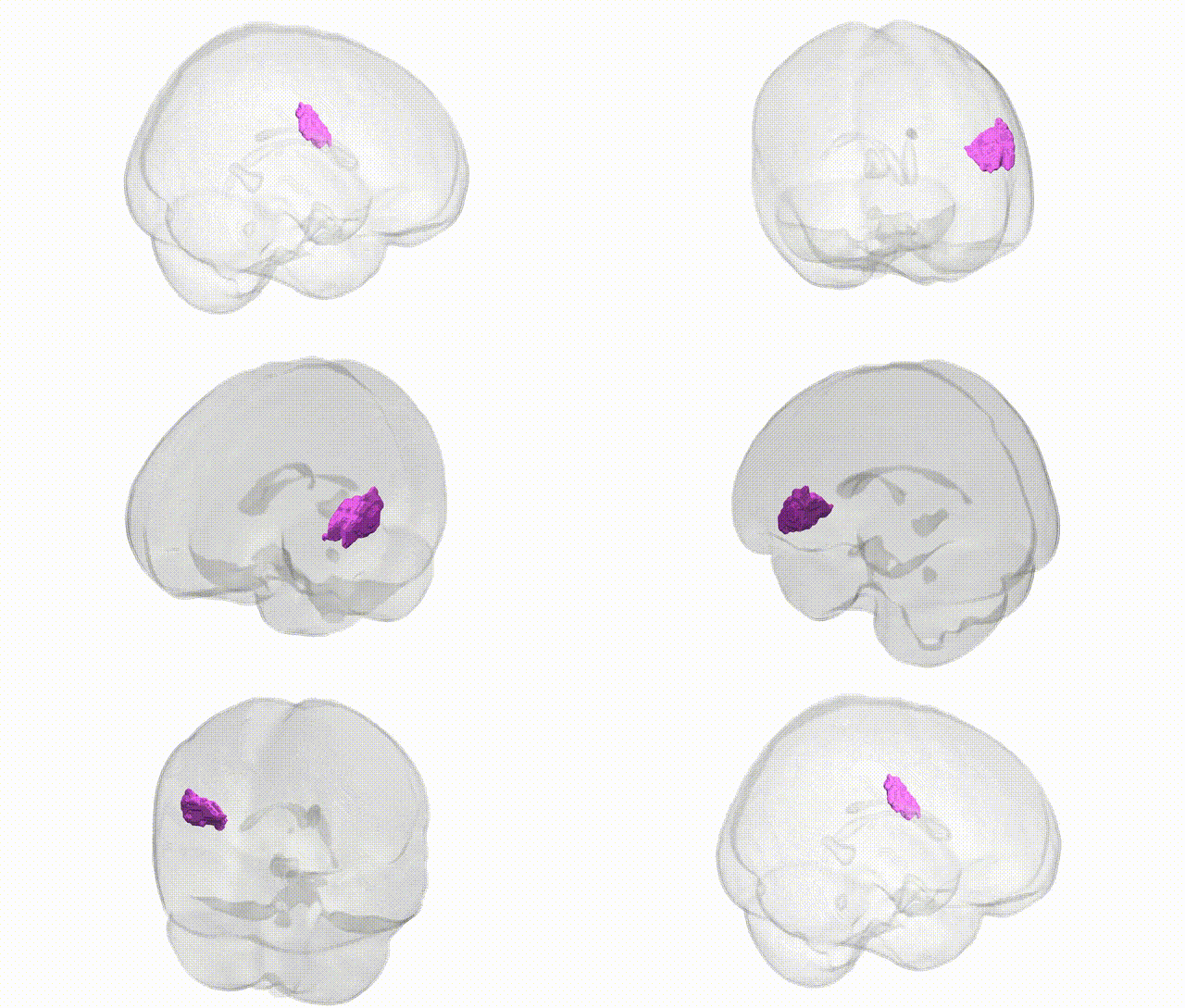
Full Quality Version: Download MP4
Wali Sidiqyar*, Gaurav Rudravaram*, Elyssa M. McMaster, Trent M. Schwartz, Adam M. Saunders, Kurt G. Schilling, Bennett A. Landman "Introducing SPINS: A Shared Public Visualization Library of Neuroanatomical Structures." Medical Imaging with Deep Learning- short paper
This resource is licensed under CC0 1.0 Universal (Public Domain).