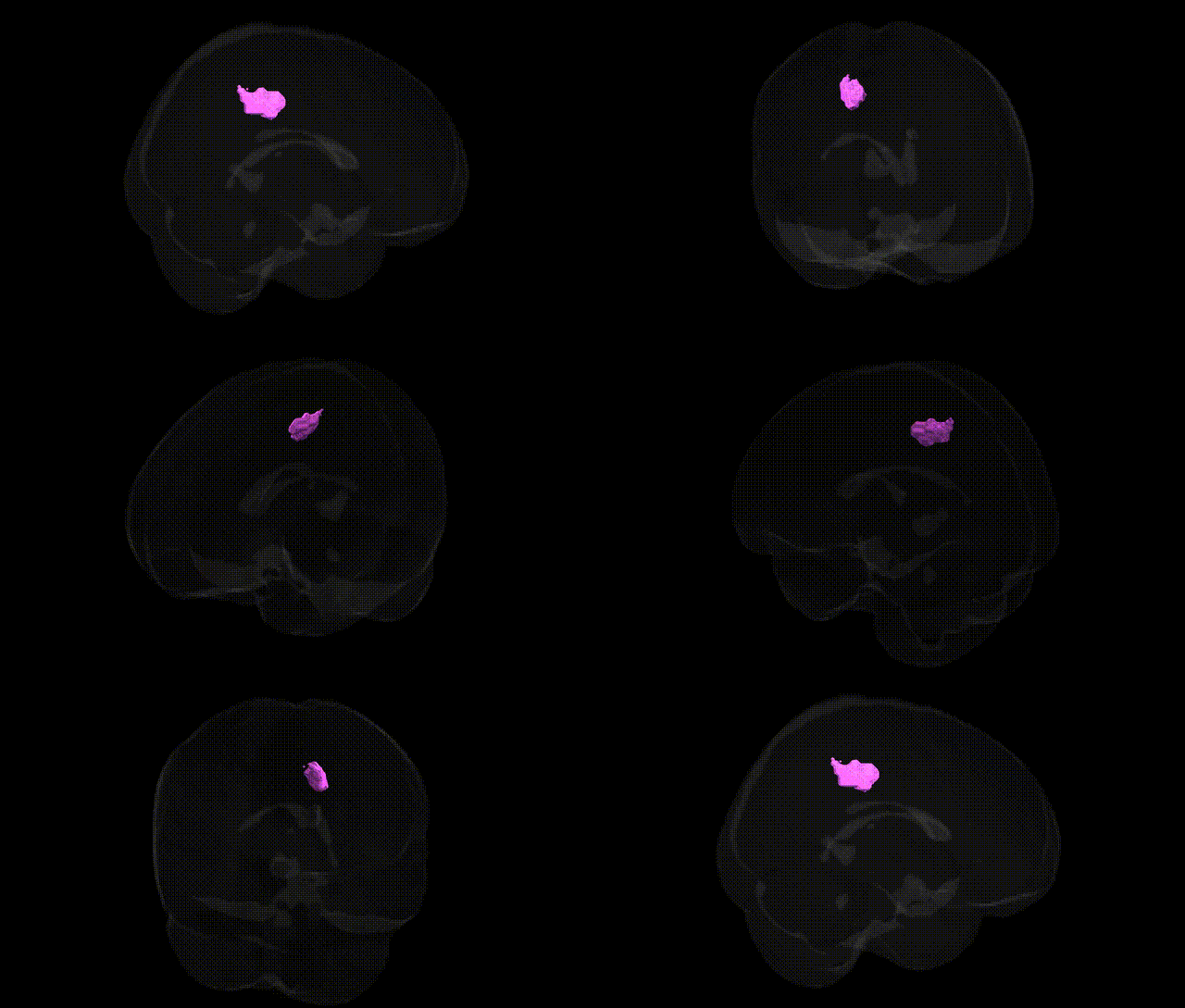
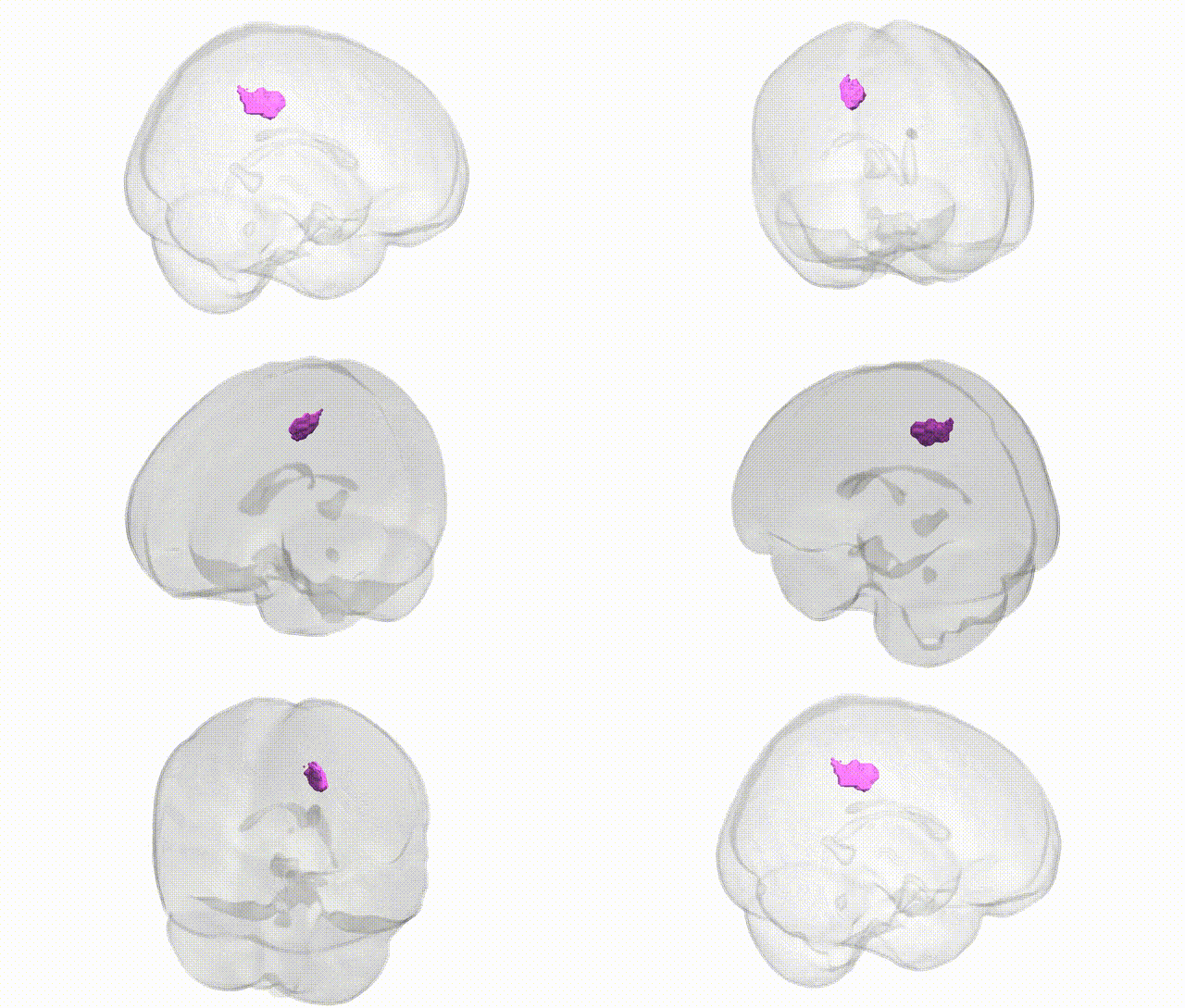
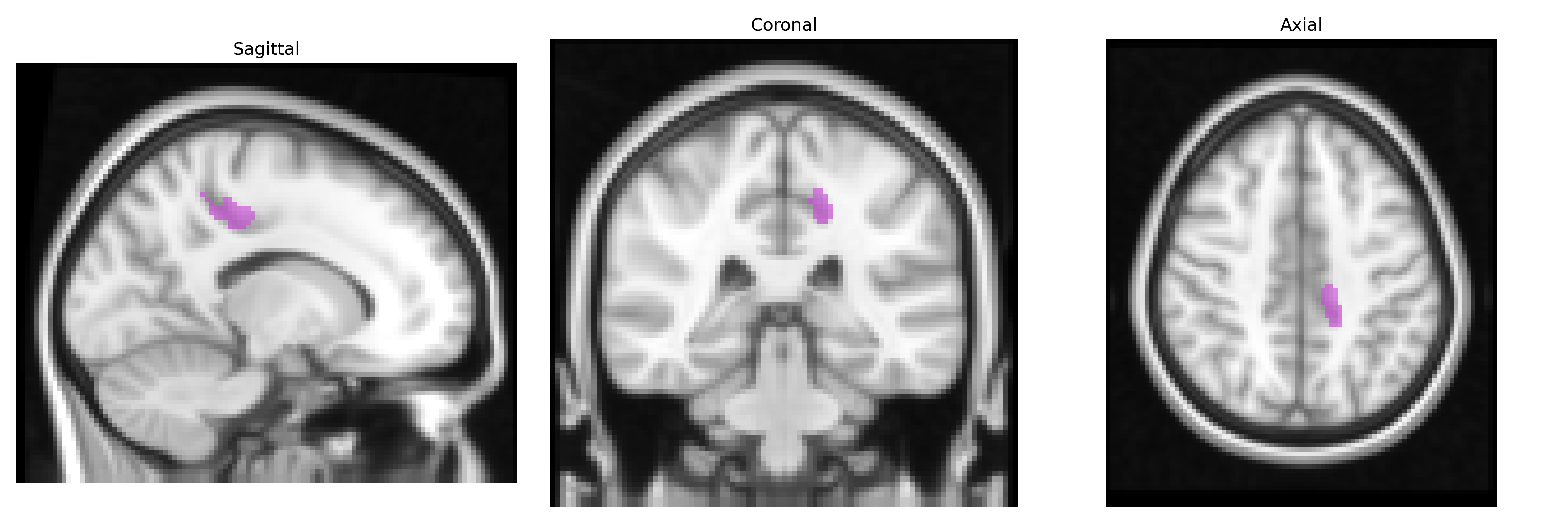
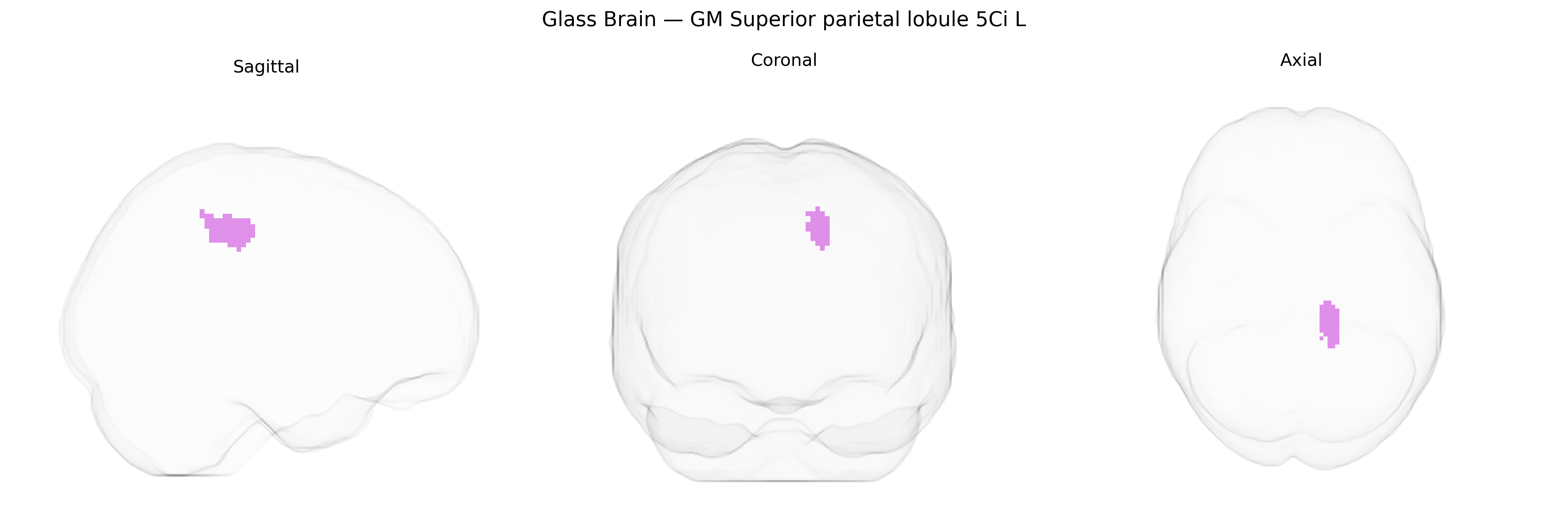
The bilateral GM Superior parietal lobule 5Ci L, as defined in the Juelich maxprob thr25 2mm atlas, corresponds to a cytoarchitectonically characterized subregion of Brodmann area 5 located in the medial portion of the superior parietal lobule, adjacent to the posterior bank of the precentral gyrus and extending toward the paracentral lobule. This region is implicated in higher-order somatosensory processing, sensorimotor integration, and aspects of proprioception and motor planning, particularly in transforming multisensory body-related information into coordinated actions. Neurons in 5Ci exhibit properties consistent with integration of tactile and proprioceptive input and contribute to representations of limb position and movement, supporting complex manual and whole-body behaviors. There is no direct Wikipedia article for “area 5Ci”; a closely related structure is the Superior parietal lobule.
The bilateral gray-matter Superior Parietal Lobule (SPL), including the 5Ci L subregion from the Juelich maxprob thr25 2mm atlas, has been implicated in multiple genetic and GWAS findings, although few studies target this cytoarchitectonic field specifically; instead, associations typically reference the superior or posterior parietal cortex more broadly. Large-scale imaging–genetics consortia (e.g., ENIGMA, UK Biobank) have identified common variants in genes involved in neurodevelopment, synaptic function, and axon guidance (such as MAPT, BDNF, and several loci near microtubule- and calcium-channel–related genes) that correlate with cortical thickness, surface area, or volume in superior parietal regions. Parietal structural and functional alterations in this territory have been linked to polygenic risk scores and individual risk loci for neurodevelopmental and psychiatric conditions, including schizophrenia, autism spectrum disorder, attention-deficit/hyperactivity disorder, and major depressive disorder, although the associations are typically modest and distributed across many regions. GWAS of cognitive traits—particularly visuospatial ability, working memory, and general intelligence—have reported that variants influencing SPL anatomy and connectivity contribute to interindividual differences in these traits, consistent with the SPL’s role in attention, sensory integration, and spatial cognition. In neurodegenerative disorders, genetic risk for Alzheimer’s disease (e.g., APOE ε4 and loci in CLU, PICALM, and others) has been associated with atrophy and hypometabolism in superior parietal and adjacent precuneus regions, while parietal involvement is also noted in genetic frontotemporal dementia and corticobasal syndrome, although these links are usually reported at a lobar or network level rather than at the resolution of 5Ci L. Overall, current genetic evidence supports a polygenic, distributed influence on SPL structure and function, with the 5Ci L region participating in networks whose variability reflects combined effects of many small-effect variants associated with cognition, psychiatric risk, and neurodegeneration.
Overview generated by GPT-4o (2026).
Region ID: 67
Hemisphere: bilateral
Atlas: Juelich maxprob thr25 2mm
Full Quality Version: Download MP4
Full Quality Version: Download MP4
Wali Sidiqyar*, Gaurav Rudravaram*, Elyssa M. McMaster, Trent M. Schwartz, Adam M. Saunders, Kurt G. Schilling, Bennett A. Landman "Introducing SPINS: A Shared Public Visualization Library of Neuroanatomical Structures." Medical Imaging with Deep Learning- short paper
This resource is licensed under CC0 1.0 Universal (Public Domain).