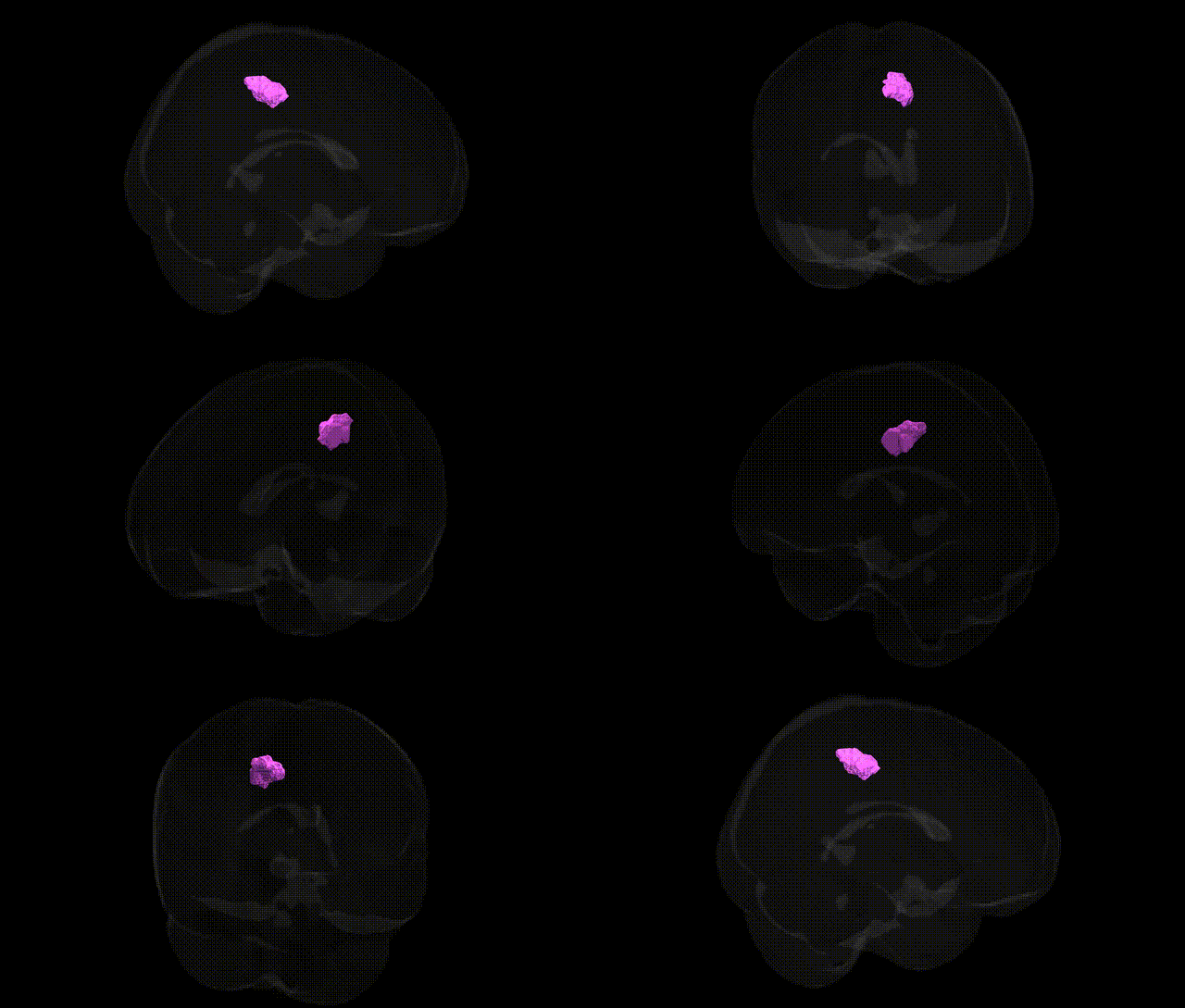
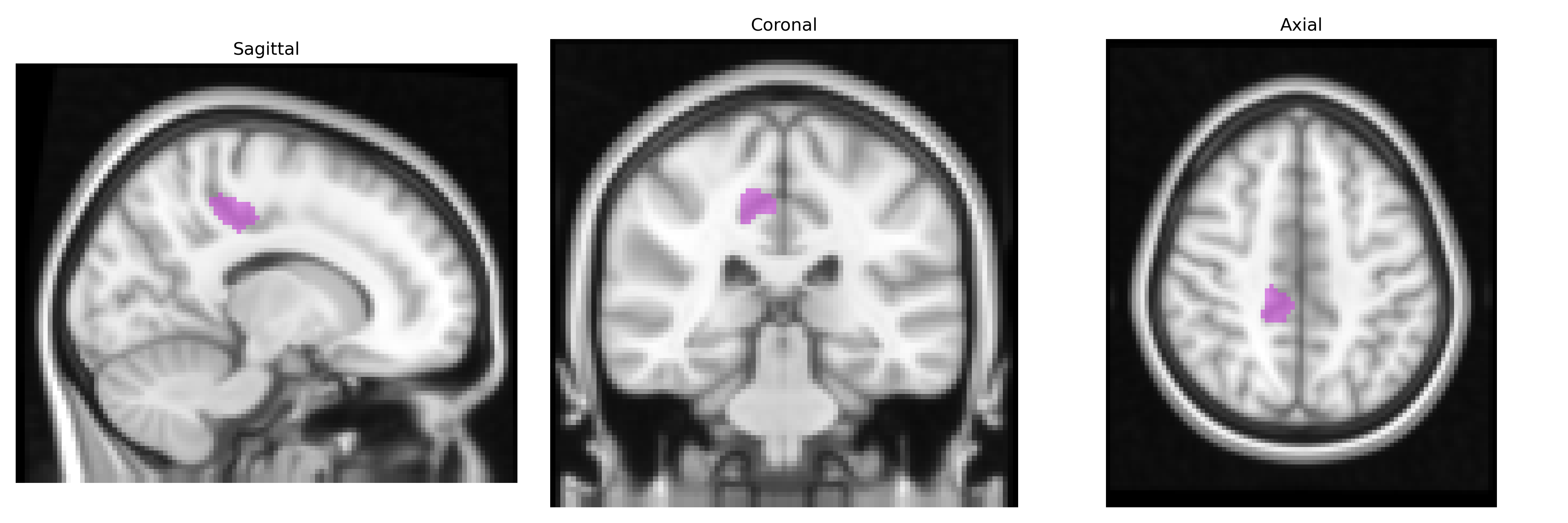
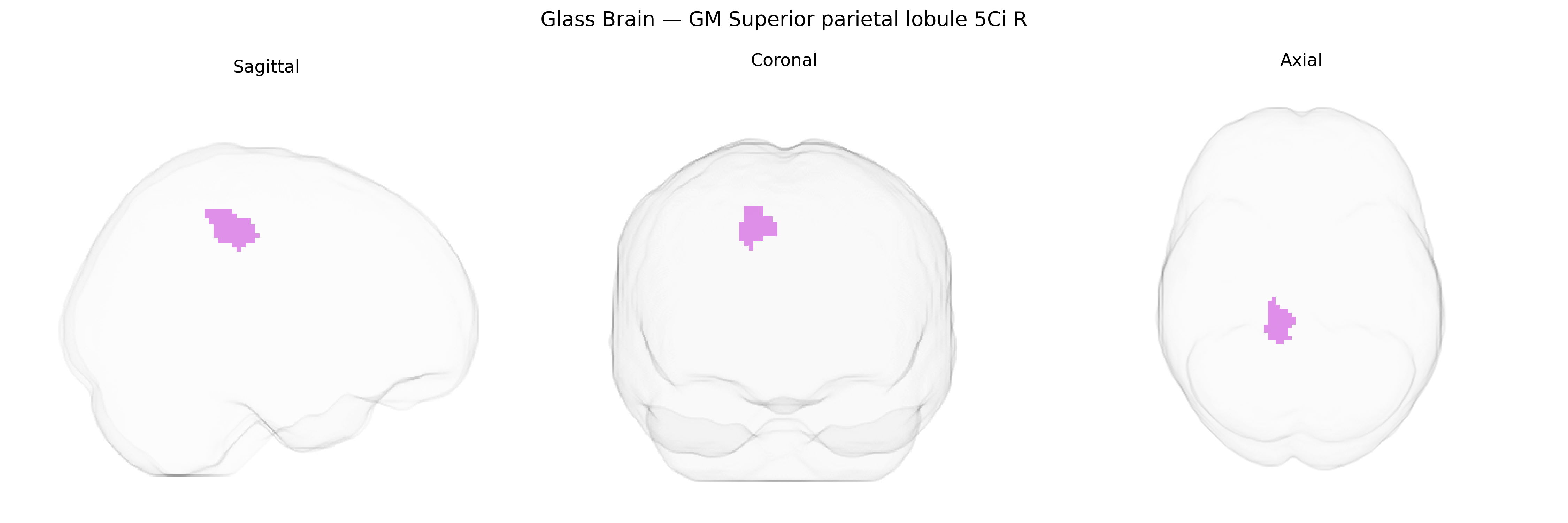
The bilateral GM Superior parietal lobule 5Ci R, as defined in the Juelich maxprob thr25 2mm atlas, corresponds to a cytoarchitectonic subregion of Brodmann area 5 within the superior parietal lobule, primarily involved in higher-order somatosensory processing and sensorimotor integration. This region participates in transforming proprioceptive and tactile information into coordinated motor commands and contributes to body-centered spatial representation, limb position sense, and the guidance of goal-directed actions such as reaching and grasping. Functionally, it forms part of the dorsal stream networks linking parietal and premotor cortices, supporting visuomotor coordination, motor planning, and aspects of attention related to the external and body-centered space. In humans, the superior parietal lobule has been implicated in multimodal integration, mental imagery of movement, and the maintenance of internal models of the body in space. There is no direct Wikipedia article for “Area 5Ci”; a closely related and encompassing structure is the Superior parietal lobule.
The bilateral gray matter Superior Parietal Lobule 5Ci R region (as defined in the Juelich maxprob thr25 2 mm atlas) corresponds to a cytoarchitectonic subregion of the superior parietal cortex, a hub for visuospatial integration, attention, and sensorimotor coordination. Although few GWAS explicitly target this fine-grained parcellation, genetic studies of cortical structure and function in parietal areas broadly—using atlases such as Desikan–Killiany, Destrieux, and multimodal parcellations—implicate numerous loci that influence parietal cortical thickness, surface area, and functional activation, including variants near genes such as HMGA2, IGF1, KIAA0586, and others involved in neurodevelopment, axon guidance, and synaptic plasticity. Large-scale neuroimaging GWAS (e.g., ENIGMA, UK Biobank) have repeatedly shown heritable variation in superior parietal morphology and connectivity, with polygenic influences overlapping those for general cognitive ability, educational attainment, and working memory performance, traits whose neural substrates often include superior parietal regions. Functionally, GWAS of task-based and resting-state fMRI have identified genetic contributions to frontoparietal and dorsal attention networks, within which superior parietal lobule subregions like 5Ci play key roles; implicated variants commonly map to genes involved in synaptic signaling and neuronal development. In terms of disorders, parietal structural and functional alterations with genetic underpinnings have been reported in schizophrenia, autism spectrum disorder, ADHD, and Alzheimer’s disease, although associations typically reference broader parietal or frontoparietal regions rather than the specific 5Ci compartment. Overall, while convergent genetic evidence links superior parietal cortex to cognition, attention, and neuropsychiatric risk, direct GWAS focused specifically on the 5Ci R subregion from the Juelich atlas remain sparse, and most known genetic associations are inferred from studies of coarser parietal measures or network-level phenotypes.
Overview generated by GPT-4o (2026).
Region ID: 68
Hemisphere: bilateral
Atlas: Juelich maxprob thr25 2mm
Full Quality Version: Download MP4
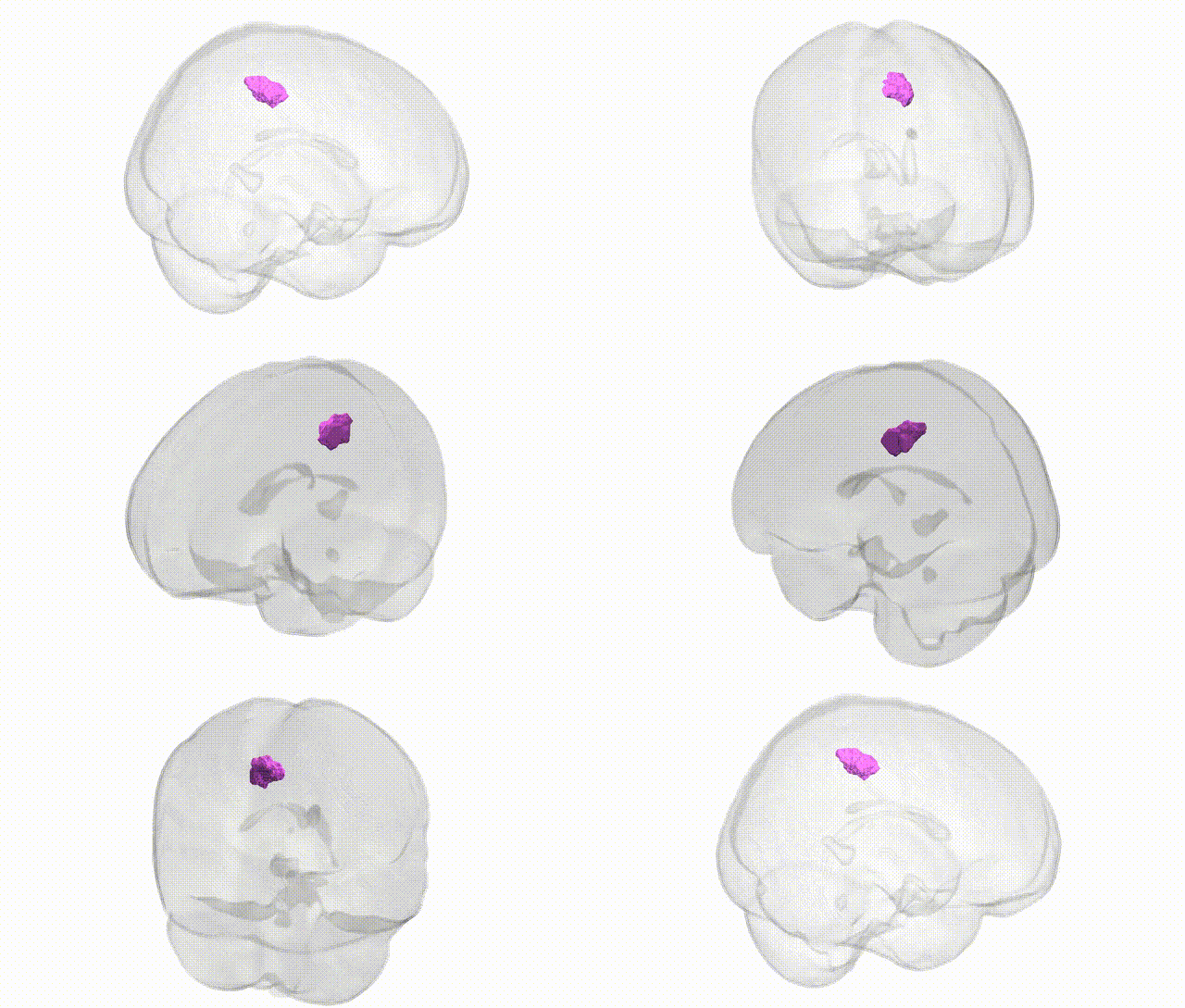
Full Quality Version: Download MP4
Wali Sidiqyar*, Gaurav Rudravaram*, Elyssa M. McMaster, Trent M. Schwartz, Adam M. Saunders, Kurt G. Schilling, Bennett A. Landman "Introducing SPINS: A Shared Public Visualization Library of Neuroanatomical Structures." Medical Imaging with Deep Learning- short paper
This resource is licensed under CC0 1.0 Universal (Public Domain).