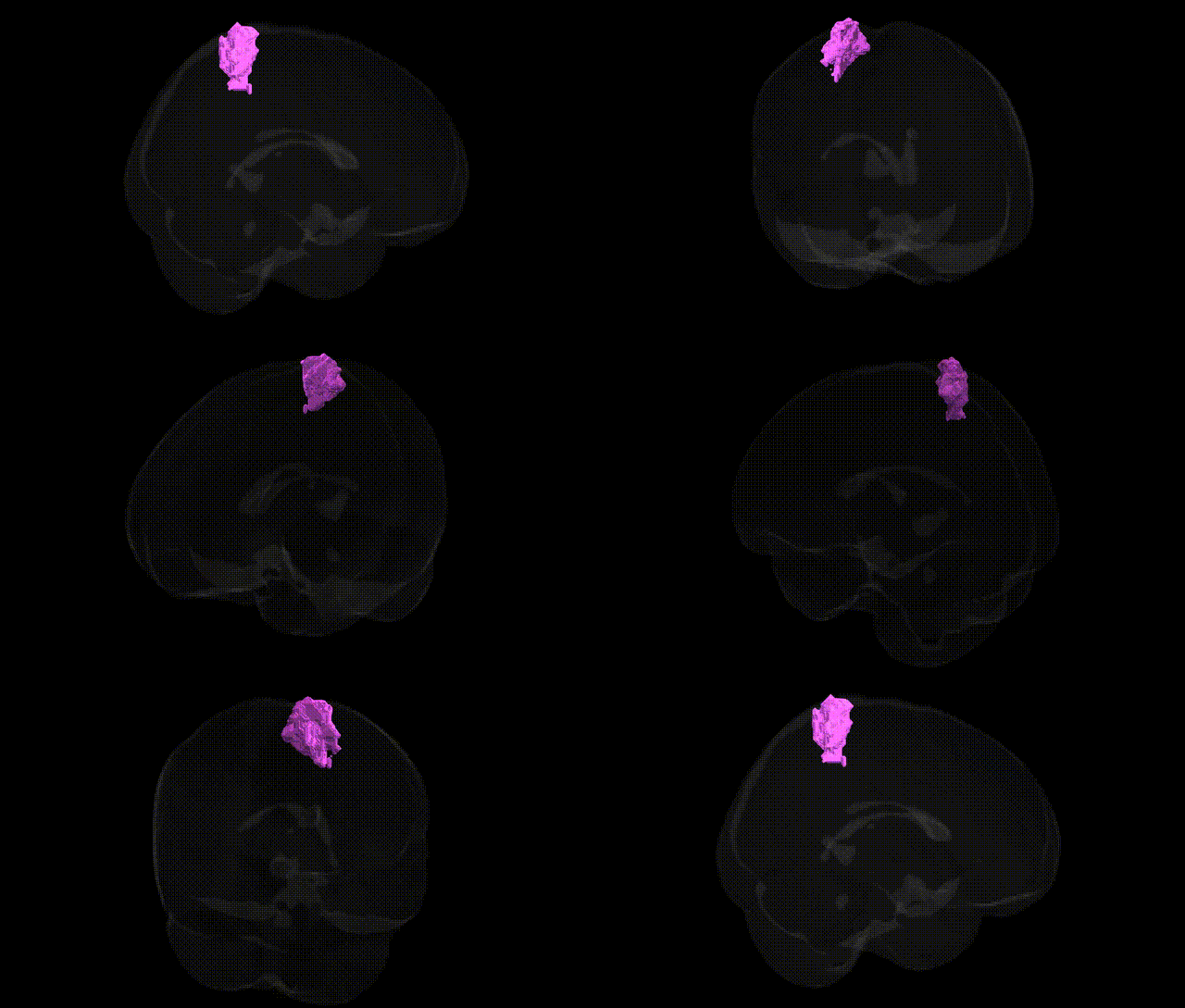
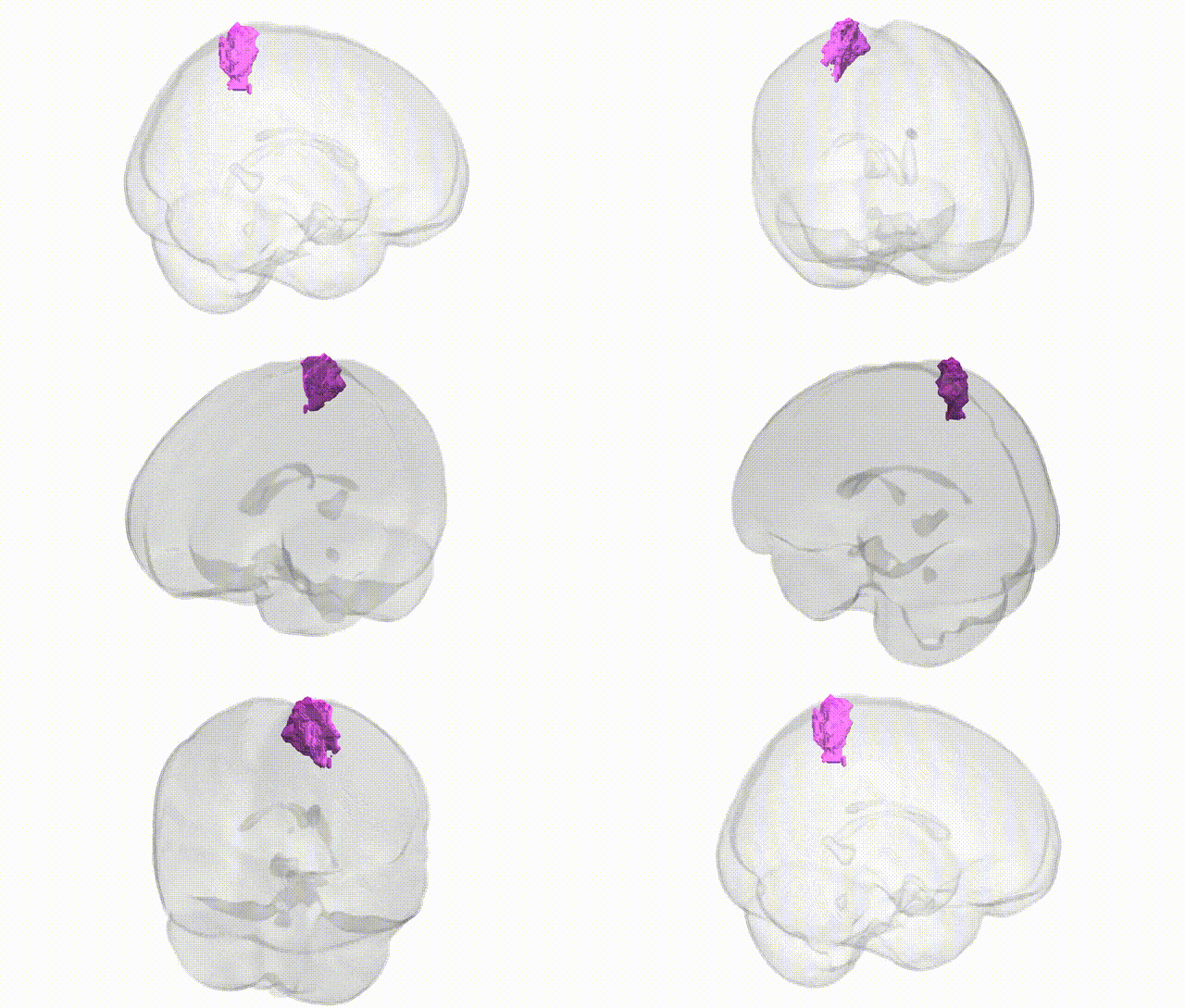
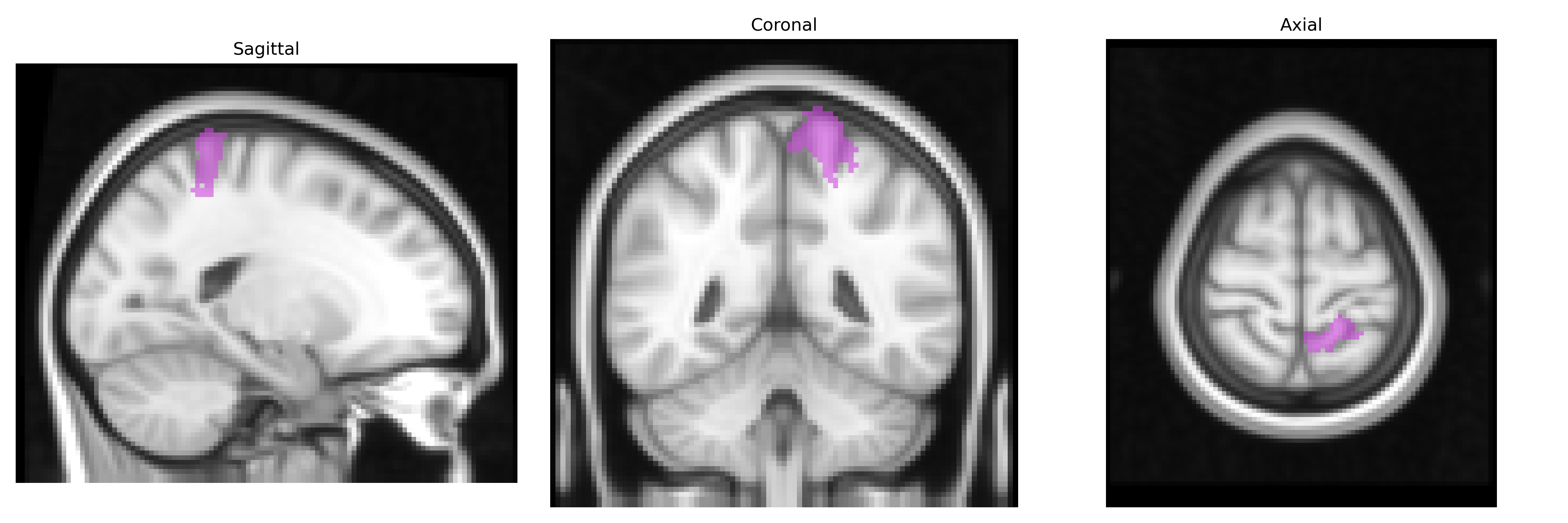
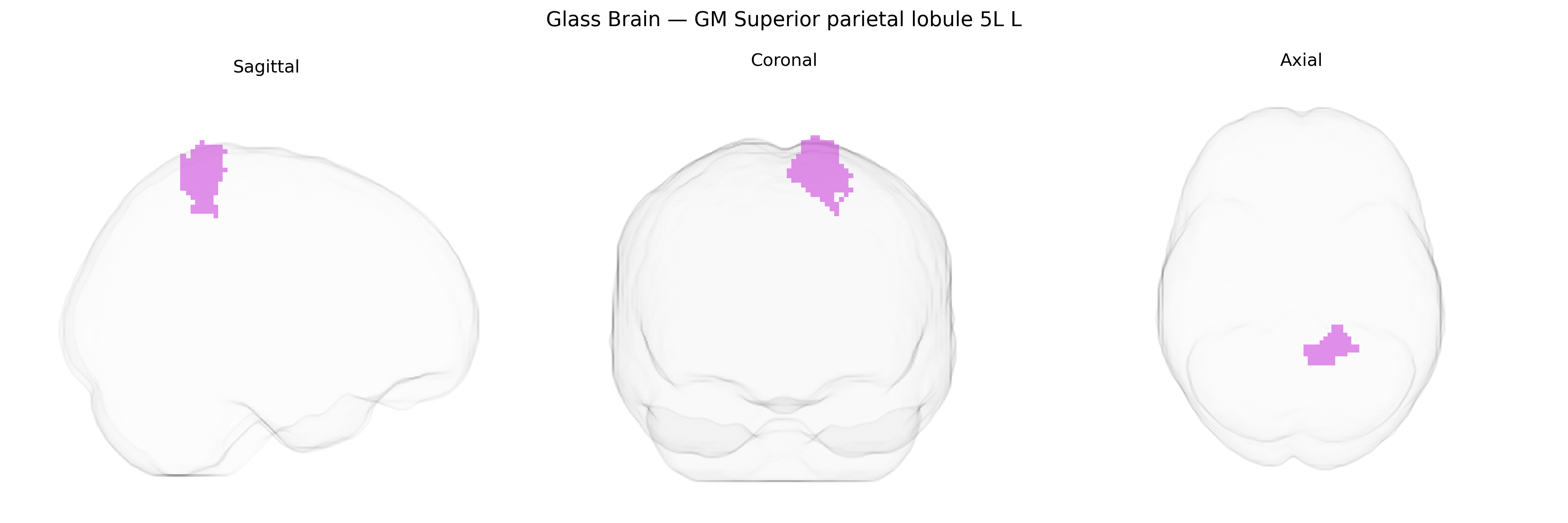
The bilateral GM Superior parietal lobule 5L L, as defined in the Juelich maxprob thr25 2mm atlas, corresponds to a left-hemispheric subdivision of cytoarchitectonic area 5 within the superior parietal lobule, implicated in higher-order somatosensory processing and sensorimotor integration. This region receives convergent tactile, proprioceptive, and visual input and contributes to the representation of limb position in space, visuomotor coordination, and the transformation of sensory information into action-related spatial maps. Functionally, area 5L is associated with planning and guidance of reaching and grasping movements, body-centered spatial cognition, and aspects of multimodal integration important for coordinated motor behavior. There is no direct Wikipedia article for “Area 5L”; a related structure is the Superior parietal lobule.
The bilateral GM Superior parietal lobule 5L (left SPL) from the Juelich maxprob thr25 2mm atlas corresponds broadly to dorsal parietal cortex implicated in visuospatial integration, attention, working memory, and sensorimotor coordination, and genetic associations for this region derive mainly from large-scale imaging-genetics and psychiatric GWAS rather than region-specific candidate studies. ENIGMA and UK Biobank analyses of cortical thickness and surface area have identified common variants in genes regulating neurodevelopment and synaptic function—such as microtubule-associated genes, cell-adhesion molecules, and Wnt/axon-guidance pathway genes—associated with parietal lobe morphology, with several loci showing effects that extend into the superior parietal cortex. Polygenic risk for schizophrenia, autism spectrum disorder, ADHD, and major depressive disorder has been associated with altered superior parietal structure or activation in imaging-genetics work, consistent with the region’s role in higher-order cognition and attention; similarly, genetic liability for Alzheimer’s disease (e.g., APOE-related risk) and other neurodegenerative conditions has been linked to parietal atrophy patterns that include SPL territory. GWAS of cognitive traits (general intelligence, working memory, mathematical ability) and educational attainment show that their polygenic scores correlate with individual differences in superior parietal thickness and activation, suggesting that many small-effect variants influencing neurodevelopment and synaptic plasticity converge on this region’s structure and function, even though no single gene or locus is uniquely or specifically defined for the GM Superior parietal lobule 5L area in current atlases.
Overview generated by GPT-4o (2026).
Region ID: 69
Hemisphere: bilateral
Atlas: Juelich maxprob thr25 2mm
Full Quality Version: Download MP4
Full Quality Version: Download MP4
Wali Sidiqyar*, Gaurav Rudravaram*, Elyssa M. McMaster, Trent M. Schwartz, Adam M. Saunders, Kurt G. Schilling, Bennett A. Landman "Introducing SPINS: A Shared Public Visualization Library of Neuroanatomical Structures." Medical Imaging with Deep Learning- short paper
This resource is licensed under CC0 1.0 Universal (Public Domain).