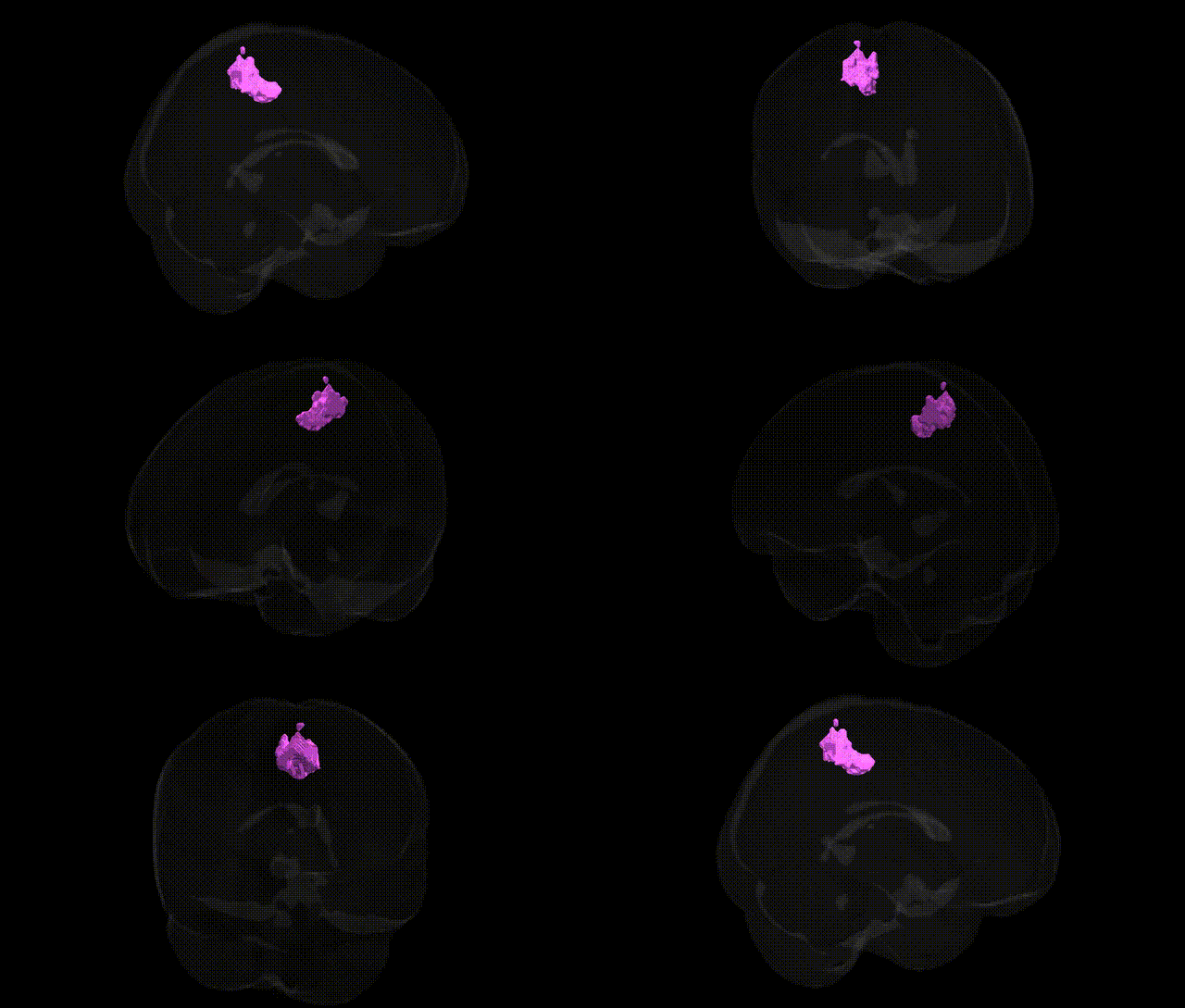
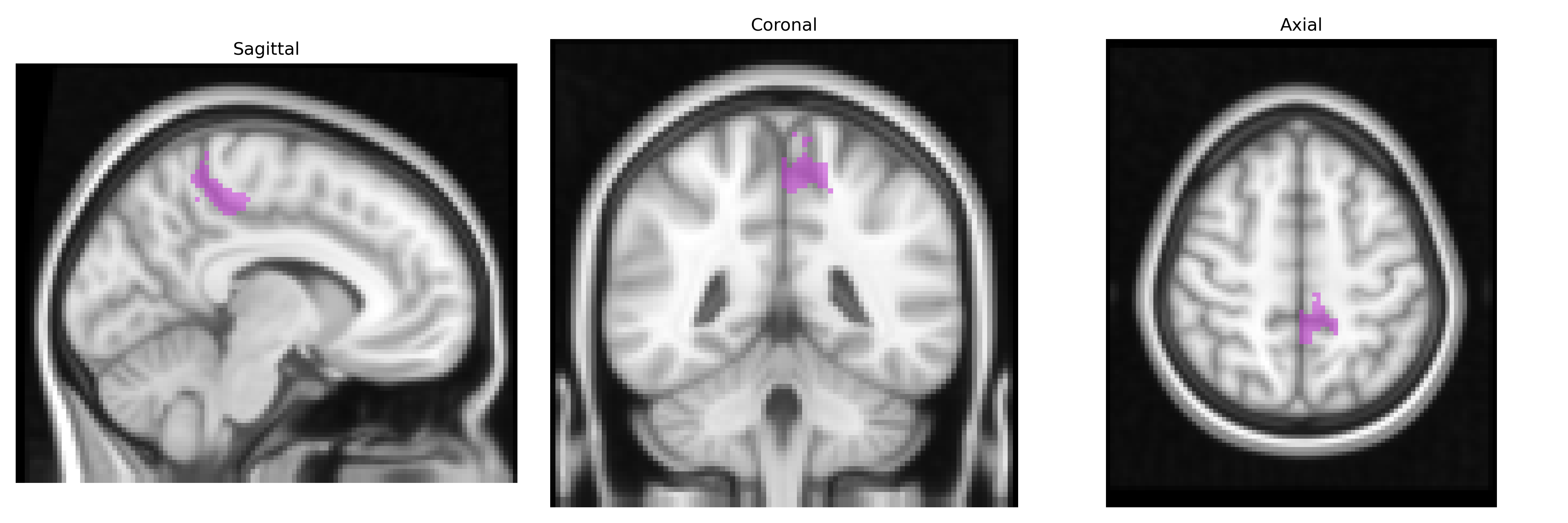
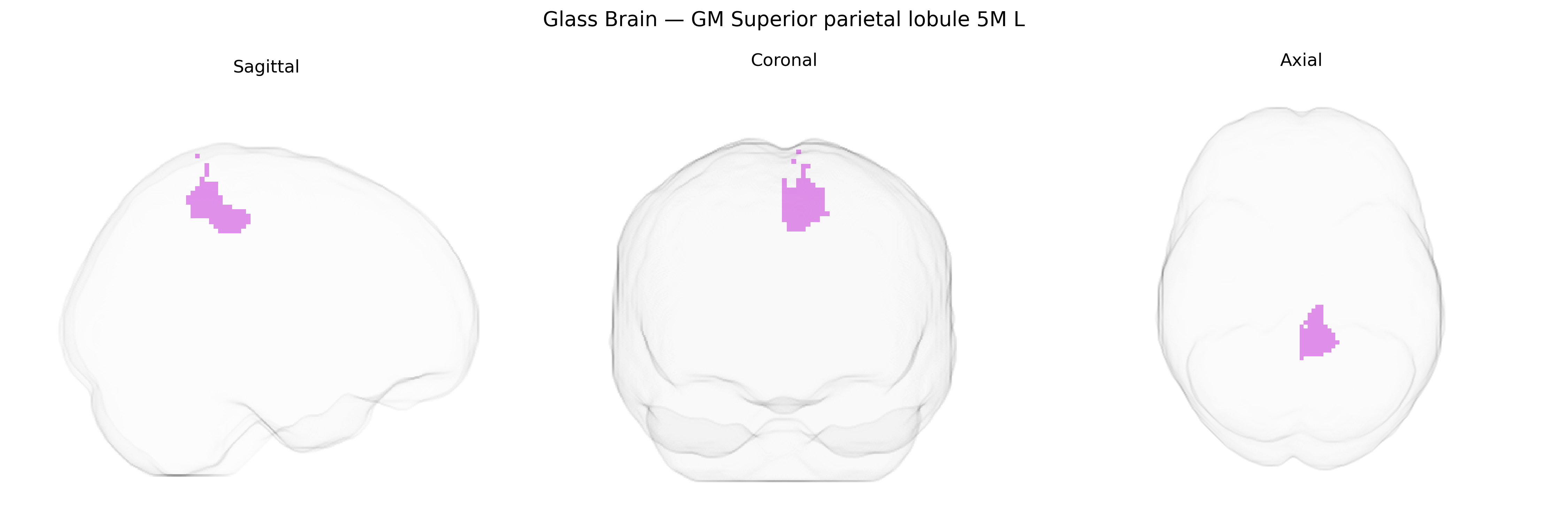
The bilateral GM Superior parietal lobule area 5M (L) in the Juelich maxprob thr25 2mm Atlas corresponds to a medial subdivision of Brodmann area 5 within the superior parietal lobule, located on the dorsal surface of the parietal lobe adjacent to the precuneus and posterior to the primary somatosensory cortex (area 3b/1/2). This region is implicated in higher-order somatosensory integration, visuomotor coordination, and body schema representation, receiving convergent input from primary somatosensory and visual areas and projecting to premotor and motor regions. Functionally, it supports complex sensorimotor transformations, including reaching, grasping, and spatial orientation of the limbs in egocentric space, and contributes to the integration of proprioceptive and tactile information with visual cues. Area 5M is considered part of the dorsal attention and sensorimotor networks and exhibits lateralization patterns that may differ between left and right hemispheres depending on task demands. There is no direct Wikipedia article for area 5M; a related structure is the Superior parietal lobule.
The bilateral GM Superior parietal lobule 5M L (SPL 5M) region, a medial superior parietal subdivision implicated in visuospatial integration, attention, and sensorimotor coordination, has been indirectly linked to genetic variation through large-scale imaging-genetics and GWAS studies rather than region-specific candidate gene work. Heritability analyses from consortia such as ENIGMA and UK Biobank indicate that cortical thickness and surface area in superior parietal regions show moderate genetic influence, enriched for common variants in neurodevelopmental and synaptic pathways (e.g., genes affecting axon guidance, dendritic spine formation, and glutamatergic signaling). GWAS of cortical morphology have identified loci in or near genes such as HMGA2, IGF1, PTCH1, and others associated with global and regional parietal surface area and thickness, while functional MRI genetics studies show that polygenic risk for schizophrenia, autism spectrum disorder, and ADHD is associated with altered activation or connectivity in superior parietal areas during attention and working memory tasks. Additional GWAS have linked superior parietal structure or function to traits including general cognitive ability, educational attainment, and visuospatial performance, with shared genetic architecture involving pleiotropic variants that also modulate frontoparietal networks. However, no major study has singled out the 5M subdivision specifically, so genetic associations for this region are inferred from broader superior parietal lobule or medial parietal measures rather than from SPL 5M-targeted GWAS.
Overview generated by GPT-4o (2026).
Region ID: 71
Hemisphere: bilateral
Atlas: Juelich maxprob thr25 2mm
Full Quality Version: Download MP4
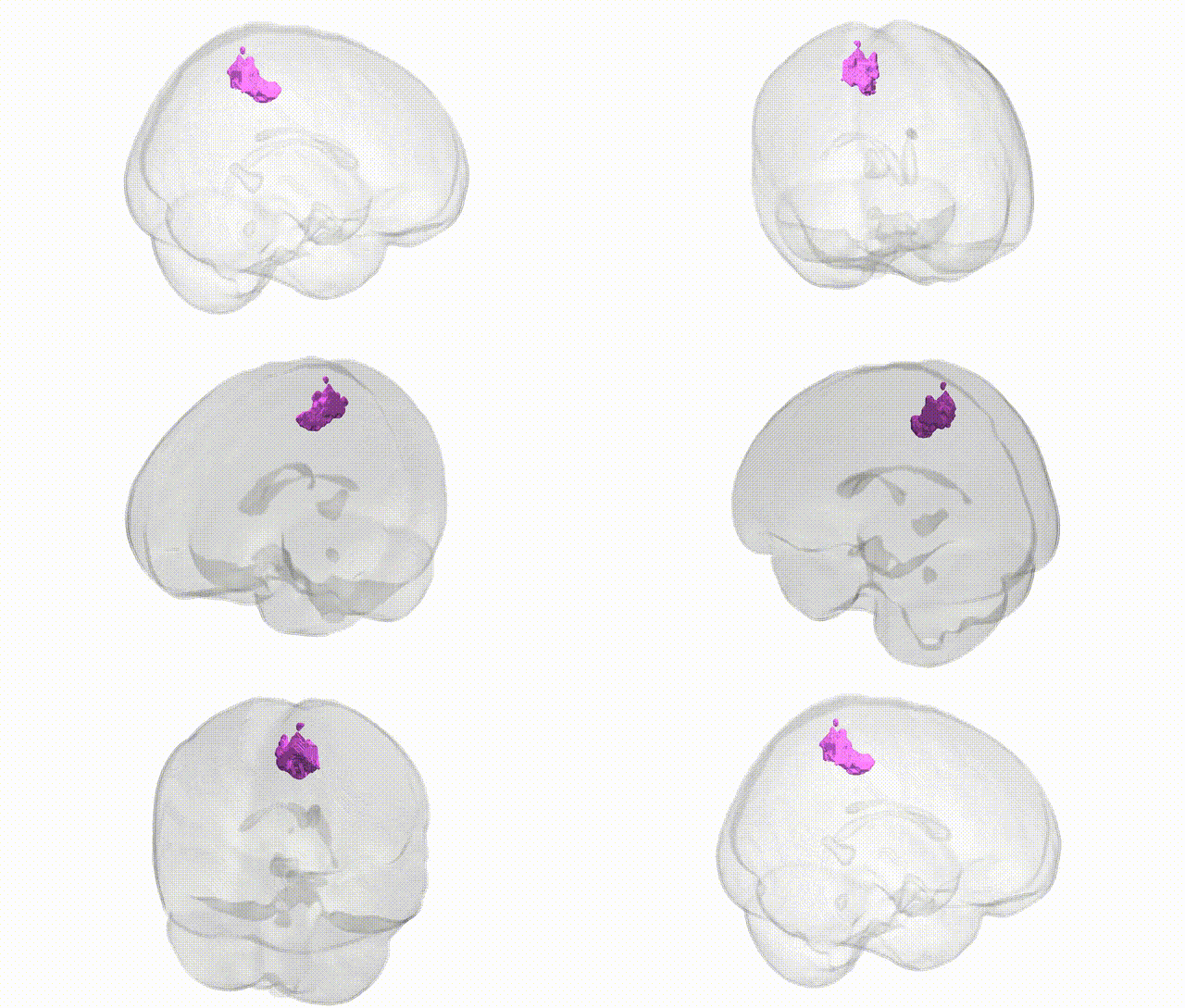
Full Quality Version: Download MP4
Wali Sidiqyar*, Gaurav Rudravaram*, Elyssa M. McMaster, Trent M. Schwartz, Adam M. Saunders, Kurt G. Schilling, Bennett A. Landman "Introducing SPINS: A Shared Public Visualization Library of Neuroanatomical Structures." Medical Imaging with Deep Learning- short paper
This resource is licensed under CC0 1.0 Universal (Public Domain).