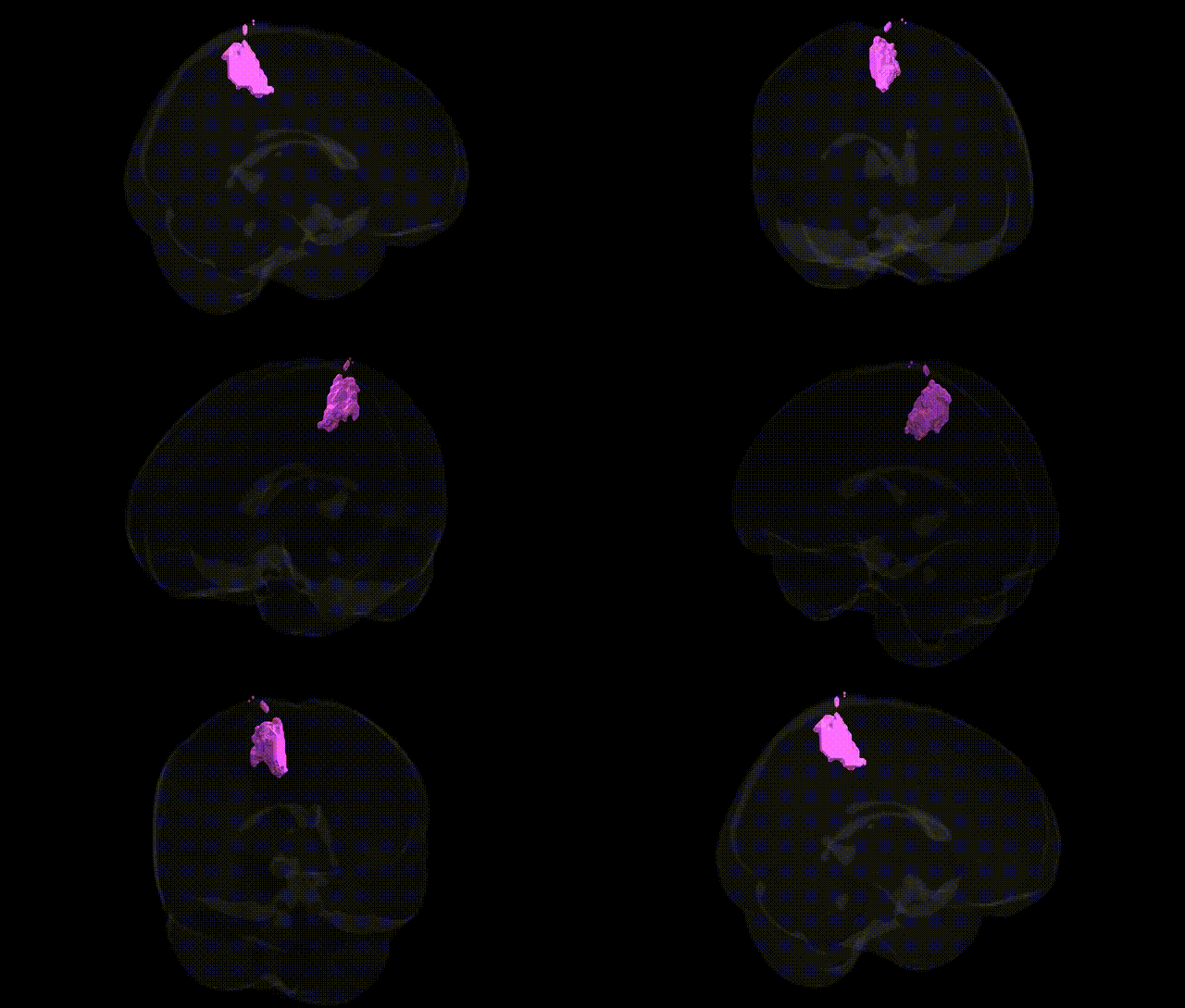
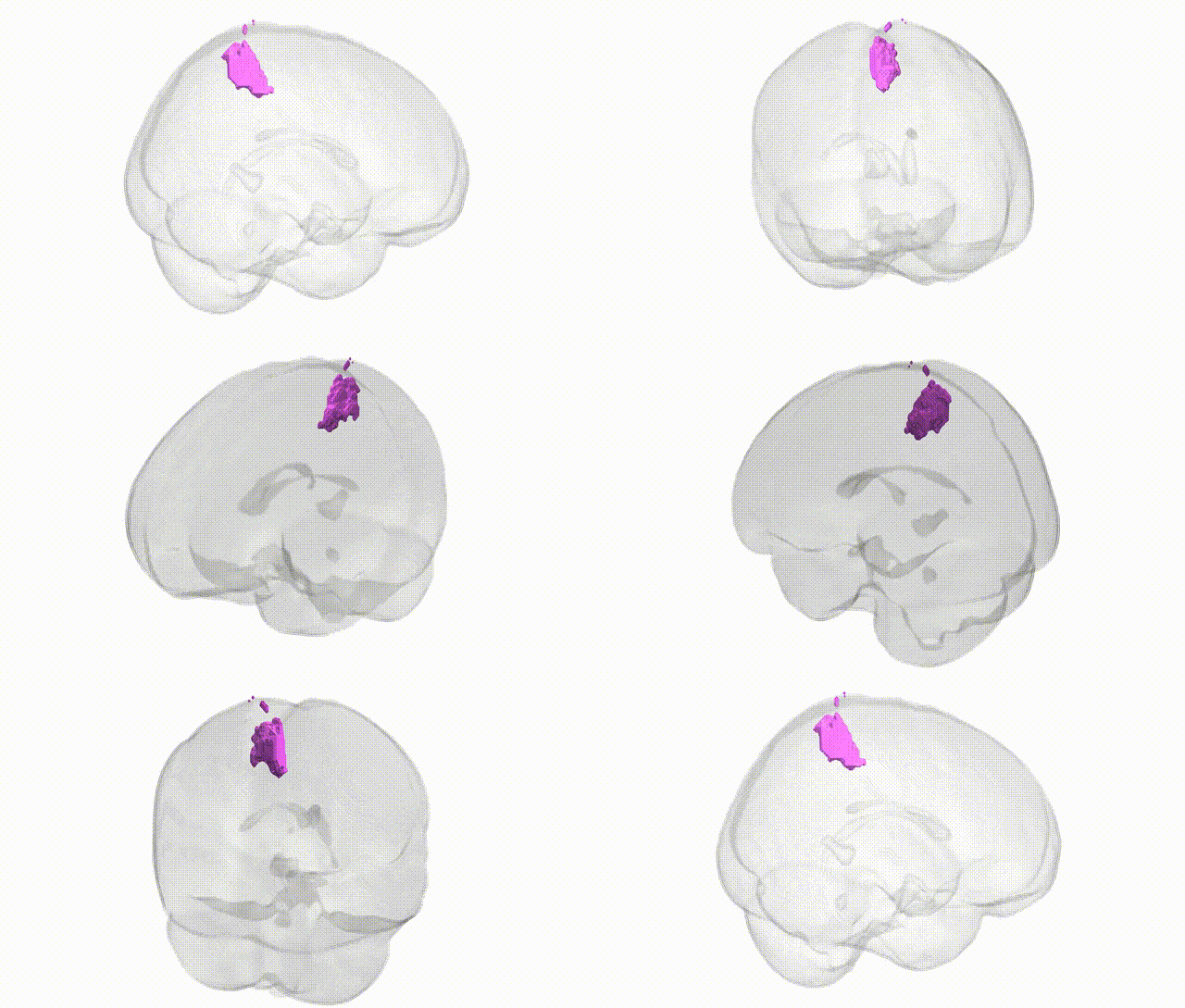
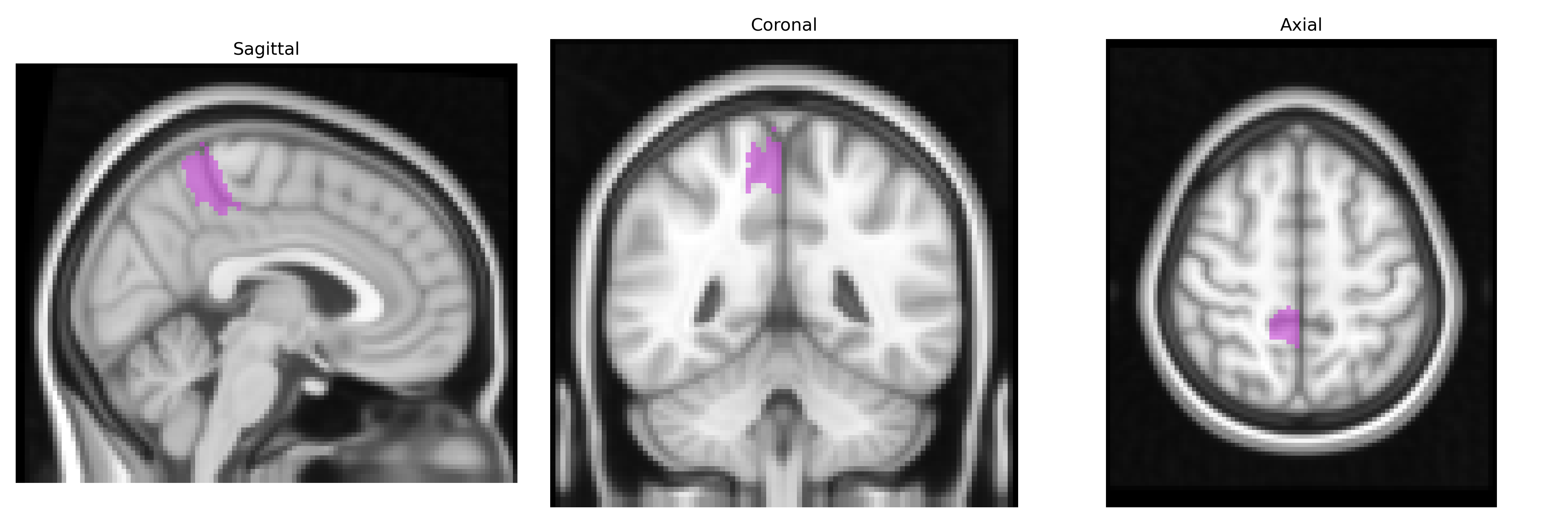
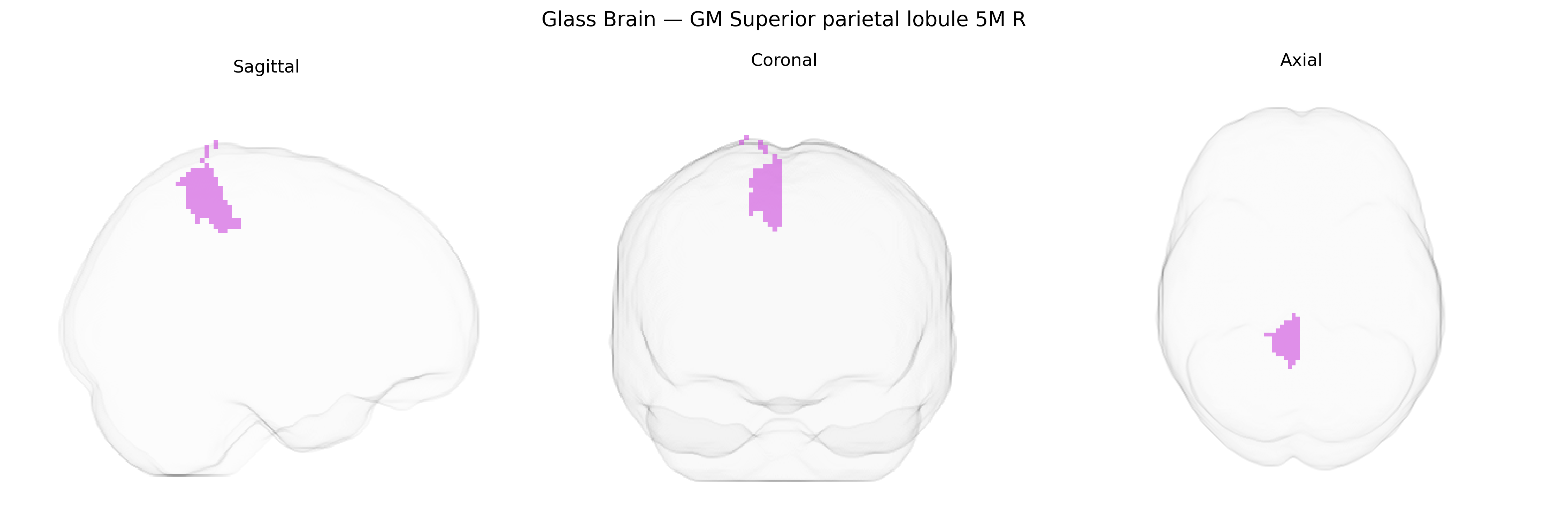
The bilateral GM Superior parietal lobule 5M R, as defined in the Juelich maxprob thr25 2 mm atlas, corresponds to a cytoarchitectonic subregion within the superior parietal lobule implicated in higher-order somatosensory integration, visuospatial processing, and sensorimotor transformation. Neurons in area 5M integrate proprioceptive, tactile, and visual information to support functions such as limb position sense, coordination of reaching and grasping, and the transformation of sensory input into motor plans. This region is interconnected with primary and secondary somatosensory cortices, premotor and motor areas, as well as posterior parietal and occipital regions, forming part of dorsal stream networks that contribute to spatial attention and goal-directed action. There is no direct Wikipedia article for “Superior parietal lobule 5M,” but it is a subregion of the Superior parietal lobule.
The bilateral GM Superior parietal lobule 5M (right hemisphere) in the Juelich maxprob thr25 2mm atlas corresponds to a dorsal parietal subregion implicated in visuospatial attention, sensorimotor integration, and higher-order cognitive control, and genetic associations involving this territory typically come from imaging genetics and GWAS of cortical structure and function rather than region-specific studies. Large-scale GWAS of cortical thickness and surface area (e.g., ENIGMA, UK Biobank) have linked common variants near genes such as HMGA2, IGF1, MEF2C, and WNT pathway components to parietal cortical morphology, with parietal measures often overlapping anatomically with superior parietal lobule territories including 5M. Functional imaging genetics has implicated dopaminergic (COMT, DRD2), glutamatergic (GRM3), and synaptic plasticity-related genes (BDNF, CNTNAP2) in activity and connectivity within dorsal attention and frontoparietal networks that prominently involve superior parietal cortex. GWAS of neurodevelopmental and psychiatric disorders—particularly schizophrenia, ADHD, autism spectrum conditions, and Alzheimer’s disease risk loci such as APOE—have shown case-control differences and polygenic risk score associations with structural or functional alterations in superior parietal regions, although these findings generally lack cytoarchitectonic specificity down to the 5M field. Additional associations arise from GWAS of cognitive traits (general intelligence, working memory, processing speed) and sensorimotor skills, where parietal cortical volume or activation serves as an intermediate phenotype linking polygenic scores to performance. Overall, current genetic evidence supports a role for common variants affecting neurodevelopment, synaptic signaling, and plasticity in modulating structural and functional properties of superior parietal lobule regions including 5M, but no robust GWAS has yet isolated variants uniquely and specifically tied to the Juelich 5M R subregion.
Overview generated by GPT-4o (2026).
Region ID: 72
Hemisphere: bilateral
Atlas: Juelich maxprob thr25 2mm
Full Quality Version: Download MP4
Full Quality Version: Download MP4
Wali Sidiqyar*, Gaurav Rudravaram*, Elyssa M. McMaster, Trent M. Schwartz, Adam M. Saunders, Kurt G. Schilling, Bennett A. Landman "Introducing SPINS: A Shared Public Visualization Library of Neuroanatomical Structures." Medical Imaging with Deep Learning- short paper
This resource is licensed under CC0 1.0 Universal (Public Domain).