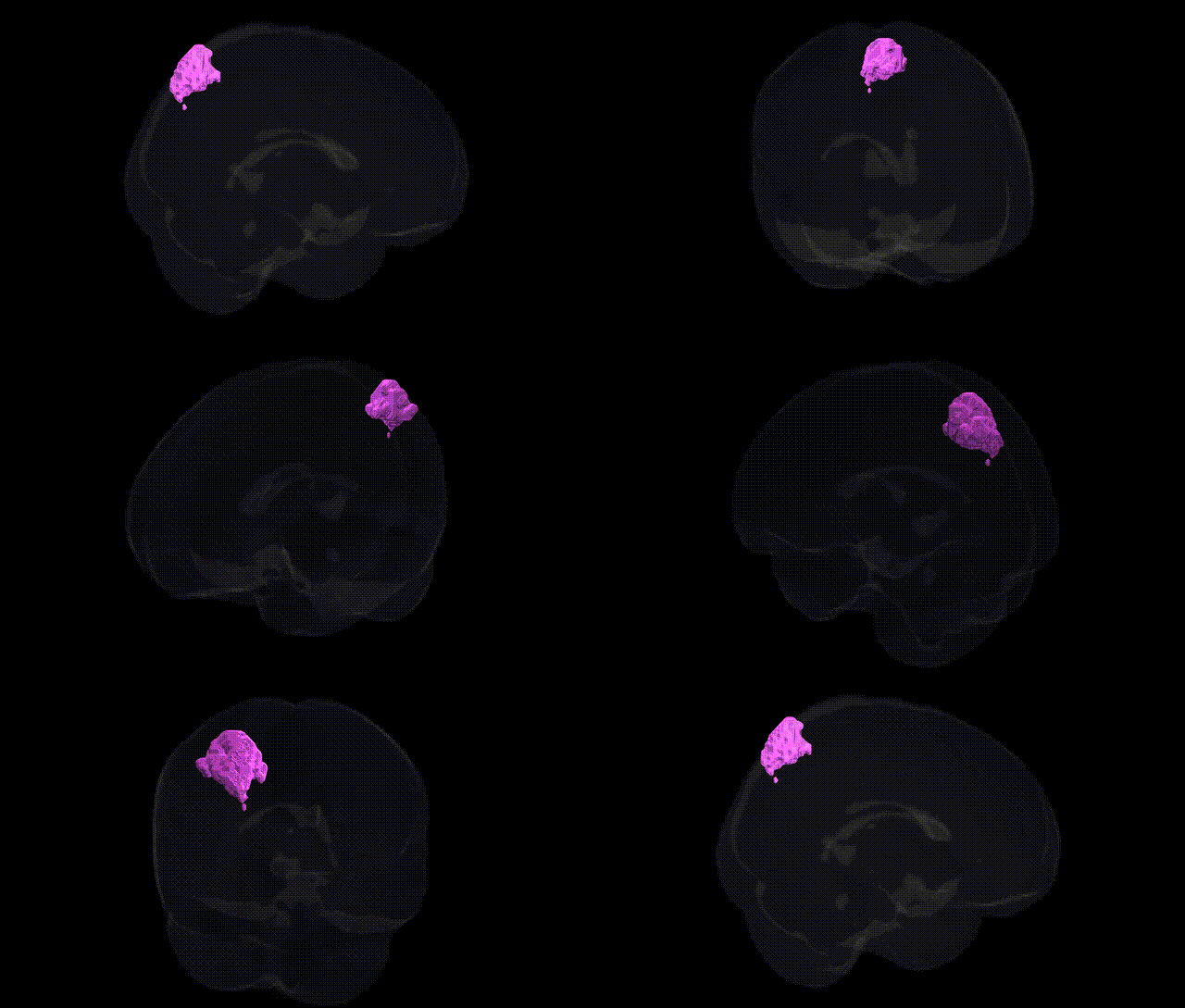
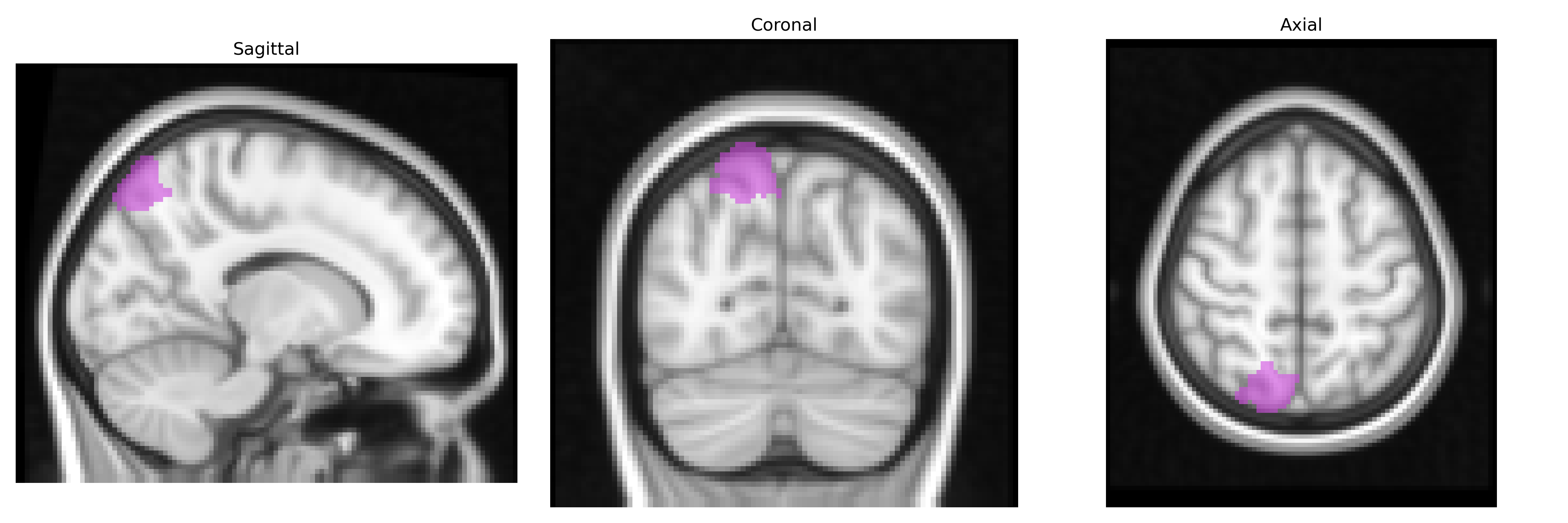
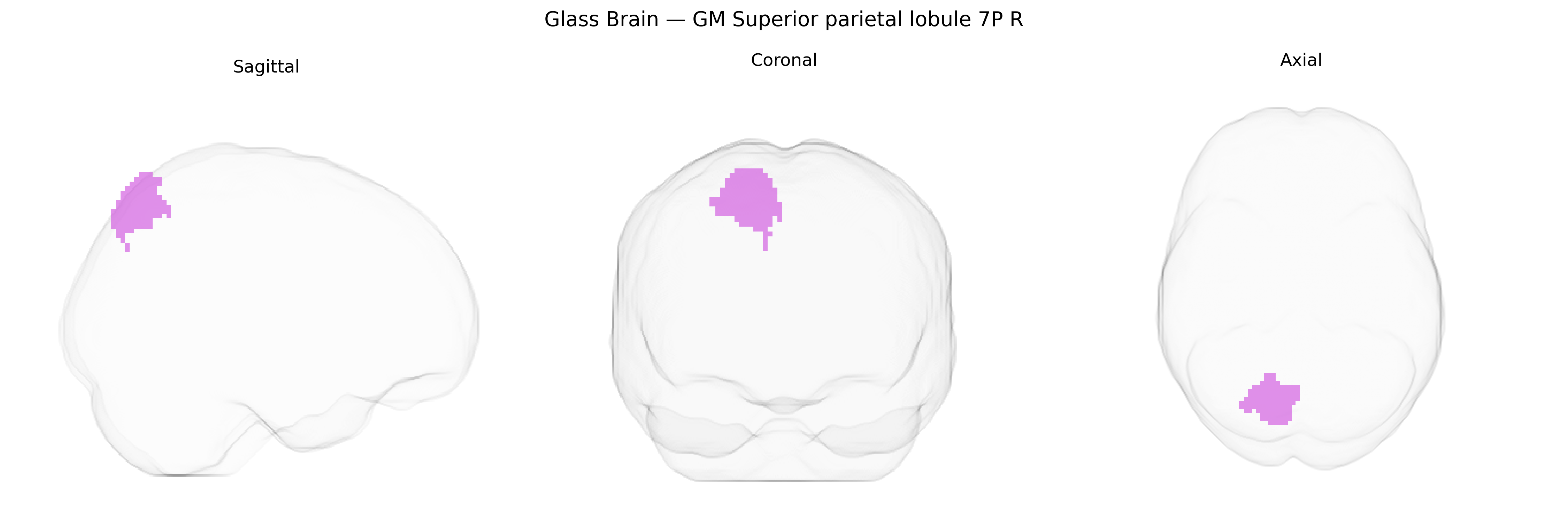
The bilateral GM Superior parietal lobule 7P R, as defined in the Juelich maxprob thr25 2mm Atlas, corresponds to a cytoarchitectonic subdivision of Brodmann area 7 located in the posterior portion of the superior parietal lobule of the right hemisphere. This region is implicated in higher-order somatosensory integration, visuospatial processing, and the coordination of attention and sensorimotor transformations, supporting functions such as spatial orientation, body-centered reference frames, and visually guided actions. Its connectivity profile includes strong links with dorsal visual stream areas, premotor and motor cortices, and other parietal association fields, situating it as a key hub in networks for goal-directed behavior and spatial cognition. There is no direct Wikipedia article for area 7P; a related and encompassing structure is the Superior parietal lobule.
The bilateral grey matter Superior Parietal Lobule (area 7P, right hemisphere) in the Juelich maxprob atlas is part of a dorsal parietal network implicated in visuospatial attention, sensorimotor integration, and higher-order cognition, and genetic associations to this region arise largely from imaging genetics and GWAS of brain structure and function rather than locus-specific studies of 7P itself. Large neuroimaging GWAS (e.g., ENIGMA, UK Biobank) have shown that cortical thickness, surface area, and volume in superior parietal regions are heritable and associated with variants in genes involved in neurodevelopment, neuronal migration, and synaptic signaling (such as BDNF, KIAA0319, microtubule-related and Wnt pathway genes), though these findings typically refer to the broader superior parietal cortex rather than cytoarchitectonic area 7P. Polygenic risk for schizophrenia, bipolar disorder, ADHD, and autism has been repeatedly linked to altered parietal morphology and connectivity, including reduced superior parietal volume or atypical activation during working memory and attention tasks, suggesting this region participates in genetically influenced vulnerability to cognitive and neurodevelopmental disorders. GWAS of general cognitive ability and education have identified variants near genes like HMGA2, CACNA1C, and others whose effects on frontoparietal networks include superior parietal cortex, and twin studies support substantial heritability of activation in parietal hubs during executive and visuospatial tasks. However, no major study has yet isolated genetic variants uniquely or specifically associated with Juelich-defined 7P R; instead, genetic associations are best understood as affecting distributed dorsal frontoparietal systems in which 7P R is a key node.
Overview generated by GPT-4o (2026).
Region ID: 80
Hemisphere: bilateral
Atlas: Juelich maxprob thr25 2mm
Full Quality Version: Download MP4
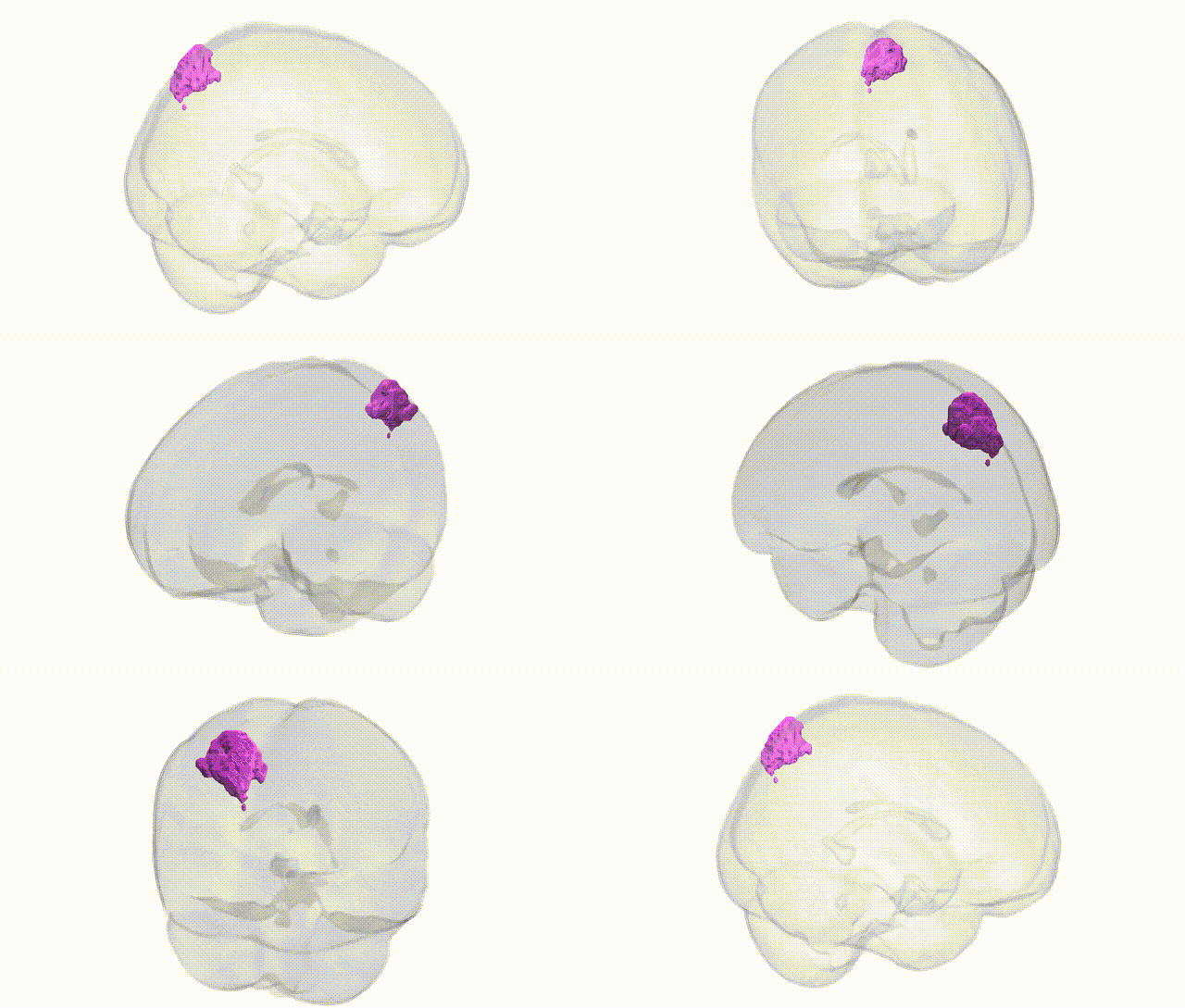
Full Quality Version: Download MP4
Wali Sidiqyar*, Gaurav Rudravaram*, Elyssa M. McMaster, Trent M. Schwartz, Adam M. Saunders, Kurt G. Schilling, Bennett A. Landman "Introducing SPINS: A Shared Public Visualization Library of Neuroanatomical Structures." Medical Imaging with Deep Learning- short paper
This resource is licensed under CC0 1.0 Universal (Public Domain).