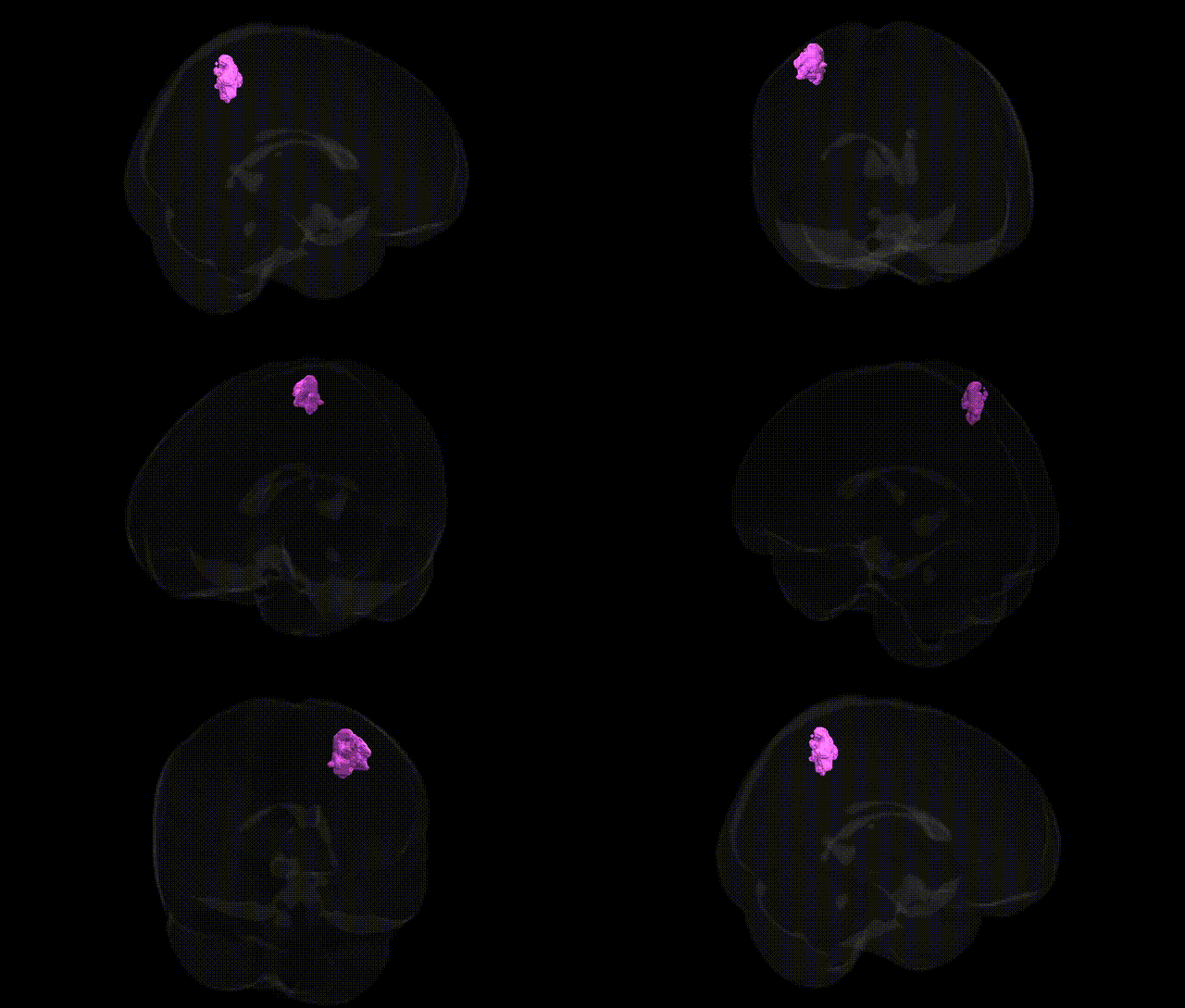
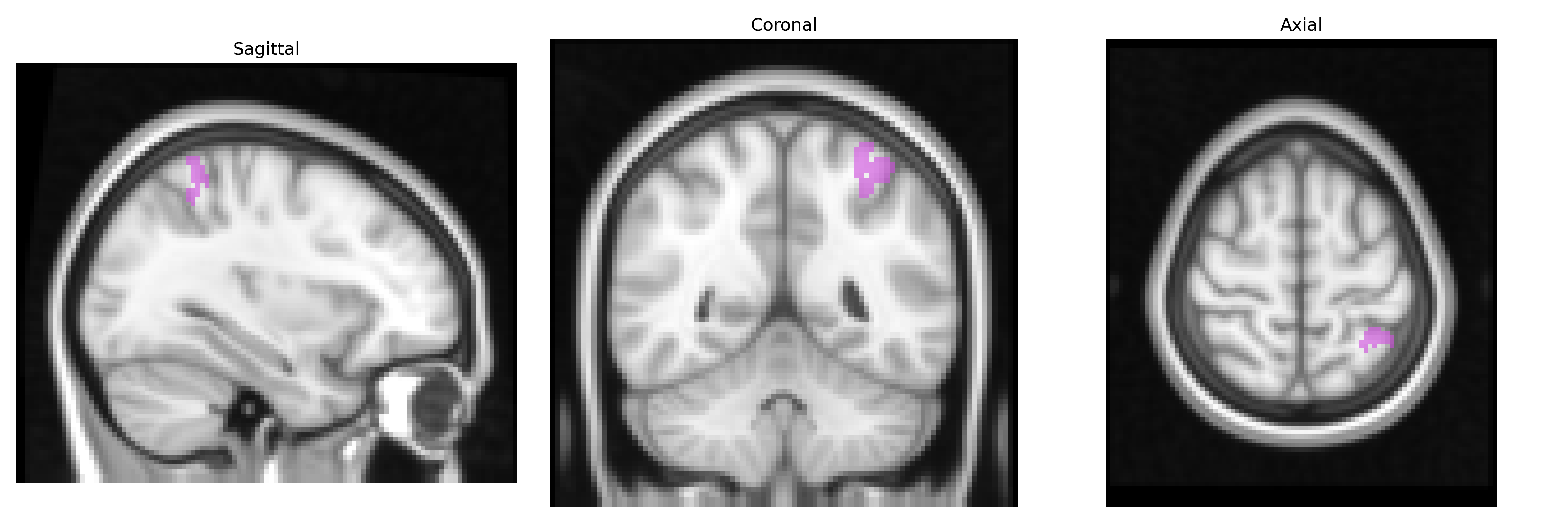
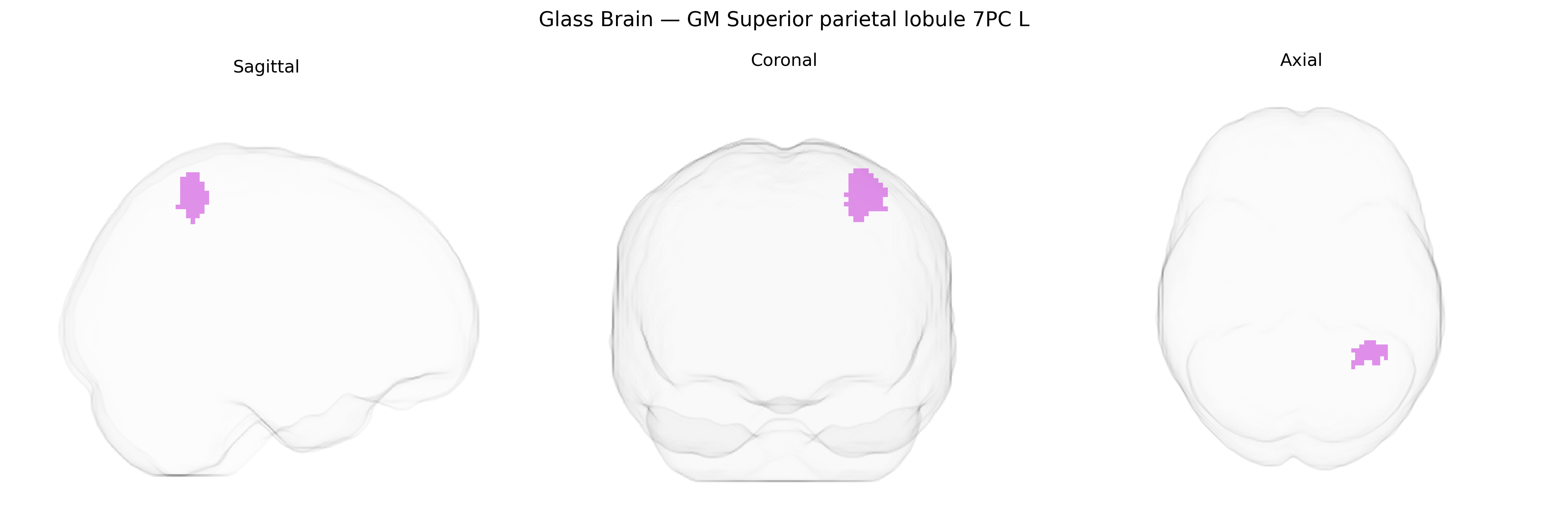
The bilateral GM Superior parietal lobule 7PC L, as defined in the Juelich maxprob thr25 2mm Atlas, corresponds to a cytoarchitectonically defined subregion of the superior parietal lobule (SPL) located in the posterior parietal cortex, predominantly within Brodmann area 7. This region is implicated in higher-order somatosensory integration, visuospatial processing, and the coordination of attention and sensorimotor transformations, contributing to functions such as reaching, grasping, and the guidance of limb movements in space. Neuronal populations in this area integrate visual, proprioceptive, and tactile information to support body-centered spatial representations and the updating of peripersonal space during action. Although no dedicated Wikipedia article exists for 7PC, it is part of the broader Superior parietal lobule.
The bilateral GM Superior parietal lobule (SPL; Juelich 7PC L, maxprob thr25 2 mm) is a high-order associative region implicated in visuospatial processing, attention, and sensorimotor integration, and its structure and function show heritable variation linked to multiple genetic loci. GWAS of cortical thickness and surface area have identified associations between SPL morphometry and common variants in genes involved in neurodevelopment and synaptic function, including loci near microtubule and axon guidance genes (e.g., CNTN4, DCC) and general brain growth pathways (e.g., IGF-related signaling), though specific effects on the 7PC subregion are typically inferred from parietal lobe–wide analyses rather than fine-grained cytoarchitectonic parcellations. Large imaging-genetics studies (e.g., ENIGMA, UK Biobank) report that SPL gray-matter metrics are influenced by polygenic factors overlapping with cognitive performance and educational attainment, and multivariate approaches link SPL patterns to schizophrenia, ADHD, and autism spectrum disorder risk alleles, often via shared networks for attention and executive control. SPL activation and connectivity, including 7PC territory, have also been implicated in GWAS of traits such as general intelligence, visuospatial ability, and motor coordination, with enrichment in genes governing synaptic plasticity and calcium signaling. However, direct GWAS focused specifically on the Juelich 7PC SPL subregion are lacking, and most genetic associations to this area are derived from broader parietal or frontoparietal network analyses, so current evidence supports SPL involvement in polygenic architectures underlying cognition and neuropsychiatric vulnerability rather than discrete single-gene effects.
Overview generated by GPT-4o (2026).
Region ID: 77
Hemisphere: bilateral
Atlas: Juelich maxprob thr25 2mm
Full Quality Version: Download MP4
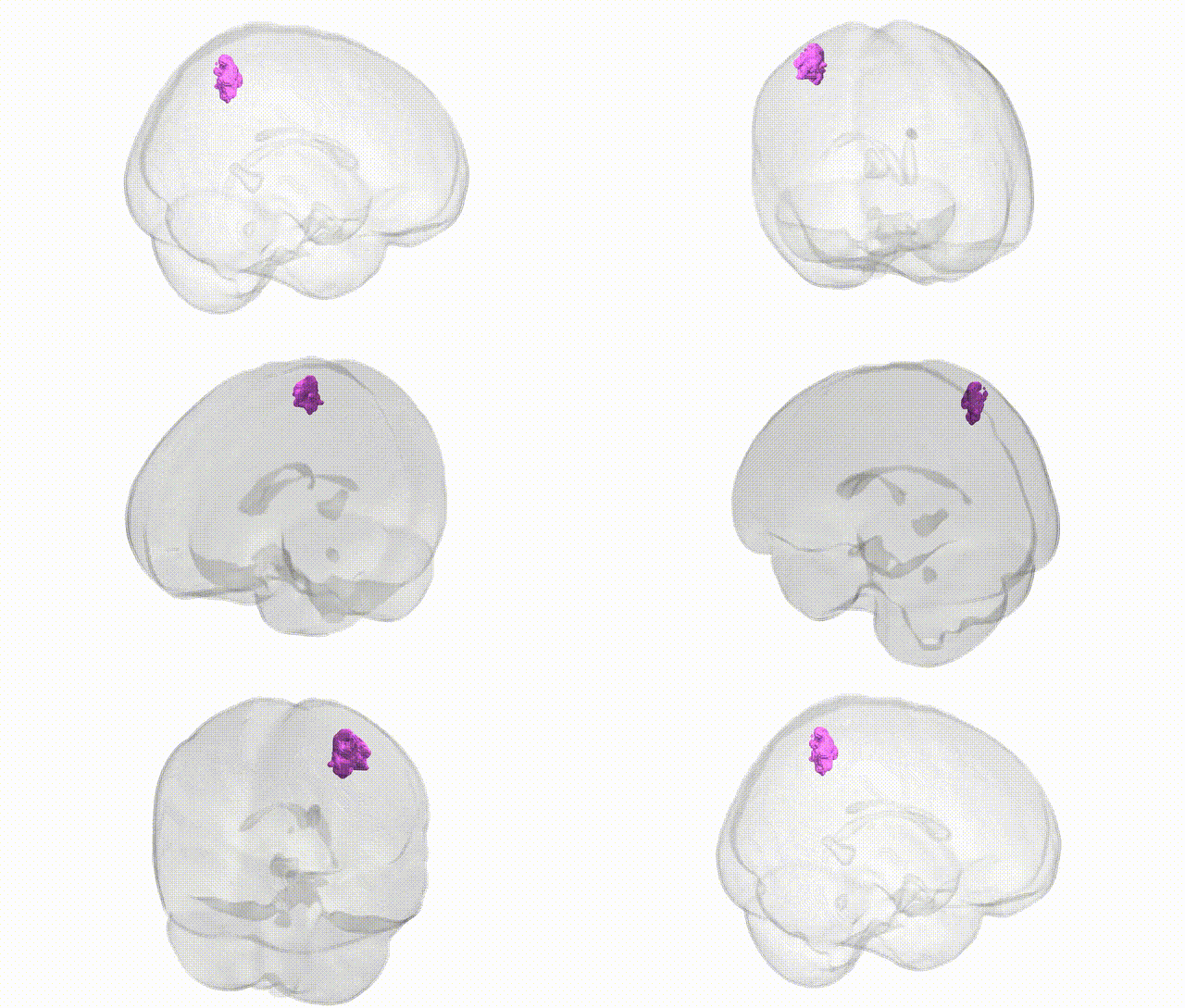
Full Quality Version: Download MP4
Wali Sidiqyar*, Gaurav Rudravaram*, Elyssa M. McMaster, Trent M. Schwartz, Adam M. Saunders, Kurt G. Schilling, Bennett A. Landman "Introducing SPINS: A Shared Public Visualization Library of Neuroanatomical Structures." Medical Imaging with Deep Learning- short paper
This resource is licensed under CC0 1.0 Universal (Public Domain).