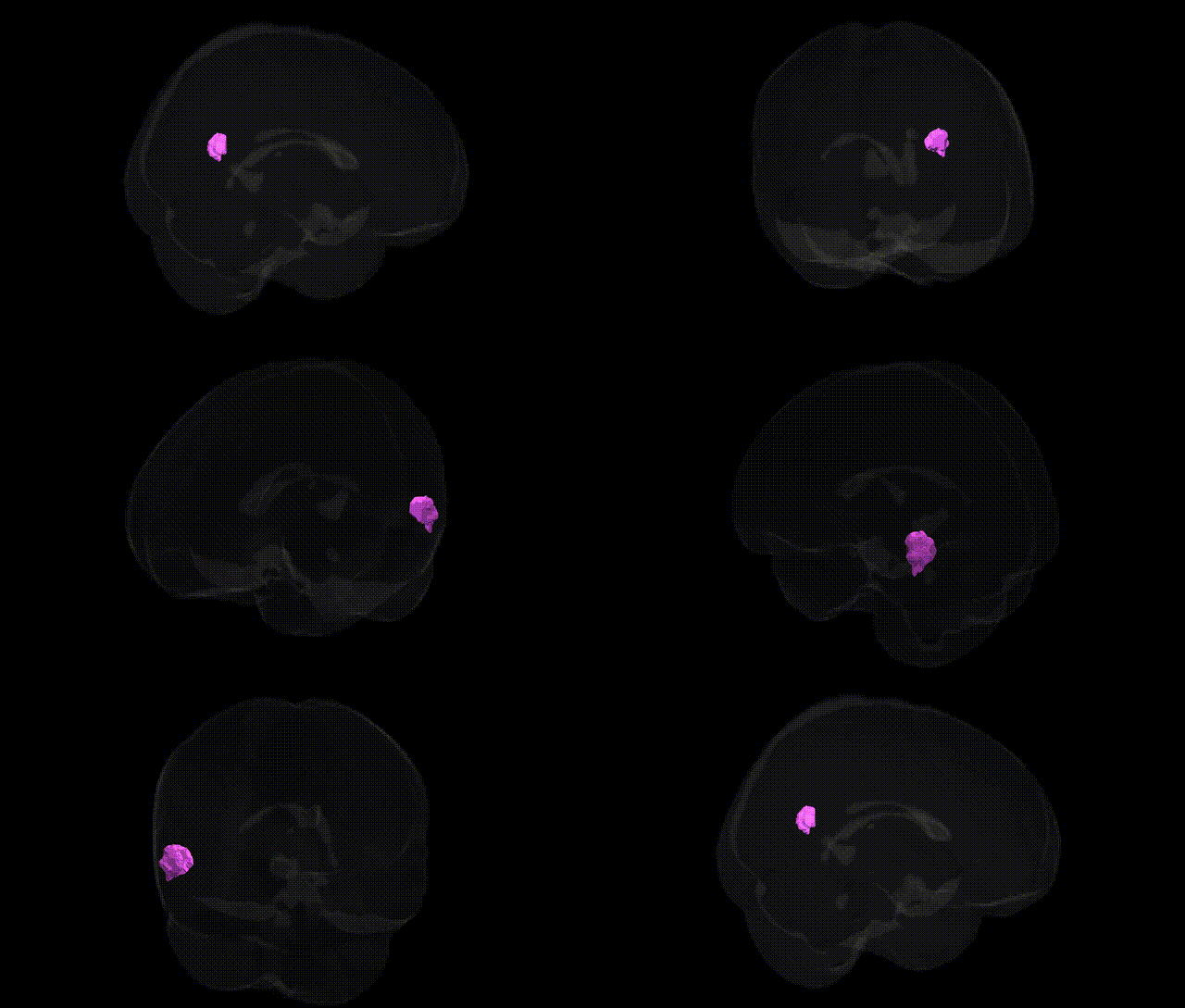
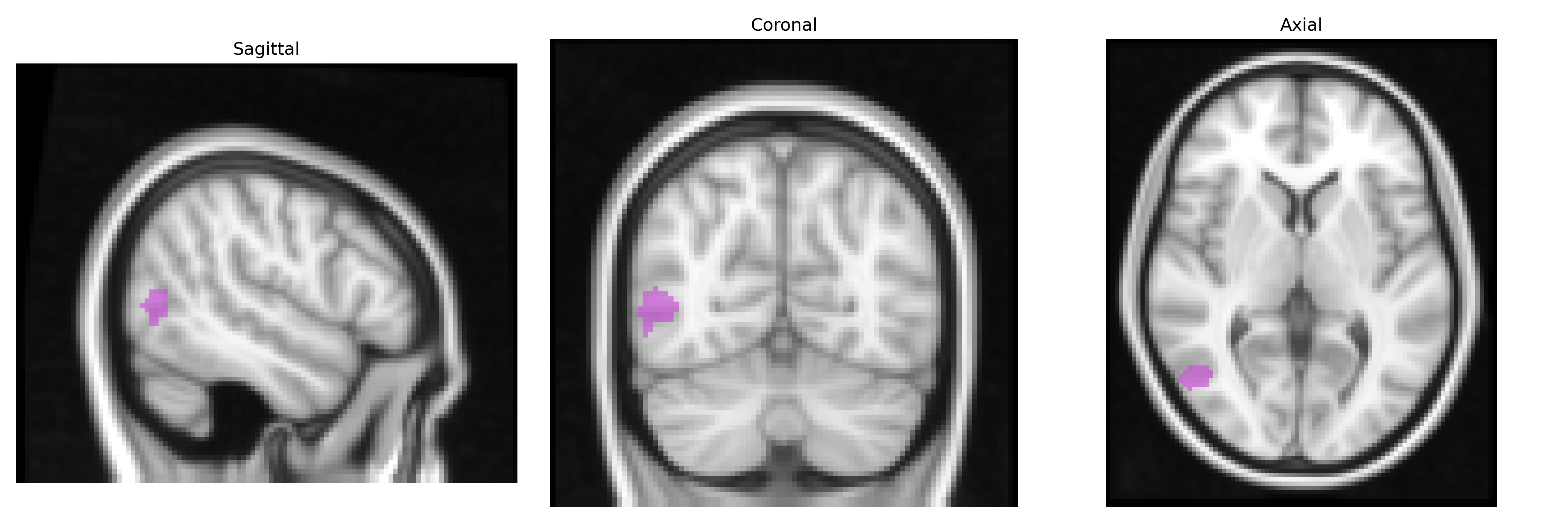
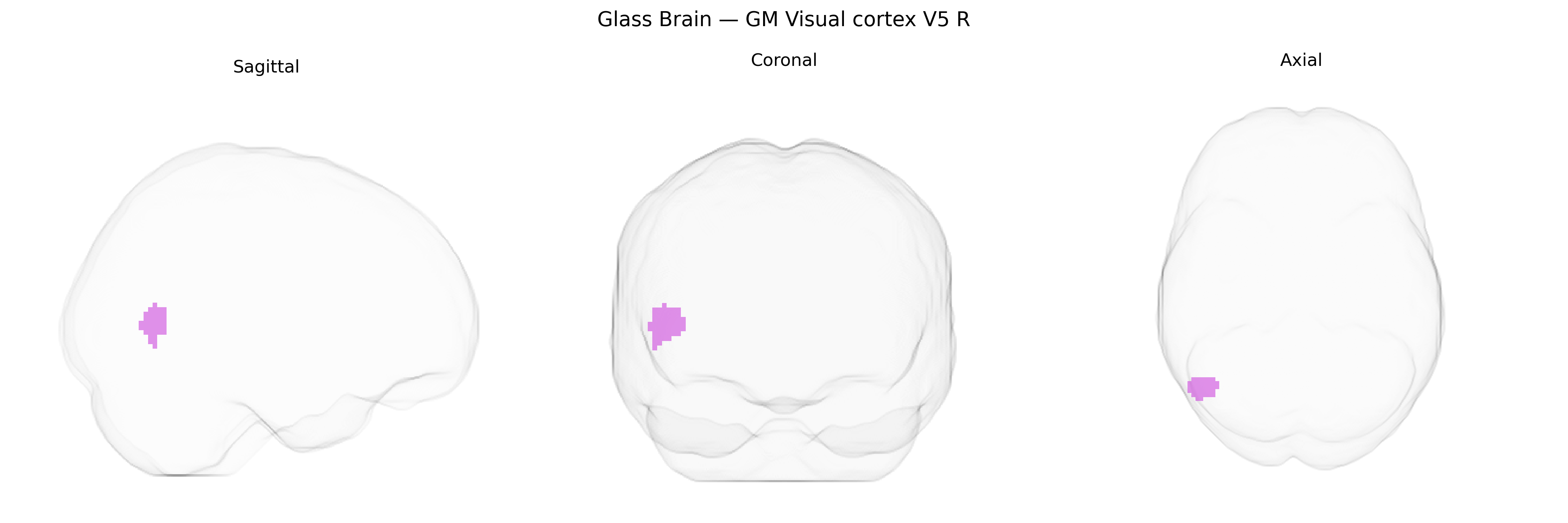
The bilateral GM Visual cortex V5 R region in the Juelich maxprob thr25 2mm Atlas corresponds to the right hemisphere portion of human area V5/MT, a motion-sensitive extrastriate visual region located in the lateral occipital and posterior temporal cortex. This region is characterized by strong selectivity for visual motion, including direction and speed, and contributes critically to perception of moving objects, motion coherence, and optic flow. Neurons in V5/MT integrate inputs from earlier visual areas (such as V1 and V2) and project to higher-order dorsal stream regions involved in visuospatial processing and visually guided action. Functionally, the right V5/MT is implicated in motion perception, smooth pursuit eye movements, and the integration of motion cues for object tracking and navigation. There is no direct Wikipedia article specifically for “Visual cortex V5 R,” but it is part of human visual area MT/V5: Visual area MT.
The bilateral GM Visual cortex V5 R (also referred to as hMT+/V5 in the Juelich maxprob thr25 2mm atlas) is a motion-sensitive visual area in the lateral occipitotemporal cortex, and genetic associations with this region are largely inferred from imaging genetics and GWAS of occipital/visual cortical structure and function rather than from V5-specific large-scale studies. GWAS of cortical thickness and surface area (e.g., ENIGMA and UK Biobank cohorts) have identified multiple loci influencing occipital and lateral temporal visual regions, including variants near genes such as TCF4, PAX6, and MEF2C that are involved in neurodevelopment and synaptic function; these loci often show pleiotropic associations with neurodevelopmental and psychiatric conditions, including schizophrenia, autism spectrum disorder, and major depressive disorder, in which altered activation or morphology of motion-sensitive visual cortex has been reported. Polygenic scores for general cognitive ability and educational attainment have been linked to variability in visual cortical volume and functional activation during motion perception tasks, suggesting a distributed genetic architecture affecting V5 along with other visual areas. Additionally, rare variant and copy number variant studies in disorders characterized by visual motion perception abnormalities (such as certain forms of dyslexia, autism, and schizophrenia) implicate genes involved in excitatory–inhibitory balance and visual pathway development, which may secondarily affect V5 function, though direct region-specific GWAS hits for V5 R in the Juelich atlas remain limited and most evidence is indirect, coming from broader occipital or dorsal visual stream phenotypes rather than this parcel alone.
Overview generated by GPT-4o (2026).
Region ID: 90
Hemisphere: bilateral
Atlas: Juelich maxprob thr25 2mm
Full Quality Version: Download MP4
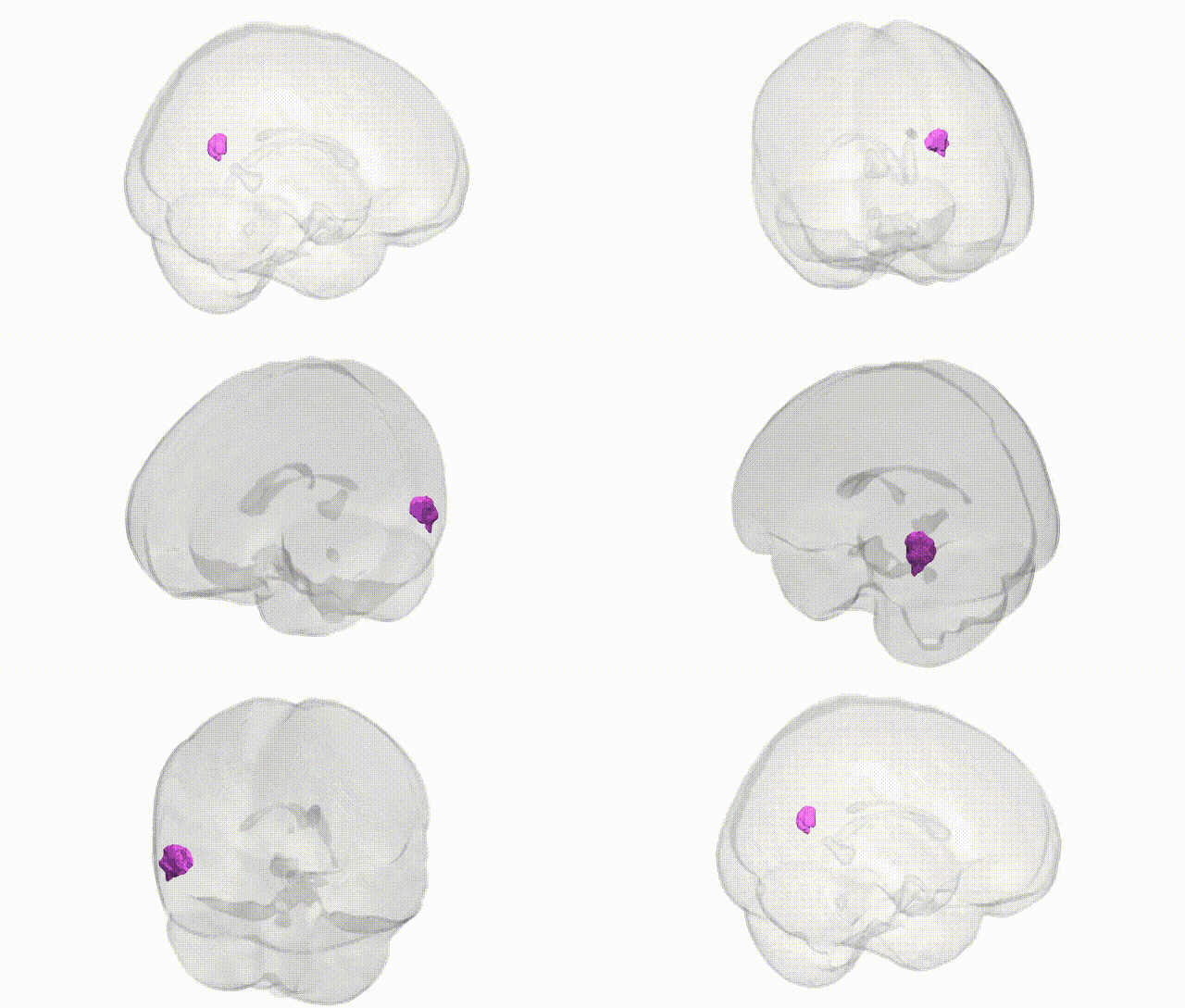
Full Quality Version: Download MP4
Wali Sidiqyar*, Gaurav Rudravaram*, Elyssa M. McMaster, Trent M. Schwartz, Adam M. Saunders, Kurt G. Schilling, Bennett A. Landman "Introducing SPINS: A Shared Public Visualization Library of Neuroanatomical Structures." Medical Imaging with Deep Learning- short paper
This resource is licensed under CC0 1.0 Universal (Public Domain).