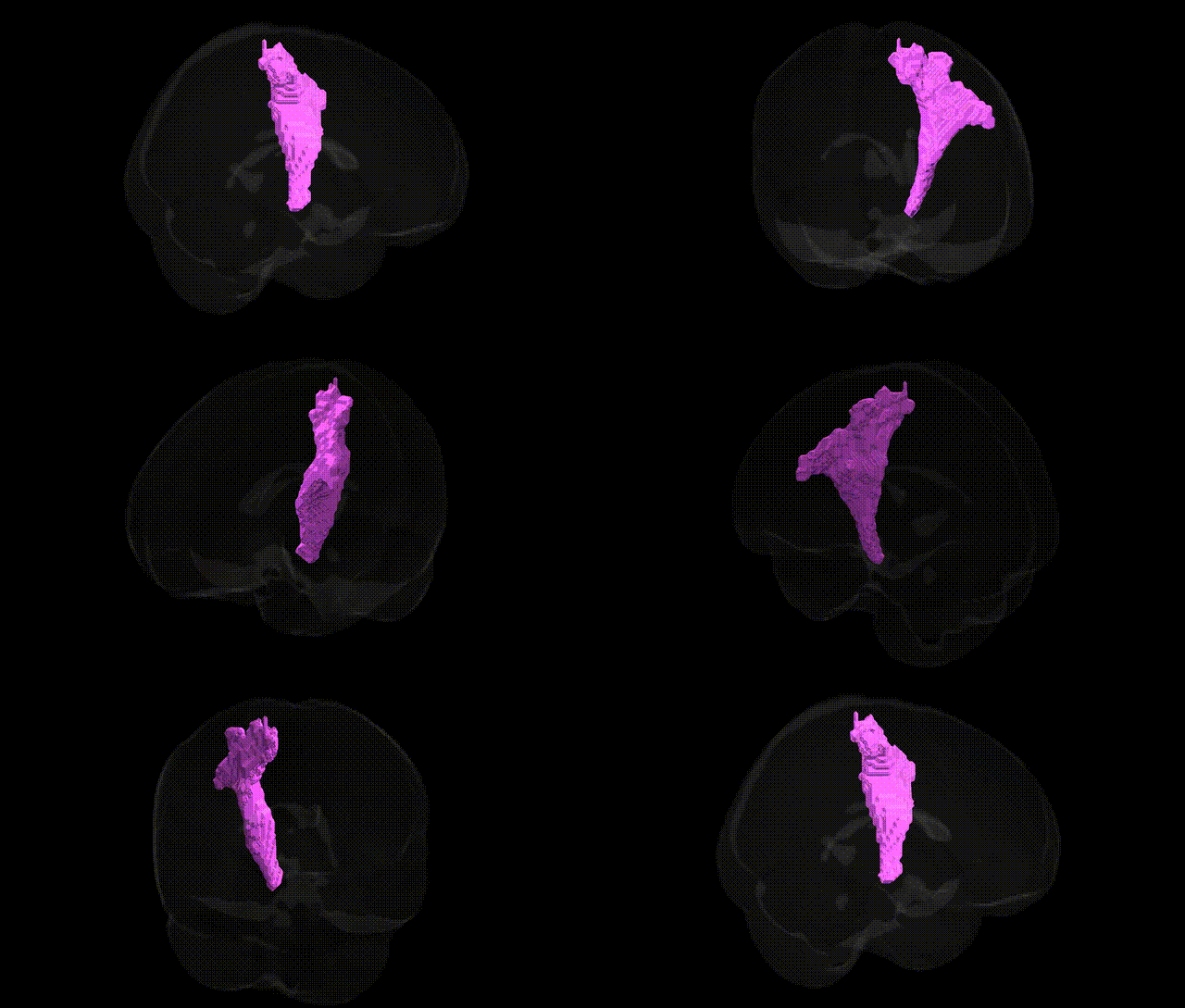
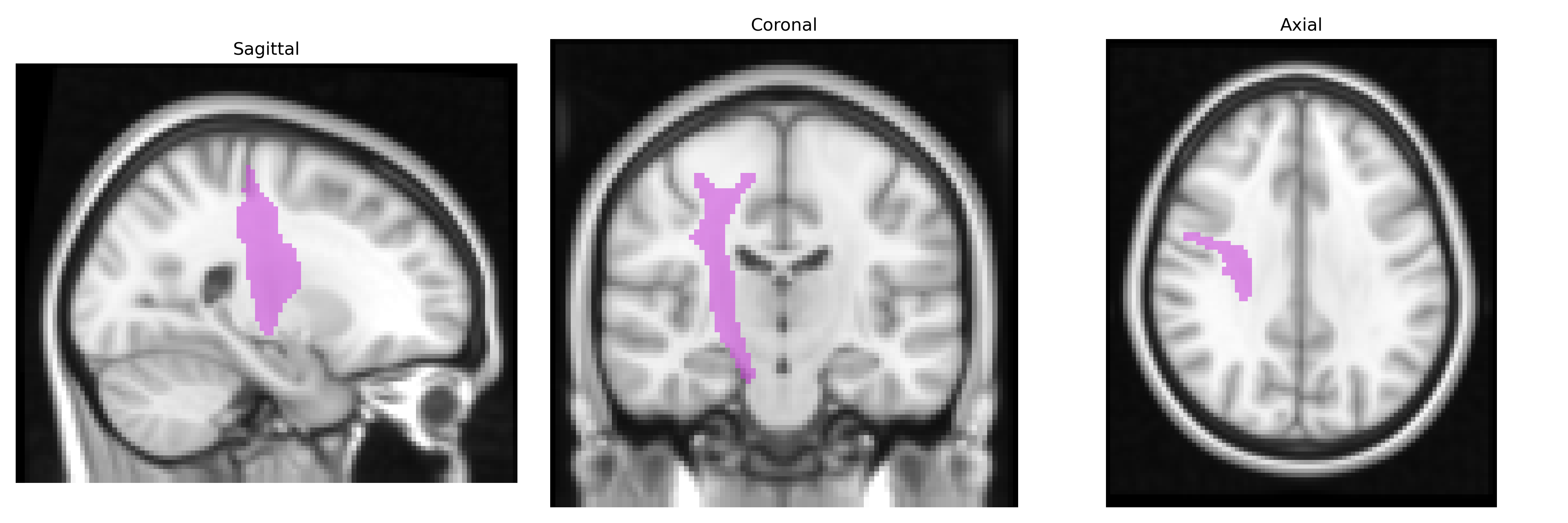
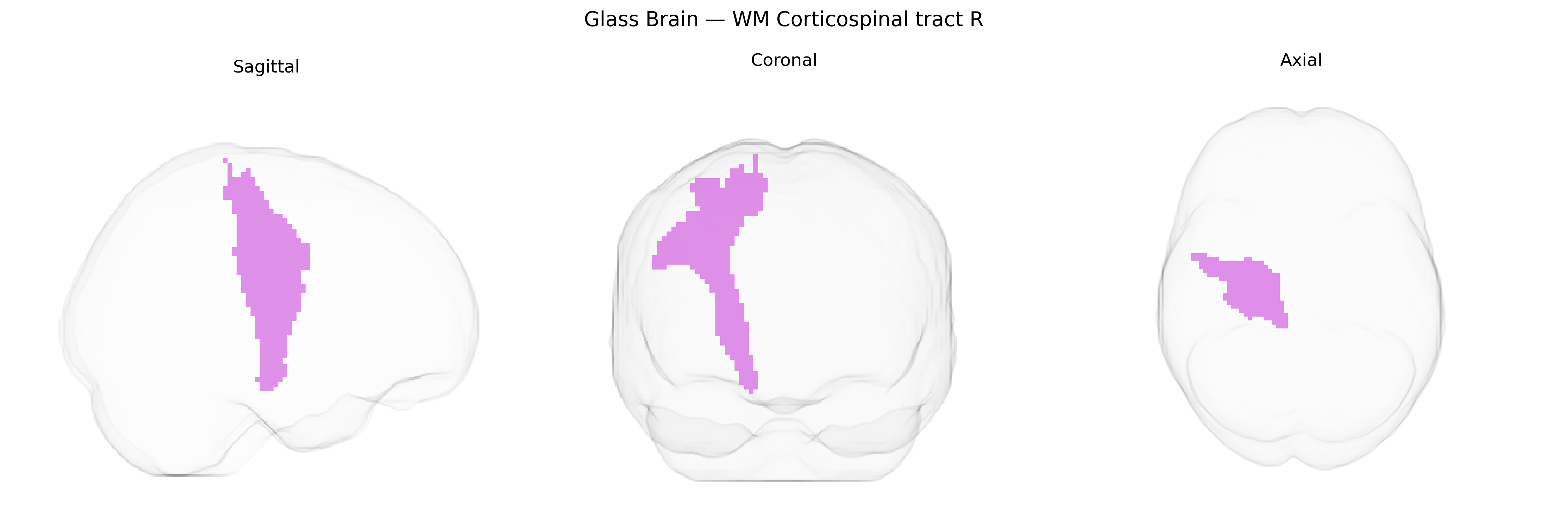
The bilateral WM Corticospinal tract R, as defined in the Juelich maxprob thr25 2 mm atlas, refers to the right-hemispheric segment of the myelinated white-matter fibers constituting the corticospinal pathway, which originates primarily from pyramidal neurons in the primary motor cortex and related motor areas and descends through the corona radiata, internal capsule, cerebral peduncles, pontine basis, and medullary pyramids before largely decussating at the pyramidal decussation to innervate contralateral spinal motor circuits. This tract is a principal conduit for voluntary motor control, especially fine, fractionated movements of the distal limbs, and shows somatotopic organization reflecting the motor homunculus in cortex and corresponding spinal segmental targets. Microstructurally, it is composed predominantly of large, heavily myelinated axons that enable rapid conduction, and it is highly vulnerable to demyelinating, ischemic, and traumatic lesions that manifest clinically as upper motor neuron signs such as spasticity, hyperreflexia, and weakness. There is no direct Wikipedia article for this specific atlas label; a closely related structure is the Corticospinal tract.
The bilateral right corticospinal tract white matter (WM Corticospinal tract R) as defined in the Juelich maxprob thr25 2mm atlas has not been a direct focus of gene-specific GWAS, but genetic influences on its microstructure and integrity are supported by large imaging-genetics studies of white matter tracts and motor pathways. Heritability analyses from cohorts such as UK Biobank indicate substantial genetic contributions to diffusion MRI metrics (e.g., fractional anisotropy, mean diffusivity) in major motor tracts, and multivariate GWAS of brain-wide white matter have implicated loci in axon guidance, myelination, and neurodevelopmental pathways (including genes related to oligodendrocyte function and cell adhesion, such as variants near MAG, NRXN1, and other synaptic/adhesion genes), which likely extend to the corticospinal system even when not labeled at this specific Juelich region. Clinically, genetic variants associated with neurodegenerative motor disorders—especially amyotrophic lateral sclerosis (ALS) and certain hereditary spastic paraplegias—show convergent effects on corticospinal tract degeneration, with genes such as C9orf72, SOD1, TARDBP, FUS and SPAST linked to structural changes and loss of integrity in this tract on MRI. In addition, polygenic risk scores for conditions involving motor and executive control (e.g., ALS, multiple sclerosis, and, more broadly, neurodevelopmental disorders) have been associated with alterations in motor-tract white matter, though these findings are typically reported at the level of the whole corticospinal tract or global white matter rather than the specific “bilateral WM Corticospinal tract R” parcel; overall, genetic studies point to a robust heritable component and disease-related vulnerability of corticospinal white matter, but fine-grained, atlas-parcel–specific GWAS associations for this particular region remain limited or indirect.
Overview generated by GPT-4o (2026).
Region ID: 98
Hemisphere: bilateral
Atlas: Juelich maxprob thr25 2mm
Full Quality Version: Download MP4
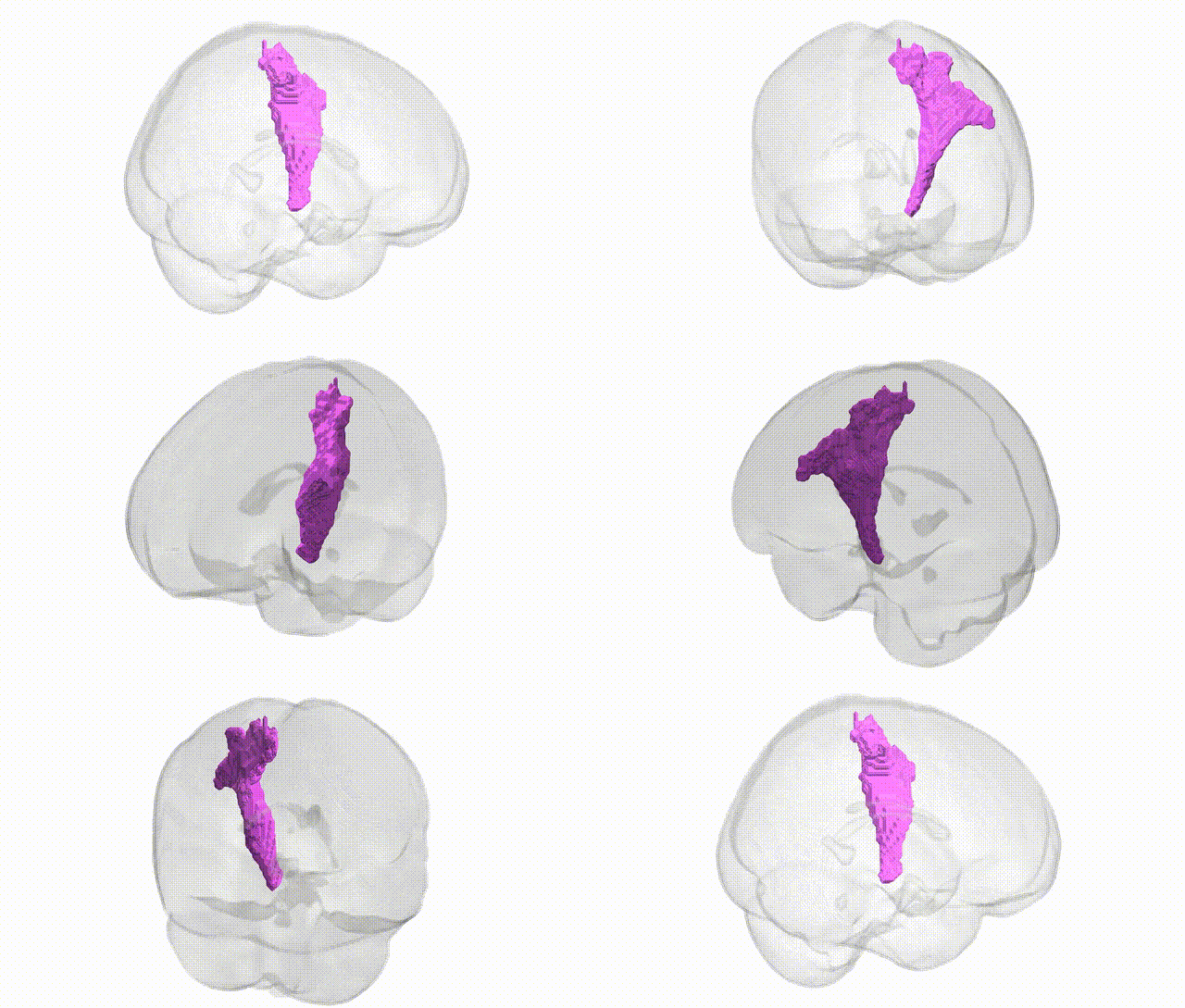
Full Quality Version: Download MP4
Wali Sidiqyar*, Gaurav Rudravaram*, Elyssa M. McMaster, Trent M. Schwartz, Adam M. Saunders, Kurt G. Schilling, Bennett A. Landman "Introducing SPINS: A Shared Public Visualization Library of Neuroanatomical Structures." Medical Imaging with Deep Learning- short paper
This resource is licensed under CC0 1.0 Universal (Public Domain).