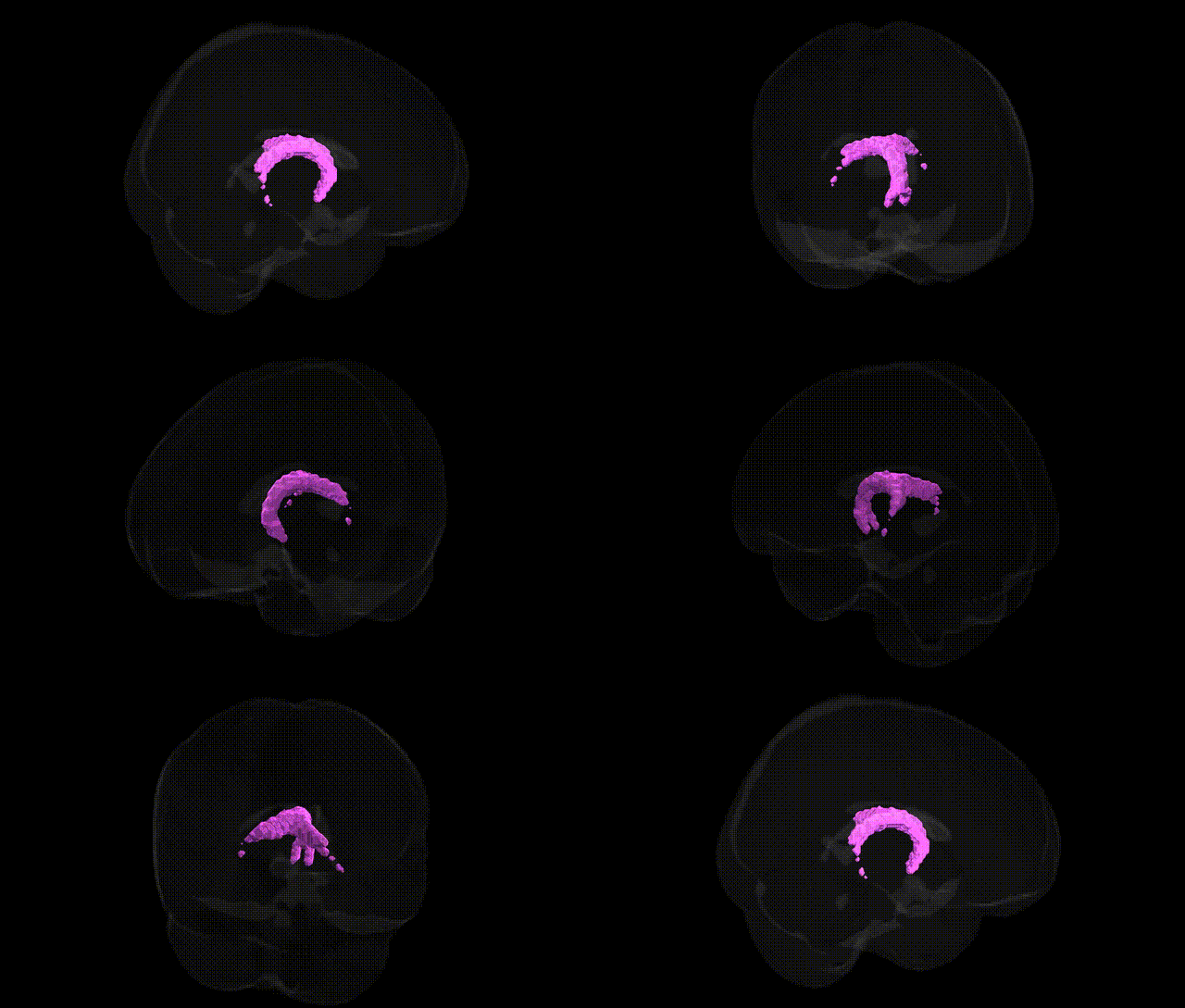
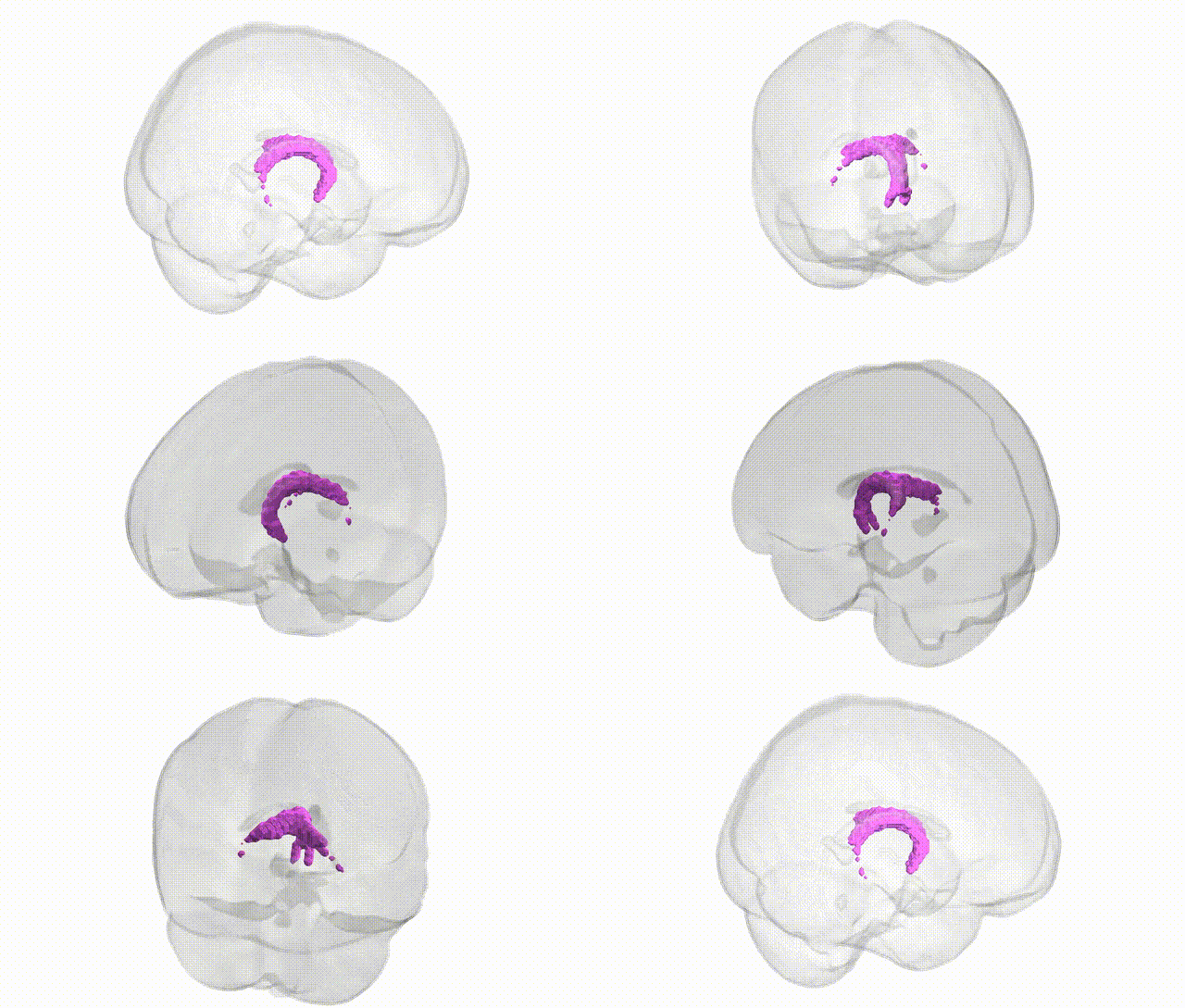
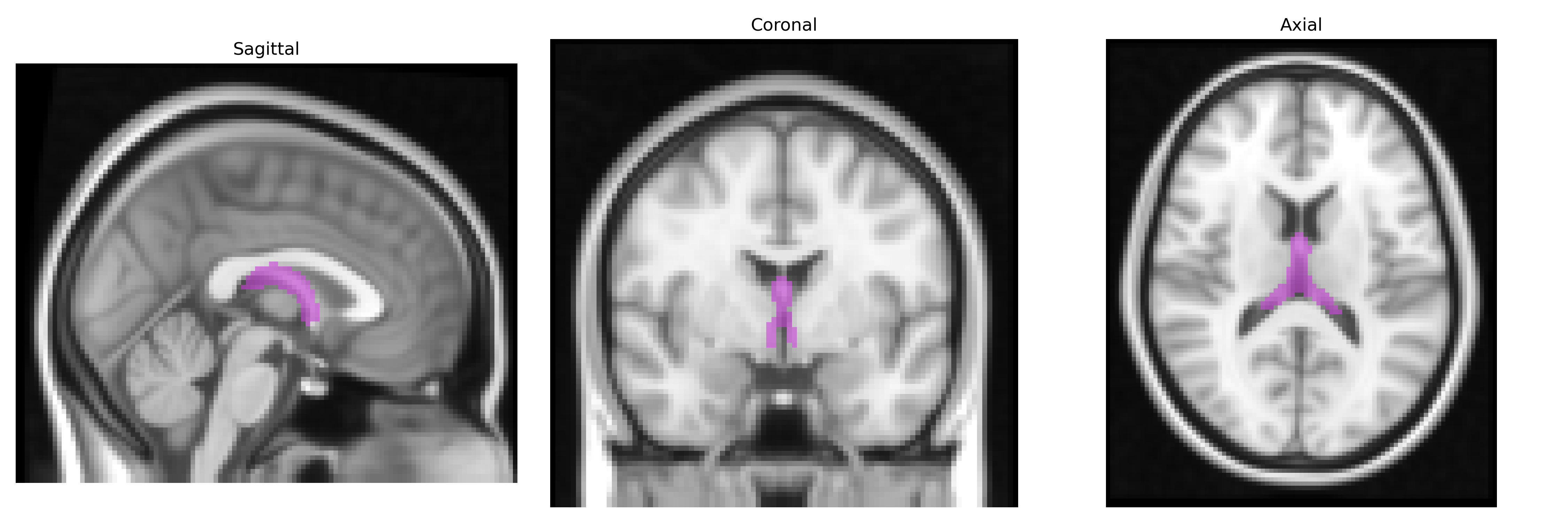
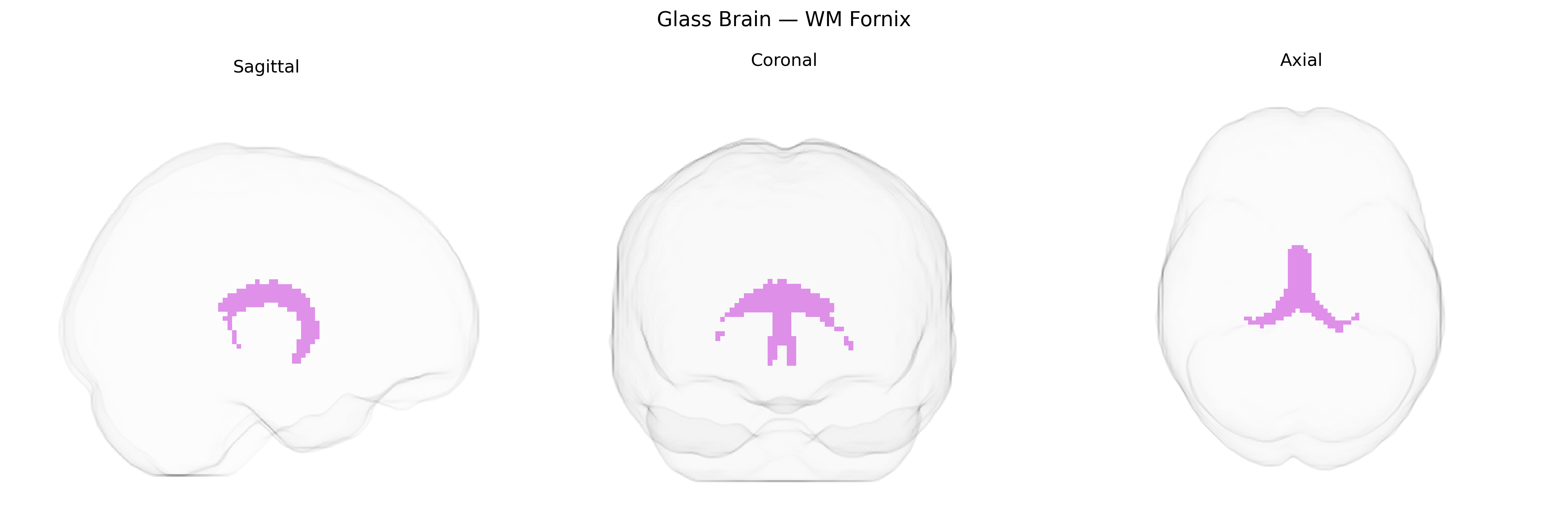
The bilateral WM Fornix in the Juelich maxprob thr25 2mm Atlas corresponds to the paired white matter fiber bundles forming the principal output tract of the hippocampal formation, coursing from the fimbria of the hippocampus through the hypothalamus to the mammillary bodies and septal nuclei. Composed primarily of myelinated axons, the fornix participates critically in the Papez circuit and broader limbic networks involved in episodic memory, spatial navigation, and emotional processing. Damage or degeneration of the fornix is associated with impairments in declarative memory and can be observed in various neurodegenerative and vascular conditions. Although there is no specific Wikipedia entry for “bilateral WM Fornix” as defined in this atlas, the structure corresponds to the classical Fornix (brain).
The bilateral WM fornix, a major white-matter tract connecting hippocampal formation with diencephalic and basal forebrain structures, has been implicated indirectly in genetic studies of memory, neurodegeneration, and psychiatric traits rather than through GWAS that target the Juelich maxprob thr25 2 mm atlas region explicitly. Imaging genetics work shows that common variants influencing hippocampal volume and limbic connectivity—such as those in APOE (particularly ε4), CLU, PICALM, and BIN1—are associated with microstructural changes in fornix integrity, often measured by diffusion MRI, and these changes are linked to Alzheimer’s disease risk, mild cognitive impairment, and age-related memory decline. Variants in genes related to myelination and axonal structure (e.g., NTRK1/2, CNTNAP2, and broader oligodendrocyte-related pathways) have been associated with white-matter integrity across limbic tracts, including the fornix, in GWAS of diffusion metrics, although such findings are typically reported at the tract or whole-brain white-matter level rather than atlas-specific parcels. Fornix microstructure shows heritability and has been tied to polygenic risk for schizophrenia, major depressive disorder, and bipolar disorder through analyses linking psychiatric GWAS summary statistics with diffusion measures in large cohorts like UK Biobank, where higher polygenic load often corresponds to reduced fornix fractional anisotropy or increased mean diffusivity. Additionally, GWAS of cognitive traits and educational attainment have reported genetic correlations with limbic white-matter measures, suggesting that variants driving general cognitive function partly act through fornix-related circuitry. However, current literature does not provide robust, region-specific GWAS hits for the bilateral WM fornix parcel as defined in the Juelich atlas; rather, genetic associations are inferred from tract-level or system-level imaging–genetics studies connecting risk loci for neurodegenerative and psychiatric disorders with fornix structure and connectivity.
Overview generated by GPT-4o (2026).
Region ID: 100
Hemisphere: bilateral
Atlas: Juelich maxprob thr25 2mm
Full Quality Version: Download MP4
Full Quality Version: Download MP4
Wali Sidiqyar*, Gaurav Rudravaram*, Elyssa M. McMaster, Trent M. Schwartz, Adam M. Saunders, Kurt G. Schilling, Bennett A. Landman "Introducing SPINS: A Shared Public Visualization Library of Neuroanatomical Structures." Medical Imaging with Deep Learning- short paper
This resource is licensed under CC0 1.0 Universal (Public Domain).