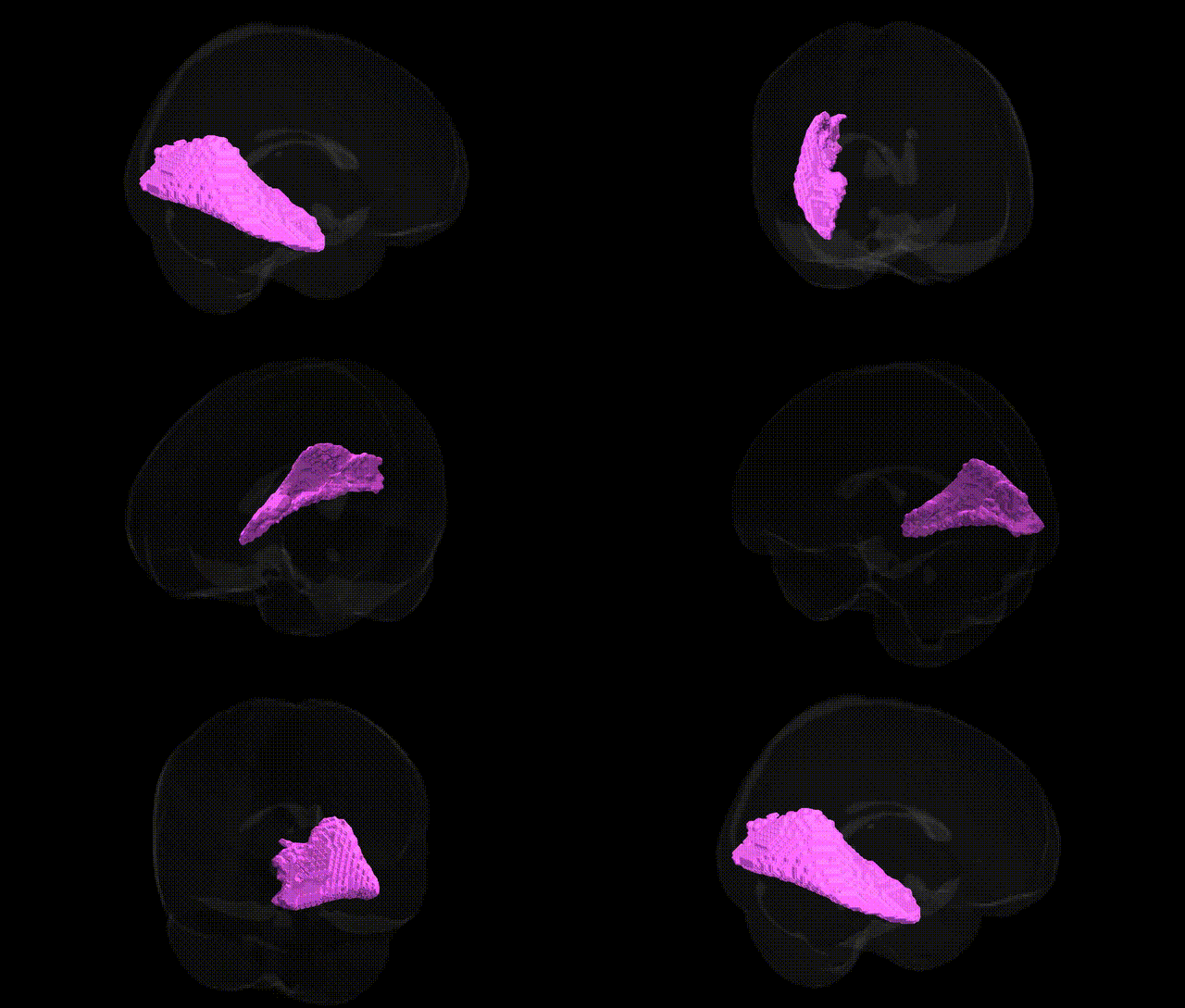
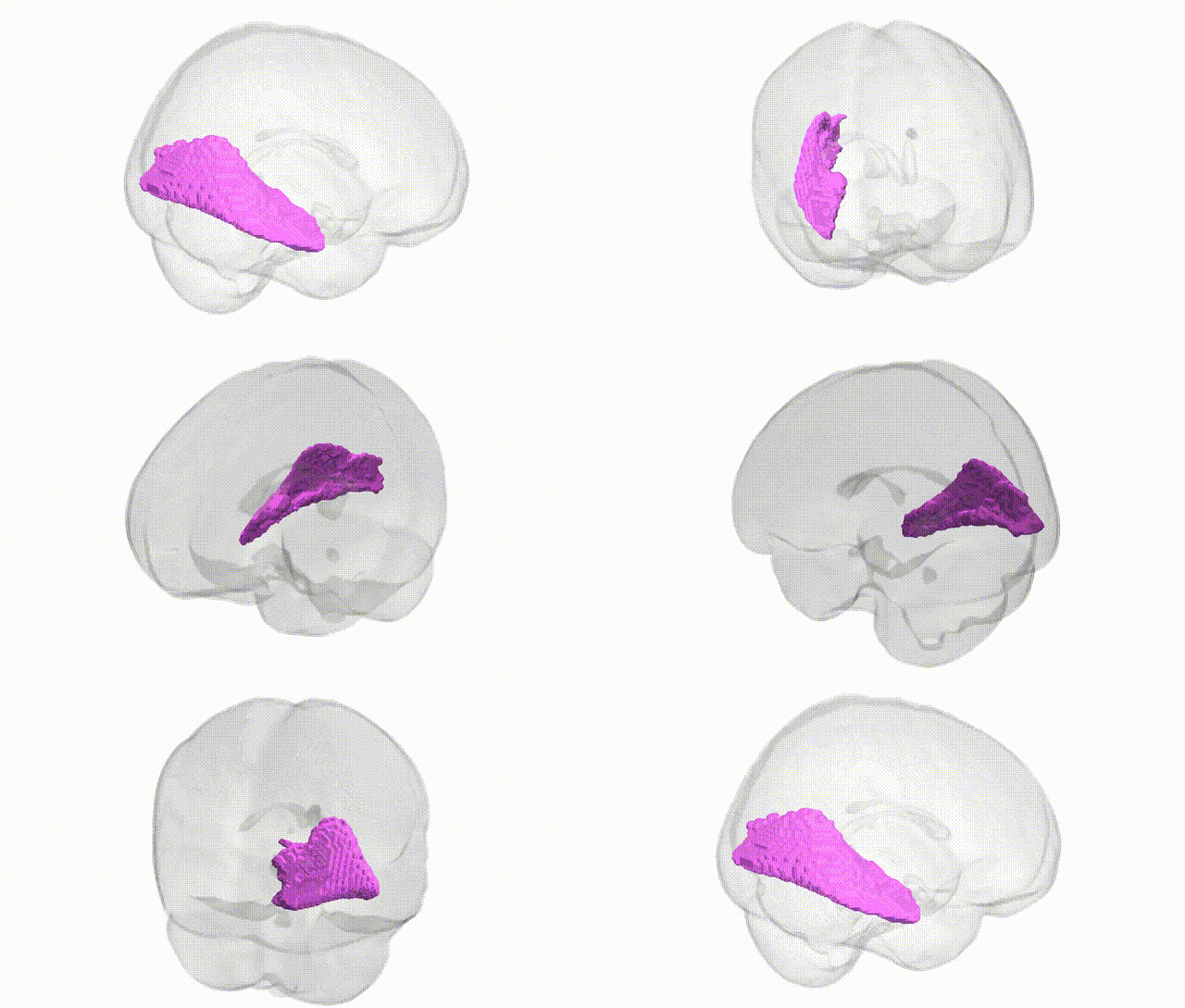
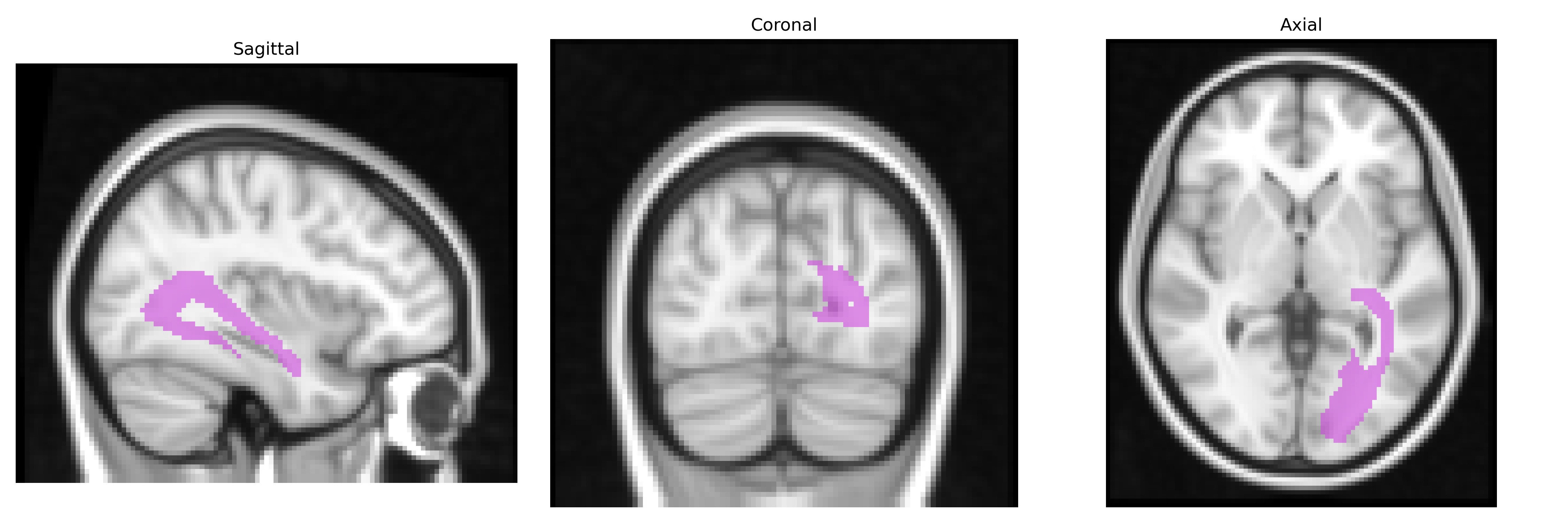
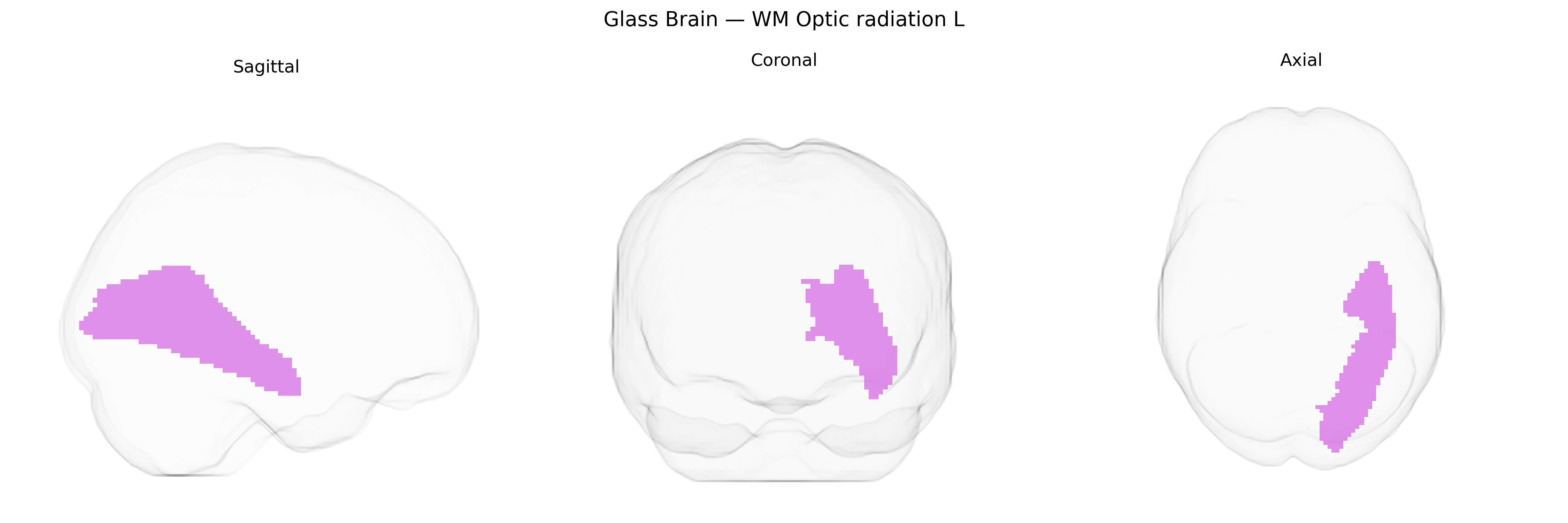
The bilateral white matter optic radiation (left) in the Juelich maxprob thr25 2mm atlas corresponds to the myelinated fiber bundles that convey visual information from the lateral geniculate nucleus of the thalamus to the primary visual cortex (V1, Brodmann area 17) in the occipital lobe. These fibers course through the temporal and parietal lobes, including the well-known Meyer’s loop, and are essential for the integrity of conscious visual perception, transmitting retinotopically organized signals that preserve spatial, color, and motion information from the retina. Damage to this tract can produce characteristic visual field defects (e.g., homonymous hemianopia or quadrantanopia) depending on the lesion’s location along its trajectory. There is no direct Wikipedia article for this exact atlas label; a closely related and encompassing structure is the Optic radiation.
The bilateral white-matter optic radiation (L) region from the Juelich maxprob thr25 2mm atlas has not itself been directly and repeatedly highlighted as a primary locus in large-scale GWAS, but genes and variants affecting visual pathway development, myelination, and white-matter integrity are indirectly implicated through imaging-genetics and neurodevelopmental studies. Polygenic influences on global and regional white-matter microstructure (e.g., diffusion metrics) include common variants in genes involved in axonal guidance and myelin biology such as NRG1, MAG, and various cell-adhesion and cytoskeletal genes, which have shown associations with optic radiation integrity in imaging-genetics cohorts. Disorders known to involve the optic radiations—such as multiple sclerosis, neuromyelitis optica spectrum disorder, and inherited leukodystrophies—show strong associations with HLA region variants, aquaporin-4 (AQP4) in NMOSD, and numerous monogenic mutations affecting myelin (e.g., PLP1, SOX10), although these genetic associations are typically framed at the disease level rather than as specific to the Juelich-defined region. In psychiatric and cognitive GWAS that incorporate brain imaging, polygenic scores for schizophrenia, bipolar disorder, and major depression, as well as genome-wide significant loci for general cognitive ability and educational attainment, have been associated with variation in optic radiation white-matter structure, suggesting that genetic architectures influencing neurodevelopment and synaptic/myelin processes contribute modestly to interindividual differences in this tract; however, no single robust, widely replicated locus has been uniquely and specifically assigned to the bilateral WM optic radiation (L) region in current atlas-based GWAS annotations.
Overview generated by GPT-4o (2026).
Region ID: 109
Hemisphere: bilateral
Atlas: Juelich maxprob thr25 2mm
Full Quality Version: Download MP4
Full Quality Version: Download MP4
Wali Sidiqyar*, Gaurav Rudravaram*, Elyssa M. McMaster, Trent M. Schwartz, Adam M. Saunders, Kurt G. Schilling, Bennett A. Landman "Introducing SPINS: A Shared Public Visualization Library of Neuroanatomical Structures." Medical Imaging with Deep Learning- short paper
This resource is licensed under CC0 1.0 Universal (Public Domain).