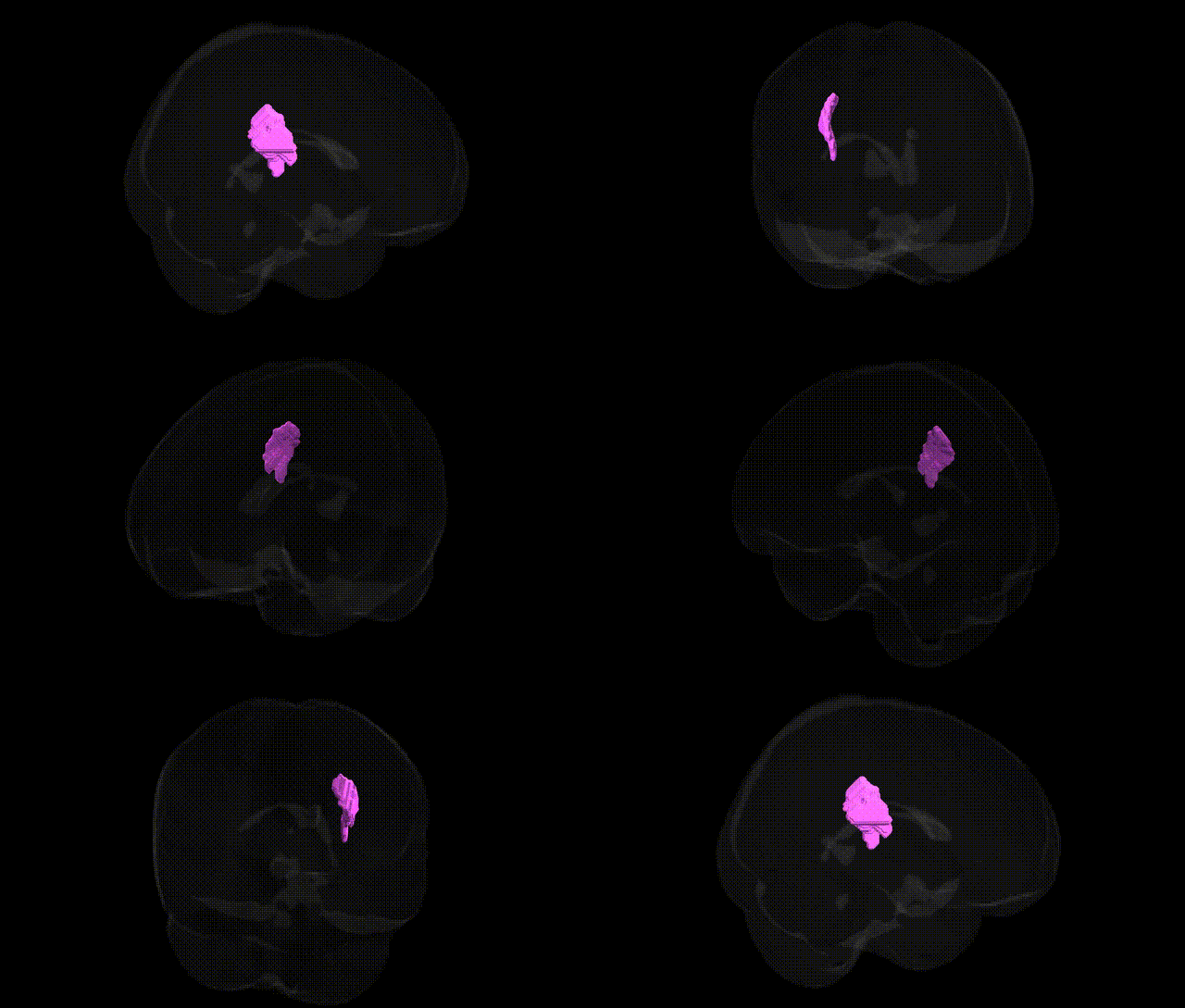
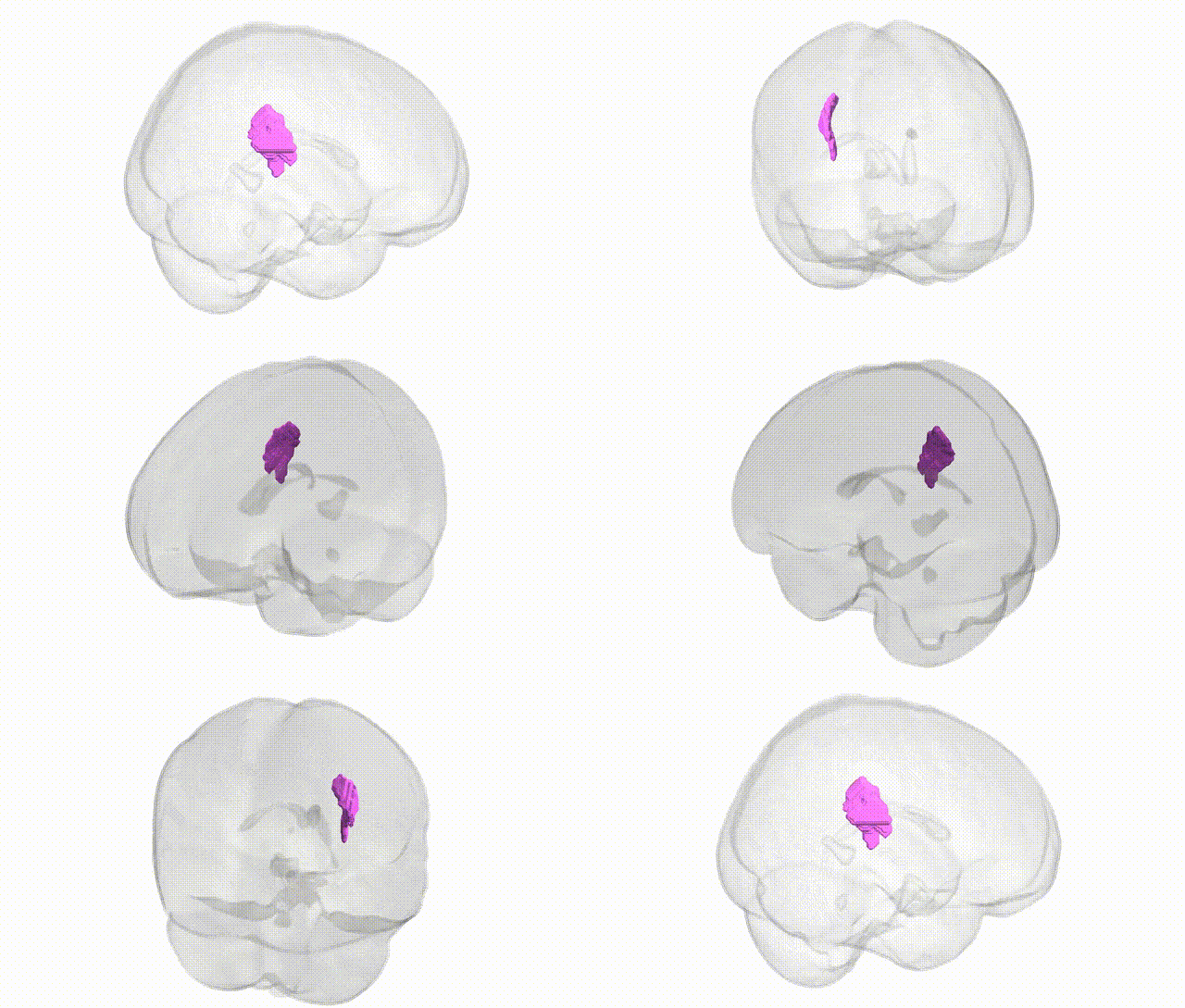
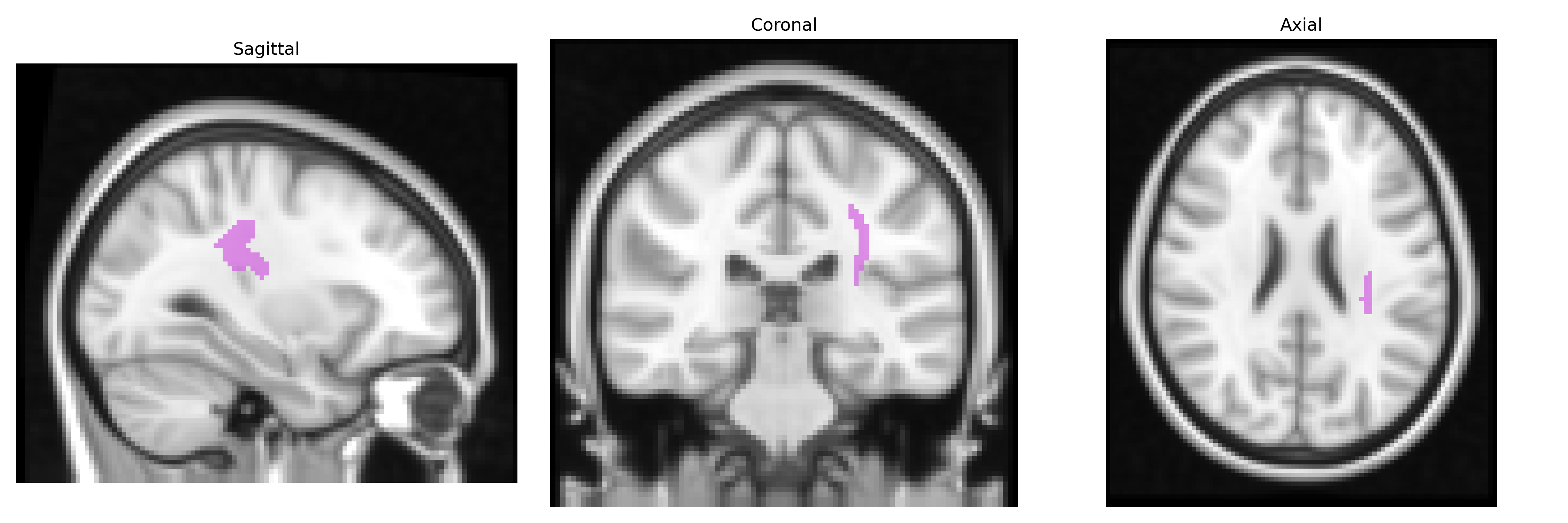
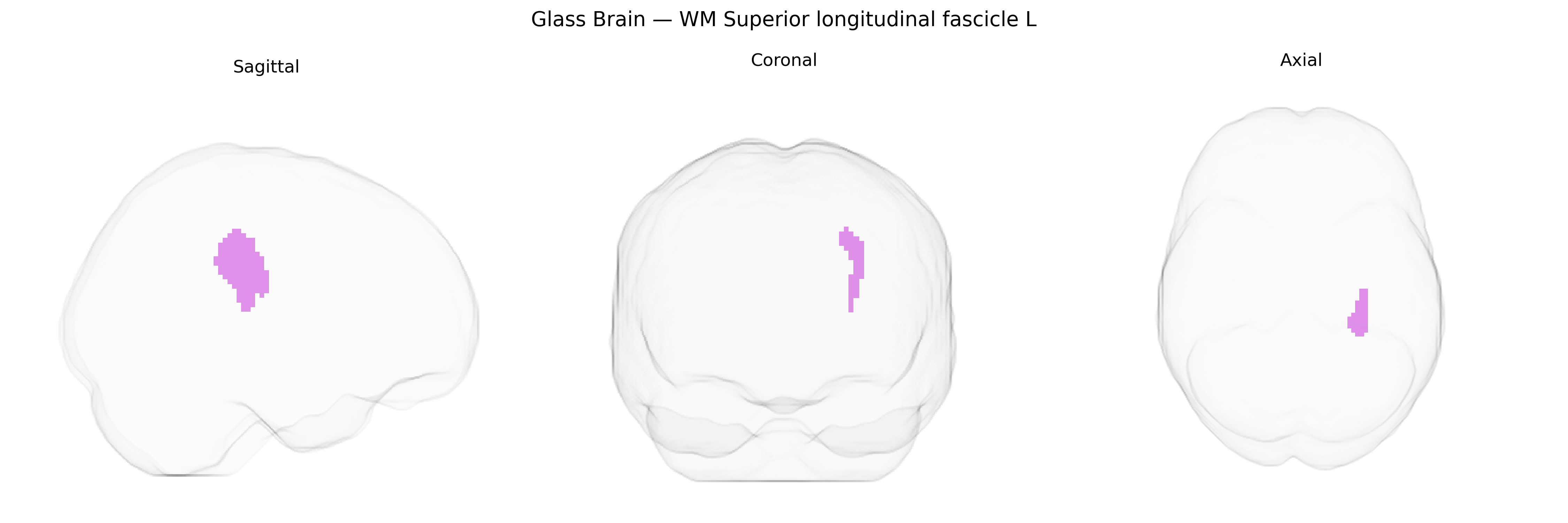
The bilateral WM Superior longitudinal fascicle L in the Juelich maxprob thr25 2mm atlas corresponds to a major association white matter tract known as the superior longitudinal fasciculus (SLF), a long bidirectional fiber bundle linking frontal, parietal, temporal, and occipital cortical regions. It plays a crucial role in higher-order cognitive functions including spatial attention, language processing, working memory, and sensorimotor integration by enabling rapid communication between dorsal frontal and parietal networks. The SLF is composed of multiple subcomponents (often described as SLF I–III and the arcuate fasciculus) that follow slightly different trajectories and connect partially distinct cortical territories. Damage or disruption of this tract has been implicated in deficits such as aphasia, neglect, and impairments in visuospatial and executive functions. There is no direct Wikipedia article for the “WM Superior longitudinal fascicle L” region label, but the corresponding structure is described under the superior longitudinal fasciculus: Superior longitudinal fasciculus.
The bilateral superior longitudinal fasciculus (SLF), a major frontoparietal white matter tract that in the Juelich maxprob thr25 2 mm atlas includes the WM Superior longitudinal fascicle L region, has been implicated by multiple genetic studies in cognitive, psychiatric, and neurodevelopmental phenotypes. Twin and SNP-based heritability analyses show that fractional anisotropy, axial and radial diffusivity, and tract volume of the SLF are substantially heritable, with common variants explaining a significant proportion of interindividual variability. Large diffusion MRI GWAS (e.g., ENIGMA, UK Biobank–based studies) have identified associations between SLF microstructure and variants near genes involved in axon guidance, myelination, and cytoskeletal organization, including loci in or near genes such as NLGN, CNTN4/CNTN6, ROBO/SLIT family members, and multiple oligodendrocyte-/myelin-related genes, although specific, consistently replicated locus–tract pairs remain limited. Genetic correlations and polygenic score analyses link SLF integrity with educational attainment, general cognitive ability, reading-related skills, and working memory, as well as with risk for schizophrenia, bipolar disorder, major depressive disorder, autism spectrum disorder, and attention-deficit/hyperactivity disorder, consistent with the SLF’s role in frontoparietal and language networks. Some studies report disorder-specific alterations in SLF structure that co-segregate with polygenic risk scores (e.g., for schizophrenia or ADHD), suggesting that SLF white matter properties partially mediate the effect of neuropsychiatric genetic liability on cognition and symptoms, though causality and directionality remain under active investigation and no single gene has been uniquely tied to this tract in a clinically definitive manner.
Overview generated by GPT-4o (2026).
Region ID: 111
Hemisphere: bilateral
Atlas: Juelich maxprob thr25 2mm
Full Quality Version: Download MP4
Full Quality Version: Download MP4
Wali Sidiqyar*, Gaurav Rudravaram*, Elyssa M. McMaster, Trent M. Schwartz, Adam M. Saunders, Kurt G. Schilling, Bennett A. Landman "Introducing SPINS: A Shared Public Visualization Library of Neuroanatomical Structures." Medical Imaging with Deep Learning- short paper
This resource is licensed under CC0 1.0 Universal (Public Domain).