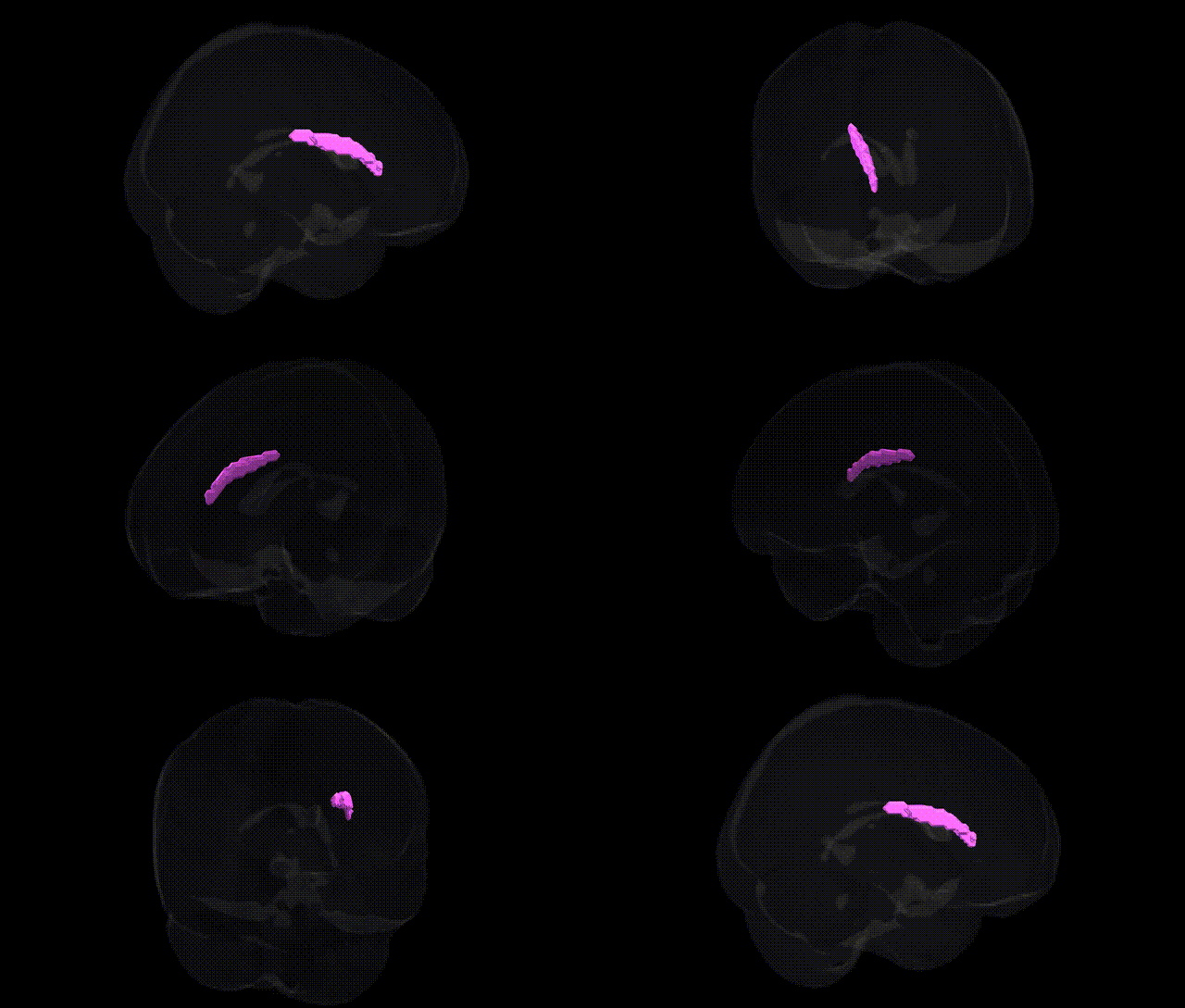
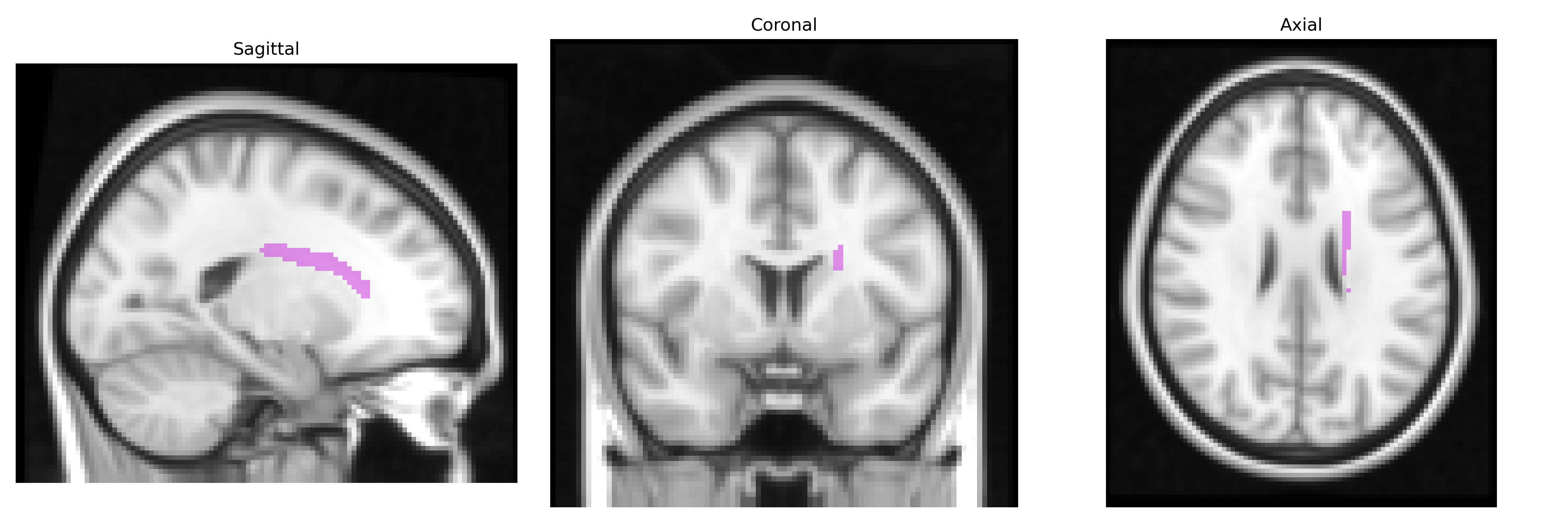
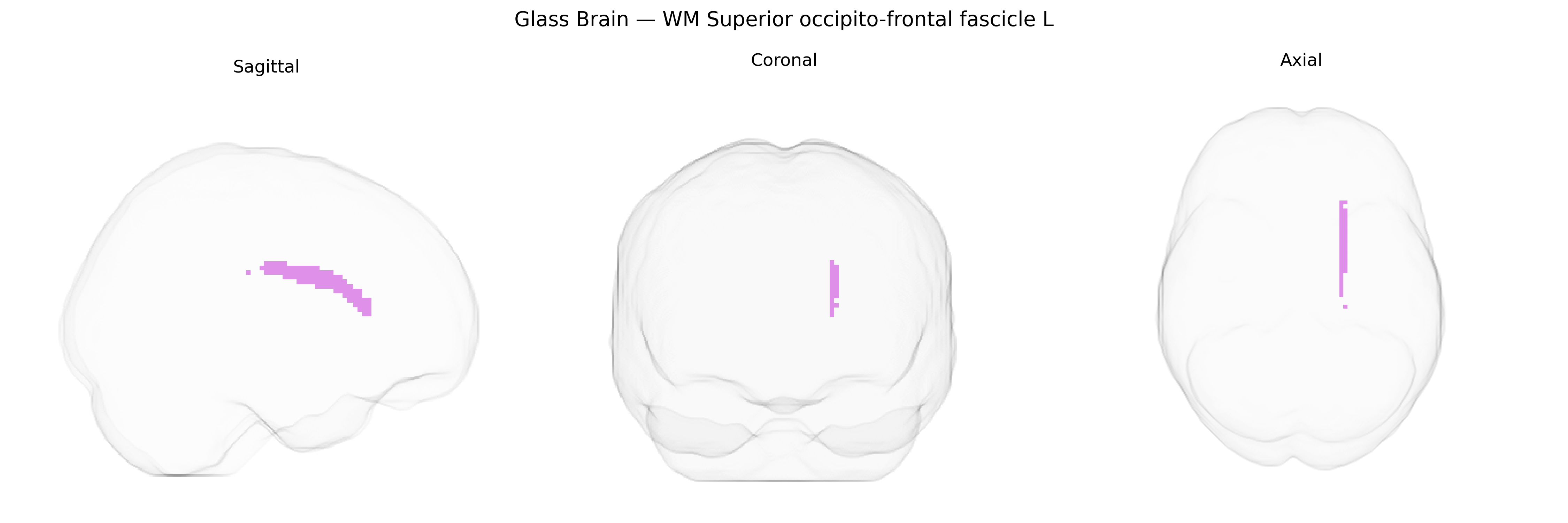
The bilateral WM Superior occipito-frontal fascicle L from the Juelich maxprob thr25 2mm atlas corresponds to a long-range association white matter pathway linking frontal and occipital (and often parietal) cortical regions, supporting integration of higher-order visual, attentional, and executive processes. This fascicle courses within the deep white matter, interconnecting dorsal visual stream areas with prefrontal and premotor territories, thereby contributing to visuospatial processing, spatial attention, and goal-directed behavior. Microstructurally, it is composed of myelinated axons enabling rapid signal transmission between posterior sensory regions and anterior control networks, and is functionally implicated in tasks involving visual guidance of action, working memory with visuospatial content, and integration of perceptual information into motor plans. There is no direct link for the “superior occipito-frontal fascicle”; a closely related and overlapping association pathway is the Superior longitudinal fasciculus.
The bilateral WM Superior occipito-frontal fascicle (often encompassed within long fronto-occipital and superior longitudinal association pathways) has been implicated in genetic studies of white matter microstructure, cognition, and neuropsychiatric risk, though findings are typically reported at the tract or voxel-wise level rather than specifically labeled to the “Superior occipito-frontal fascicle L” in the Juelich atlas. Large imaging-genetics GWAS (e.g., ENIGMA and UK Biobank) have identified heritable variation in diffusion MRI metrics such as fractional anisotropy and mean diffusivity within fronto-occipital and superior longitudinal tracts, with significant associations to loci near genes involved in axon guidance, myelination, and neural development (including variants in or near CNTN4, NCAM1, NTRK3, MAG, and oligodendrocyte-related genes). Polygenic scores for schizophrenia, bipolar disorder, major depressive disorder, and ADHD have been linked to altered integrity of long association fibers connecting frontal and occipital/parietal cortices, and risk alleles in genes such as ZNF804A, CACNA1C, and DISC1 have been associated with disruptions in fronto-parietal/occipito-frontal connectivity and white matter organization. Additionally, GWAS of intelligence, educational attainment, and processing speed consistently show that genetic variants contributing to these traits partly exert their effects through white matter properties in fronto-parietal and fronto-occipital networks, suggesting that the superior occipito-frontal pathways participate in the genetically mediated architecture of higher cognition. However, precise gene–region mappings to the specific “WM Superior occipito-frontal fascicle L” label remain limited, and most evidence derives from broader tract-based or network-level analyses.
Overview generated by GPT-4o (2026).
Region ID: 113
Hemisphere: bilateral
Atlas: Juelich maxprob thr25 2mm
Full Quality Version: Download MP4
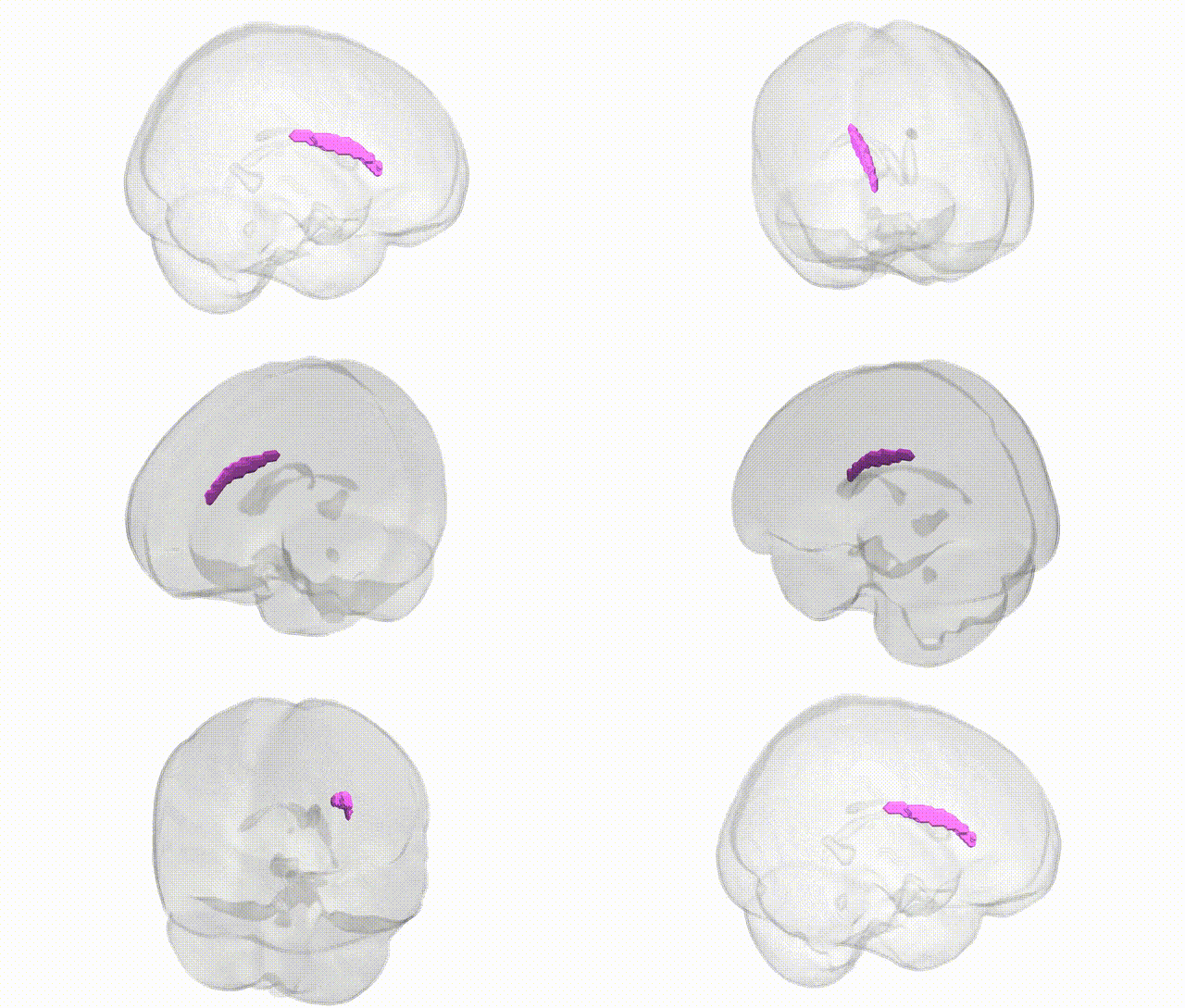
Full Quality Version: Download MP4
Wali Sidiqyar*, Gaurav Rudravaram*, Elyssa M. McMaster, Trent M. Schwartz, Adam M. Saunders, Kurt G. Schilling, Bennett A. Landman "Introducing SPINS: A Shared Public Visualization Library of Neuroanatomical Structures." Medical Imaging with Deep Learning- short paper
This resource is licensed under CC0 1.0 Universal (Public Domain).