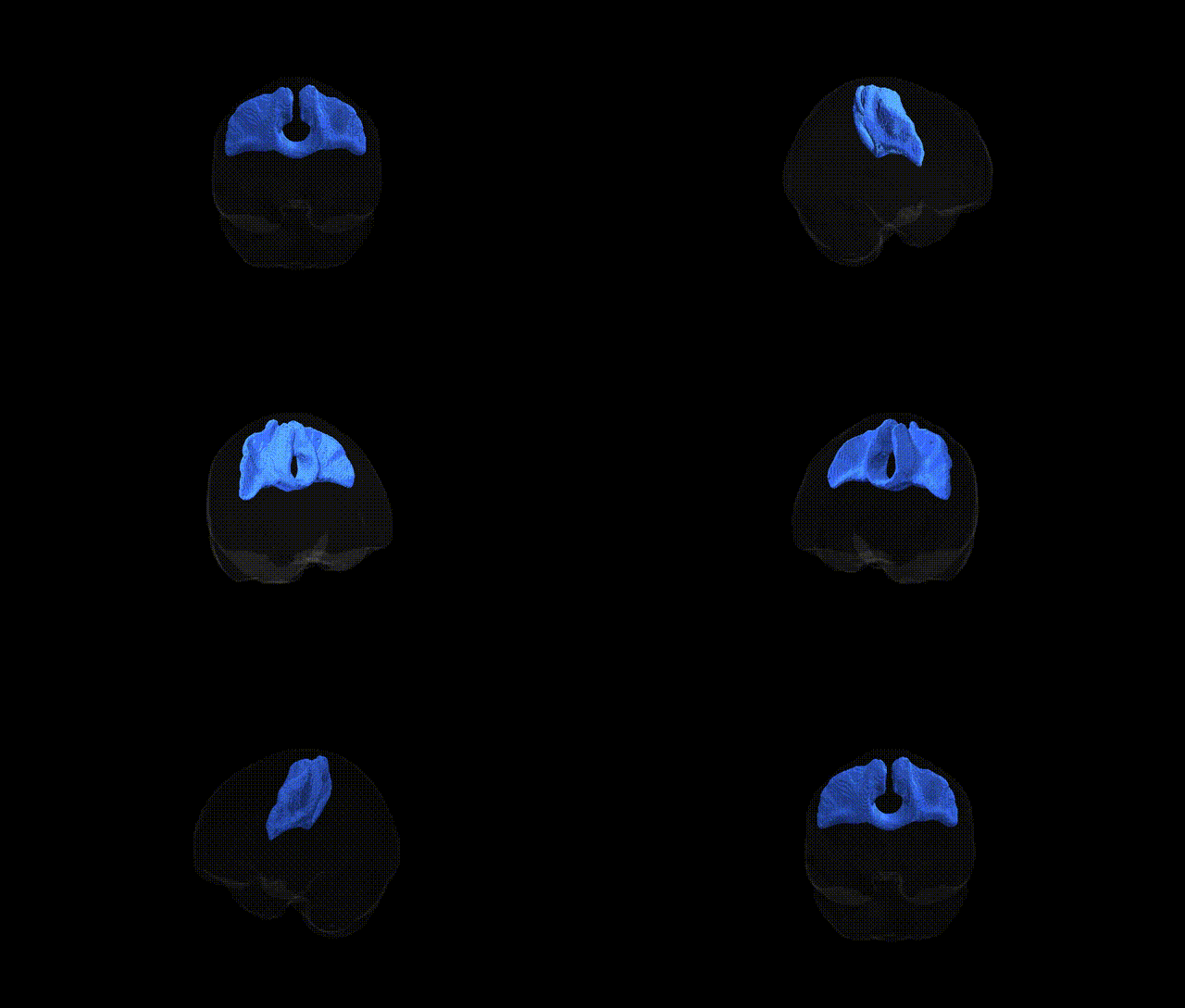
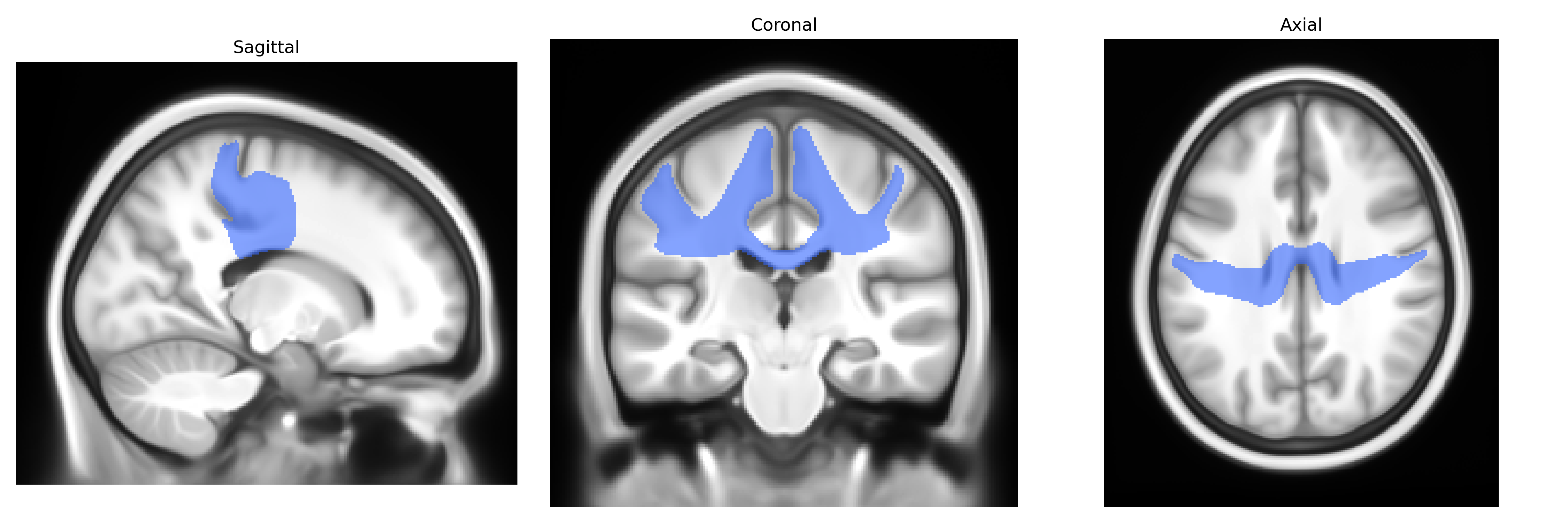
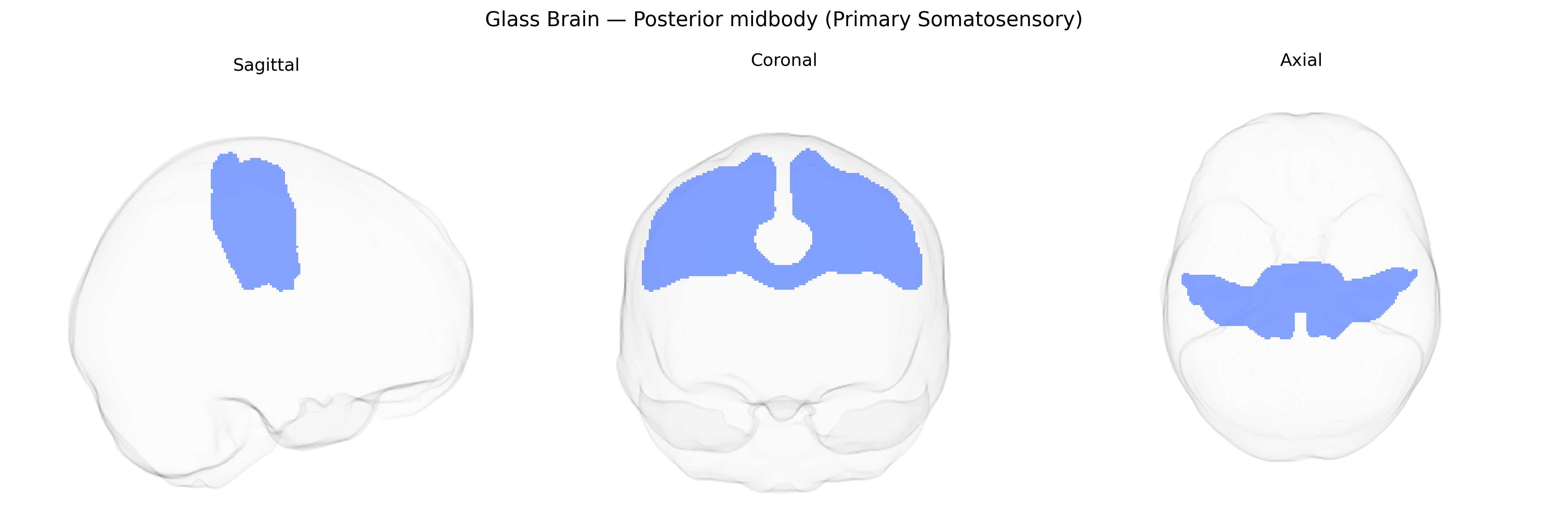
The Posterior midbody (Primary Somatosensory) region in the Pandora-TractSeg atlas corresponds to callosal white matter fibers interconnecting homologous portions of the primary somatosensory cortex across the midline, typically situated in the posterior midbody of the corpus callosum. These fibers mediate rapid interhemispheric transfer of somatosensory information—such as touch, proprioception, and vibration—from body representations in the postcentral gyrus, supporting bilateral integration of sensory inputs and coordination of sensorimotor functions. Anatomically, this tract lies dorsal to deeper commissural and projection systems and is topographically organized such that distinct somatotopic fields (e.g., trunk, proximal limbs) in one hemisphere’s somatosensory cortex communicate with their counterparts in the opposite hemisphere. There is no direct link for this tract; a closely related structure is the Corpus callosum.
Current literature provides very limited tract-specific genetic information about the Posterior midbody (Primary Somatosensory) white matter tract as defined in the Pandora-TractSeg Atlas, and most diffusion MRI GWAS have not reported findings at this fine-grained level of tract parcellation. Large imaging-genetics consortia (e.g., ENIGMA, UK Biobank–based GWAS) have shown that diffusion measures such as fractional anisotropy and mean diffusivity in major callosal and somatosensory-related tracts are heritable and associated with common genetic variants, including loci near genes involved in neurodevelopment, axon guidance, and myelination (for example, variants near or in genes such as FOXP2, NTRK3, CNTN4, and others in broader white-matter analyses), and these white-matter properties have been genetically correlated with cognitive performance, psychiatric disorders (e.g., schizophrenia, major depression), and neurodevelopmental traits. However, these results generally aggregate across larger regions like the corpus callosum body, sensorimotor callosal fibers, or global diffusion metrics, and do not isolate the posterior midbody primary somatosensory tract as a distinct phenotype. As of current knowledge, no robust, replicated GWAS or disorder-specific genetic association has been uniquely and explicitly mapped to the Posterior midbody (Primary Somatosensory) tract as defined in the Pandora-TractSeg framework.
Overview generated by GPT-4o (2026).
Region ID: 9
Hemisphere: bilateral
Atlas: Pandora-TractSeg
Full Quality Version: Download MP4
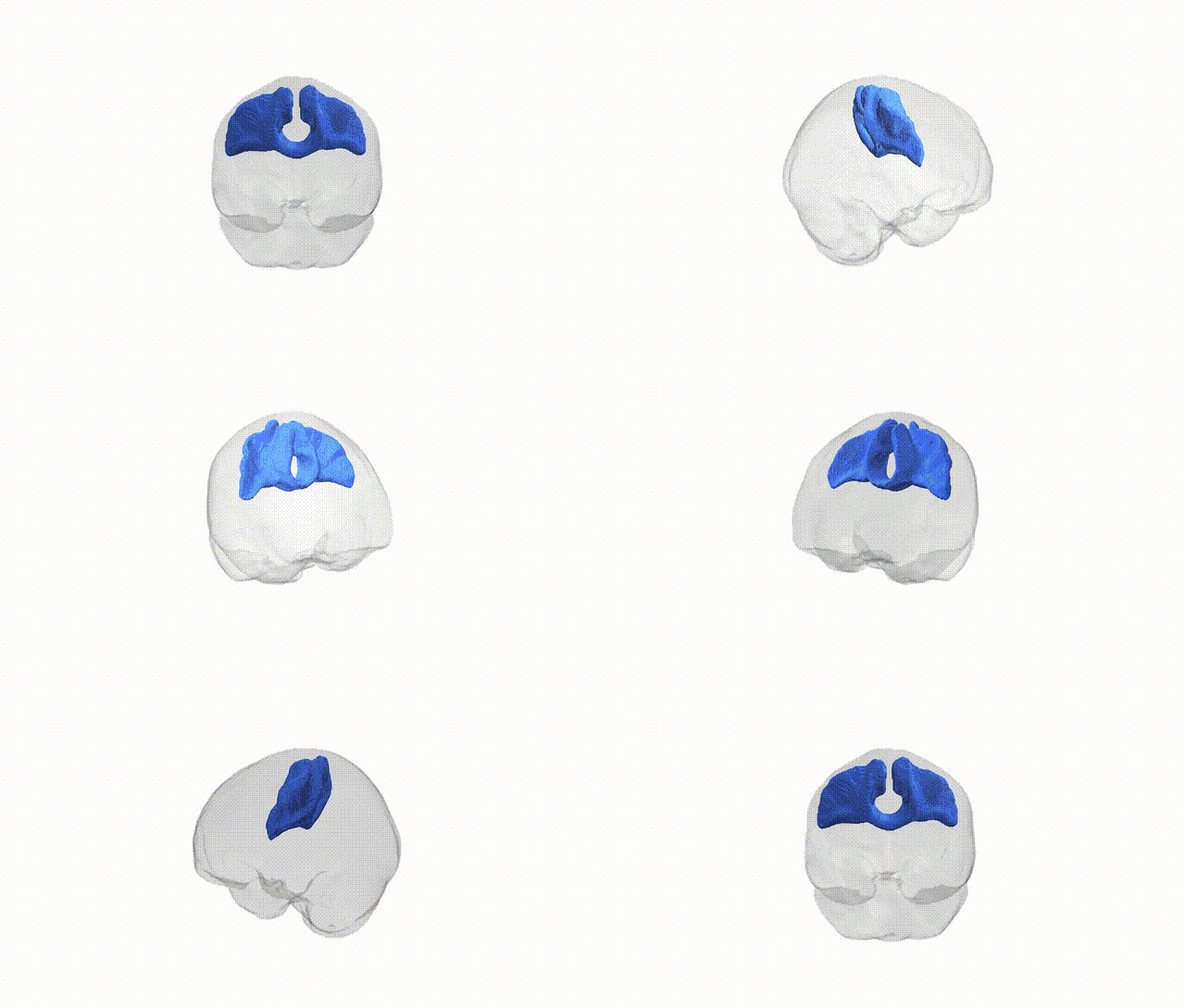
Full Quality Version: Download MP4
Wali Sidiqyar*, Gaurav Rudravaram*, Elyssa M. McMaster, Trent M. Schwartz, Adam M. Saunders, Kurt G. Schilling, Bennett A. Landman "Introducing SPINS: A Shared Public Visualization Library of Neuroanatomical Structures." Medical Imaging with Deep Learning- short paper
This resource is licensed under CC0 1.0 Universal (Public Domain).