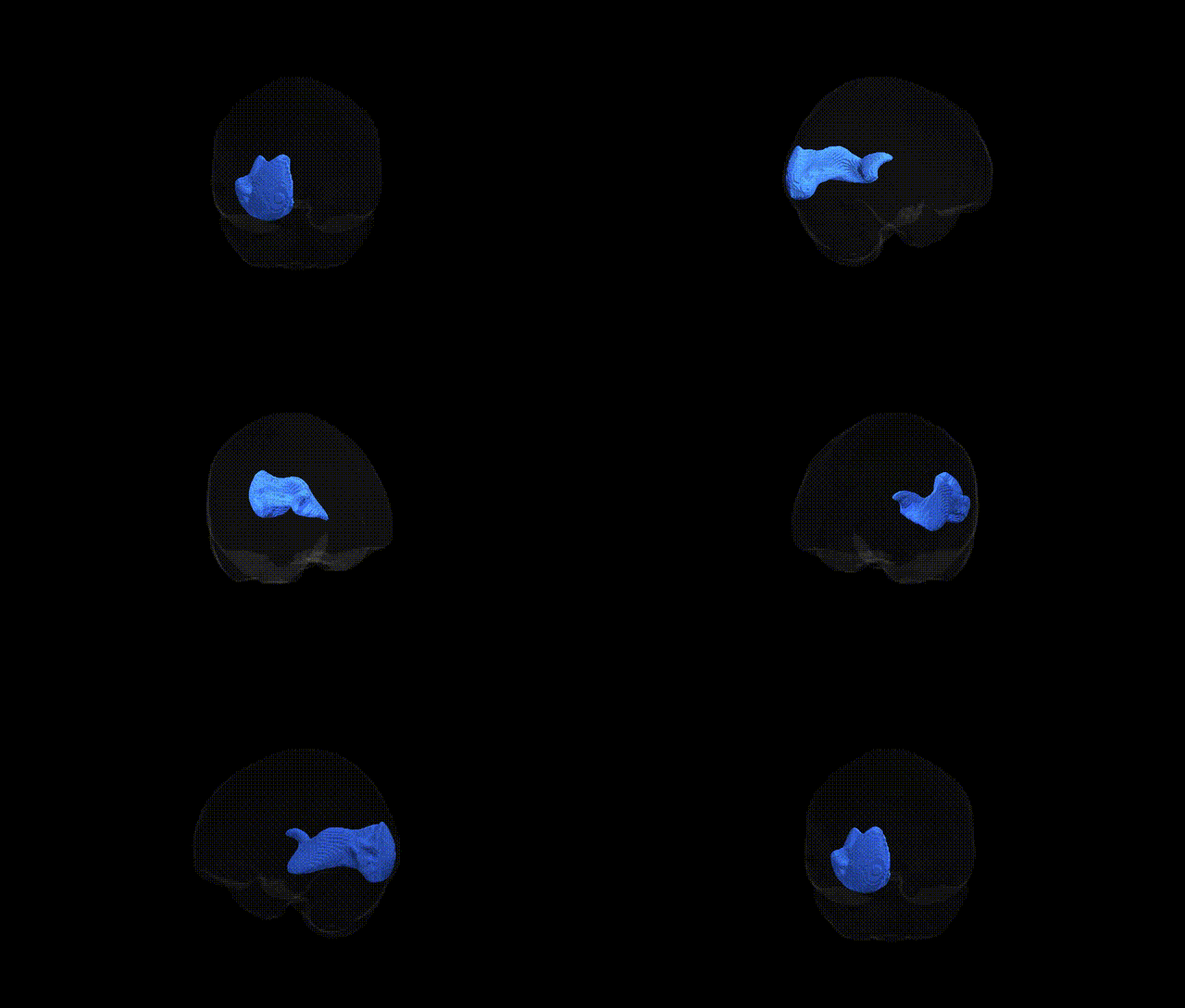
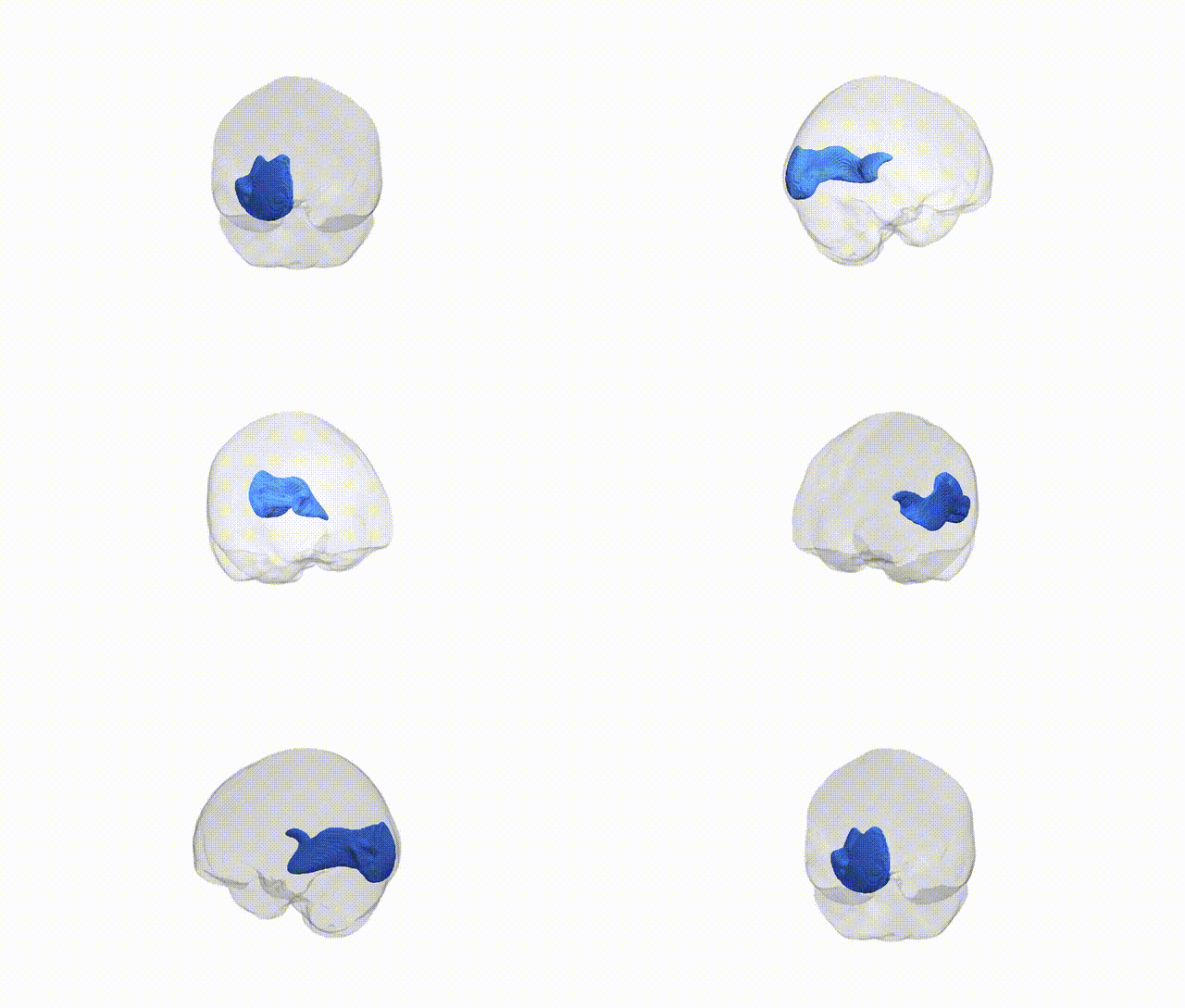
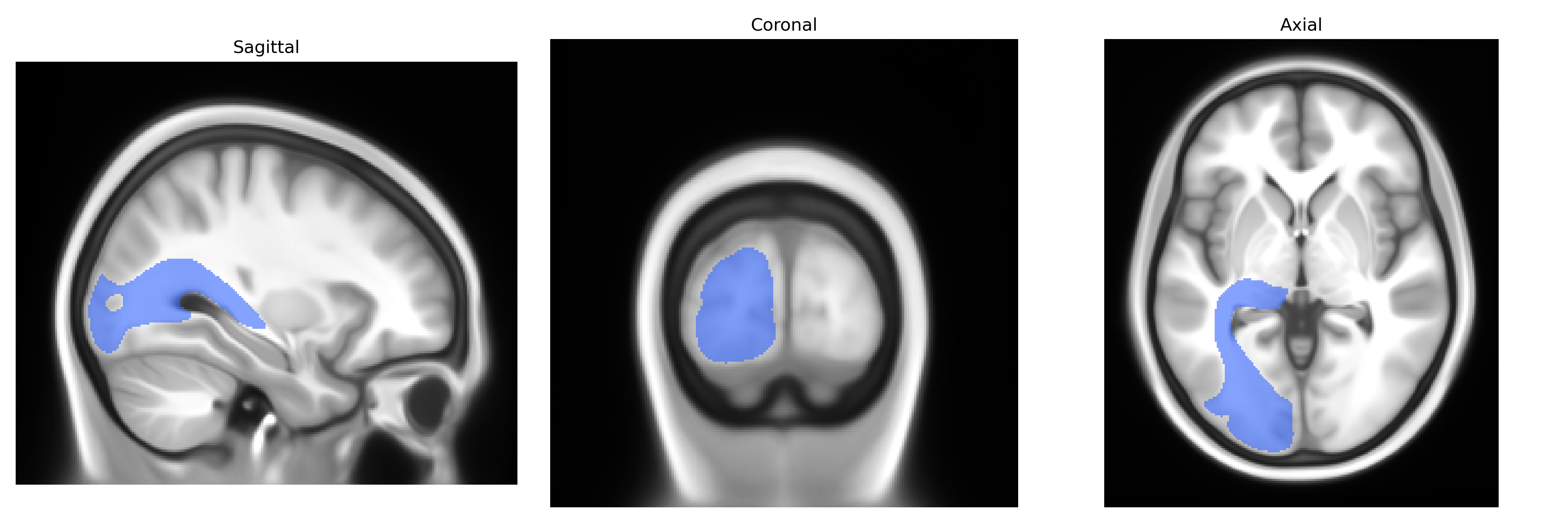
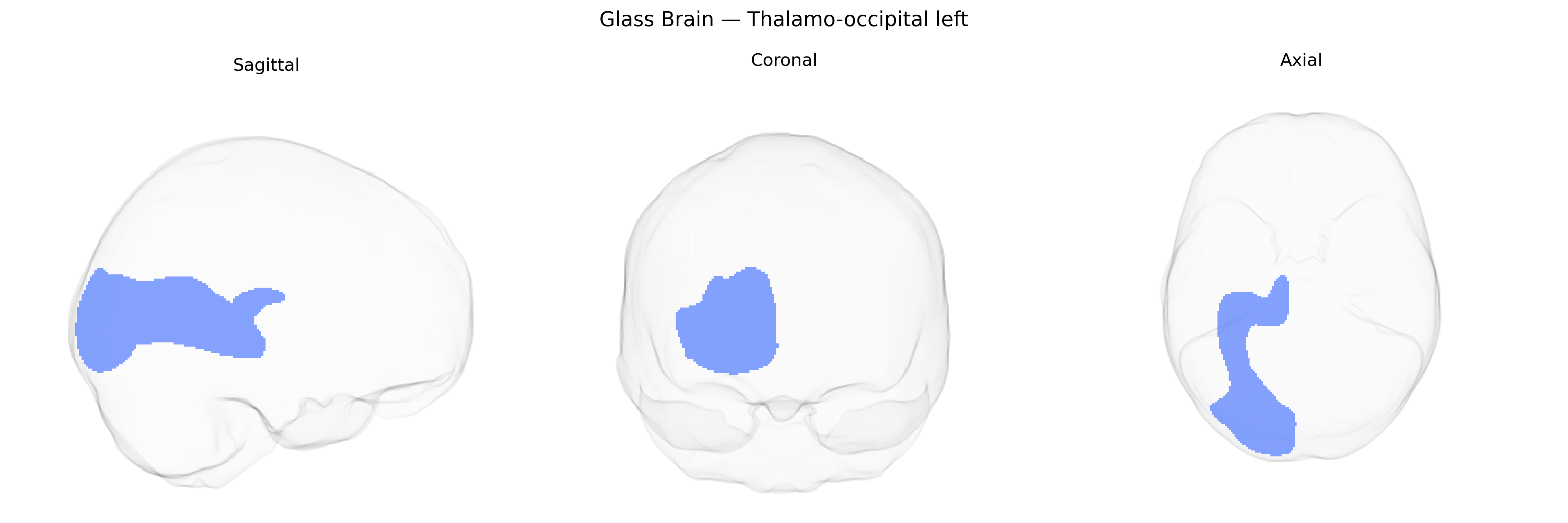
The Thalamo-occipital left white matter tract, as defined in the Pandora-TractSeg Atlas, comprises association fibers that connect nuclei of the left thalamus with cortical regions of the left occipital lobe. Functionally, this pathway is implicated in the relay and modulation of visual and visuospatial information, contributing to the integration of thalamic sensory processing with higher-order visual areas. Structurally, these fibers course posteriorly from the dorsal thalamus through the deep white matter, traversing regions adjacent to the lateral ventricles before terminating in occipital cortex, and are often considered part of the broader thalamocortical projection system. There is no direct Wikipedia link for this specific tract; a closely related structure is the Thalamocortical radiations.
As of 2024, there are no well-replicated, tract-specific genetic association findings reported in the literature that are uniquely attributable to the left thalamo-occipital white matter tract as defined in the Pandora-TractSeg Atlas; most imaging-genetics and GWAS studies of white matter use broader regional or voxelwise diffusion MRI measures rather than this specific tract. Large-scale diffusion tensor imaging GWAS (e.g., UK Biobank–based studies of fractional anisotropy, mean diffusivity, and related metrics) have identified numerous loci affecting occipital and thalamic projection pathways in aggregate—often implicating genes involved in axon guidance, myelination, and oligodendrocyte biology (such as variants near NTRK1/2, MAG, or genes in the netrin and semaphorin pathways)—but these results are typically reported at the level of major fasciculi (e.g., optic radiation, posterior thalamic radiations) or global “occipital” and “thalamic” white matter rather than an anatomically isolated thalamo-occipital left tract. Similarly, genetic correlations between diffusion metrics in posterior white matter and neuropsychiatric or neurodevelopmental conditions (including schizophrenia, bipolar disorder, autism spectrum disorder, and cognitive traits) suggest that posterior thalamic–occipital connectivity is heritable and relevant to disease risk, yet current data do not allow confident attribution of specific risk variants or disorder associations to the Pandora-defined left thalamo-occipital tract itself.
Overview generated by GPT-4o (2026).
Region ID: 58
Hemisphere: left
Atlas: Pandora-TractSeg
Full Quality Version: Download MP4
Full Quality Version: Download MP4
Wali Sidiqyar*, Gaurav Rudravaram*, Elyssa M. McMaster, Trent M. Schwartz, Adam M. Saunders, Kurt G. Schilling, Bennett A. Landman "Introducing SPINS: A Shared Public Visualization Library of Neuroanatomical Structures." Medical Imaging with Deep Learning- short paper
This resource is licensed under CC0 1.0 Universal (Public Domain).