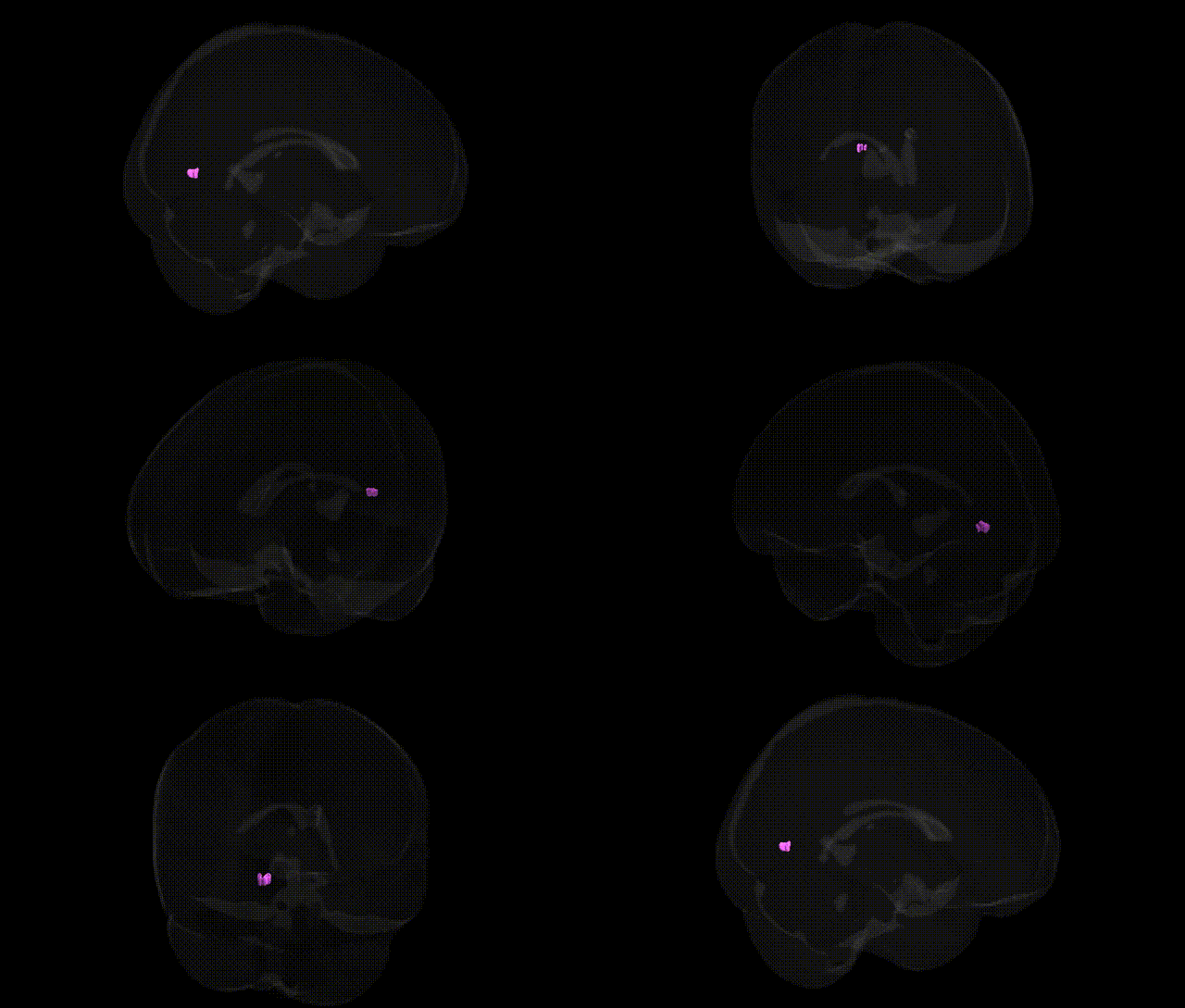
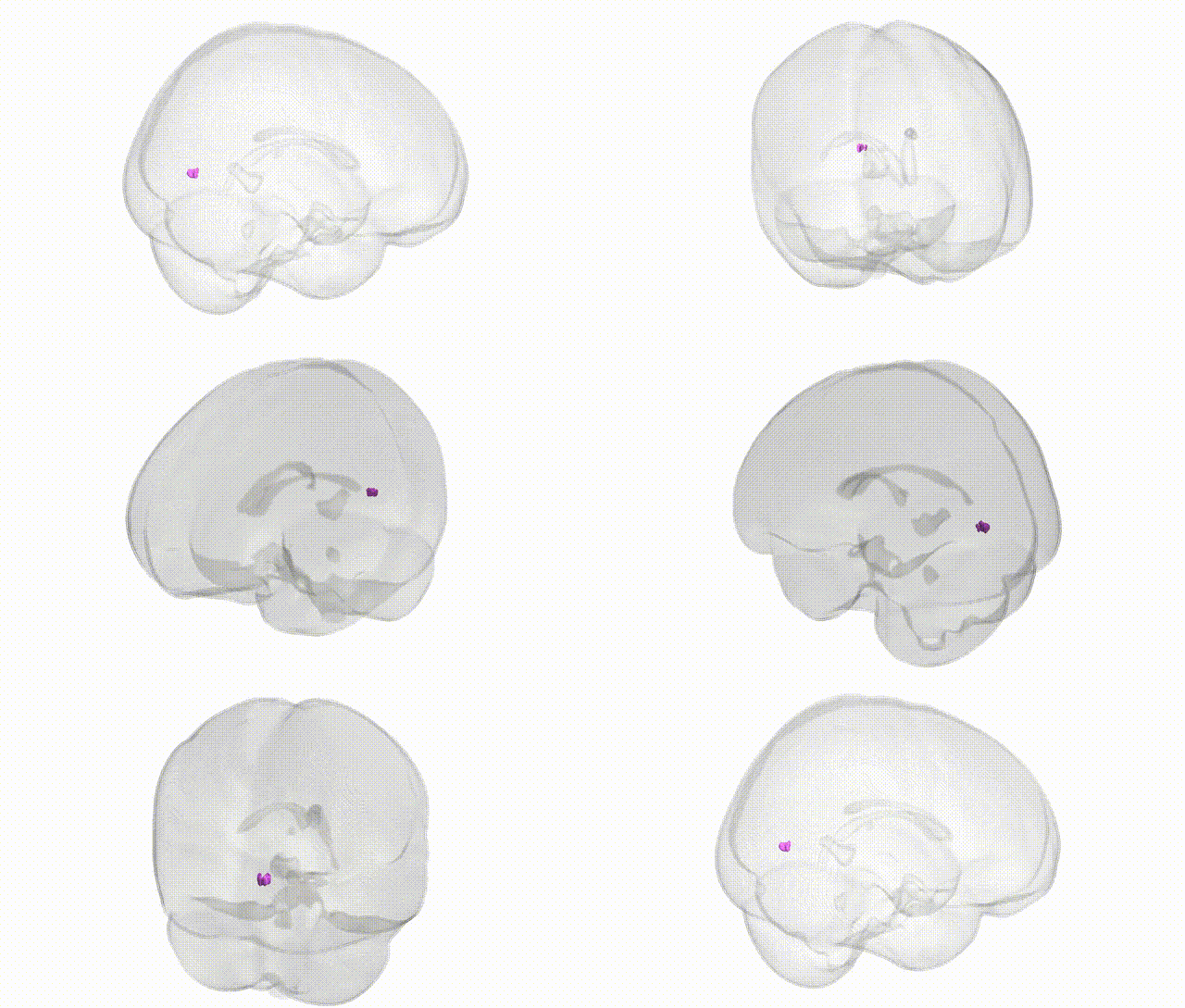
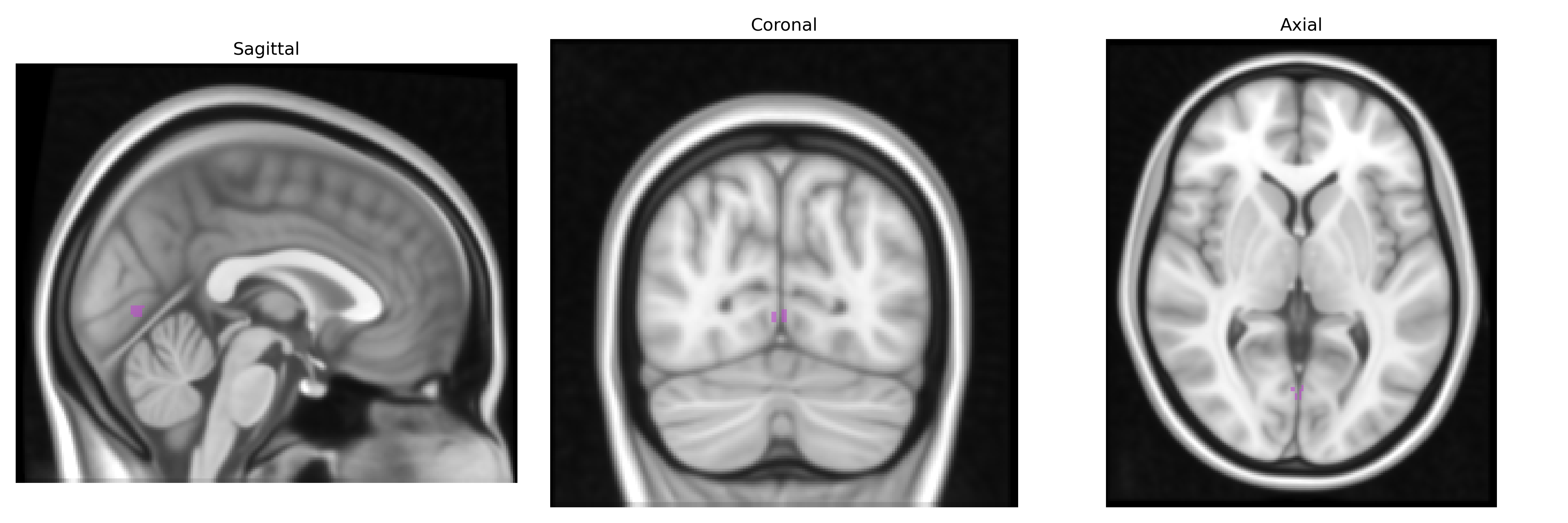
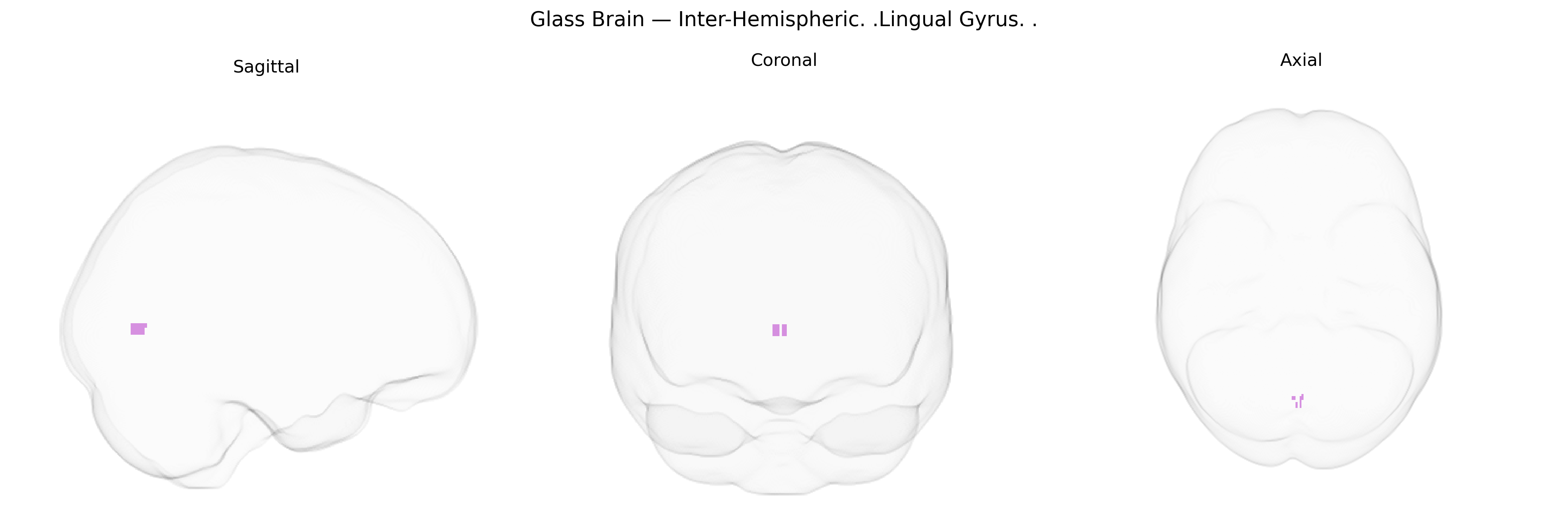
The bilateral inter-hemispheric lingual gyrus refers to gray matter located in the medial occipital lobe of both hemispheres, spanning the region along the calcarine sulcus and extending into the ventral occipitotemporal cortex. This cortical area is primarily involved in early and mid-level visual processing, including analysis of complex visual patterns, scenes, and words, and contributes to visual memory and integration of visual information with higher-order associative regions. Functionally, it participates in processing visual imagery and is frequently activated in tasks involving reading, recognition of letters and words, and interpretation of visual context. The lingual gyrus receives input from primary visual areas and projects to temporal and parietal association cortices, forming part of the ventral visual “what” pathway. There is no direct link for “inter-hemispheric lingual gyrus”; a related structure is the Lingual gyrus.
The bilateral inter-hemispheric lingual gyrus, a ventral occipital region involved in visual processing and higher-order visual cognition, has been implicated in several imaging genetics and GWAS-based imaging studies that link common variants to structural and functional variability in this area. Large-scale brain MRI GWAS (e.g., ENIGMA, UK Biobank) have identified associations between lingual gyrus volume or cortical thickness and variants in genes related to neurodevelopment, synaptic function, and myelination, including loci near MIR2113, HMGA2, and genes influencing intracranial and occipital lobe volume; these effects are often modest and part of broader, distributed patterns rather than specific to the lingual gyrus alone. Polygenic risk for schizophrenia, major depressive disorder, and bipolar disorder has been associated with alterations in lingual gyrus structure or activity, and individual risk loci within calcium-channel, glutamatergic, and synaptic genes show weak but convergent links with occipito-temporal cortex, including the lingual gyrus, in some multimodal studies. Variants associated with reading ability, dyslexia, and visual word-form processing, particularly within DCDC2, KIAA0319, and related loci, have been tied to functional differences in ventral occipito-temporal regions that encompass or border the lingual gyrus, consistent with its role in orthographic and visual-language processing. Additionally, GWAS of visual acuity, refractive error, and migraine have reported occipital lobe or lingual gyrus correlates of risk alleles in genes related to neurovascular regulation and visual system development, though these findings typically implicate broader visual networks rather than this region in isolation. Overall, the genetic architecture of the bilateral inter-hemispheric lingual gyrus appears highly polygenic and shared with other visual and association cortices, with disease- and trait-related findings emerging primarily from large-scale imaging-genetic consortia and polygenic risk analyses rather than single, region-specific loci.
Overview generated by GPT-4o (2026).
Region ID: 524
Hemisphere: bilateral
Atlas: Talairach labels 1mm
Full Quality Version: Download MP4
Full Quality Version: Download MP4
Wali Sidiqyar*, Gaurav Rudravaram*, Elyssa M. McMaster, Trent M. Schwartz, Adam M. Saunders, Kurt G. Schilling, Bennett A. Landman "Introducing SPINS: A Shared Public Visualization Library of Neuroanatomical Structures." Medical Imaging with Deep Learning- short paper
This resource is licensed under CC0 1.0 Universal (Public Domain).