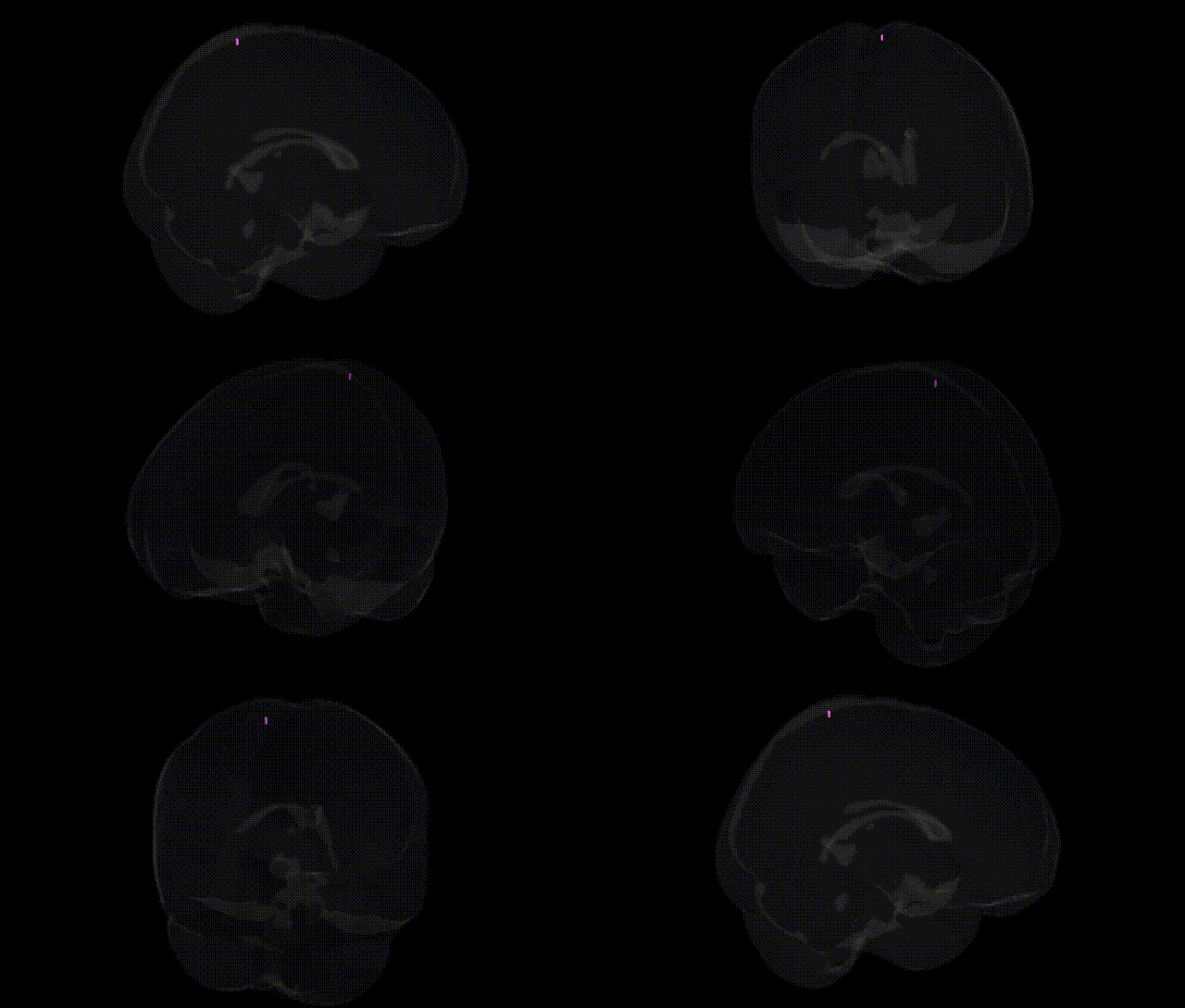
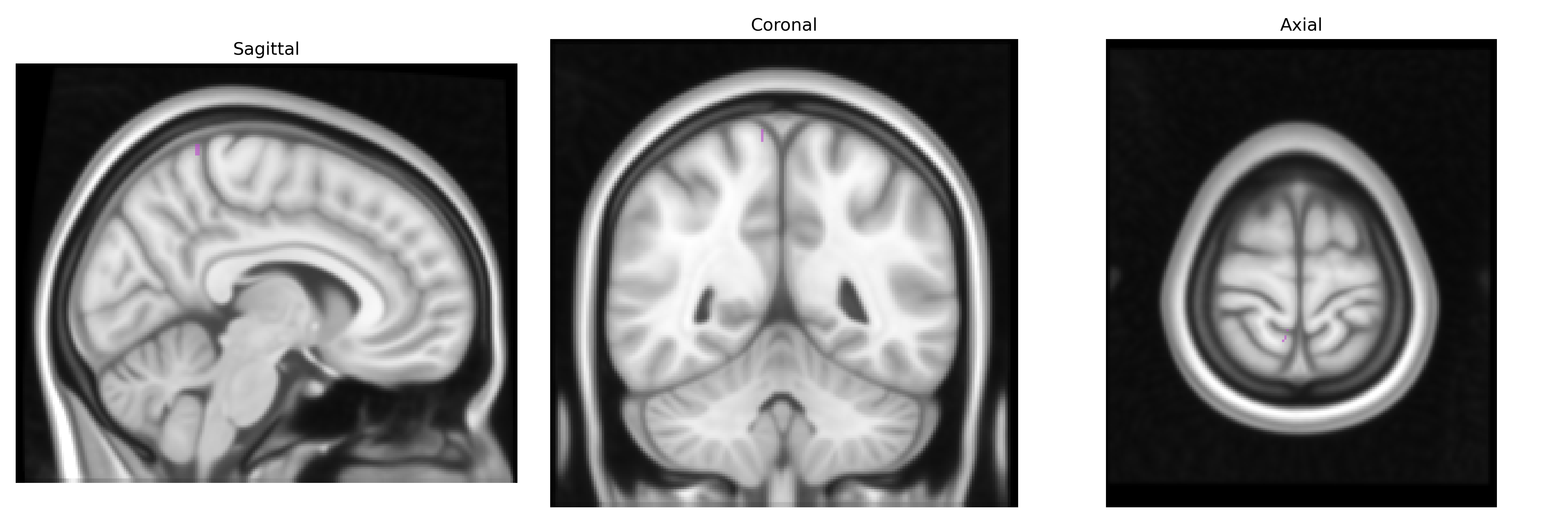
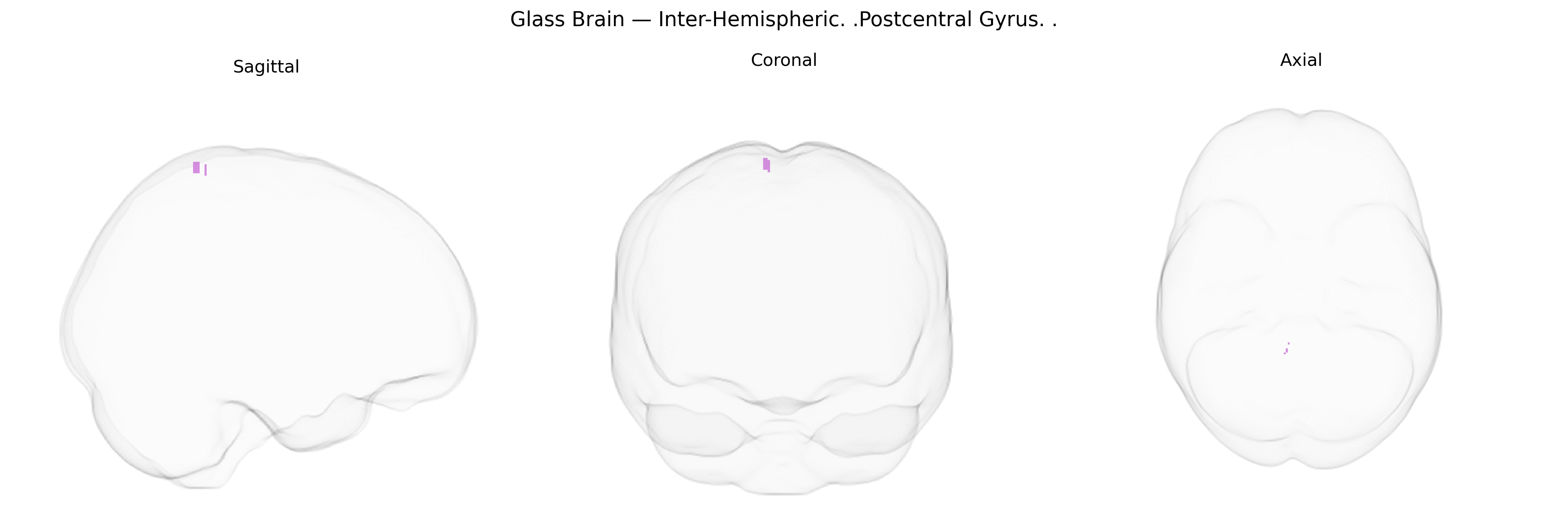
The bilateral inter-hemispheric postcentral gyrus corresponds to the primary somatosensory cortex (Brodmann areas 1, 2, and 3) located immediately posterior to the central sulcus in both cerebral hemispheres, with the “inter-hemispheric” designation emphasizing regions near the midline adjacent to the longitudinal fissure. This cortical region receives dense thalamocortical input from the ventral posterior nucleus of the thalamus and is topographically organized into a somatotopic “homunculus,” with distinct representations for different body parts such as the face, upper limb, trunk, and lower limb. Neurons in this region encode modalities including fine touch, vibration, proprioception, and, to a lesser extent, nociception and temperature, and they participate in higher-order processes such as tactile discrimination, sensorimotor integration, and body schema representation. The bilateral aspect reflects coordinated processing and integration of somatosensory information across both hemispheres, particularly for midline and bilateral body regions, supporting coherent perception of the body and facilitating complex goal-directed movements and bimanual coordination. Postcentral gyrus
The bilateral inter-hemispheric postcentral gyrus—corresponding largely to primary somatosensory cortex (S1)—has been repeatedly implicated in genetic and GWAS-based studies of brain structure and function, though typically under broader labels such as “postcentral gyrus,” “somatosensory cortex,” or “parietal lobe,” rather than specifically the Talairach 1 mm inter-hemispheric parcel. Twin and family studies show high heritability for cortical thickness, surface area, and gyrification in this region, with variants in genes involved in neurodevelopment and synaptic plasticity (e.g., BDNF, NRG1, and various cell-adhesion and axon-guidance genes) contributing to interindividual differences in somatosensory cortical morphology. Large-scale neuroimaging GWAS (e.g., ENIGMA, UK Biobank) have identified multiple loci (including MHCI-region immune genes, MAPT/17q21.31, and genes regulating neuronal proliferation and myelination) associated with postcentral gyrus thickness and surface area, and polygenic scores for global brain volume and intracranial volume also predict variation in this region. Clinically, genetic risk for autism spectrum disorder, schizophrenia, ADHD, and epilepsy has been linked to altered structure or activation of the postcentral gyrus in imaging–genetics studies, with shared polygenic architectures for neurodevelopmental disorders often manifesting as atypical somatosensory cortical organization; in addition, rare monogenic and CNV syndromes affecting cortical development (e.g., 22q11.2 deletion, LIS1/PAFAH1B1-related lissencephaly, and other malformation-of-cortical-development genes) frequently involve abnormal morphology of the postcentral gyrus, underscoring the region’s sensitivity to genetic perturbations of early cortical patterning and sensorimotor circuitry.
Overview generated by GPT-4o (2026).
Region ID: 1103
Hemisphere: bilateral
Atlas: Talairach labels 1mm
Full Quality Version: Download MP4
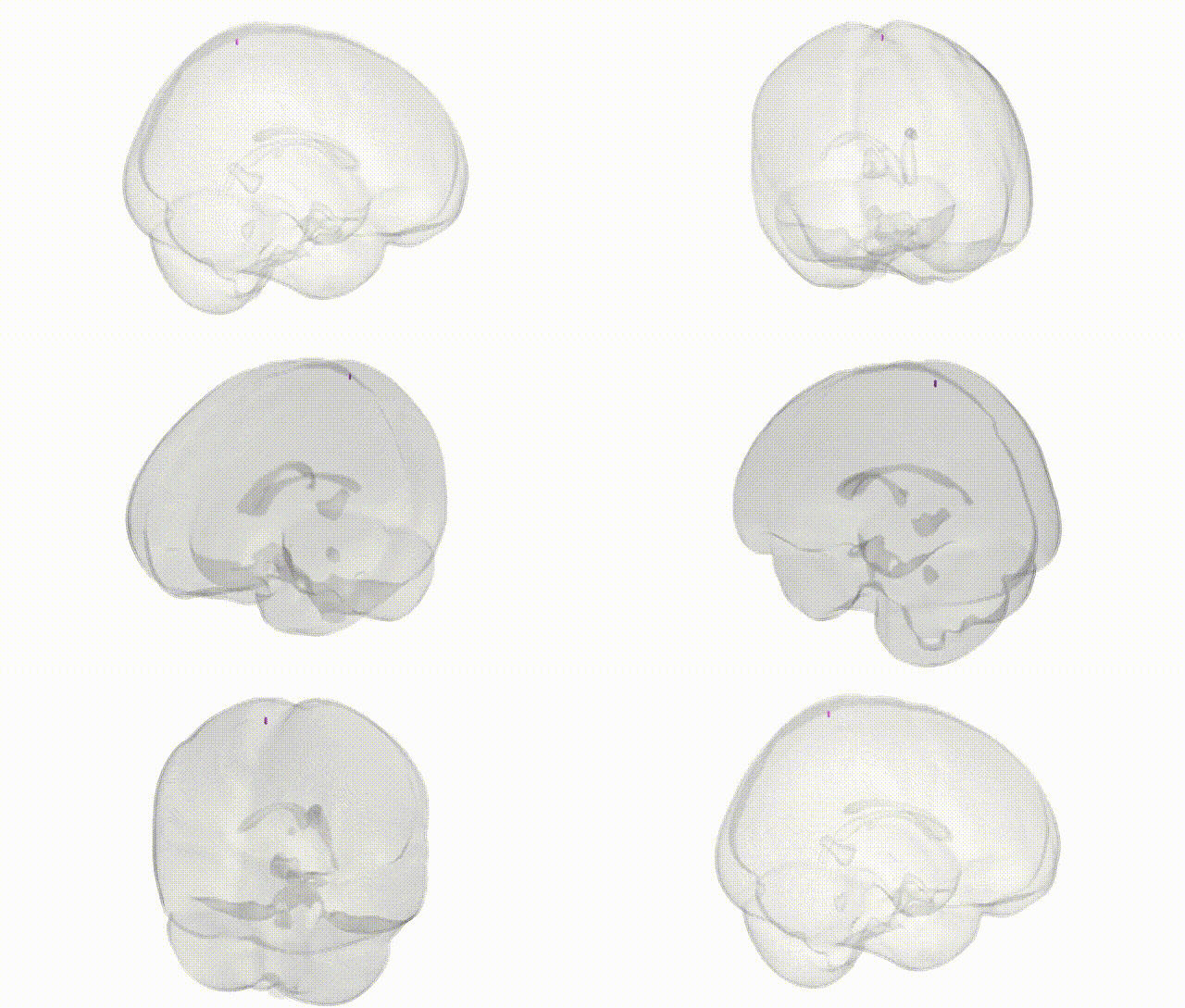
Full Quality Version: Download MP4
Wali Sidiqyar*, Gaurav Rudravaram*, Elyssa M. McMaster, Trent M. Schwartz, Adam M. Saunders, Kurt G. Schilling, Bennett A. Landman "Introducing SPINS: A Shared Public Visualization Library of Neuroanatomical Structures." Medical Imaging with Deep Learning- short paper
This resource is licensed under CC0 1.0 Universal (Public Domain).