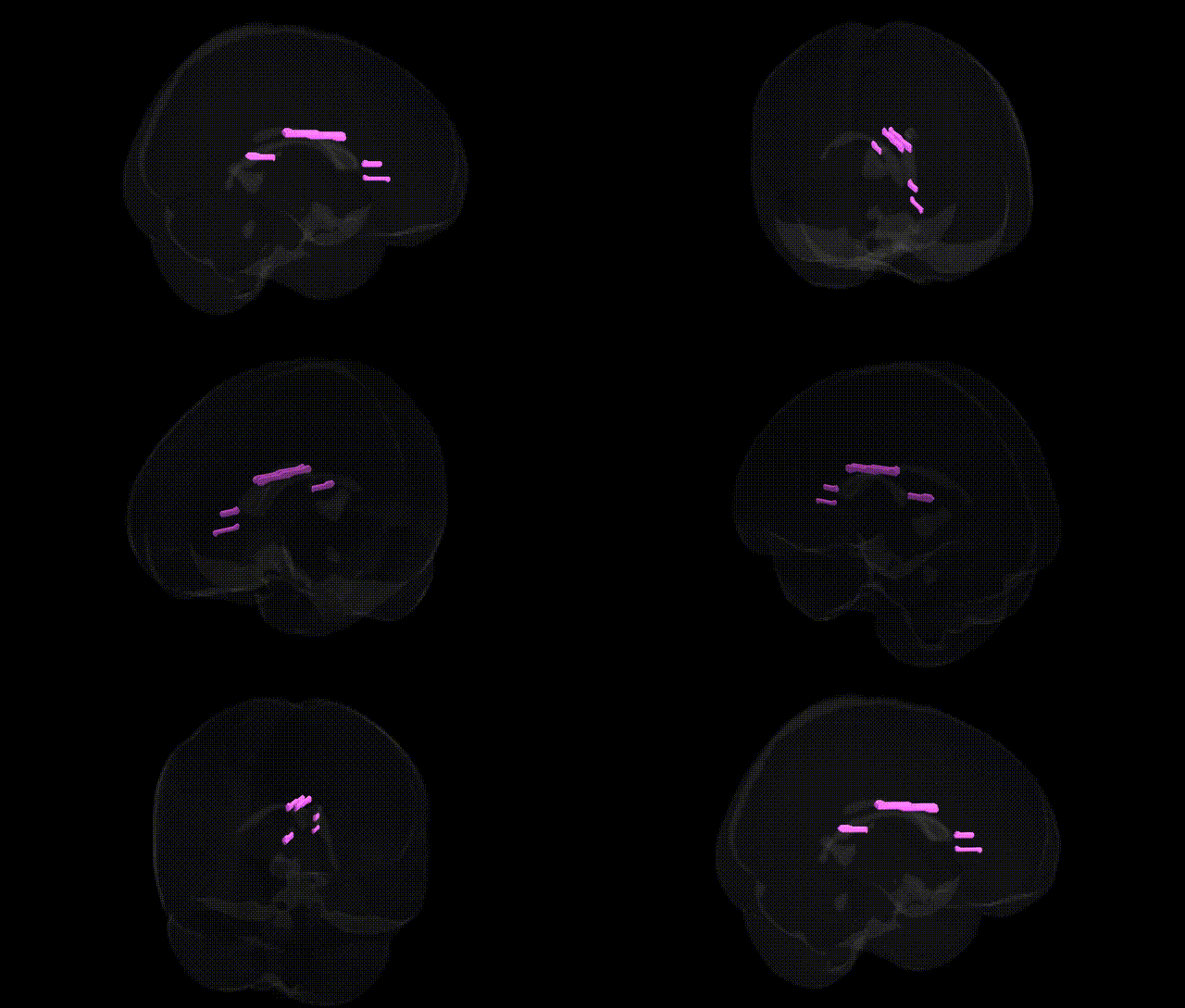
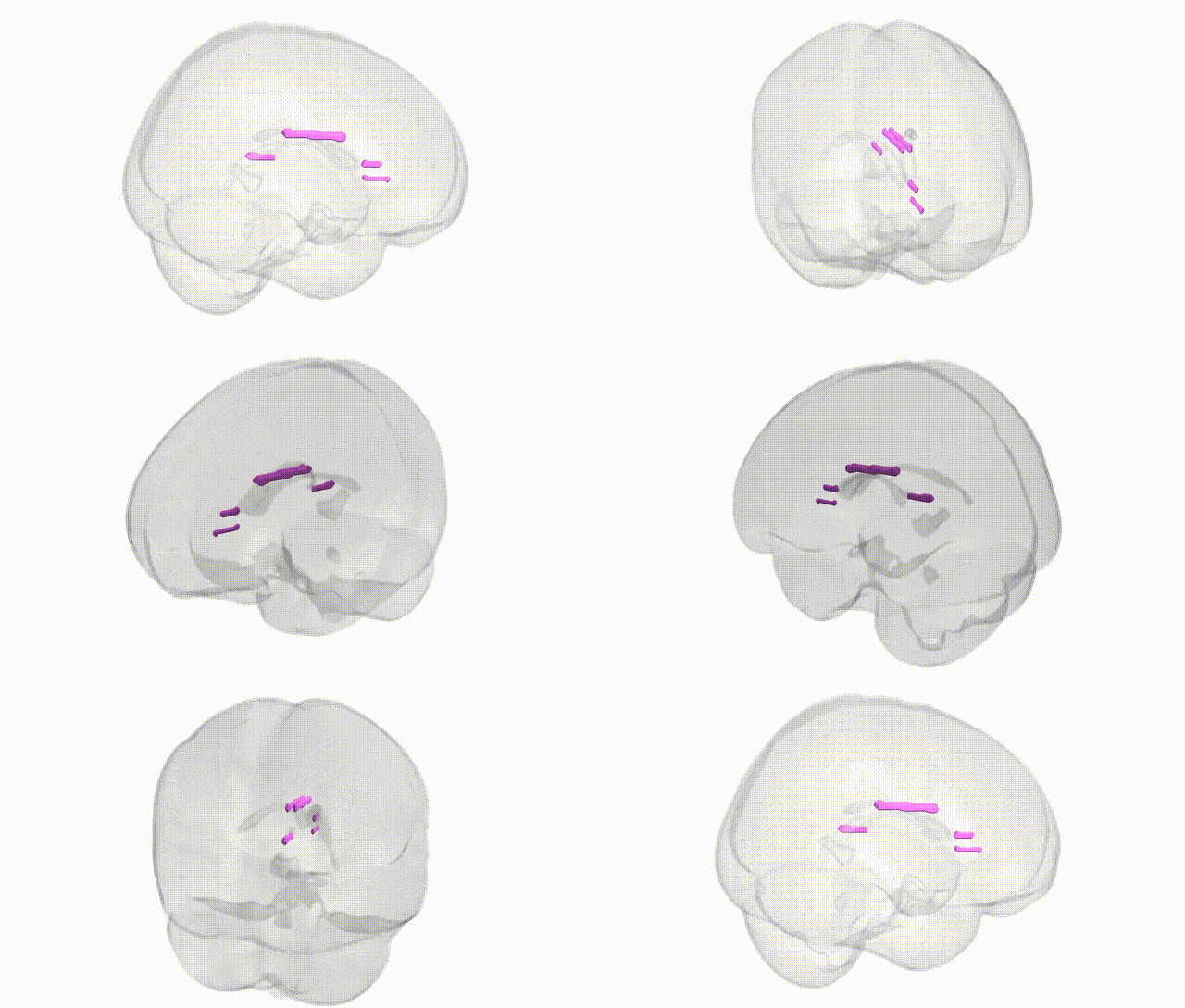
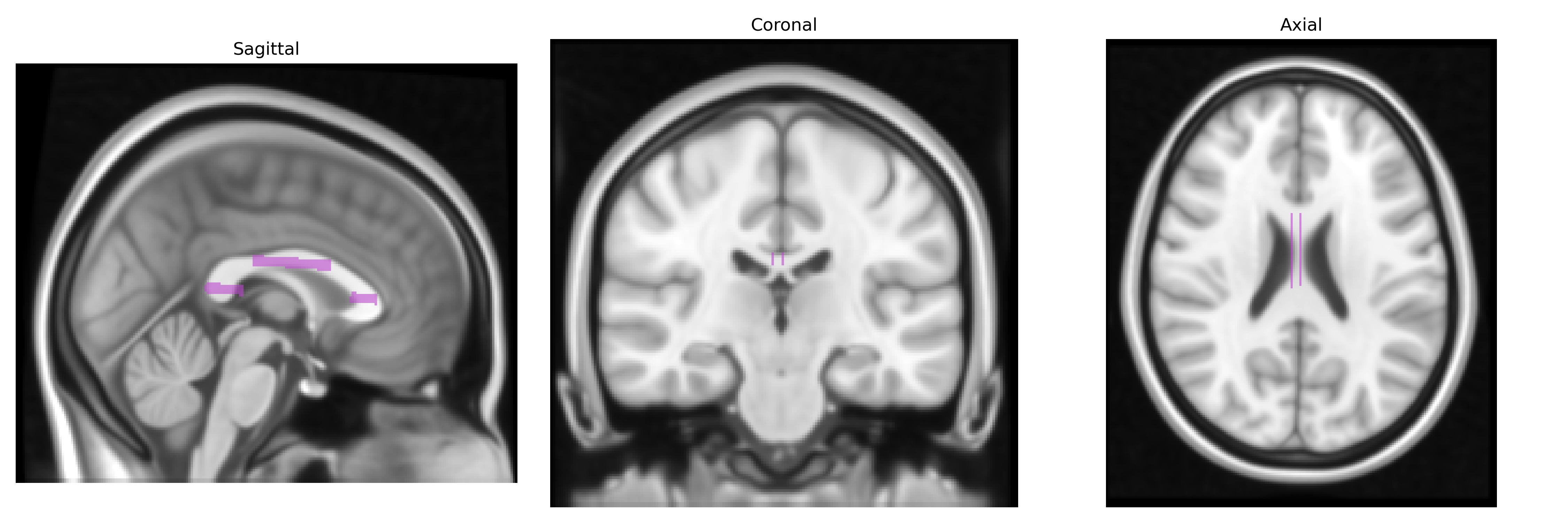
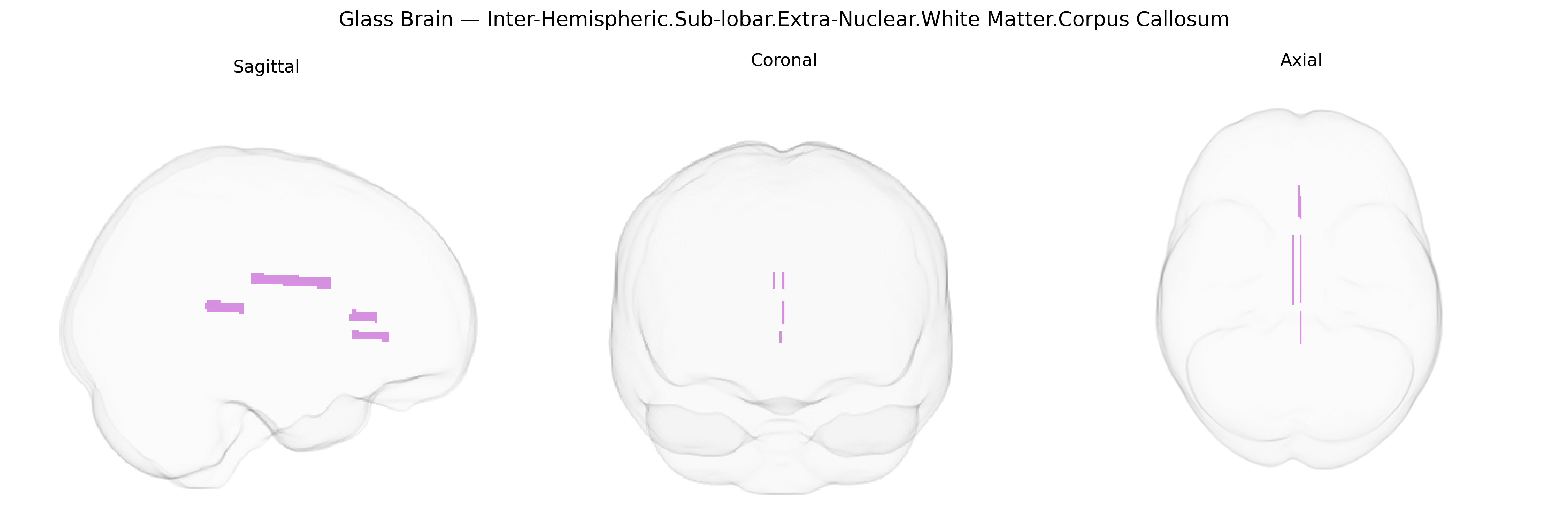
The bilateral Inter-Hemispheric.Sub-lobar.Extra-Nuclear.White Matter.Corpus Callosum region, as defined in the Talairach 1 mm Atlas, corresponds to the major interhemispheric white matter tract that connects homologous and heterologous areas of the left and right cerebral hemispheres. Composed primarily of densely myelinated axons, it is subdivided into rostrum, genu, body, isthmus, and splenium, each segment projecting to distinct cortical territories, including frontal, parietal, temporal, and occipital regions. Functionally, this structure mediates rapid interhemispheric transfer of sensory, motor, and higher-order cognitive information, contributing to coordinated bilateral motor control, integration of visual and somatosensory inputs, language lateralization, and complex behaviors requiring synchronization of activity across hemispheres. Disruption of this white matter pathway, whether by congenital agenesis, demyelinating disease, infarction, or surgical section (callosotomy), can lead to characteristic disconnection syndromes and impairments in interhemispheric communication. Corpus callosum
The corpus callosum, the major interhemispheric white matter tract corresponding to the Inter-Hemispheric.Sub-lobar.Extra-Nuclear.White Matter.Corpus Callosum label in the Talairach 1 mm atlas, has been repeatedly implicated in genetic studies, including large-scale GWAS of brain structure that show strong heritability of callosal area, thickness, and microstructure (e.g., fractional anisotropy) with significant loci in genes involved in axon guidance, myelination, and neurodevelopment such as NTRK1/2, LINGO1, CNTNAP2, and multiple oligodendrocyte-related genes. Variants in callosal-development genes like L1CAM, ROBO1/2, DCC, and ARX have been associated with agenesis or hypoplasia of the corpus callosum and syndromic neurodevelopmental disorders. GWAS and imaging-genetics studies link corpus callosum morphology and integrity to schizophrenia, bipolar disorder, major depression, autism spectrum disorder, ADHD, and Alzheimer’s disease, often mediated by polygenic risk scores enriched for synaptic and white-matter–related genes. Callosal diffusion and volume measures show genetic correlations with cognitive performance, educational attainment, and neuroticism, and are influenced by risk loci for demyelinating and white matter diseases such as multiple sclerosis. Overall, genetic associations for this region converge on pathways regulating midline crossing of axons, oligodendrocyte function, and neuroinflammation, which help explain its involvement across a broad range of psychiatric, neurodevelopmental, and neurodegenerative traits.
Overview generated by GPT-4o (2026).
Region ID: 651
Hemisphere: bilateral
Atlas: Talairach labels 1mm
Full Quality Version: Download MP4
Full Quality Version: Download MP4
Wali Sidiqyar*, Gaurav Rudravaram*, Elyssa M. McMaster, Trent M. Schwartz, Adam M. Saunders, Kurt G. Schilling, Bennett A. Landman "Introducing SPINS: A Shared Public Visualization Library of Neuroanatomical Structures." Medical Imaging with Deep Learning- short paper
This resource is licensed under CC0 1.0 Universal (Public Domain).