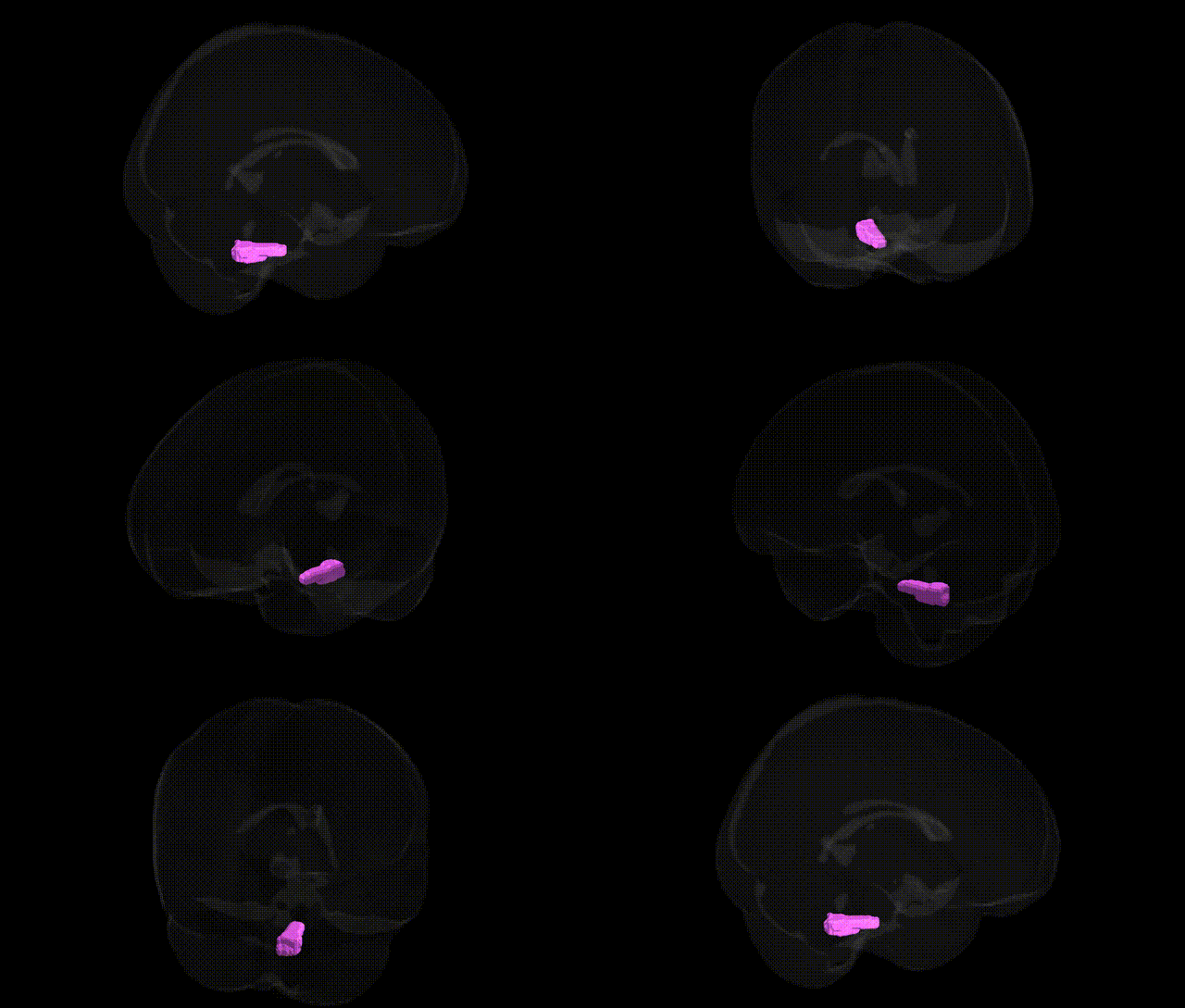
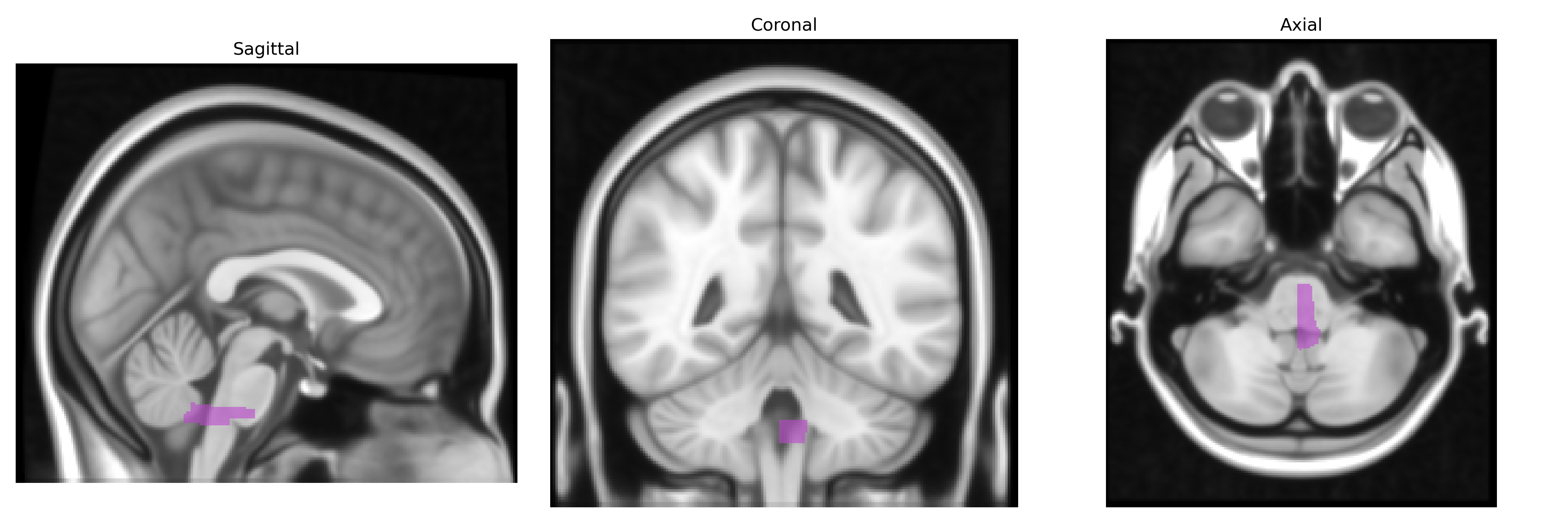
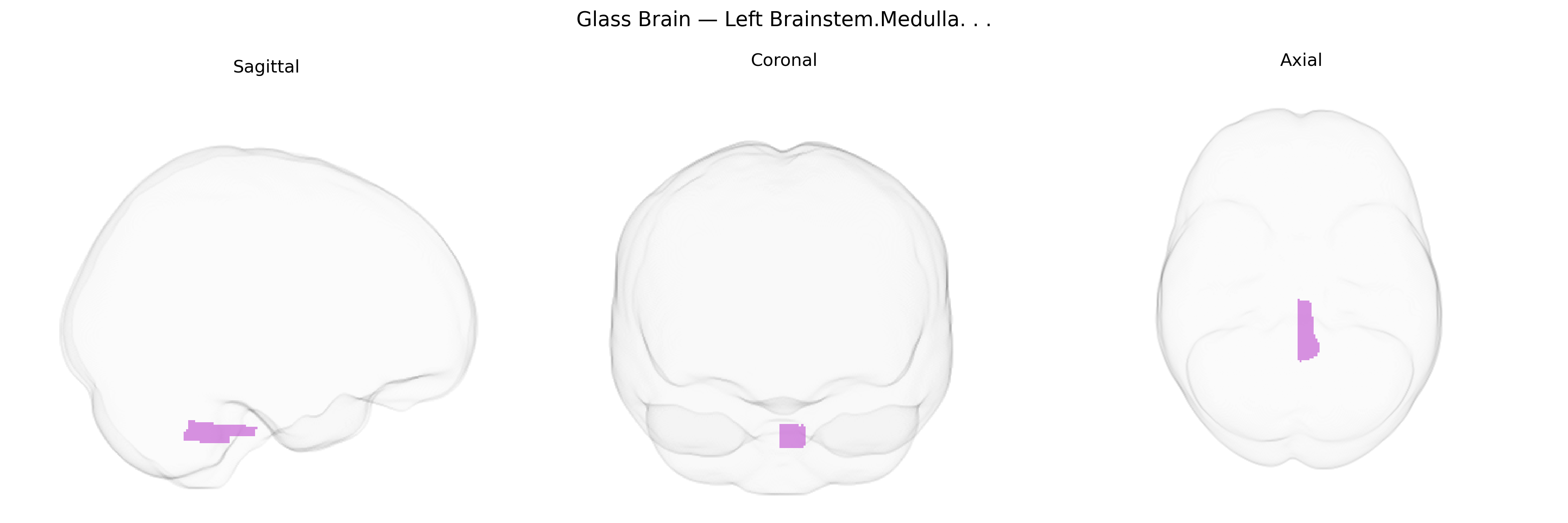
The bilateral Left Brainstem.Medulla corresponds to the medulla oblongata, the caudal portion of the brainstem that is continuous with the spinal cord and lies just below the pons. This structure contains critical autonomic control centers for cardiovascular and respiratory regulation, including nuclei that modulate heart rate, blood pressure, and breathing rhythm, as well as reflex centers for coughing, sneezing, swallowing, and vomiting. The medulla houses major ascending sensory and descending motor pathways, such as the corticospinal tracts (which decussate in the pyramids), dorsal column nuclei (gracile and cuneate), and multiple cranial nerve nuclei (e.g., for cranial nerves IX–XII). Its bilateral organization supports essential life-sustaining functions and integrates visceral, somatic, and reflexive responses. Medulla oblongata
The bilateral left medulla, a brainstem region encompassing autonomic and motor nuclei, has been implicated indirectly in genetic studies of neurodevelopmental, neurodegenerative, and psychiatric traits, although few GWAS pinpoint it as a primary anatomical endpoint. Variants in genes affecting brainstem development and hindbrain patterning (e.g., HOXA1, PHOX2B, L1CAM) have been associated with congenital brainstem malformations, autonomic dysfunction, and disorders such as congenital central hypoventilation syndrome, which prominently involve medullary structures. Large-scale imaging–genetics consortia (e.g., ENIGMA and UK Biobank) have identified polygenic influences on brainstem volume and microstructure, implicating genes involved in axon guidance, myelination, and neuroinflammation, though these signals are typically reported for the brainstem or hindbrain as a whole rather than for the Talairach-defined left medulla specifically. Medullary involvement is also noted in monogenic and polygenic forms of Parkinson’s disease, multiple system atrophy, and amyotrophic lateral sclerosis, where risk variants in genes such as SNCA, LRRK2, GBA, C9orf72, and others co-occur with pathology and atrophy affecting medullary nuclei. In addition, GWAS of blood pressure, heart rate, and respiratory traits highlight genes that modulate autonomic circuits, some of which converge on pathways expressed in medullary cardiovascular and respiratory centers, although spatial resolution is generally insufficient to assign effects to the unilateral left medulla alone. Overall, current genetic evidence links the medulla’s structural and functional integrity to polygenic influences across neurodevelopmental, autonomic, and neurodegenerative pathways rather than to a small set of region-specific risk loci.
Overview generated by GPT-4o (2026).
Region ID: 5
Hemisphere: bilateral
Atlas: Talairach labels 1mm
Full Quality Version: Download MP4
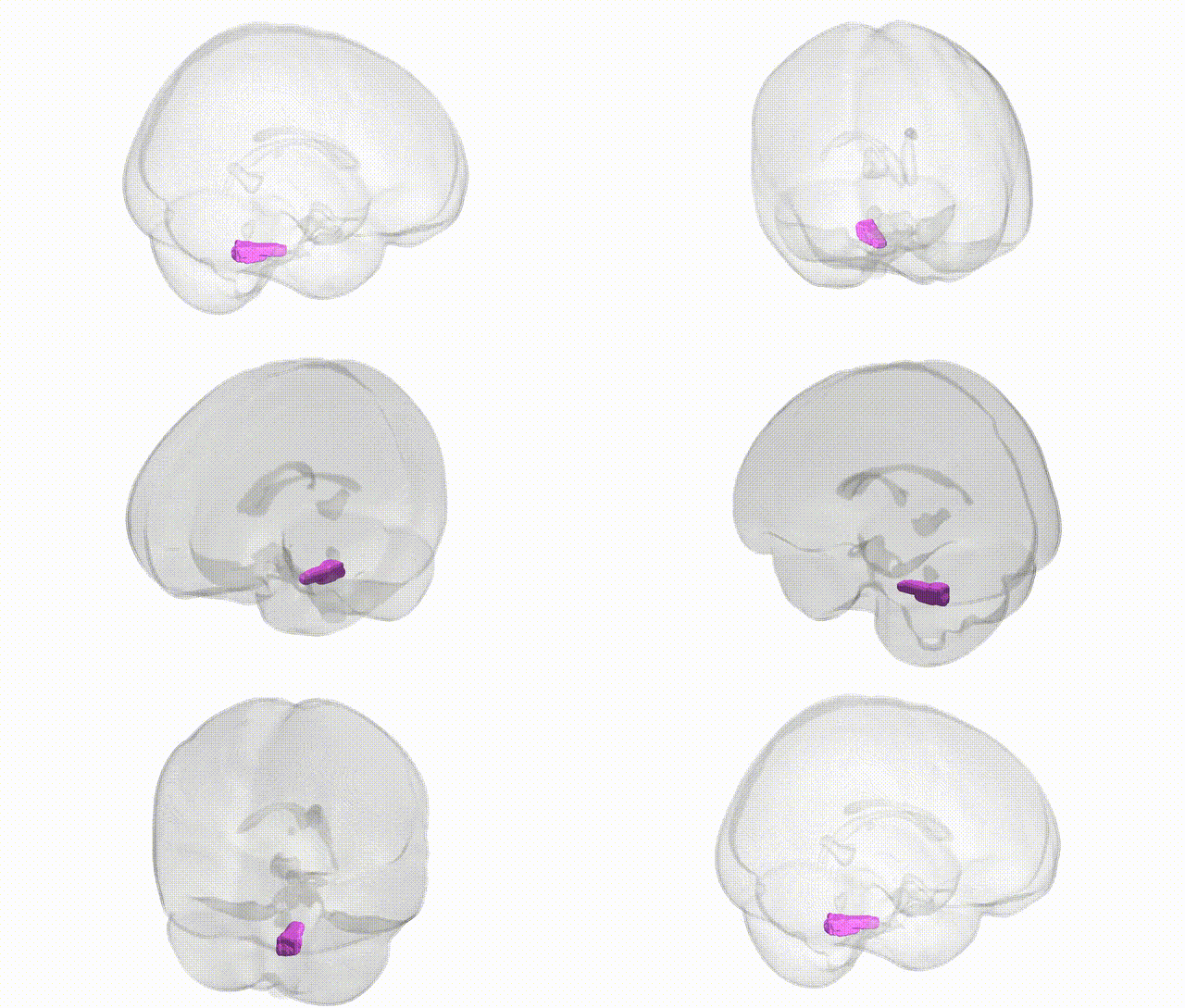
Full Quality Version: Download MP4
Wali Sidiqyar*, Gaurav Rudravaram*, Elyssa M. McMaster, Trent M. Schwartz, Adam M. Saunders, Kurt G. Schilling, Bennett A. Landman "Introducing SPINS: A Shared Public Visualization Library of Neuroanatomical Structures." Medical Imaging with Deep Learning- short paper
This resource is licensed under CC0 1.0 Universal (Public Domain).