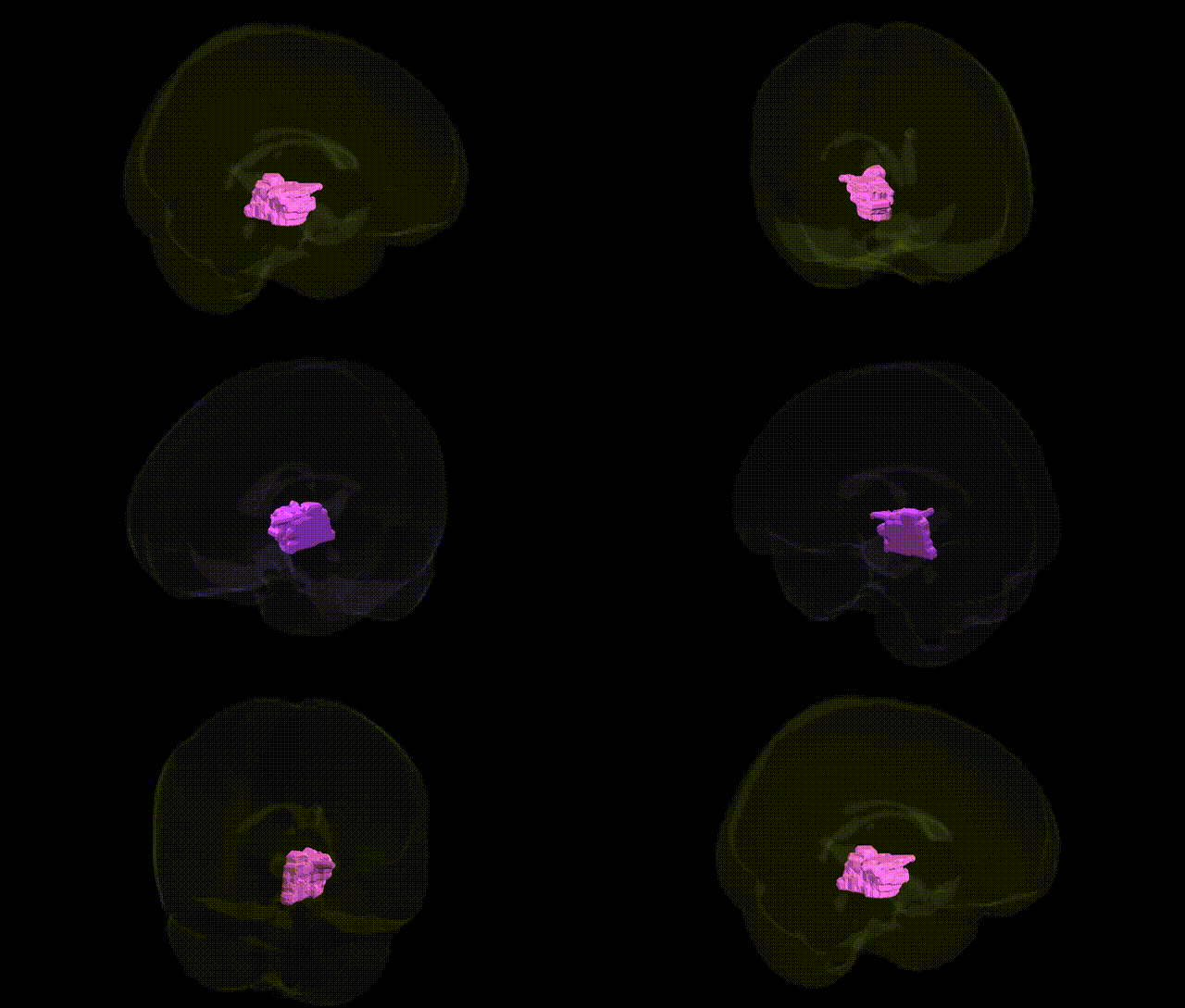
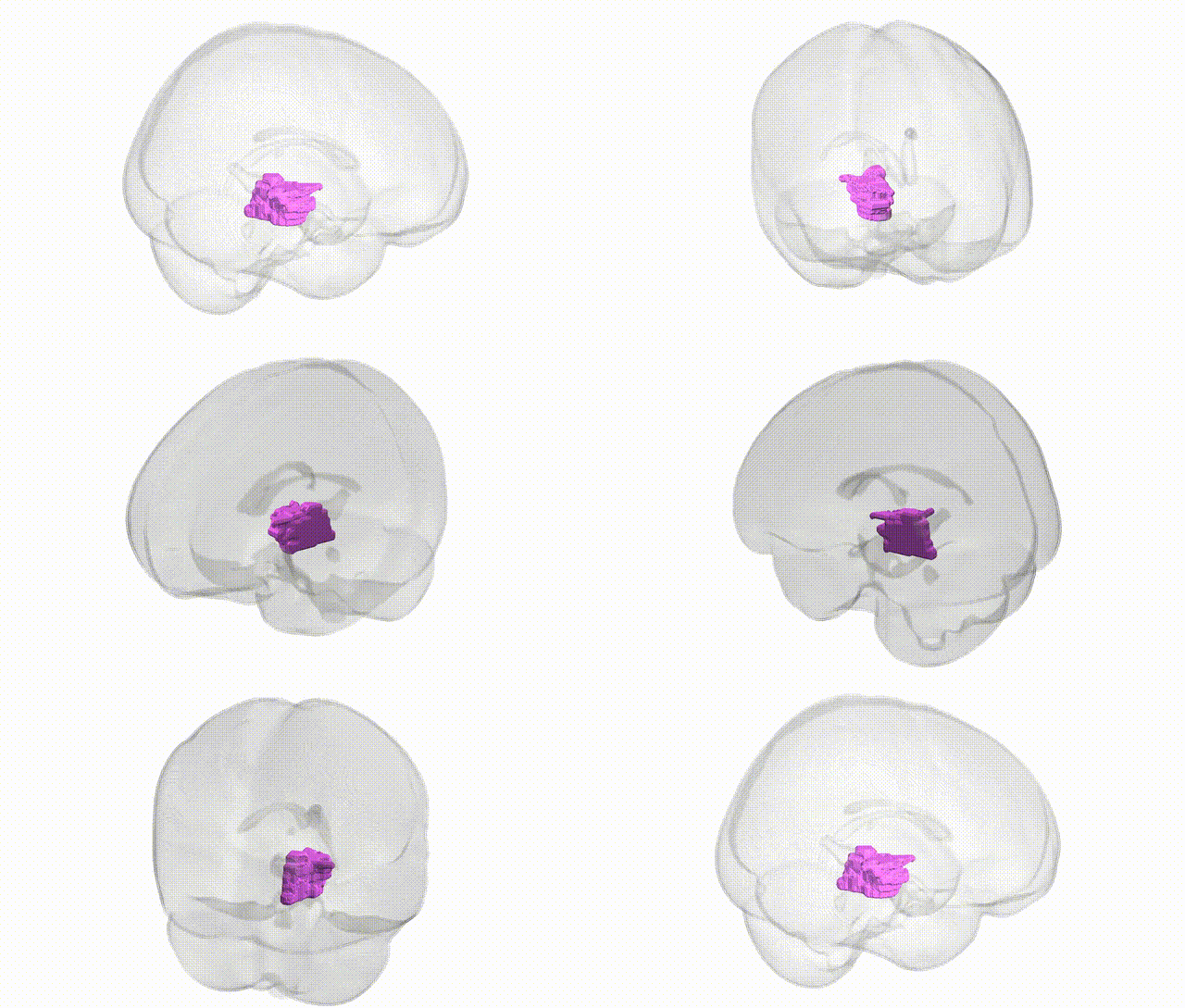
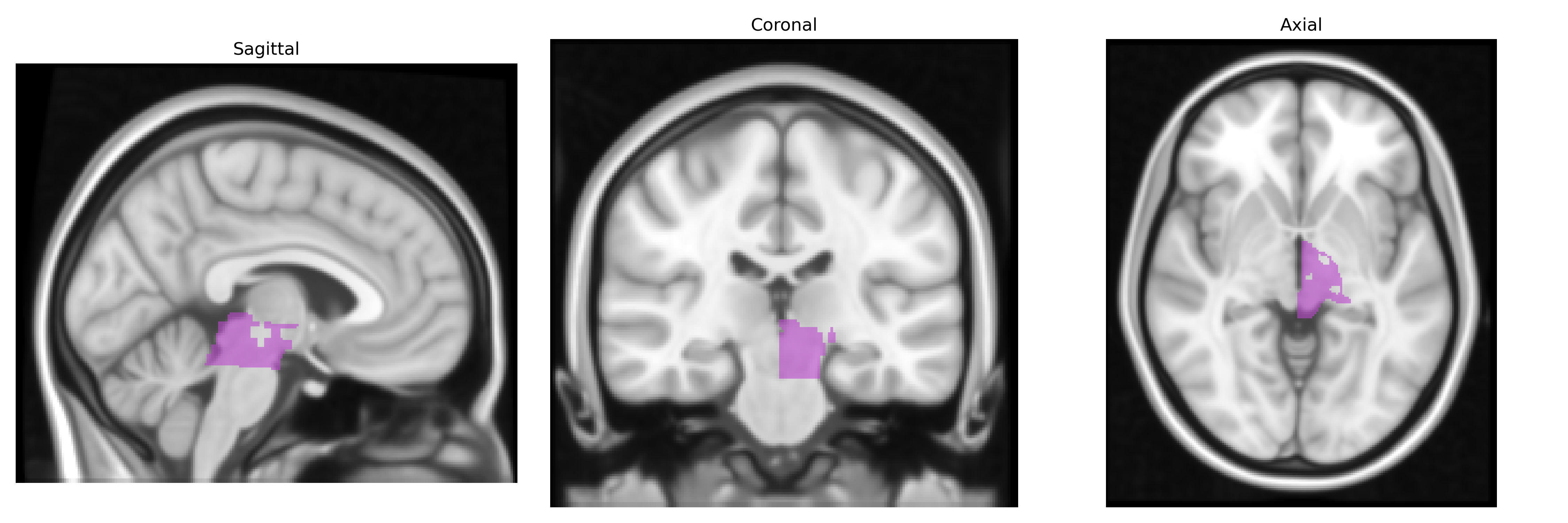
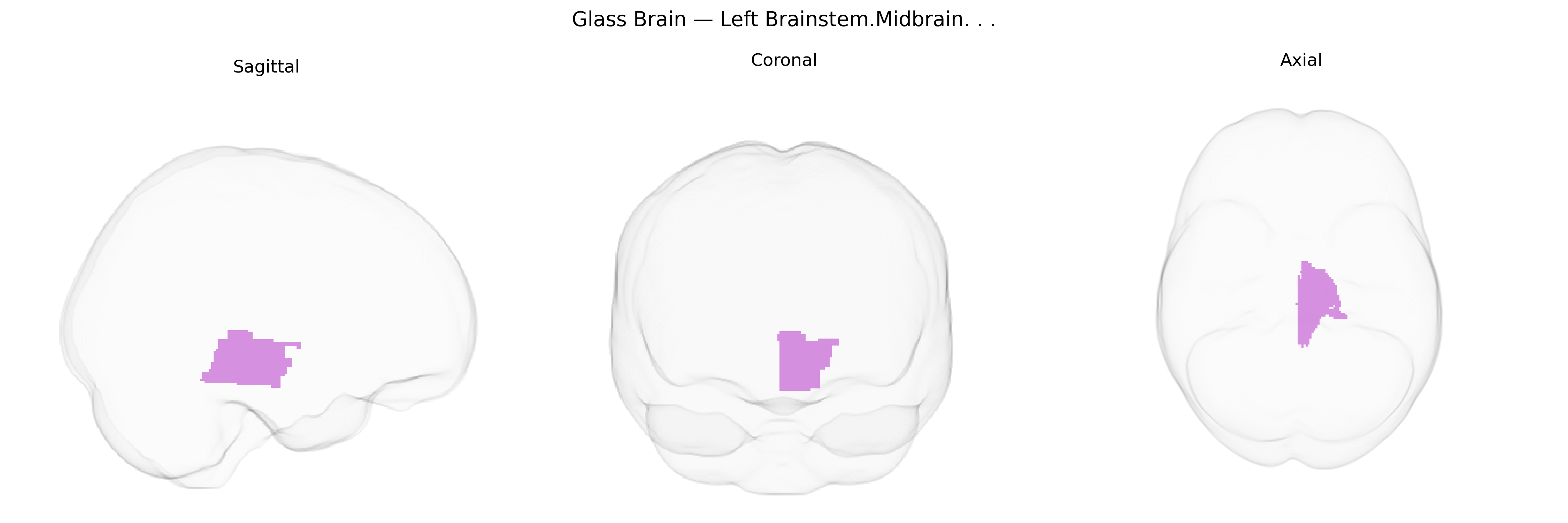
The bilateral Left Brainstem.Midbrain refers to the portion of the mesencephalon located within the brainstem on the left side, encompassing structures such as the superior and inferior colliculi, substantia nigra, red nucleus, periaqueductal gray, and ascending and descending fiber tracts. This region serves as a critical relay and integration center for visual and auditory reflexes, motor control, pain modulation, and arousal, as well as a conduit for major pathways connecting the forebrain, cerebellum, and spinal cord. Dopaminergic neurons in the substantia nigra within the midbrain contribute to the regulation of voluntary movement and are implicated in movement disorders such as Parkinson’s disease, while other nuclei and tracts coordinate eye movements, head orientation, and autonomic functions. There is no direct Wikipedia article for “Left Brainstem.Midbrain” as a Talairach label; a related structure is the Midbrain.
The bilateral left midbrain region in the Talairach 1 mm atlas, encompassing structures such as the substantia nigra, ventral tegmental area, and adjacent tegmental nuclei, is indirectly implicated in several genetic associations through GWAS and candidate-gene studies of brainstem volume, connectivity, and related clinical phenotypes. Variants in genes central to dopaminergic neuron development and survival (e.g., SNCA, LRRK2, GBA, MAPT) show strong associations with Parkinson’s disease and parkinsonian syndromes, which prominently involve midbrain degeneration, particularly in the substantia nigra. Midbrain volume and brainstem structural measures from large imaging-genetics consortia (e.g., ENIGMA, UK Biobank) have been linked to loci near genes involved in neurodevelopment, axon guidance, and synaptic signaling, including common variants in MAPT and other neurodegeneration-related genes that influence brainstem and subcortical morphology. GWAS of schizophrenia, major depressive disorder, and substance use traits implicate polygenic risk affecting midbrain dopaminergic circuits, with risk loci in glutamatergic, GABAergic, and monoaminergic genes (such as DRD2 and SLC6A3) influencing midbrain-related functional networks, although these associations are typically inferred via circuit-level or imaging-based endophenotypes rather than direct midbrain-specific GWAS hits.
Overview generated by GPT-4o (2026).
Region ID: 215
Hemisphere: bilateral
Atlas: Talairach labels 1mm
Full Quality Version: Download MP4
Full Quality Version: Download MP4
Wali Sidiqyar*, Gaurav Rudravaram*, Elyssa M. McMaster, Trent M. Schwartz, Adam M. Saunders, Kurt G. Schilling, Bennett A. Landman "Introducing SPINS: A Shared Public Visualization Library of Neuroanatomical Structures." Medical Imaging with Deep Learning- short paper
This resource is licensed under CC0 1.0 Universal (Public Domain).