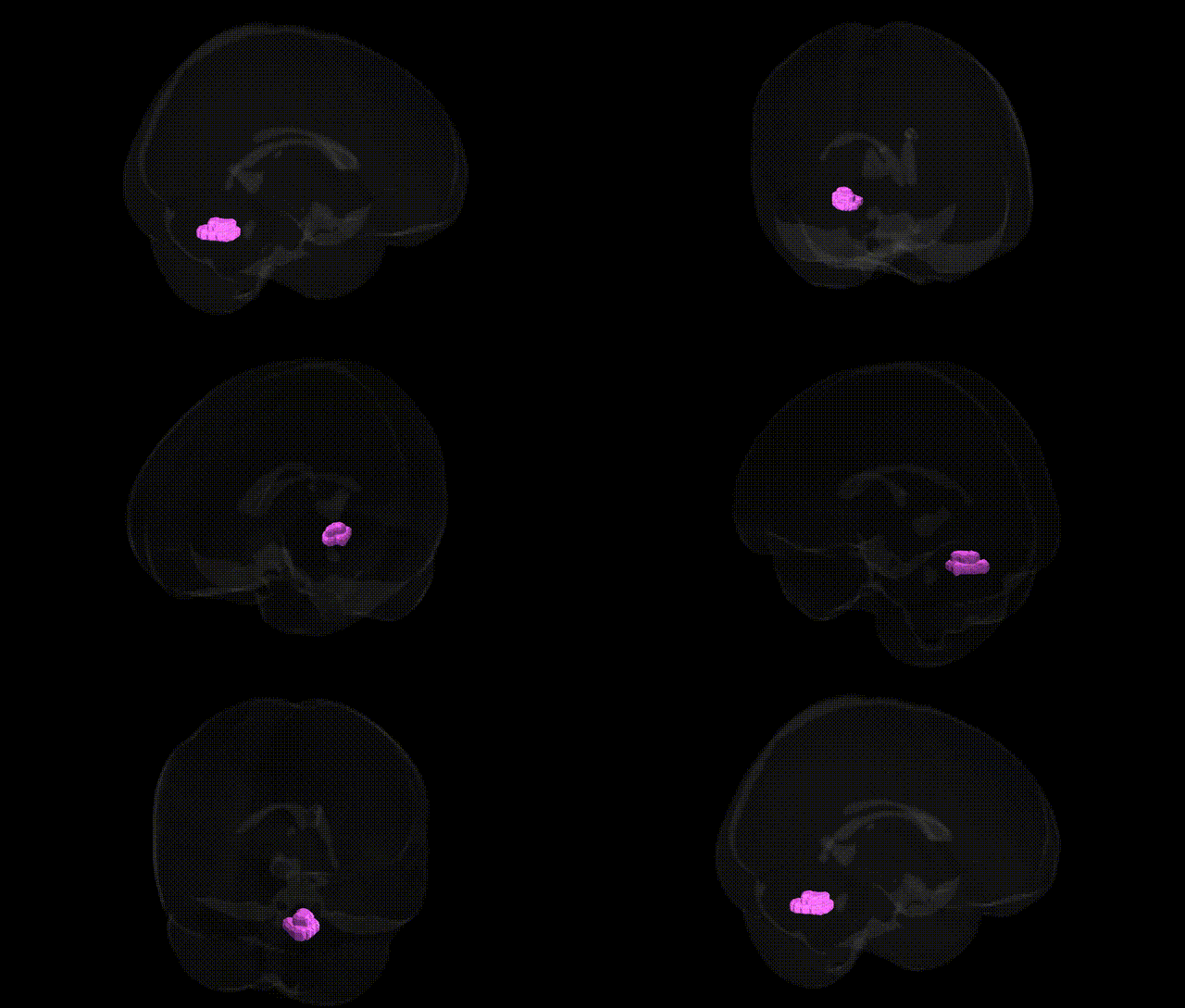
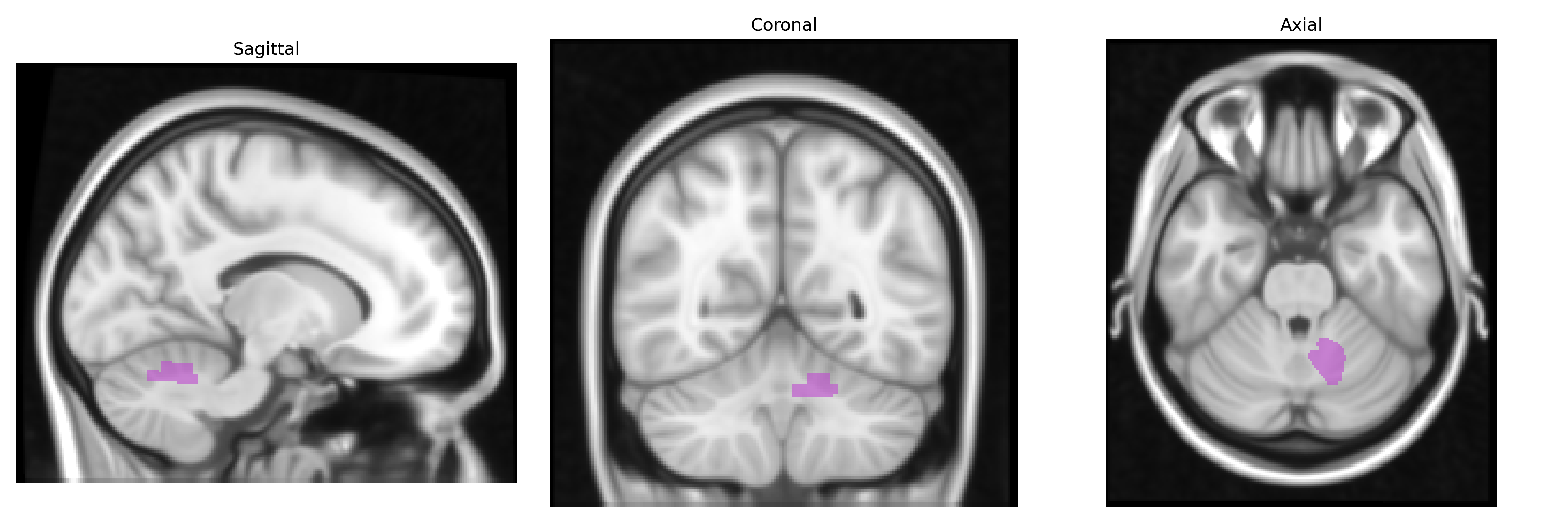
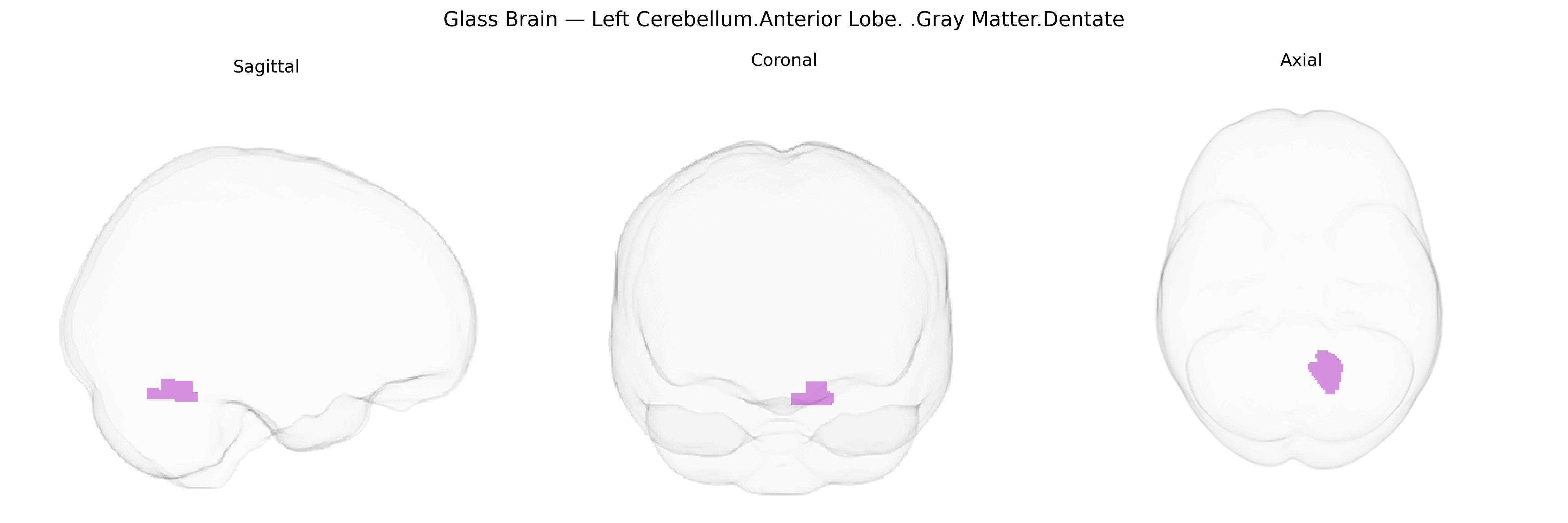
The bilateral Left Cerebellum, Anterior Lobe, Gray Matter, Dentate region corresponds to the dentate nucleus located within the anterior lobe of the cerebellar hemispheres, representing a major deep cerebellar nucleus composed of densely packed gray matter. It receives processed input from the surrounding cerebellar cortex, particularly from regions involved in coordinating limb movements and posture, and serves as a principal output station of the cerebellum. Through its efferent projections, primarily via the superior cerebellar peduncle to contralateral thalamic and red nucleus targets, the dentate nucleus participates in the modulation of voluntary motor activity, motor learning, and aspects of motor planning and timing, integrating sensory and motor information to refine ongoing and future movements. There is no direct link for this exact composite label; a related structure is the Dentate nucleus.
The bilateral Left Cerebellum Anterior Lobe Gray Matter Dentate region, a core output nucleus involved in motor coordination and higher-order cognitive functions, has been repeatedly implicated in imaging-genetics and GWAS-based brain-structure studies, which show that its gray matter volume and morphology are moderately heritable and influenced by common variants in neurodevelopmental and synaptic genes. Large-scale MRI–GWAS consortia (e.g., ENIGMA, UK Biobank–based analyses) report associations between cerebellar gray matter measures—including dentate and anterior lobe–adjacent regions—and loci near or within genes related to neuronal migration, axon guidance, and synaptic plasticity (such as variants near RELN, KIAA0319, and other neurodevelopmental loci), although specific, consistently replicated SNPs uniquely tied to the dentate nucleus itself remain sparse. Genetically, this region participates in broader cerebello-thalamo-cortical circuits implicated in movement and cognitive control, and polygenic risk analyses indicate overlap between cerebellar structural variation and genetic liability for neurodevelopmental and psychiatric disorders, including autism spectrum disorder, schizophrenia, attention-deficit/hyperactivity disorder, and major depressive disorder, where subtle but reproducible cerebellar volume or microstructural differences have been documented. Additionally, cerebellar and dentate-related structural measures show genetic correlations with traits such as educational attainment, general cognitive ability, and motor phenotypes (e.g., gait and balance), suggesting shared polygenic architectures; however, current evidence points to pleiotropic, distributed genetic effects on cerebellar networks rather than region-specific, high-penetrance variants for the left anterior lobe dentate gray matter alone.
Overview generated by GPT-4o (2026).
Region ID: 119
Hemisphere: bilateral
Atlas: Talairach labels 1mm
Full Quality Version: Download MP4
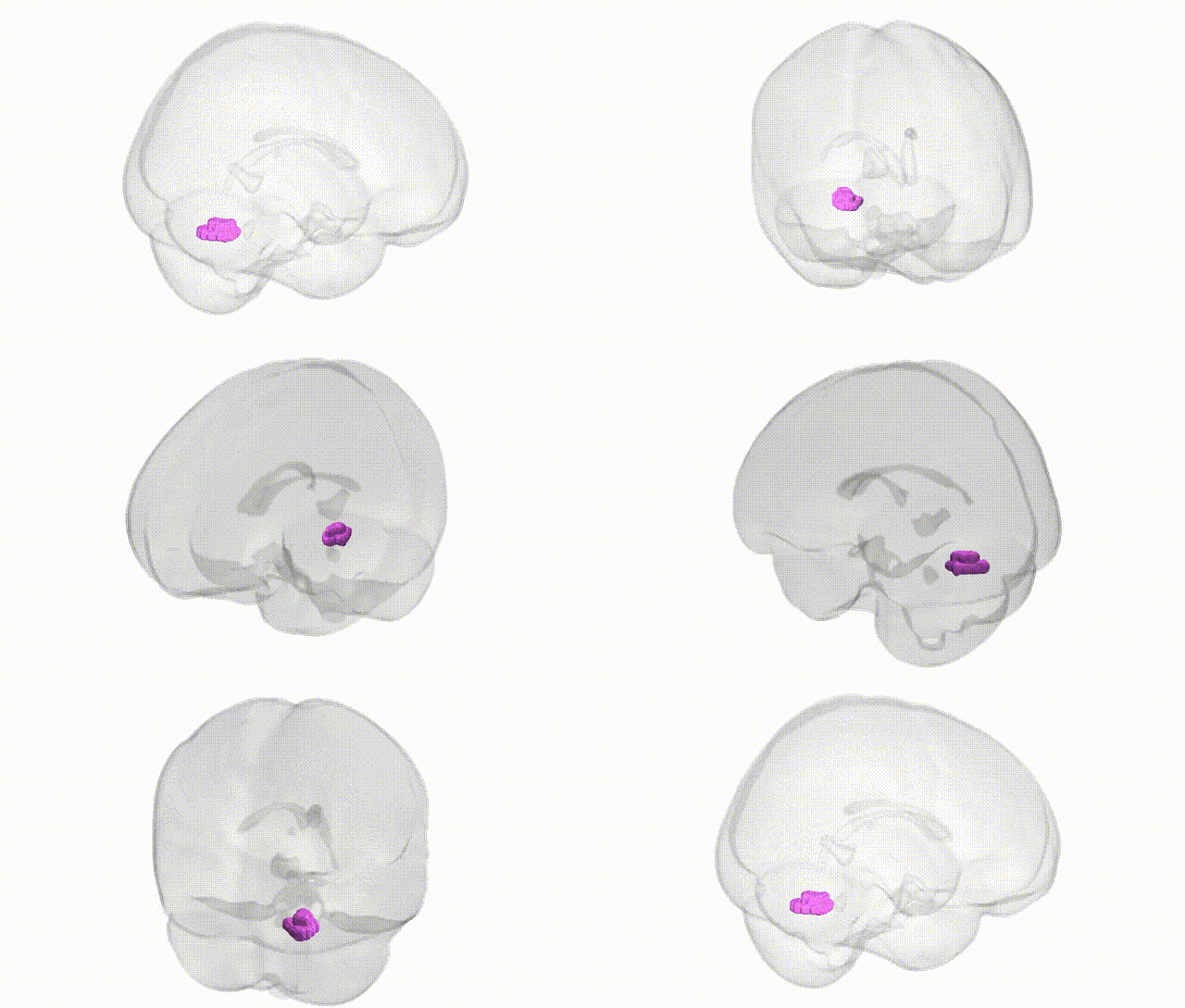
Full Quality Version: Download MP4
Wali Sidiqyar*, Gaurav Rudravaram*, Elyssa M. McMaster, Trent M. Schwartz, Adam M. Saunders, Kurt G. Schilling, Bennett A. Landman "Introducing SPINS: A Shared Public Visualization Library of Neuroanatomical Structures." Medical Imaging with Deep Learning- short paper
This resource is licensed under CC0 1.0 Universal (Public Domain).