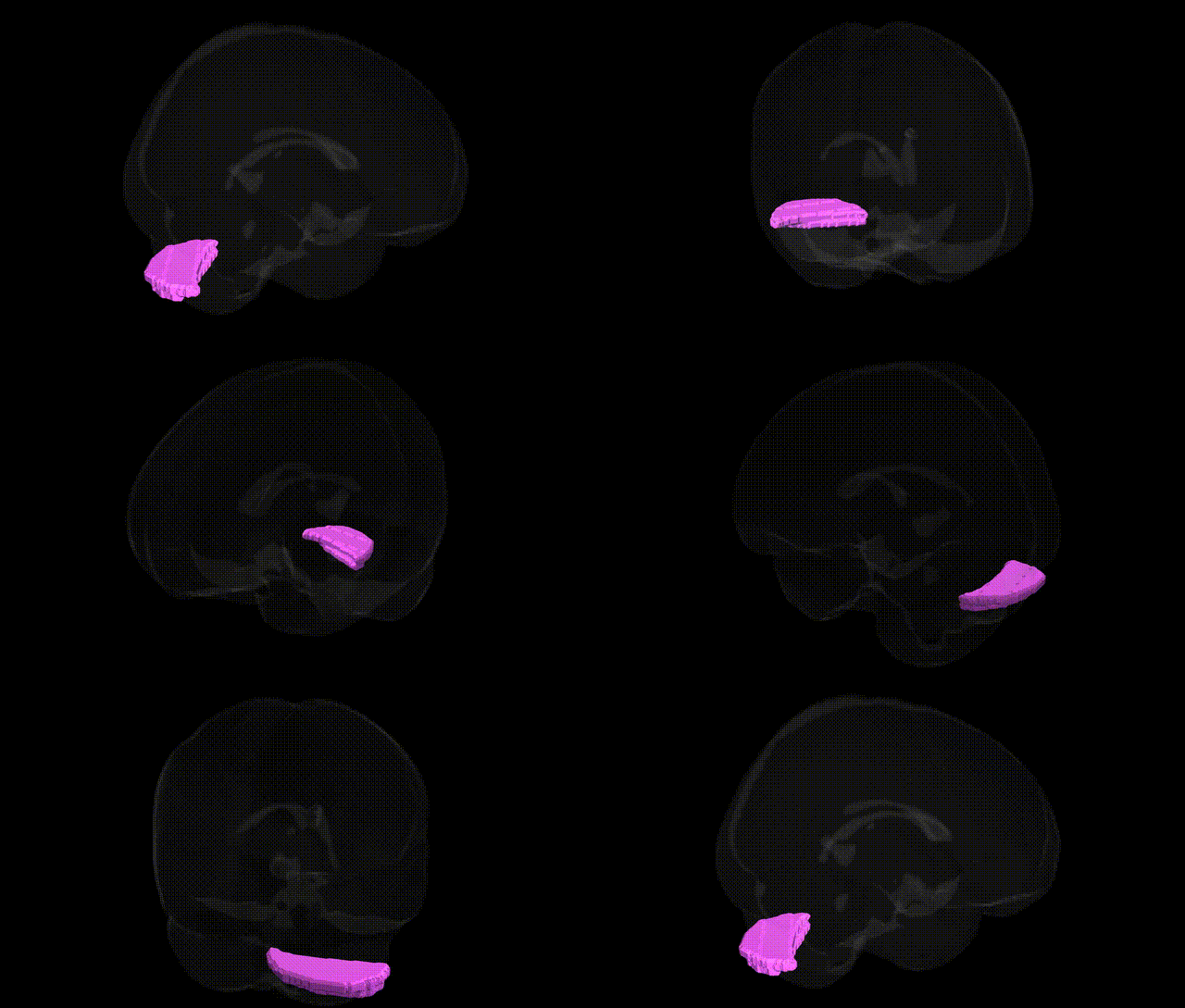
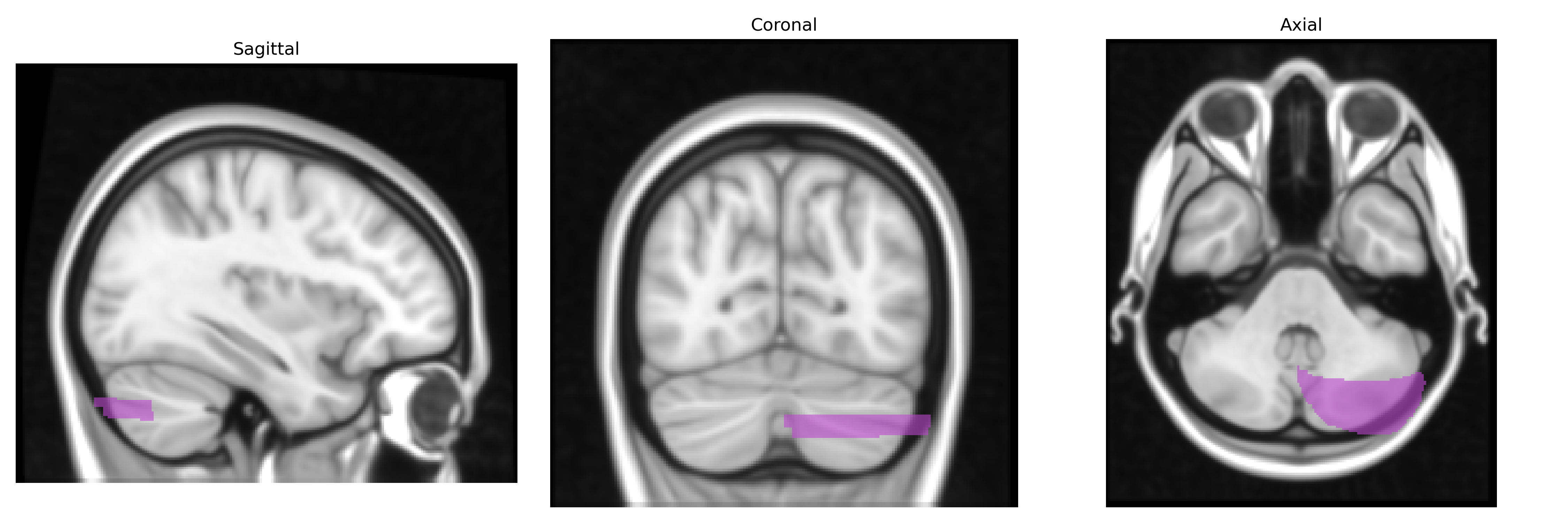
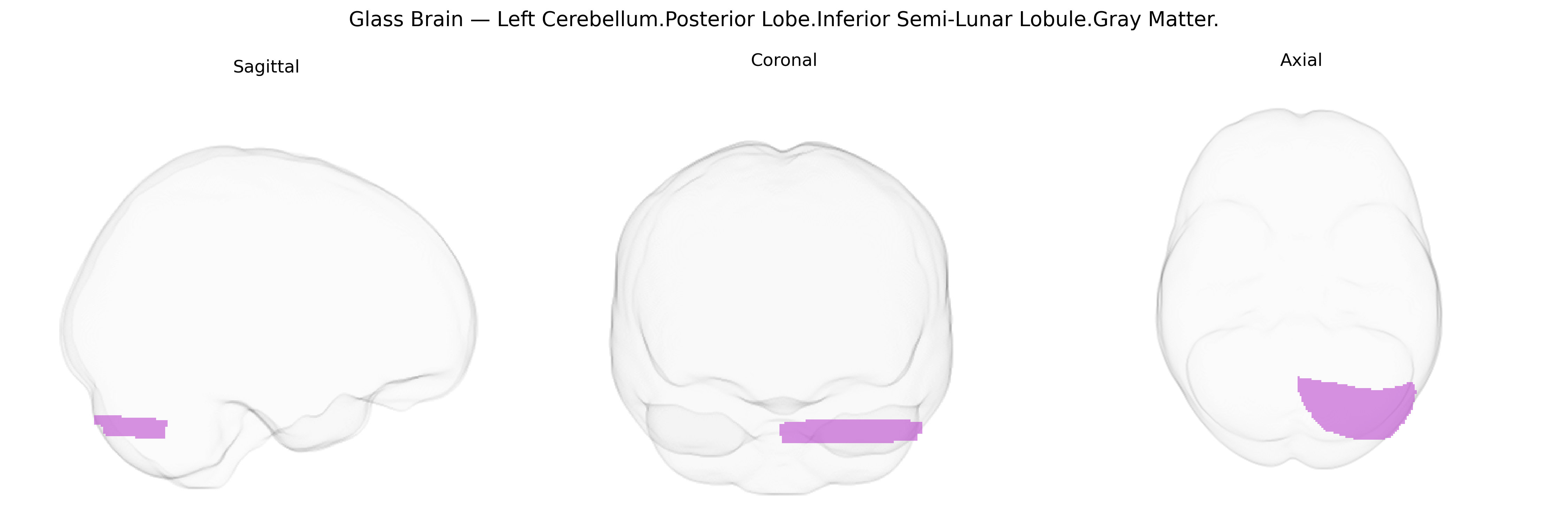
The bilateral Left Cerebellum, Posterior Lobe, Inferior Semi-Lunar Lobule, Gray Matter corresponds primarily to parts of cerebellar lobule VIIB and adjacent Crus II in the posterior lobe, a region involved in higher-order sensorimotor integration and cognitive processing rather than purely basic motor coordination. This gray matter subdivision receives afferent input from pontine nuclei and various cortical association areas, and projects via deep cerebellar nuclei—particularly the dentate nucleus—to thalamic and cortical motor and prefrontal regions, contributing to functions such as fine-tuning of complex movements, motor learning, timing, and aspects of language and executive control. Functionally, this lobule participates in cerebro-cerebellar loops that integrate multisensory and cognitive information to optimize behavioral output and adapt motor programs based on experience and context. There is no direct link for the “Inferior Semi-Lunar Lobule,” but it is part of the posterior lobe of the cerebellum: Posterior lobe of cerebellum.
The bilateral Left Cerebellum Posterior Lobe Inferior Semi-Lunar Lobule (gray matter), as labeled in the Talairach 1 mm atlas, does not yet have region-specific GWAS hits, but genetic associations can be inferred from broader studies of the posterior cerebellum and lobule VII/Crus II–like territories, which are strongly implicated in higher-order cognitive and affective functions. Large-scale imaging–genetics consortia (e.g., ENIGMA, UK Biobank) have identified polygenic influences on cerebellar gray matter volume and morphology, with heritability estimates often in the 40–70% range and associations implicating genes involved in neurodevelopment (e.g., RELN, FOXP2-related pathways), synaptic plasticity (e.g., GRM family, glutamatergic signaling), and axon guidance. Posterior cerebellar regions overlapping the inferior semi-lunar lobule show altered gray matter in schizophrenia, bipolar disorder, major depressive disorder, autism spectrum disorder, and ADHD; GWAS for these conditions have repeatedly implicated genes regulating synapse formation (e.g., CACNA1C, GRIN2A), neuronal migration, and immune–inflammatory pathways, with imaging–genetics studies suggesting that risk alleles for these disorders modulate cerebellar structure and connectivity. Additionally, GWAS of cognitive traits (general intelligence, educational attainment, working memory) and personality/affective traits (neuroticism, anxiety-related phenotypes) have linked polygenic scores to structural and functional variation in posterior cerebellar lobules, supporting a role for distributed gene networks affecting cortico-cerebellar loops that include the inferior semi-lunar lobule rather than single, region-exclusive loci.
Overview generated by GPT-4o (2026).
Region ID: 1
Hemisphere: bilateral
Atlas: Talairach labels 1mm
Full Quality Version: Download MP4
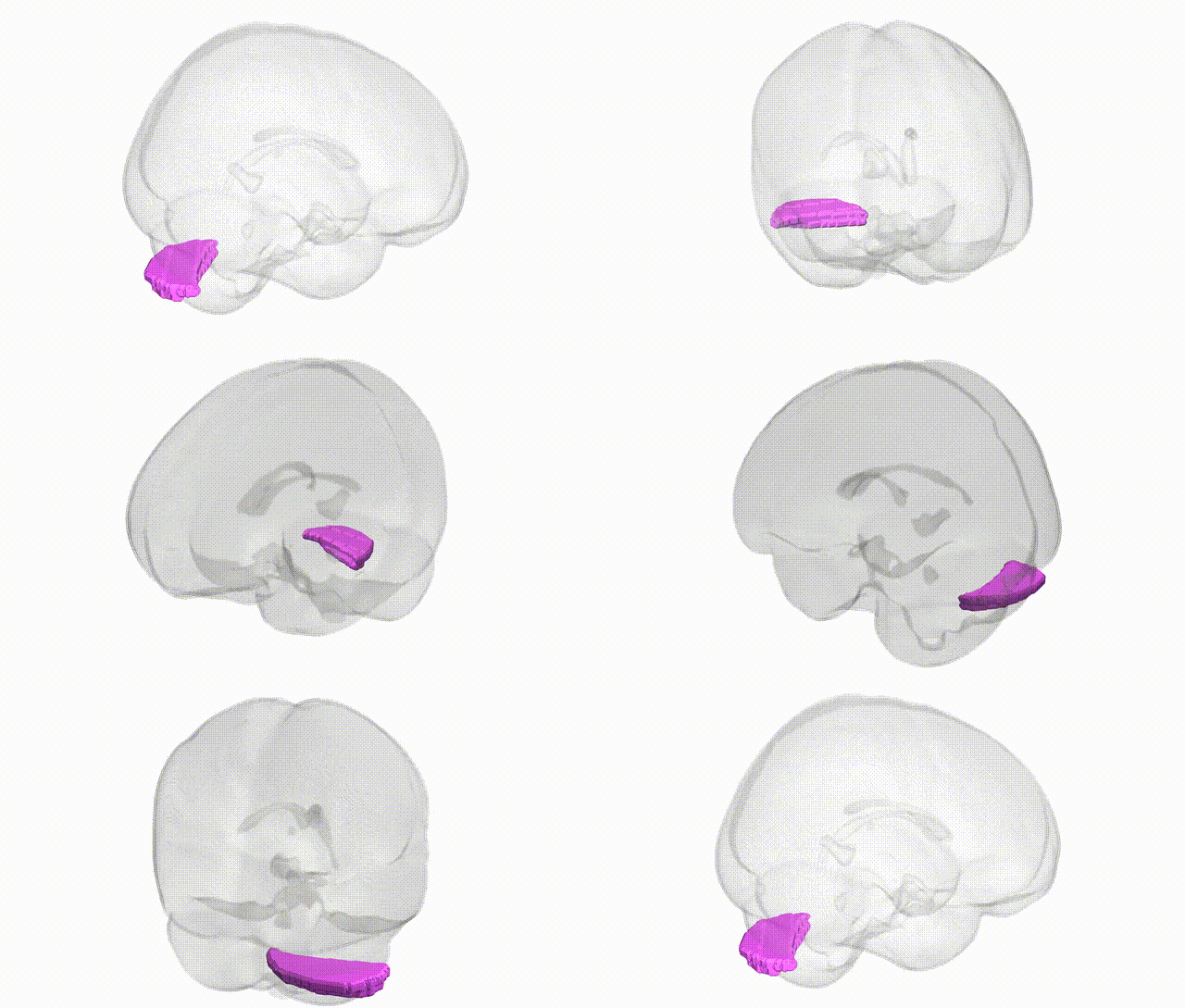
Full Quality Version: Download MP4
Wali Sidiqyar*, Gaurav Rudravaram*, Elyssa M. McMaster, Trent M. Schwartz, Adam M. Saunders, Kurt G. Schilling, Bennett A. Landman "Introducing SPINS: A Shared Public Visualization Library of Neuroanatomical Structures." Medical Imaging with Deep Learning- short paper
This resource is licensed under CC0 1.0 Universal (Public Domain).