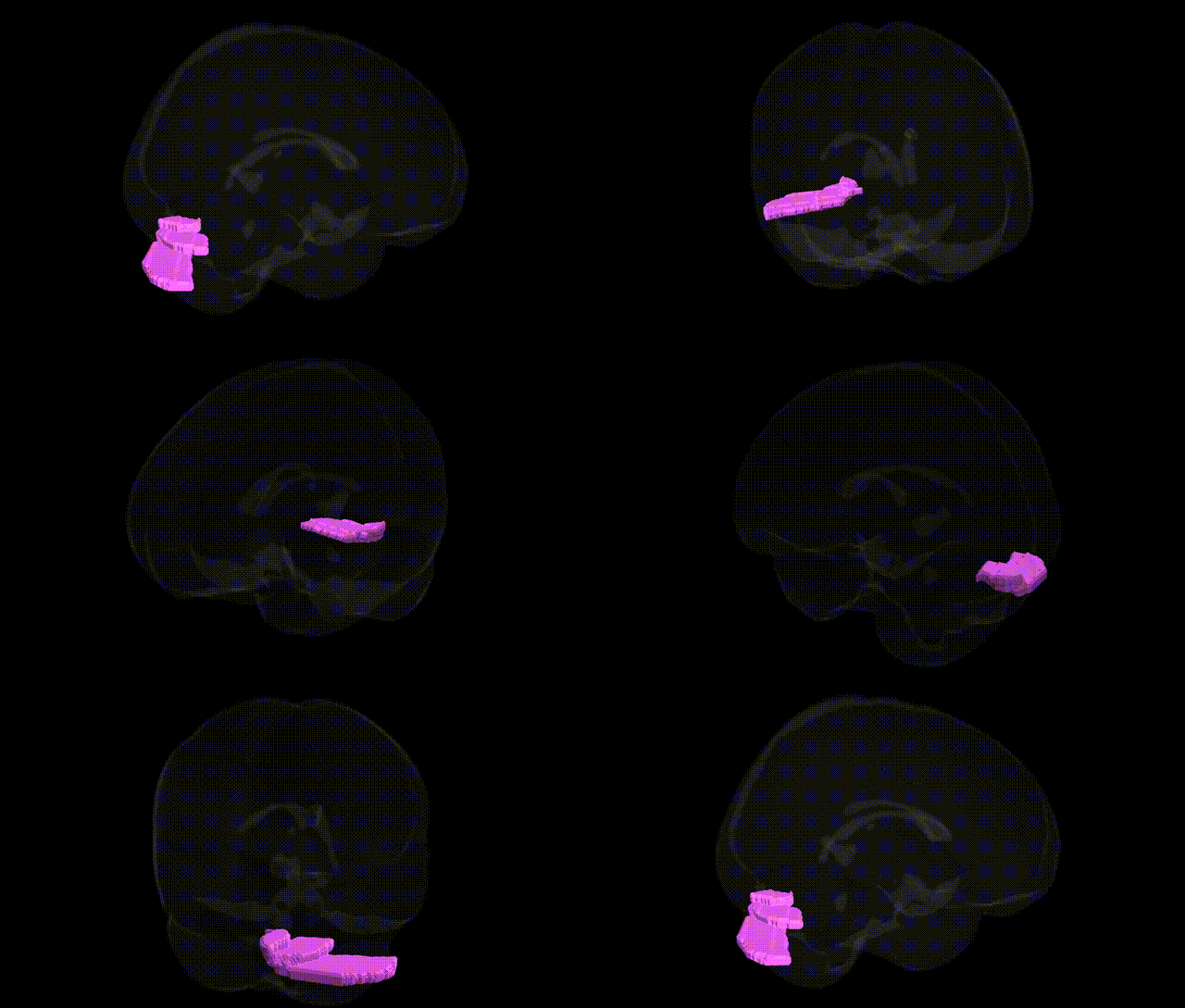
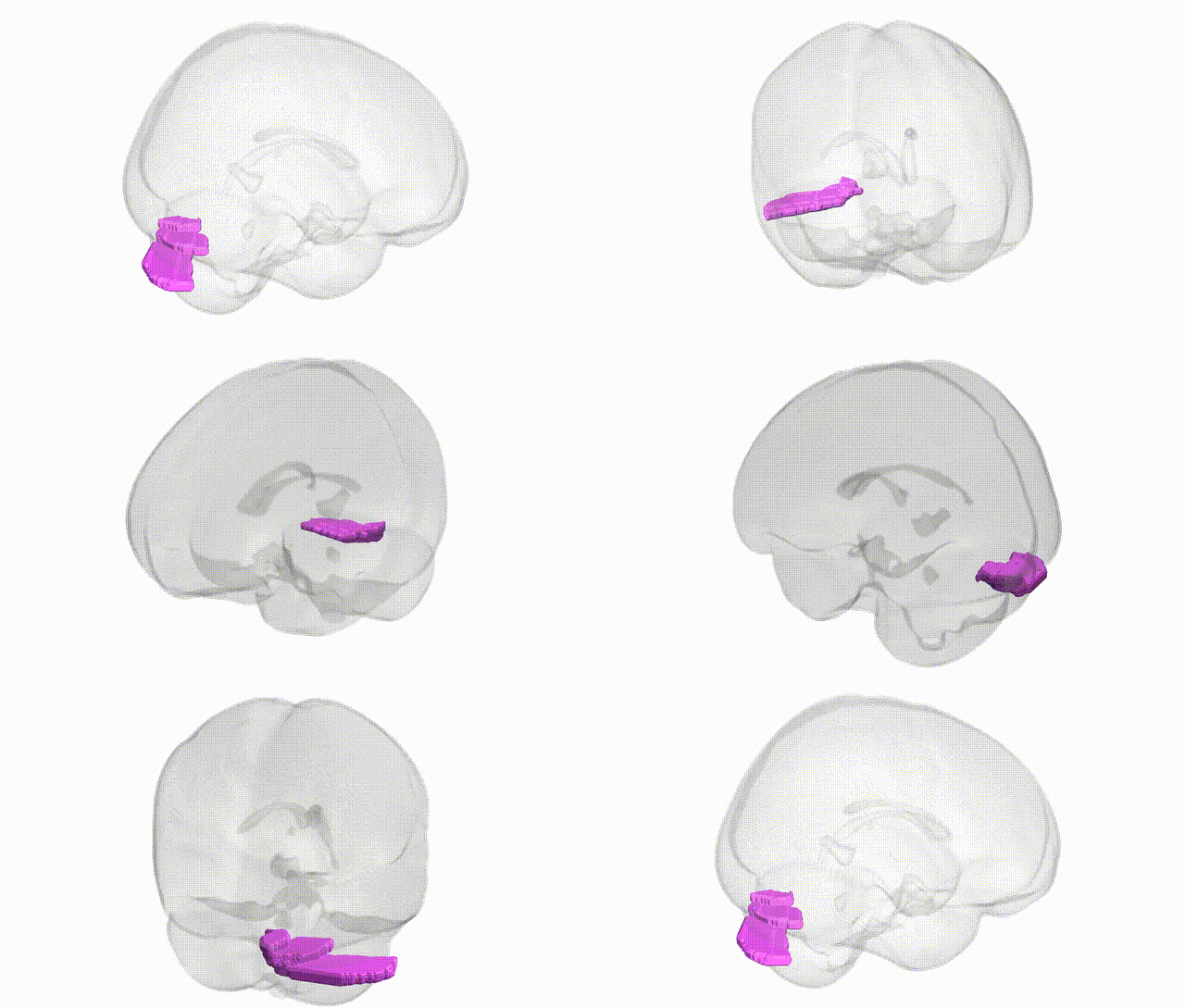
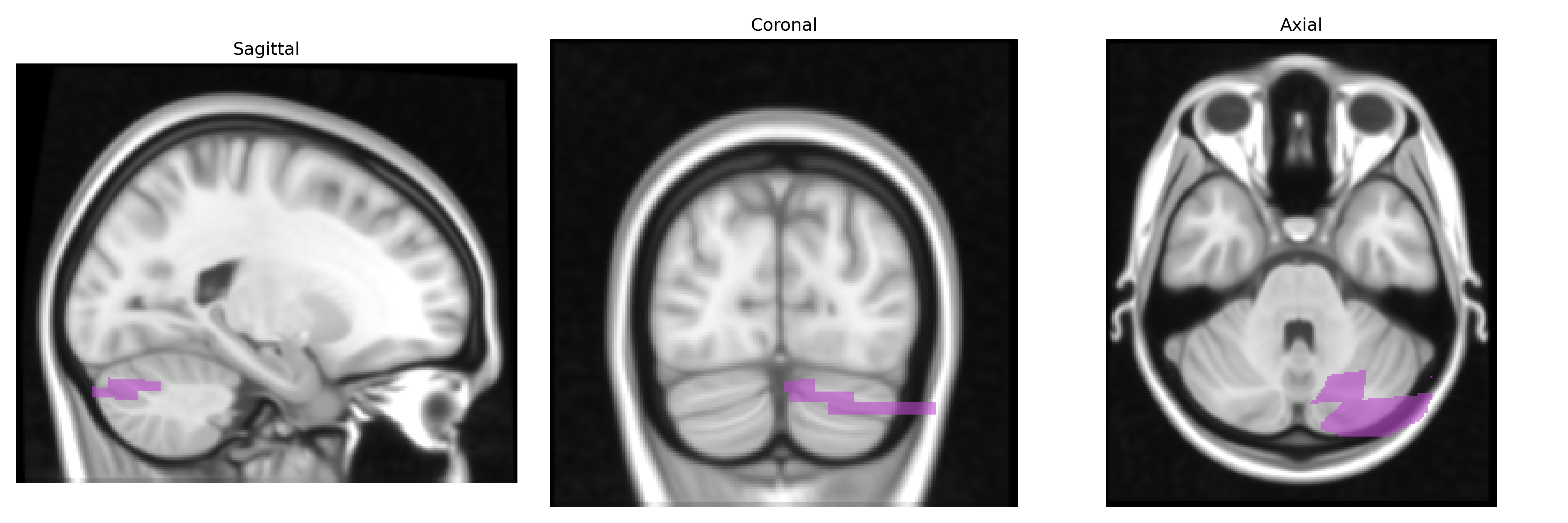
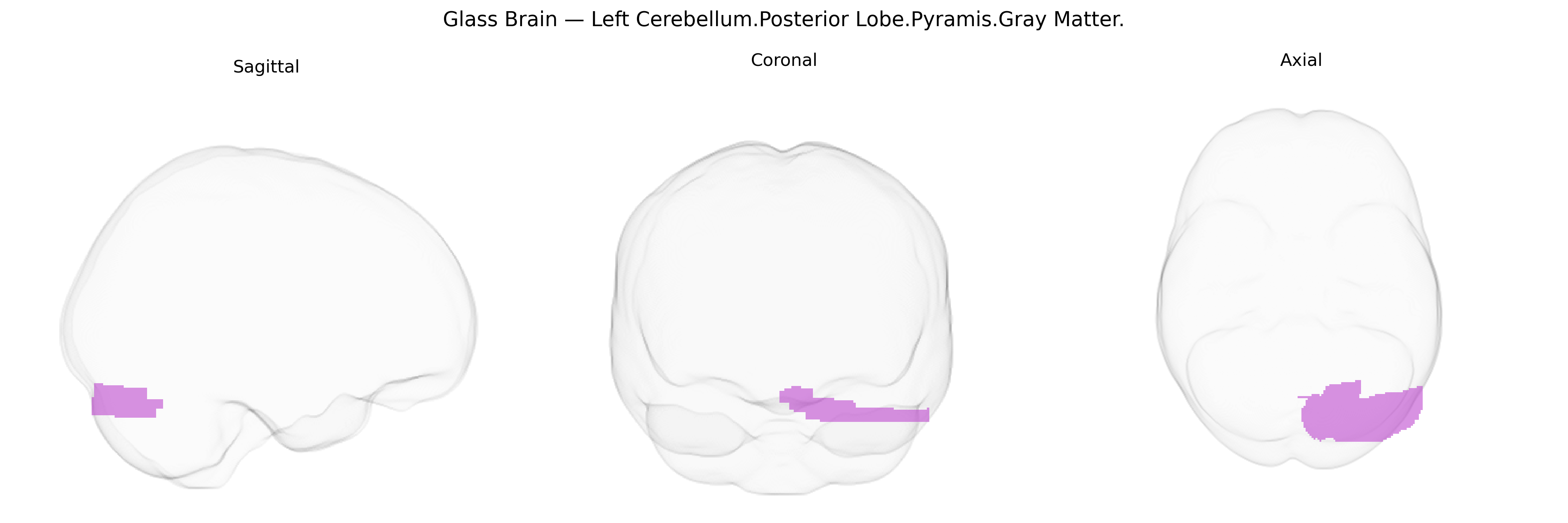
The bilateral Left Cerebellum Posterior Lobe Pyramis Gray Matter, as defined in the Talairach 1 mm atlas, corresponds to the gray matter of the pyramis, a vermal structure in the posterior lobe of the cerebellum involved primarily in coordination of posture, balance, and axial motor control. It forms part of the spinocerebellum, receiving somatosensory input from the body and contributing to the fine-tuning of ongoing movements and muscle tone, particularly of trunk and proximal musculature. Neuronal circuitry in this region, including Purkinje cells projecting to deep cerebellar nuclei, supports error correction and timing of motor output, and lesions here can lead to gait ataxia, truncal instability, and impaired postural reflexes. There is no direct link for this specific subregion; a related structure is the Cerebellum.
The bilateral left cerebellar posterior lobe pyramis (gray matter) has not been a primary focus of region-specific genetic association studies, but convergent evidence from GWAS of cerebellar volume, structure, and functional connectivity, as well as disorder-focused imaging genetics, implicates several relevant pathways. Large-scale GWAS of cerebellar volume and morphology (e.g., ENIGMA and UK Biobank–based studies) have identified variants near genes involved in neurodevelopment, synaptic organization, and axon guidance (such as PPP2R2B, SHANK family genes, FOXP1/FOXP2-related loci, and multiple chromatin-remodeling genes) that broadly influence posterior cerebellar anatomy, including vermal and pyramis-adjacent regions. Imaging-genetics work in autism spectrum disorder, schizophrenia, and bipolar disorder frequently reports altered gray matter or functional connectivity in midline and posterior cerebellar structures, with polygenic risk scores for these conditions correlating with reduced vermal and posterior lobe volumes that encompass the pyramis. Cerebellar contributions to motor coordination and higher-order cognitive/affective processing link this region indirectly to genetic risk for ataxias (e.g., spinocerebellar ataxias with CAG-repeat expansions in genes like ATXN1, ATXN2, ATXN3, and CACNA1A), as well as to mood and anxiety traits where GWAS-identified loci affect cerebello-thalamo-cortical circuits rather than the pyramis specifically. Overall, genetic influences on the bilateral left posterior lobe pyramis appear to be shared with broader cerebellar networks, reflecting polygenic contributions to neurodevelopment, synaptic function, and neuropsychiatric disease rather than highly specific locus–region pairings.
Overview generated by GPT-4o (2026).
Region ID: 61
Hemisphere: bilateral
Atlas: Talairach labels 1mm
Full Quality Version: Download MP4
Full Quality Version: Download MP4
Wali Sidiqyar*, Gaurav Rudravaram*, Elyssa M. McMaster, Trent M. Schwartz, Adam M. Saunders, Kurt G. Schilling, Bennett A. Landman "Introducing SPINS: A Shared Public Visualization Library of Neuroanatomical Structures." Medical Imaging with Deep Learning- short paper
This resource is licensed under CC0 1.0 Universal (Public Domain).