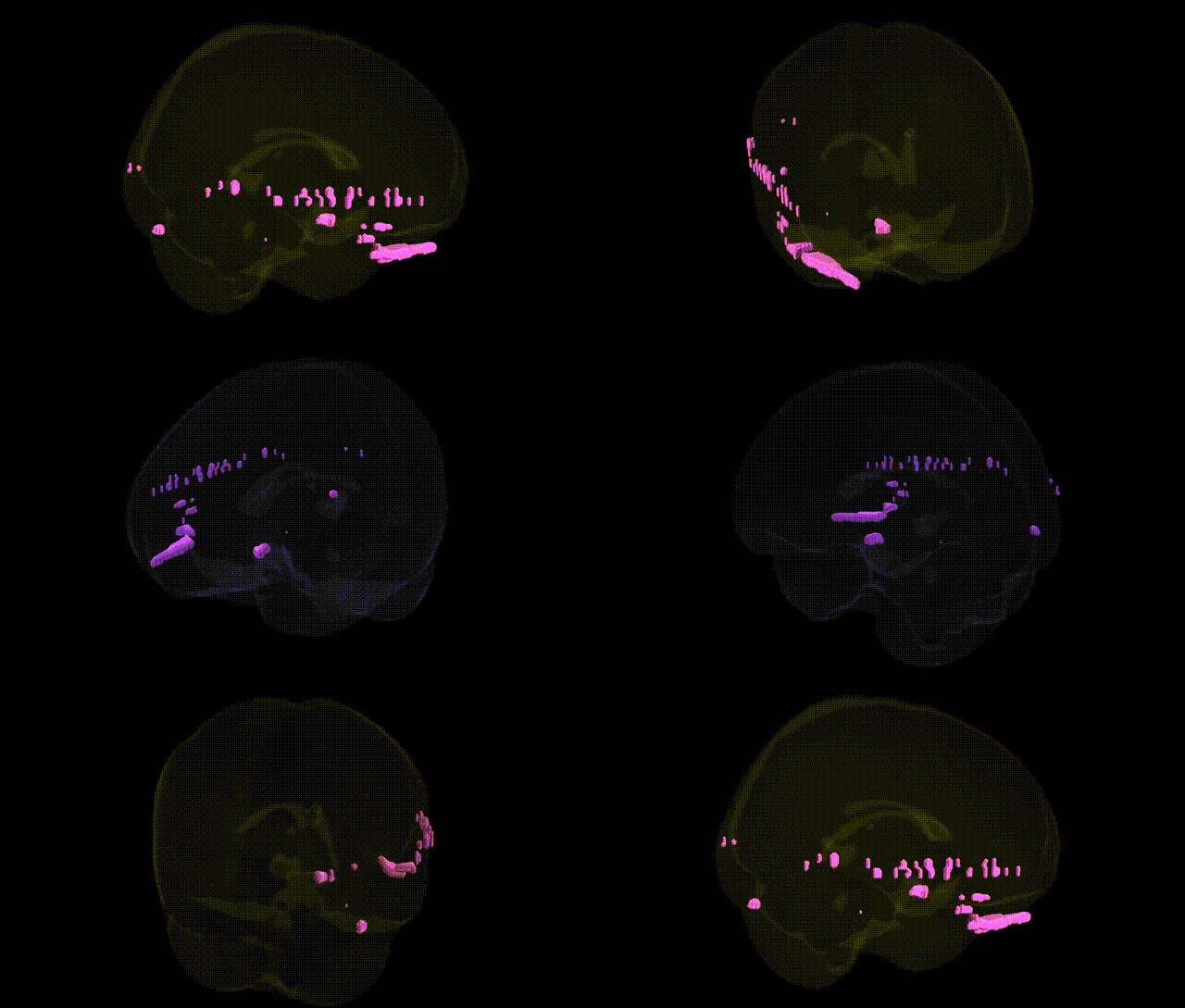
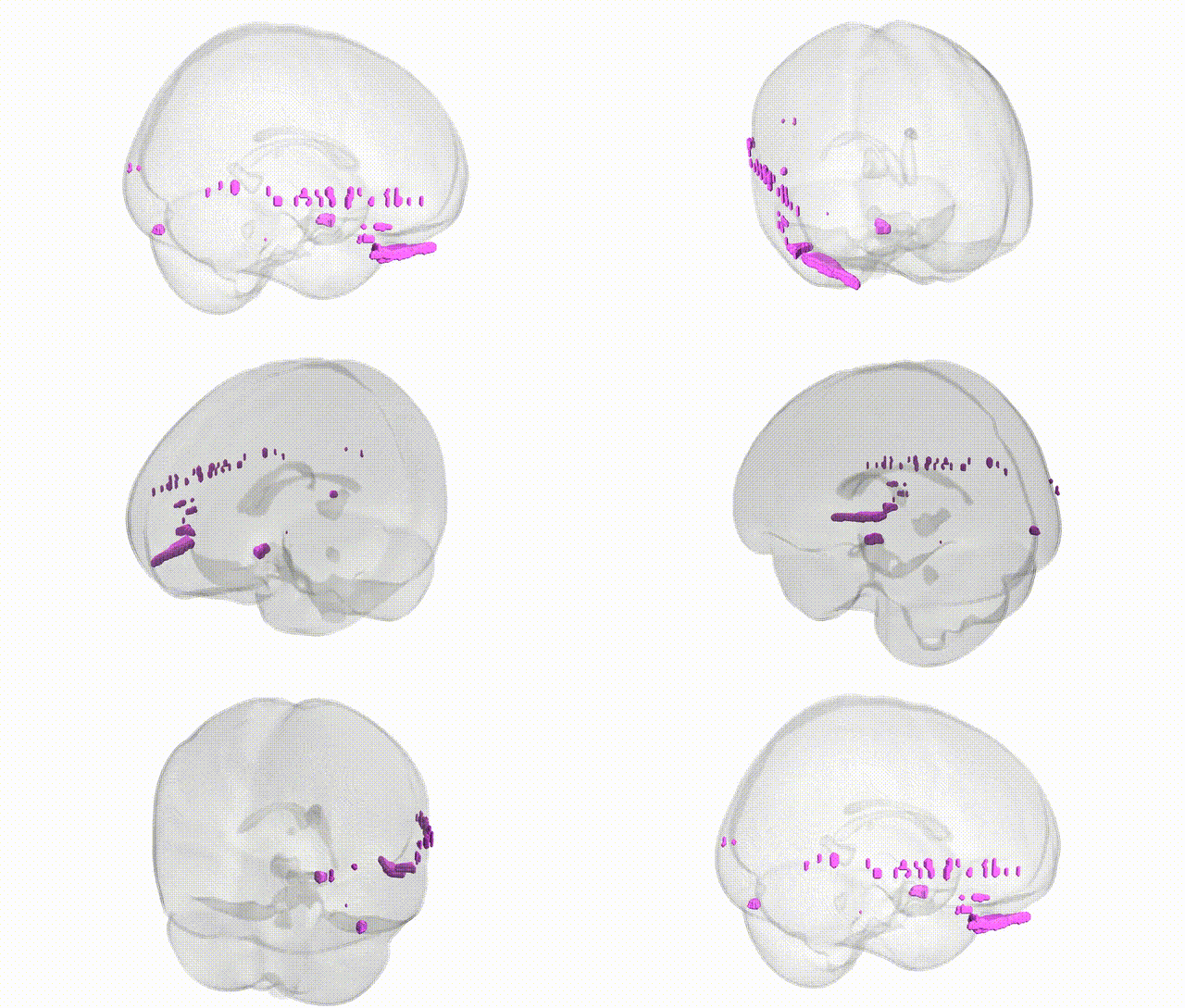
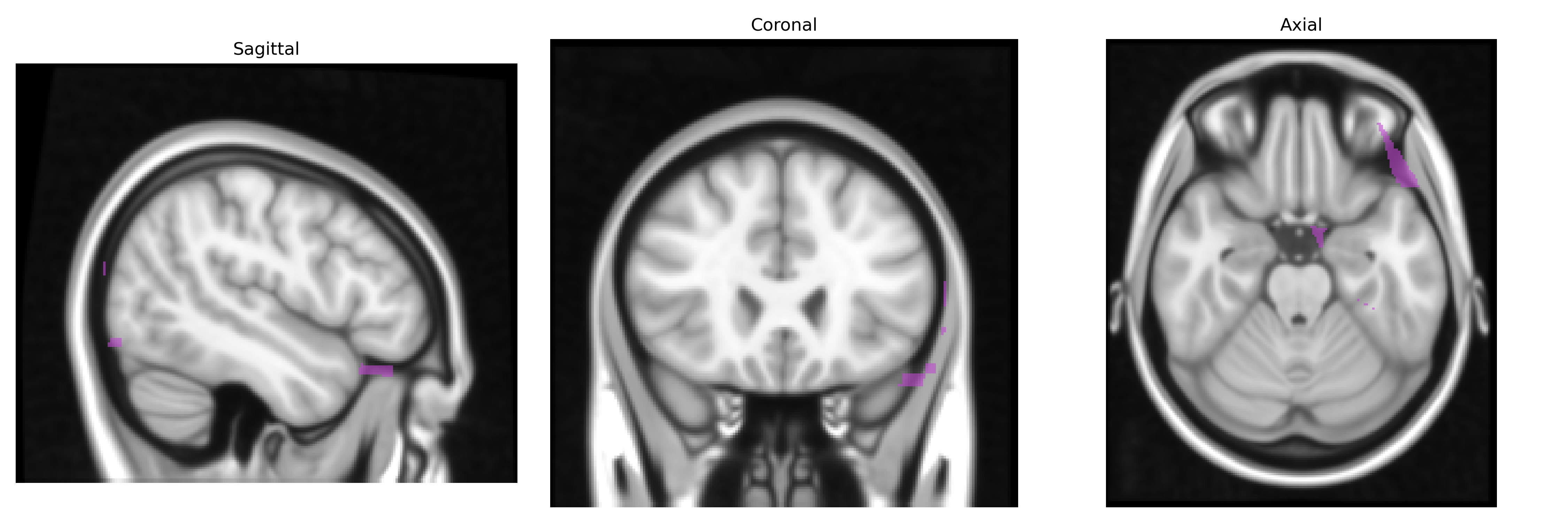
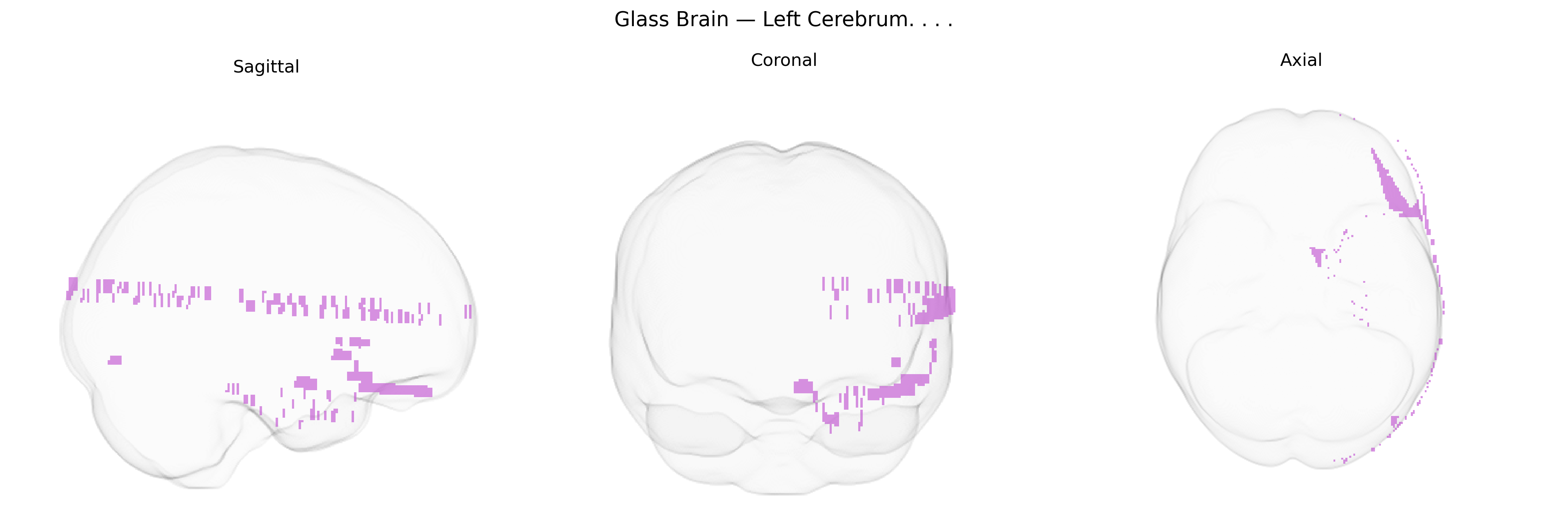
The bilateral Left Cerebrum, as labeled in the Talairach 1 mm atlas, encompasses the entire left cerebral hemisphere, including frontal, parietal, temporal, and occipital lobes, along with deep subcortical structures. It is composed of gray matter (cerebral cortex and nuclei) and white matter tracts that support higher-order cognitive functions such as language, analytical reasoning, motor planning, and aspects of consciousness, as well as sensory processing and integration. Functionally, the left cerebrum is often associated with hemispheric specialization for language (in most right-handed individuals), sequential processing, and fine motor control of the contralateral (right) side of the body. Its intricate connectivity with the right hemisphere via the corpus callosum supports coordinated bilateral function and integration of perceptual, motor, and cognitive information. Cerebrum
The bilateral Left Cerebrum, as defined by the Talairach 1 mm atlas, encompasses widespread cortical and subcortical territories, and genetic associations mapped to this broad region reflect its involvement in diverse neurodevelopmental, cognitive, and psychiatric phenotypes rather than a single structure-specific profile. Large-scale GWAS of brain morphology (e.g., ENIGMA, UK Biobank) have identified numerous loci (including variants in genes such as HMGA2, MAPT, KIAA0586, and others) associated with global and hemispheric cortical volume, surface area, and thickness, often showing asymmetric effects between left and right hemispheres, particularly in frontal, temporal, and perisylvian language-related regions. Polygenic risk scores for disorders such as schizophrenia, bipolar disorder, major depressive disorder, autism spectrum disorder, and attention-deficit/hyperactivity disorder are consistently associated with structural and functional alterations distributed across the left cerebrum, including changes in total and regional gray matter volume and white matter microstructure. Genetic variants influencing handedness and language lateralization (e.g., in LRRTM1, PCSK6, and loci near microtubule-related genes) have also been linked to asymmetries in left cerebral cortex architecture and connectivity. Moreover, GWAS of cognitive traits and educational attainment implicate many pleiotropic loci (e.g., in genes related to synaptic functioning, neurogenesis, and axon guidance) whose effects are expressed in large-scale left-hemispheric networks supporting language, executive function, and memory, reinforcing the view that genetic influences on this atlas-defined “Left Cerebrum” act through distributed, overlapping systems rather than a single anatomically discrete target.
Overview generated by GPT-4o (2026).
Region ID: 74
Hemisphere: bilateral
Atlas: Talairach labels 1mm
Full Quality Version: Download MP4
Full Quality Version: Download MP4
Wali Sidiqyar*, Gaurav Rudravaram*, Elyssa M. McMaster, Trent M. Schwartz, Adam M. Saunders, Kurt G. Schilling, Bennett A. Landman "Introducing SPINS: A Shared Public Visualization Library of Neuroanatomical Structures." Medical Imaging with Deep Learning- short paper
This resource is licensed under CC0 1.0 Universal (Public Domain).