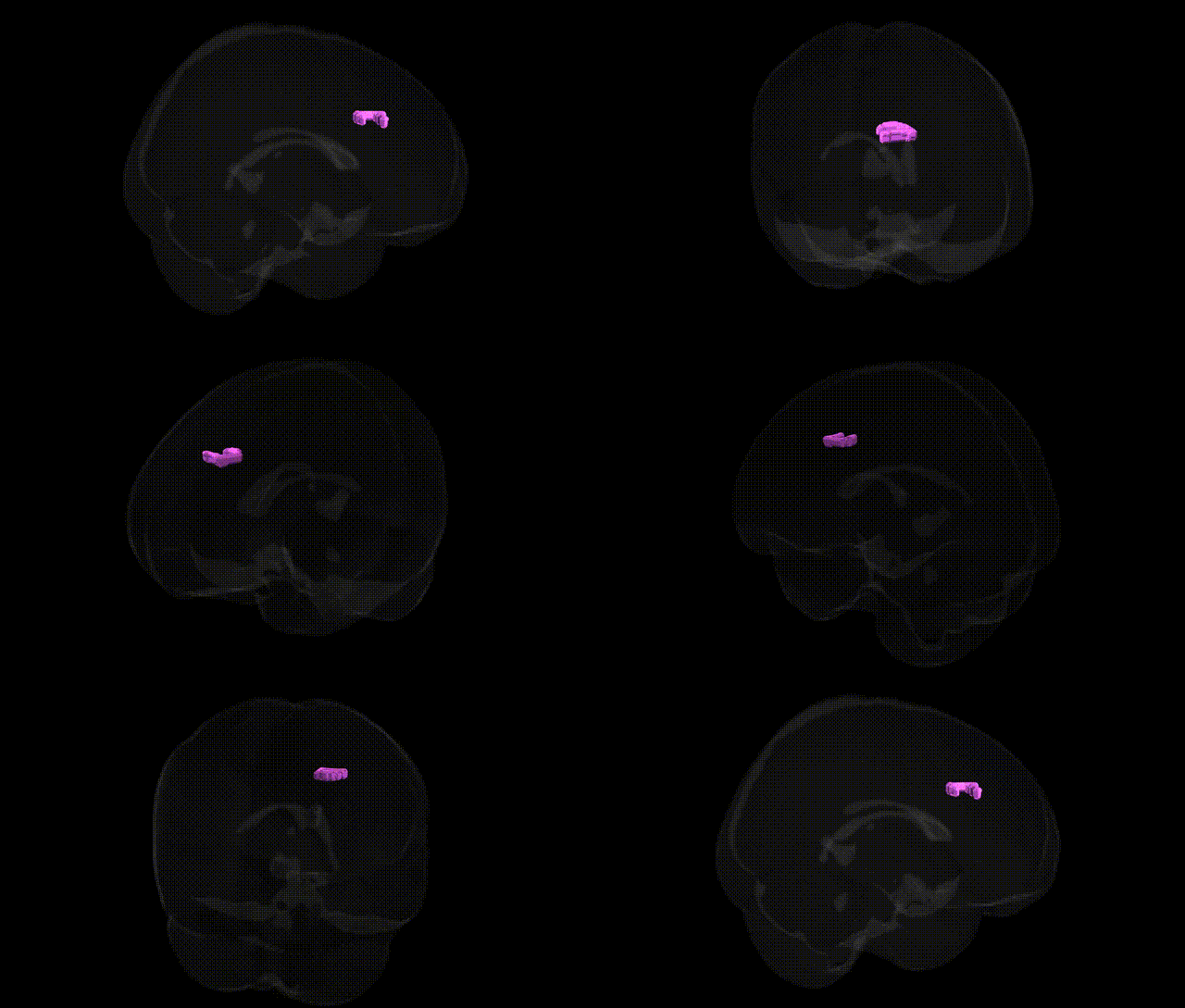
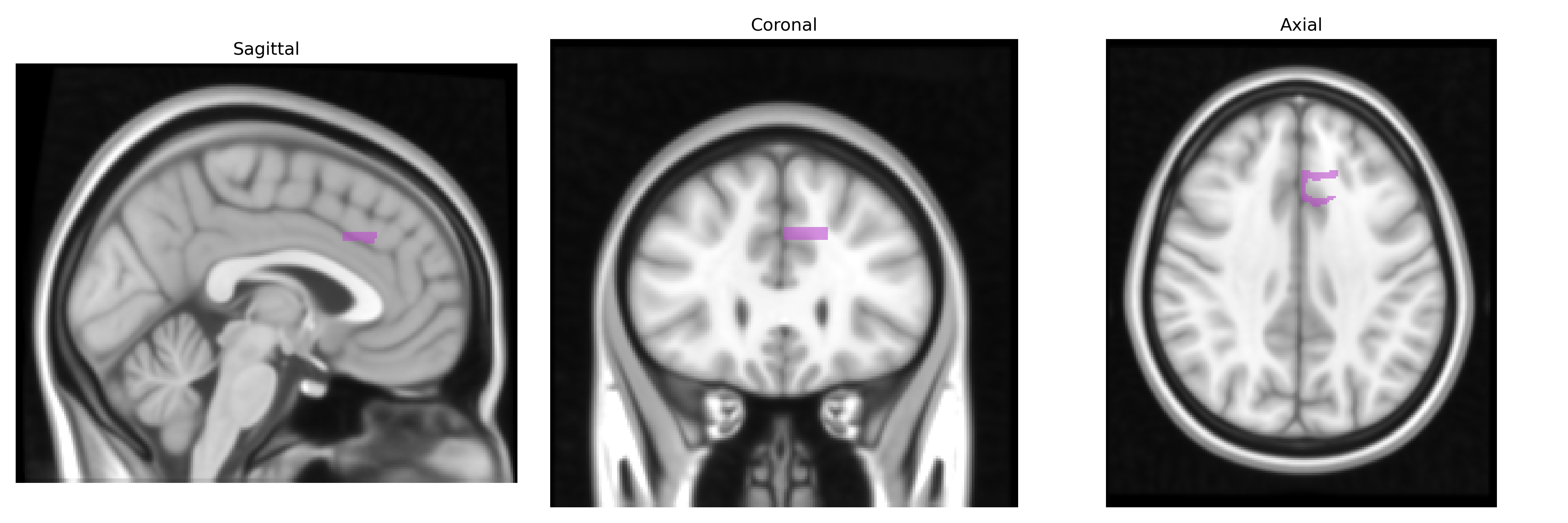
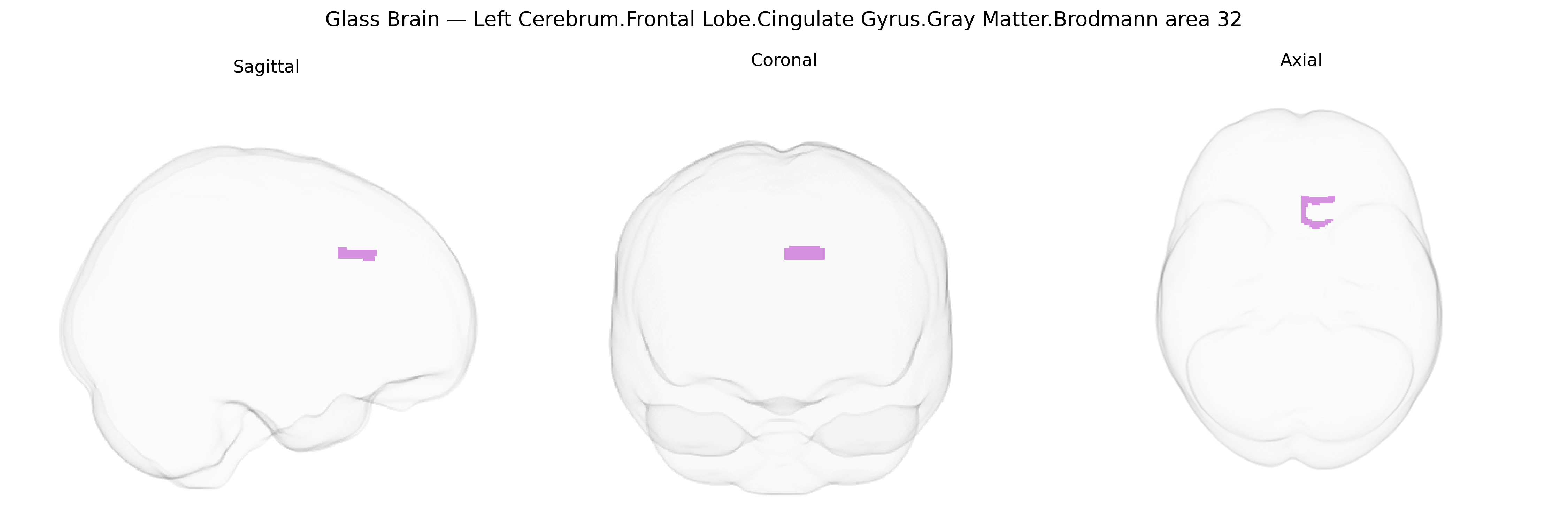
The bilateral Left Cerebrum.Frontal Lobe.Cingulate Gyrus.Gray Matter.Brodmann area 32 corresponds to a portion of the dorsal anterior cingulate cortex (ACC), a medial frontal cortical region implicated in higher-order cognitive and affective functions. Cytoarchitectonically defined by Korbinian Brodmann, area 32 is characterized by its agranular to dysgranular lamination pattern and its dense reciprocal connectivity with prefrontal, premotor, limbic, and subcortical structures, including the amygdala and thalamus. Functionally, this region is associated with conflict monitoring, decision-making, error detection, emotional regulation, and autonomic control, integrating motivational and cognitive signals to guide behavior and adjust responses under changing environmental demands. In the Talairach 1 mm Atlas, this label denotes the gray matter within the cingulate gyrus of the frontal lobe, localized around the medial surface superior to the corpus callosum and anterior to the supplementary motor areas. Brodmann area 32
The bilateral left frontal lobe cingulate gyrus gray matter corresponding largely to Brodmann area 32 (dorsal/rostral anterior cingulate cortex) has been repeatedly implicated in imaging–genetics and GWAS-based neuroanatomical studies as a heritable region whose volume, thickness, and functional properties are influenced by common variation in genes involved in synaptic plasticity, neurotransmission, and neurodevelopment, including loci near or within genes such as CACNA1C, DRD2, GRM3, and BDNF, among others. Structural and functional alterations in BA32 are consistently associated, via genetic risk burden, with major psychiatric and neurodevelopmental disorders—most prominently schizophrenia, bipolar disorder, major depressive disorder, anxiety disorders, and autism spectrum disorder—where polygenic risk scores for these conditions correlate with cingulate morphology or activation patterns. Large-scale GWAS of cortical thickness and surface area (e.g., ENIGMA and related consortia) have identified significant associations between common variants in neurodevelopmental and cell-adhesion genes and the morphology of medial prefrontal/anterior cingulate regions overlapping BA32, and these same variants often exhibit pleiotropy with cognitive traits, educational attainment, and neuroticism or other personality dimensions. Additional imaging–genetics work links BA32 structure and function to genetic variation in serotonin and dopamine system genes (such as SLC6A4 and COMT), particularly in the context of emotion regulation, reward processing, and conflict monitoring, providing a mechanistic bridge between molecular risk architecture and higher-order cognitive–affective phenotypes localized to this medial frontal/cingulate territory.
Overview generated by GPT-4o (2026).
Region ID: 1006
Hemisphere: bilateral
Atlas: Talairach labels 1mm
Full Quality Version: Download MP4
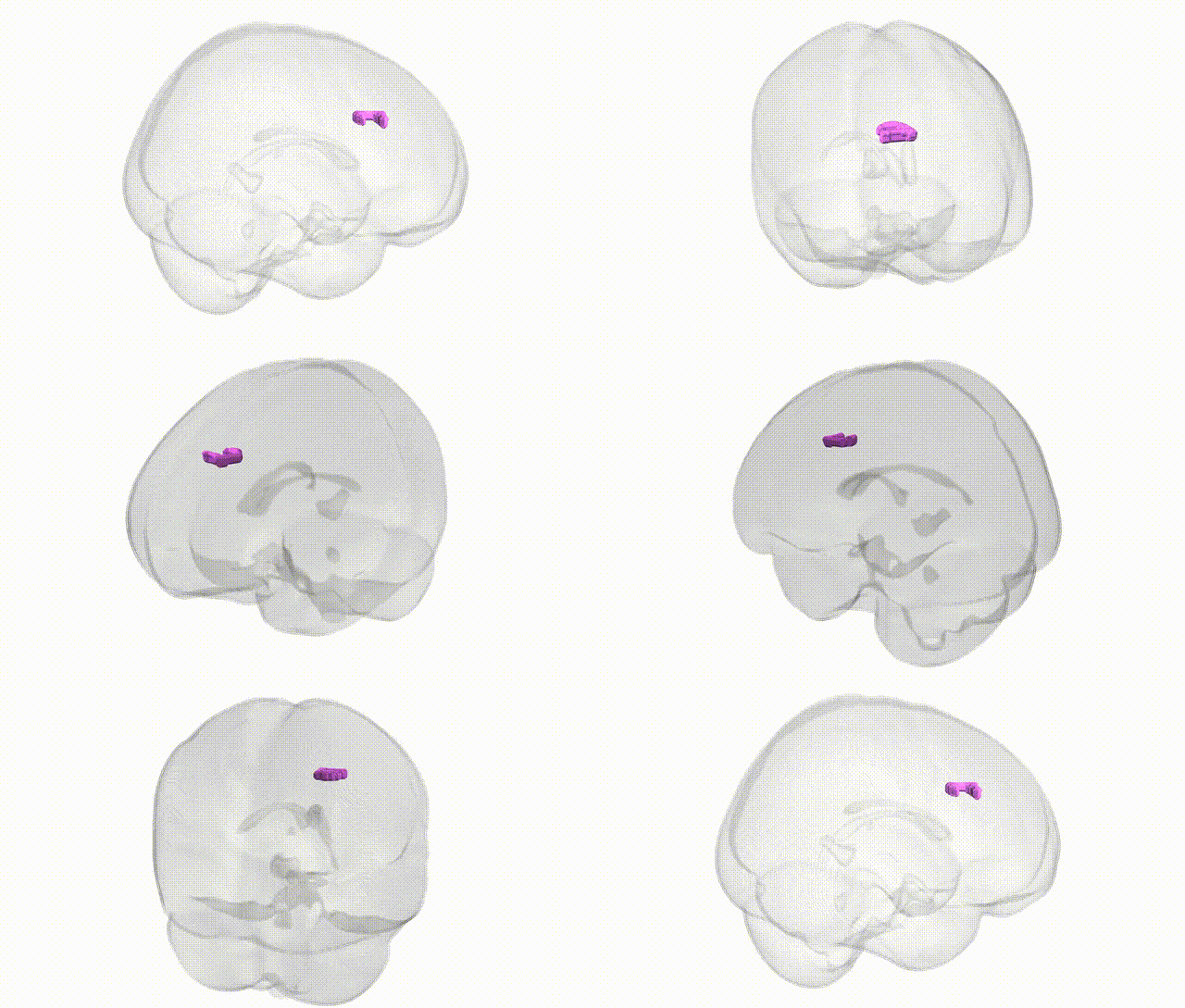
Full Quality Version: Download MP4
Wali Sidiqyar*, Gaurav Rudravaram*, Elyssa M. McMaster, Trent M. Schwartz, Adam M. Saunders, Kurt G. Schilling, Bennett A. Landman "Introducing SPINS: A Shared Public Visualization Library of Neuroanatomical Structures." Medical Imaging with Deep Learning- short paper
This resource is licensed under CC0 1.0 Universal (Public Domain).