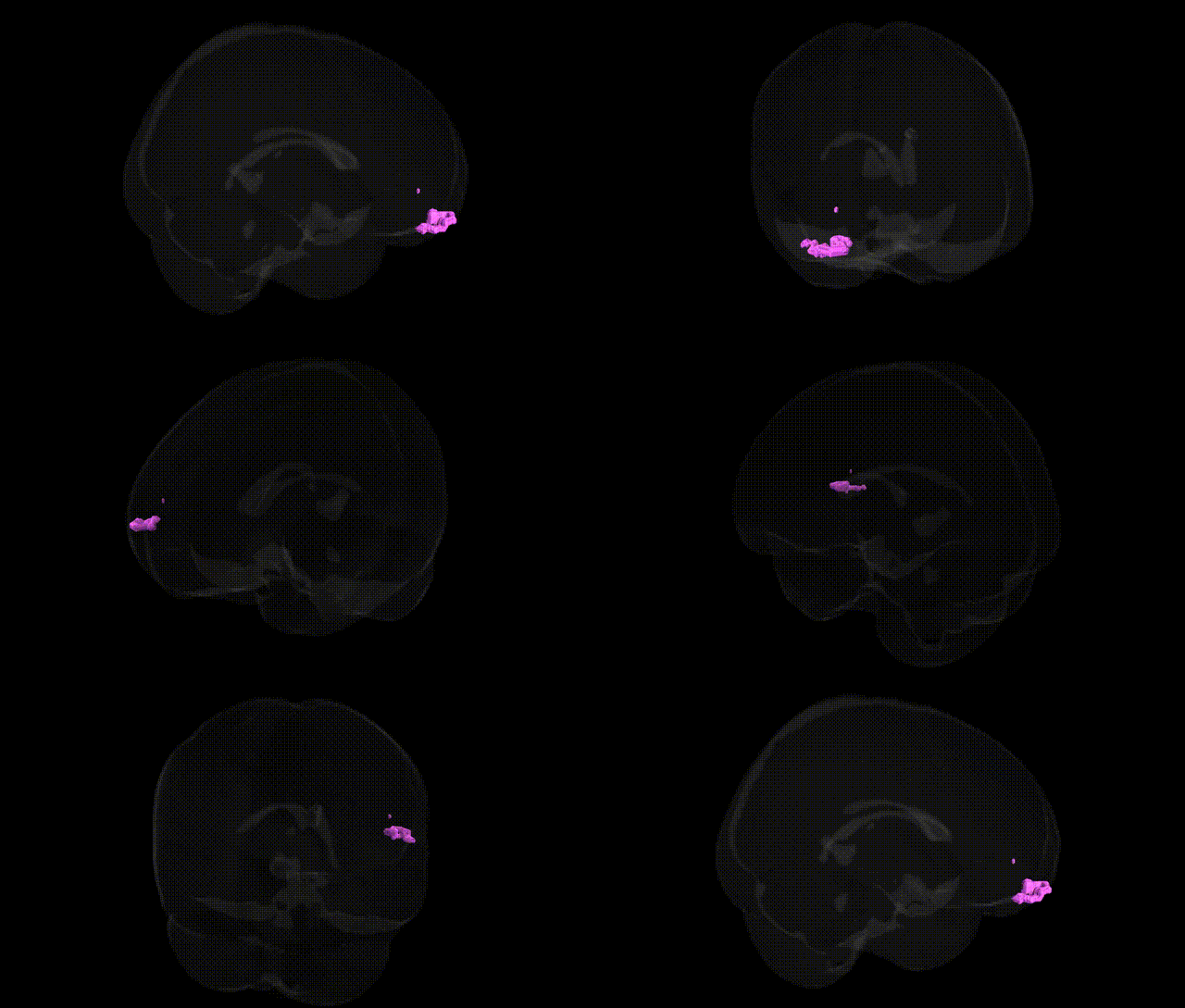
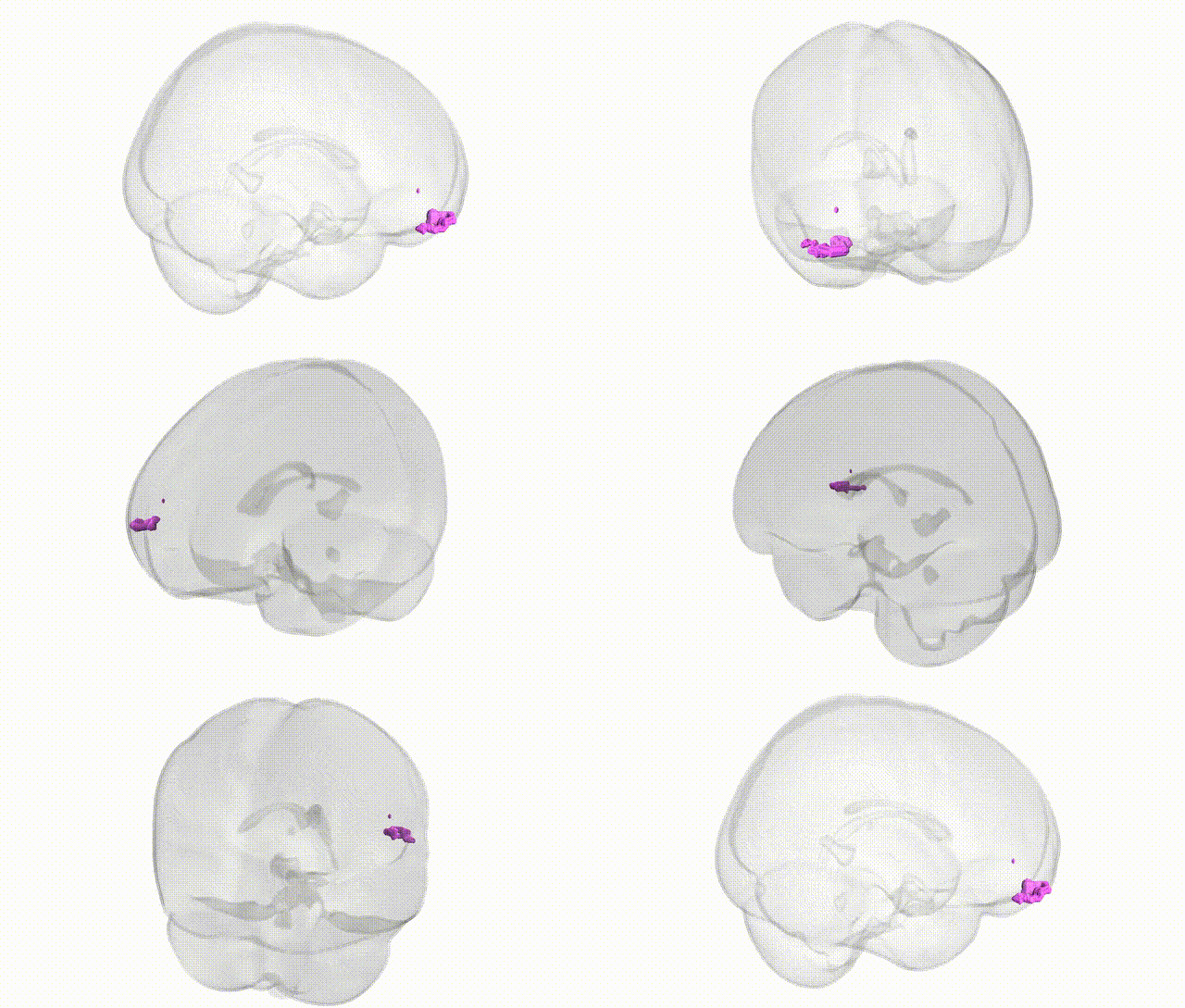
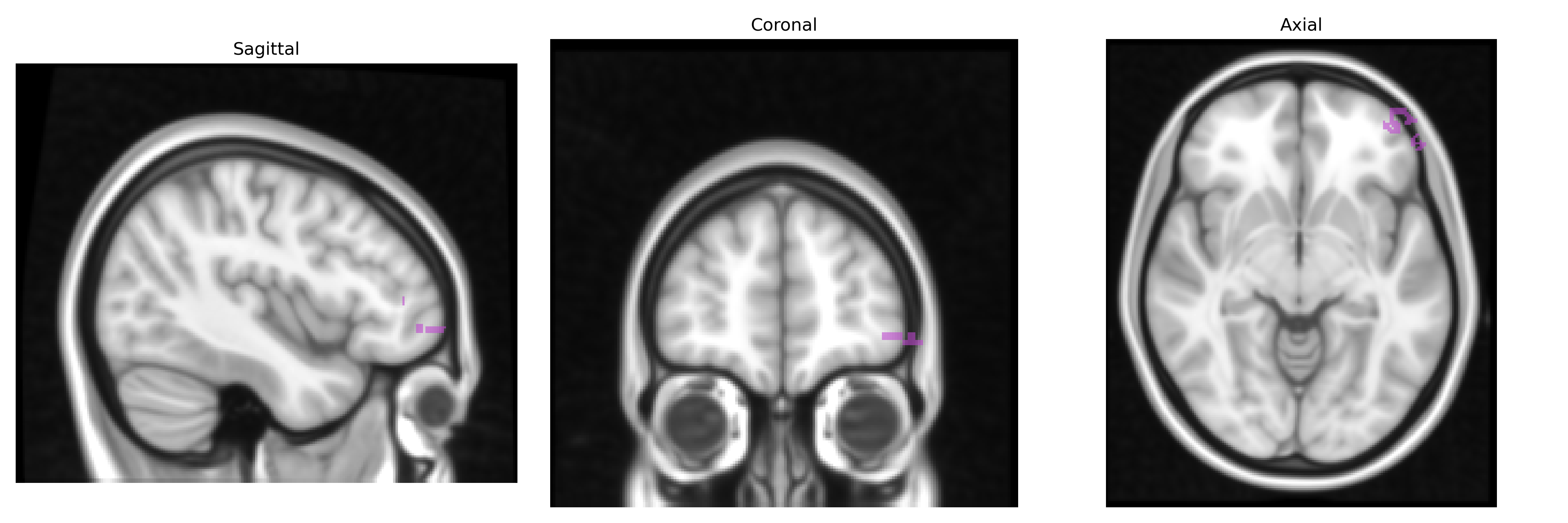
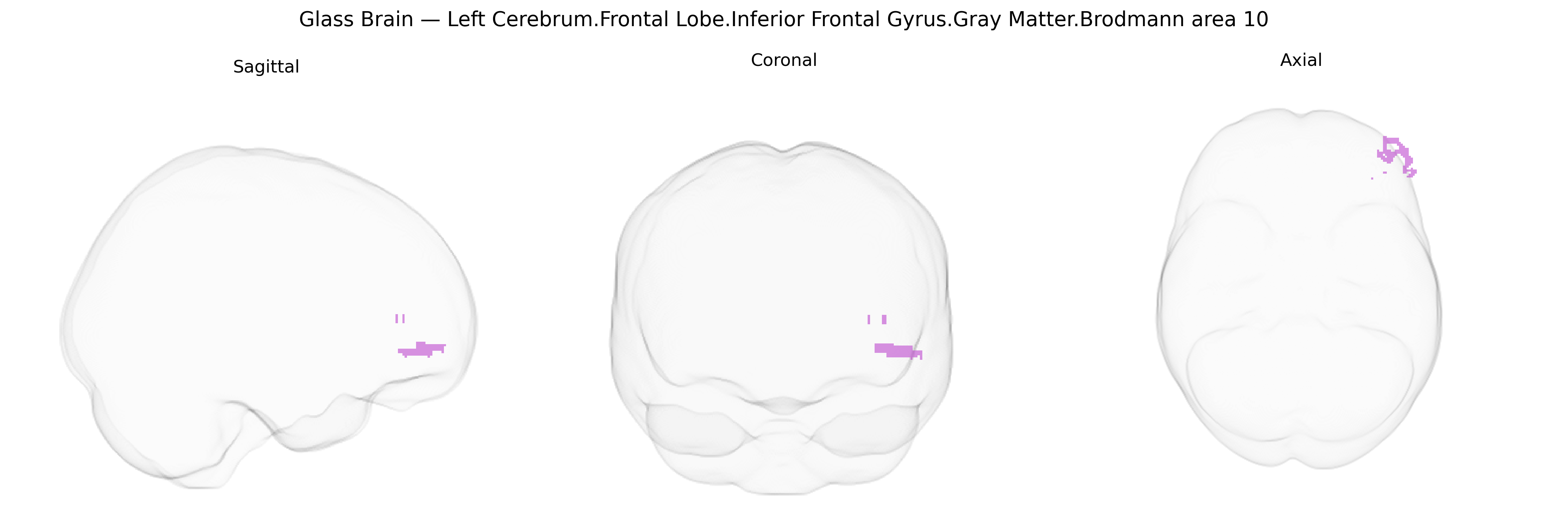
The bilateral Left Cerebrum.Frontal Lobe.Inferior Frontal Gyrus.Gray Matter.Brodmann area 10 corresponds to the anterior portion of the prefrontal cortex located at the frontal pole, extending into the rostral inferior frontal gyrus. Brodmann area 10 is implicated in high-level executive and integrative functions, including prospective memory, multitasking, complex decision-making, and the coordination of internal goals with external stimuli. It is involved in abstract reasoning, social cognition, and the evaluation of future outcomes, and exhibits extensive connectivity with other prefrontal, limbic, and association cortices, supporting its role in meta-cognition and control of thought and behavior over long time scales. There is no direct link for this exact Talairach-defined region; a closely related structure is the frontal pole: Frontal pole.
The inferior frontal gyrus portion of Brodmann area 10 in the left frontal lobe, as defined in the Talairach 1 mm atlas, has been implicated in multiple genetic association studies, largely through imaging genetics and GWAS of brain structure and function. Variants in genes involved in synaptic plasticity, neuronal development, and cortical patterning—such as BDNF, COMT, and DISC1—have been repeatedly associated with gray matter volume, cortical thickness, or activation patterns in anterior frontal regions that include BA10, often in the context of working memory, executive function, and decision-making tasks. Large-scale GWAS of cortical morphology (e.g., ENIGMA and UK Biobank) have identified polygenic influences on frontal lobe surface area and thickness, with loci near genes such as HMGA2, MAPT, and others contributing to global and regional frontal measures that overlap BA10, though typically not at the fine-grained level of Talairach-defined subregions. Genetic risk for psychiatric disorders—including schizophrenia, bipolar disorder, major depression, ADHD, and autism spectrum disorder—has been linked to structural and functional alterations in BA10/inferior frontal regions, with polygenic risk scores predicting reduced gray matter, altered connectivity, or atypical activation, suggesting that common variant burden in neurodevelopmental and synaptic genes partly drives vulnerability in this area. Additionally, GWAS of cognitive traits (general intelligence, educational attainment, and executive control) often show downstream correlations with structural and functional measures in frontopolar and inferior frontal cortex, including BA10, indicating that complex polygenic architectures influencing cognition and psychiatric risk converge on this high-order associative region rather than being driven by single locus–specific effects.
Overview generated by GPT-4o (2026).
Region ID: 483
Hemisphere: bilateral
Atlas: Talairach labels 1mm
Full Quality Version: Download MP4
Full Quality Version: Download MP4
Wali Sidiqyar*, Gaurav Rudravaram*, Elyssa M. McMaster, Trent M. Schwartz, Adam M. Saunders, Kurt G. Schilling, Bennett A. Landman "Introducing SPINS: A Shared Public Visualization Library of Neuroanatomical Structures." Medical Imaging with Deep Learning- short paper
This resource is licensed under CC0 1.0 Universal (Public Domain).