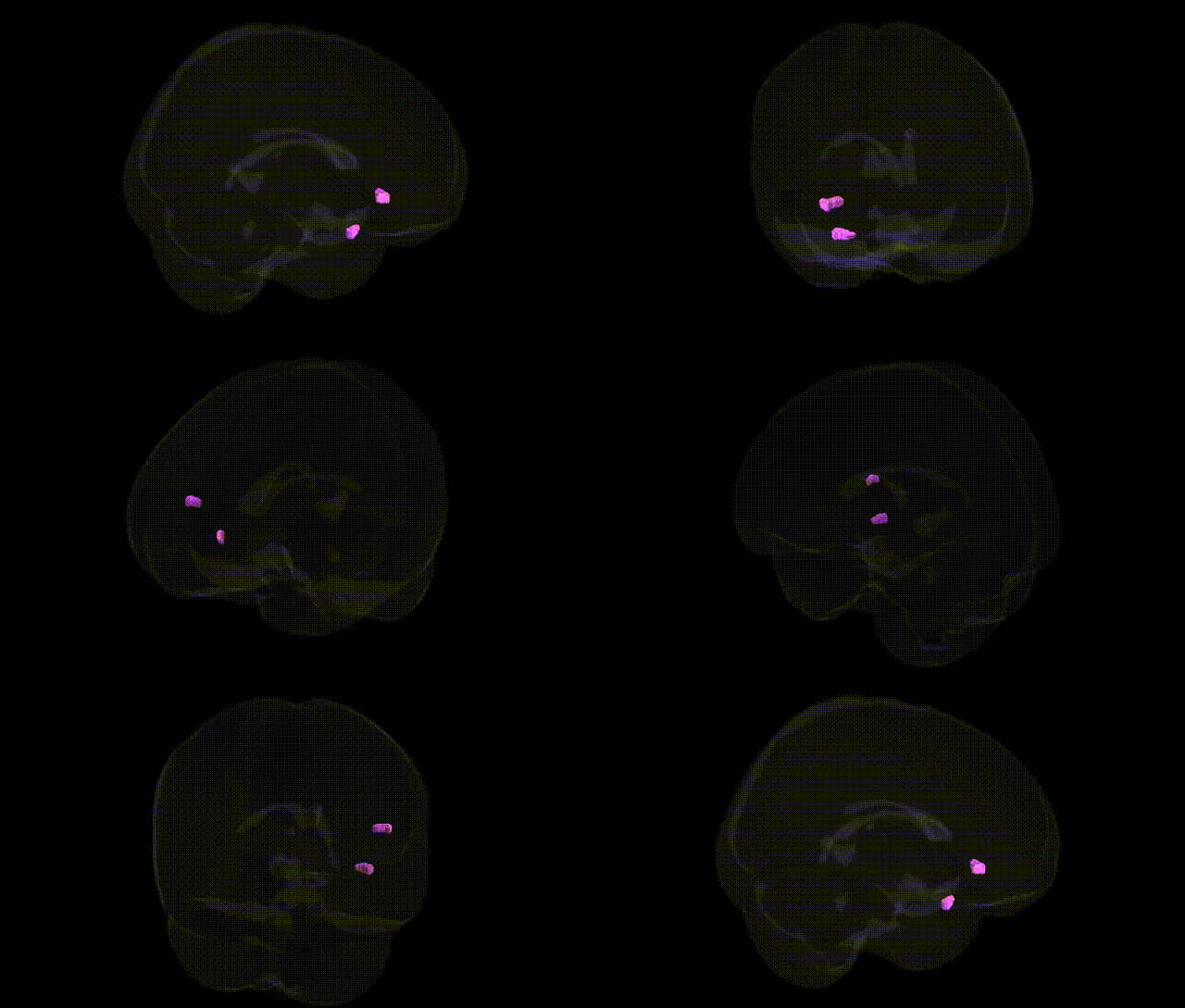
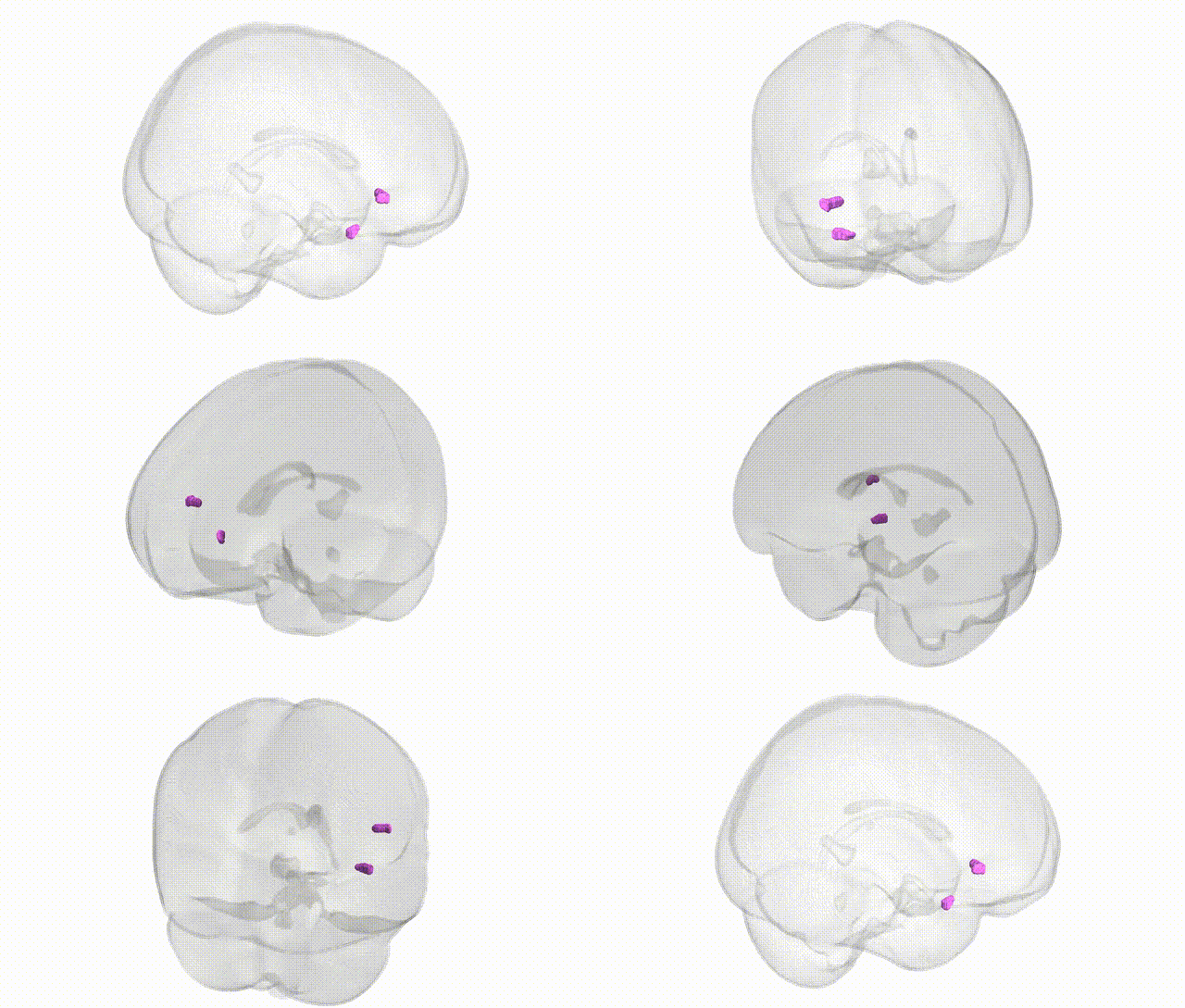
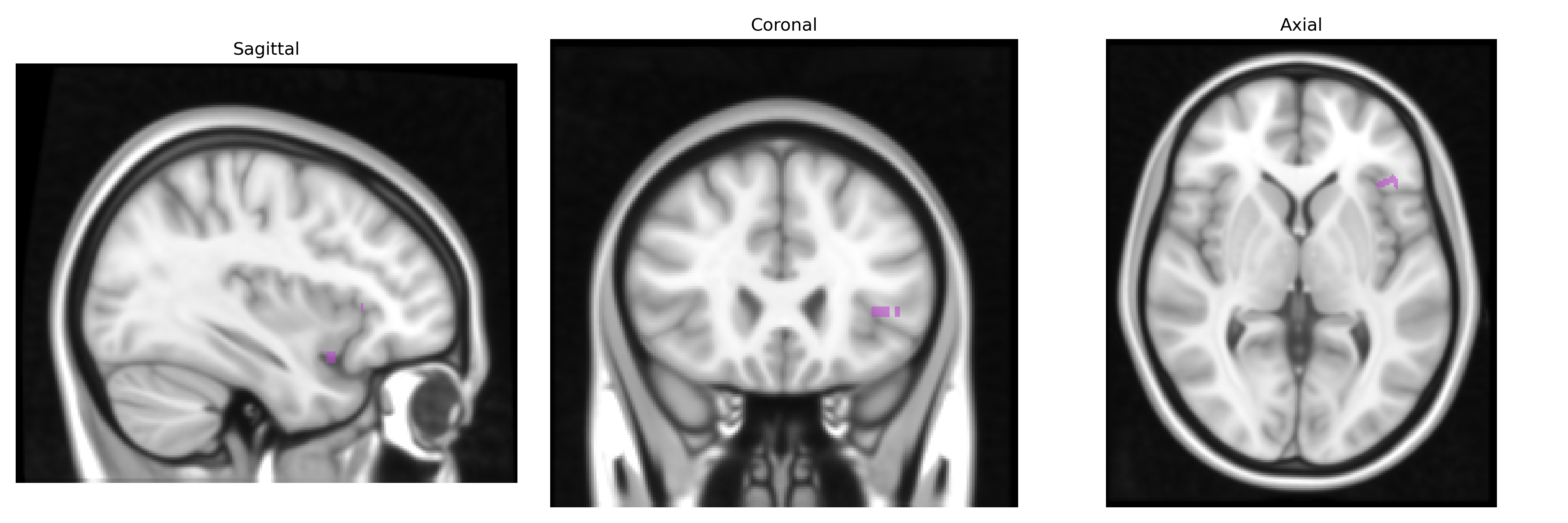
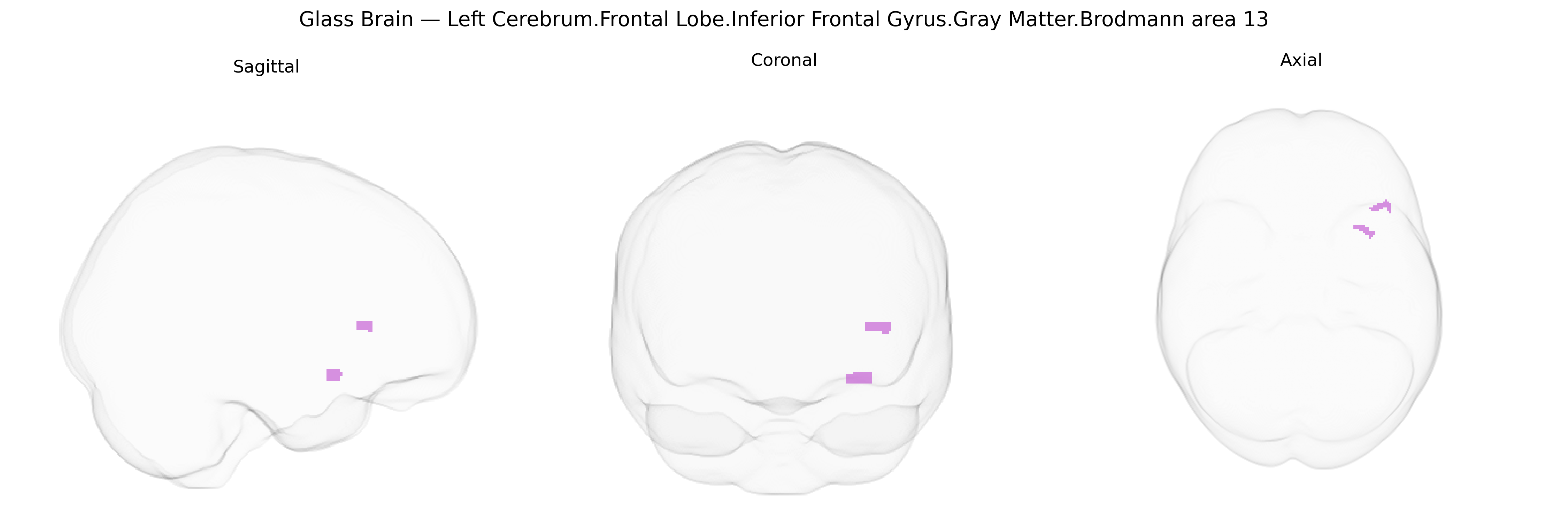
The bilateral Left Cerebrum.Frontal Lobe.Inferior Frontal Gyrus.Gray Matter.Brodmann area 13, as labeled in the Talairach 1 mm Atlas, corresponds to a ventral prefrontal (orbitofrontal/insular-adjacent) sector implicated in high-order integrative functions, including affective processing, decision-making, and the evaluation of reward- and punishment-related stimuli; in many neuroanatomical schemes, Brodmann area 13 is primarily associated with the insular cortex and adjacent orbitofrontal regions, integrating visceral, emotional, and cognitive information to guide behavior. There is no direct link for this exact label; a closely related structure with overlapping territory and functional significance is the Insular cortex.
Genetic associations involving the bilateral left inferior frontal gyrus (IFG) gray matter, corresponding to Brodmann area 13 in the Talairach 1 mm atlas, emerge primarily from imaging‑genetics and GWAS studies of cortical structure and function rather than from direct “BA13‑specific” analyses, since BA13 more traditionally maps to insular/claustral regions and the IFG is more often classified as BA44/45/47. Large-scale GWAS of cortical morphology (e.g., ENIGMA, UK Biobank) have identified multiple loci (including variants near genes such as MAPT, WNT3, ZIC4, HMGA2, and others) associated with frontal cortical thickness, surface area, and gyrification, with several signals encompassing inferior frontal regions implicated in language, cognitive control, and affective regulation. Imaging-genetics studies link common polymorphisms in dopaminergic (COMT, DRD2), serotonergic (5-HTTLPR/SLC6A4), glutamatergic (GRM3), and neurotrophic (BDNF Val66Met) genes to variability in inferior frontal activation during tasks involving response inhibition, working memory, and emotional processing, often in conjunction with altered gray matter volume. Clinically, genetic risk variants for neurodevelopmental and psychiatric disorders—including schizophrenia (e.g., CACNA1C, ZNF804A, MIR137 loci), bipolar disorder, major depression, ADHD, and autism—have been associated with structural or functional abnormalities in the IFG, while language- and reading-related risk loci (e.g., DCDC2, KIAA0319, FOXP2 pathway genes) show convergent effects on left frontal language networks that include inferior frontal regions. Additionally, polygenic risk scores for Alzheimer’s disease, frontotemporal dementia, and general cognitive ability have shown associations with frontal gray matter measures and IFG involvement, suggesting that BA13-adjacent inferior frontal cortex is a convergence zone where multiple neuropsychiatric and cognitive genetic risk pathways exert effects on brain structure and function, even though precise, BA13-specific GWAS annotations remain limited and often atlas-dependent.
Overview generated by GPT-4o (2026).
Region ID: 294
Hemisphere: bilateral
Atlas: Talairach labels 1mm
Full Quality Version: Download MP4
Full Quality Version: Download MP4
Wali Sidiqyar*, Gaurav Rudravaram*, Elyssa M. McMaster, Trent M. Schwartz, Adam M. Saunders, Kurt G. Schilling, Bennett A. Landman "Introducing SPINS: A Shared Public Visualization Library of Neuroanatomical Structures." Medical Imaging with Deep Learning- short paper
This resource is licensed under CC0 1.0 Universal (Public Domain).