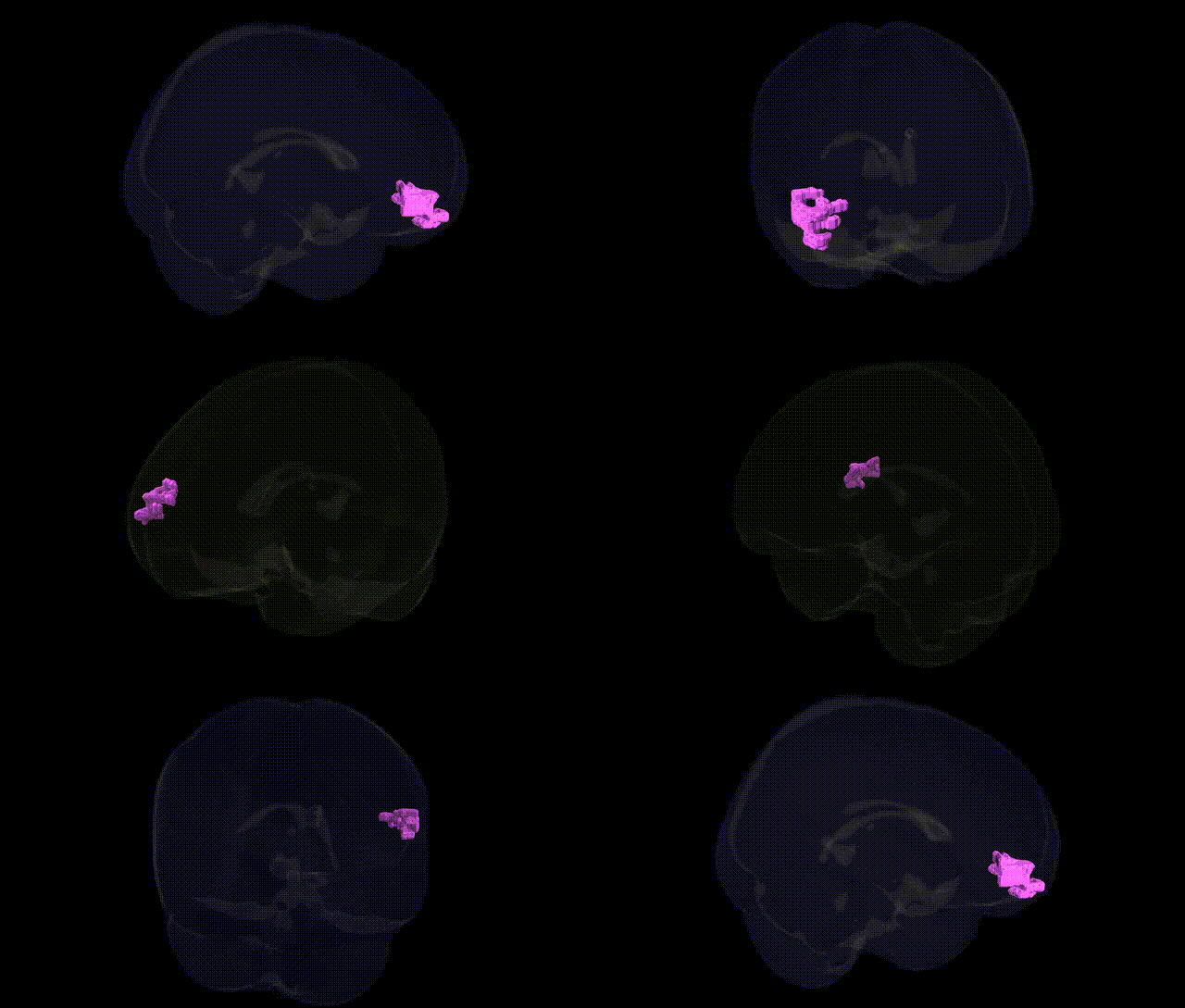
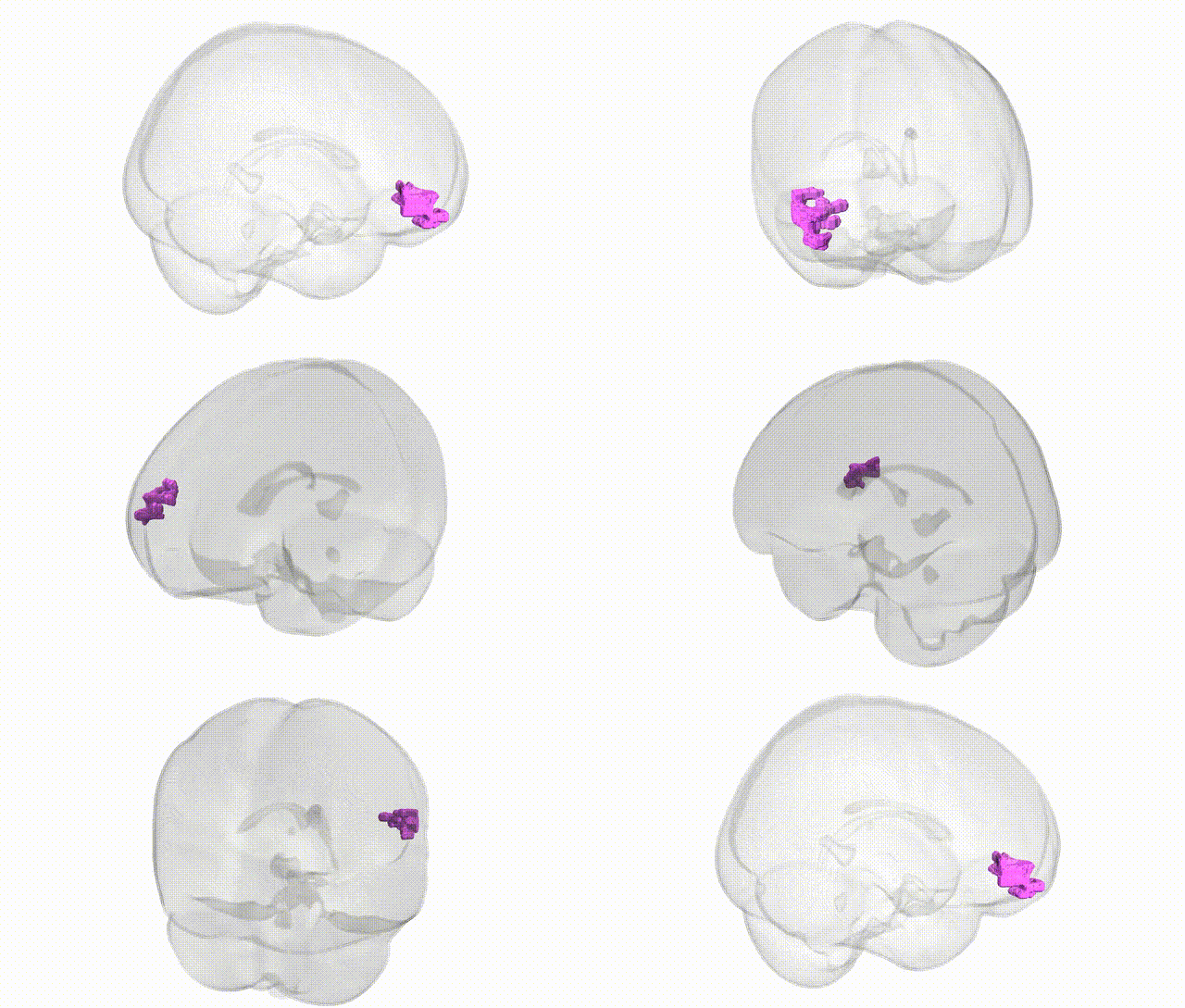
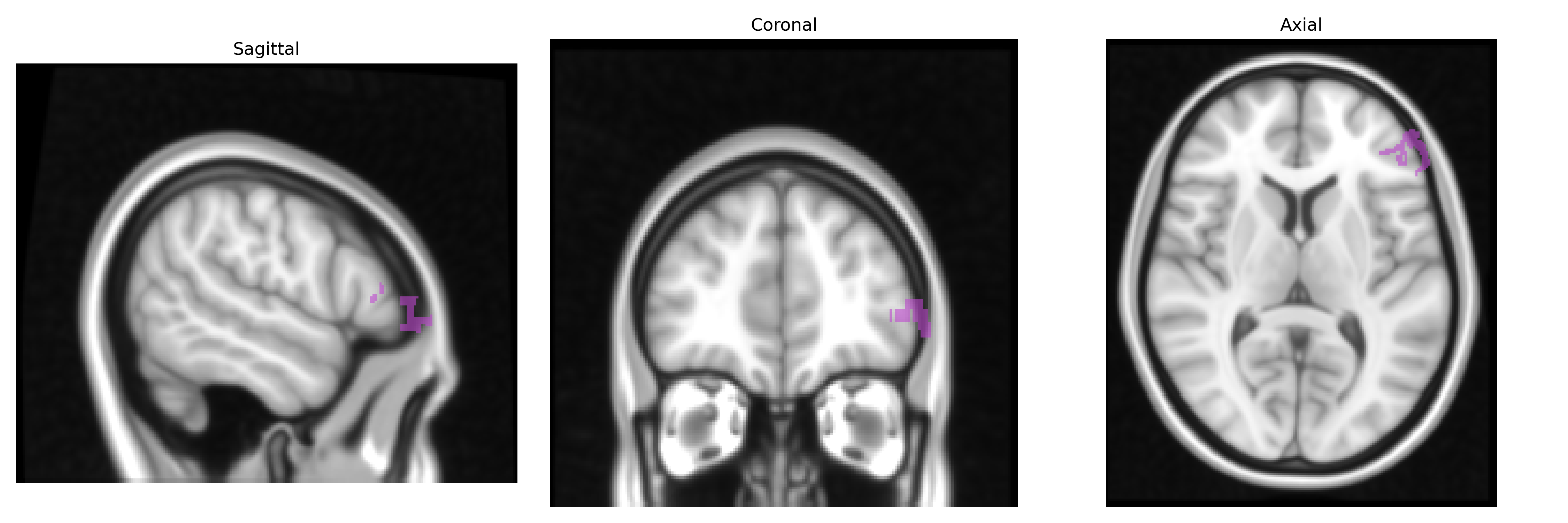
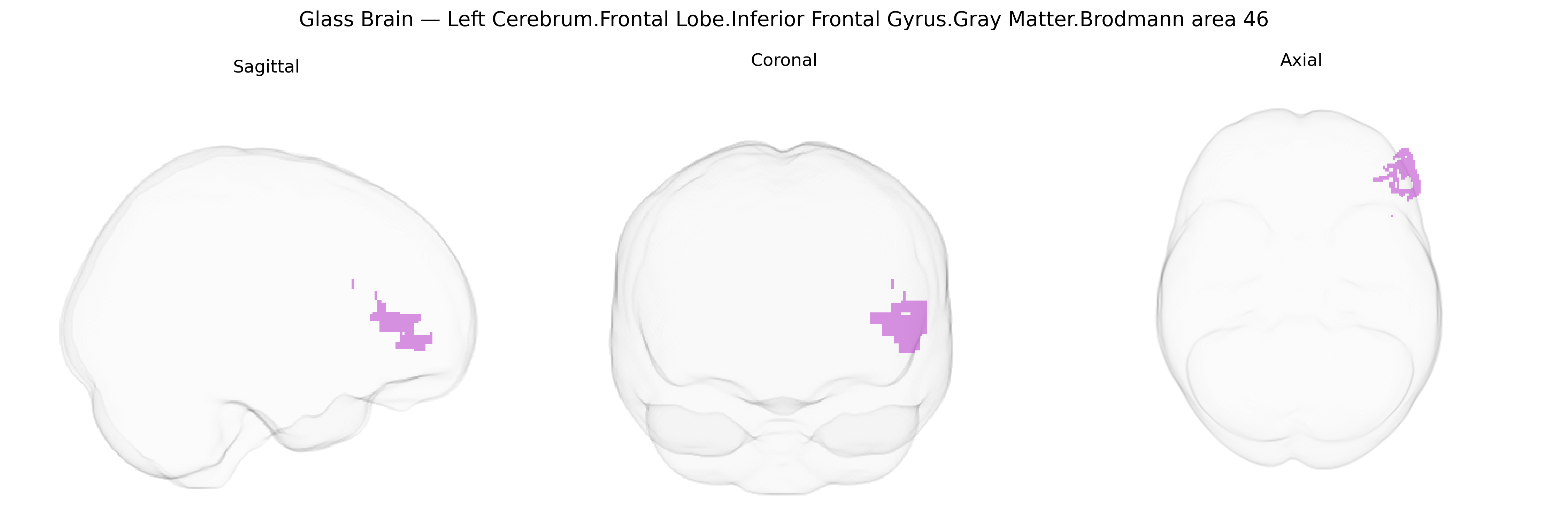
The bilateral Left Cerebrum.Frontal Lobe.Inferior Frontal Gyrus.Gray Matter.Brodmann area 46 corresponds to the dorsolateral prefrontal cortex (DLPFC) portion of the inferior frontal gyrus, as defined in the Talairach 1 mm atlas. This region lies in the frontal lobe’s lateral convexity and is characterized cytoarchitectonically by Brodmann area 46, which is associated with high-level executive functions including working memory, cognitive flexibility, abstract reasoning, planning, and top–down attentional control. Neuronal populations in this area integrate multimodal sensory inputs with internal goals to guide behavior, contribute to the regulation of complex decision-making, and interact extensively with other prefrontal, parietal, and subcortical networks involved in cognition and behavior modulation. There is no direct link for this exact Talairach label; a closely related structure is the Dorsolateral prefrontal cortex.
Brodmann area 46 (inferior/middle frontal gyrus, part of dorsolateral prefrontal cortex) has been repeatedly implicated in genetic studies of cognitive control, working memory, and psychiatric risk, though most findings are indirect through imaging–genetics and GWAS of cortical morphology or function rather than Talairach-specific loci. Large-scale GWAS of cortical thickness and surface area (e.g., ENIGMA and UK Biobank–based consortia) have identified common variants in genes regulating neurodevelopment and synaptic function—such as MAPT, MIR137, GRIN2A, and multiple loci near FOXP2, CNTNAP2, and NRG3—that show effects on frontal association cortex including BA46, often via regional or global prefrontal thickness/surface area measures; these effects are polygenic and distributed rather than region-specific. Imaging–genetics studies link COMT (Val158Met), DRD2/ANKK1, and BDNF (Val66Met) variants to BA46 activation and structural variation during working-memory and executive tasks, while polygenic scores for intelligence, educational attainment, and schizophrenia show associations with BA46-related activation patterns and gray-matter measures. BA46 structural and functional alterations are genetically correlated with major psychiatric and neurodevelopmental disorders—particularly schizophrenia, bipolar disorder, major depression, autism spectrum disorder, and ADHD—through shared polygenic architectures that affect prefrontal circuitry, with some overlap in risk loci involving calcium-channel genes (e.g., CACNA1C), synaptic scaffolding (e.g., DLG2), and neuronal migration pathways. Additionally, GWAS and twin studies indicate that individual differences in BA46 volume and function are moderately heritable and contribute to heritable variance in executive function, working memory, and general cognitive ability; however, no single gene or variant is uniquely specific to bilateral BA46, and current evidence reflects broad polygenic influences on prefrontal networks rather than a discrete genetic signature for this Talairach-defined region.
Overview generated by GPT-4o (2026).
Region ID: 607
Hemisphere: bilateral
Atlas: Talairach labels 1mm
Full Quality Version: Download MP4
Full Quality Version: Download MP4
Wali Sidiqyar*, Gaurav Rudravaram*, Elyssa M. McMaster, Trent M. Schwartz, Adam M. Saunders, Kurt G. Schilling, Bennett A. Landman "Introducing SPINS: A Shared Public Visualization Library of Neuroanatomical Structures." Medical Imaging with Deep Learning- short paper
This resource is licensed under CC0 1.0 Universal (Public Domain).